Skip this screen if you don't care about the math and want to know how the implementation works.
The mathematical definition is as follows: the Levenshtein distance between two strings a and b can be calculated by:
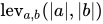
This makes sense, we're inputting a and b and are arriving an outcome after processing the two values somehow.
So how do we process them?
By using an indicator function, which is a defined as a function defined on a set X that indicates membership of an element in a subset A of X. This is represented by a 1 in all elements of A where there's a membership and a 0 for all elements of X not in A.
So the following:

Is the indicator function equal to 0 when ai = bj (when the letters are the same in the same position) and equal to 1 otherwise (if they differ).
To calculate the actual distance, we use:
The above is the distance between the first i characters of a and the first j characters of b.
Confused? Don't worry, we'll move beyond the math in the next section.
xxxxxxxxxx console.log('PASSED: ' + "getEditDistance('busa', 'ebcar') should return 4");var assert = require('assert');function getEditDistance(a, b) { return '';}class Graph { constructor() { this.adjacencyList = new Map(); this.verticesCount = 0; } addVertex(nodeVal) { this.adjacencyList.set(nodeVal, []); this.verticesCount++; } addEdge(src, dest) { this.adjacencyList.get(src).push(dest); this.adjacencyList.get(dest).push(src); // push to both adjacency lists } removeVertex(val) { if (this.adjacencyList.get(val)) { this.adjacencyList.delete(val); }