Detect Substring in String
Read at your own pace. Code execution, quizzes, progress tracking, and the AI tutor are available in the interactive view with JavaScript enabled.
Description
How would you write a function to detect a substring in a string?
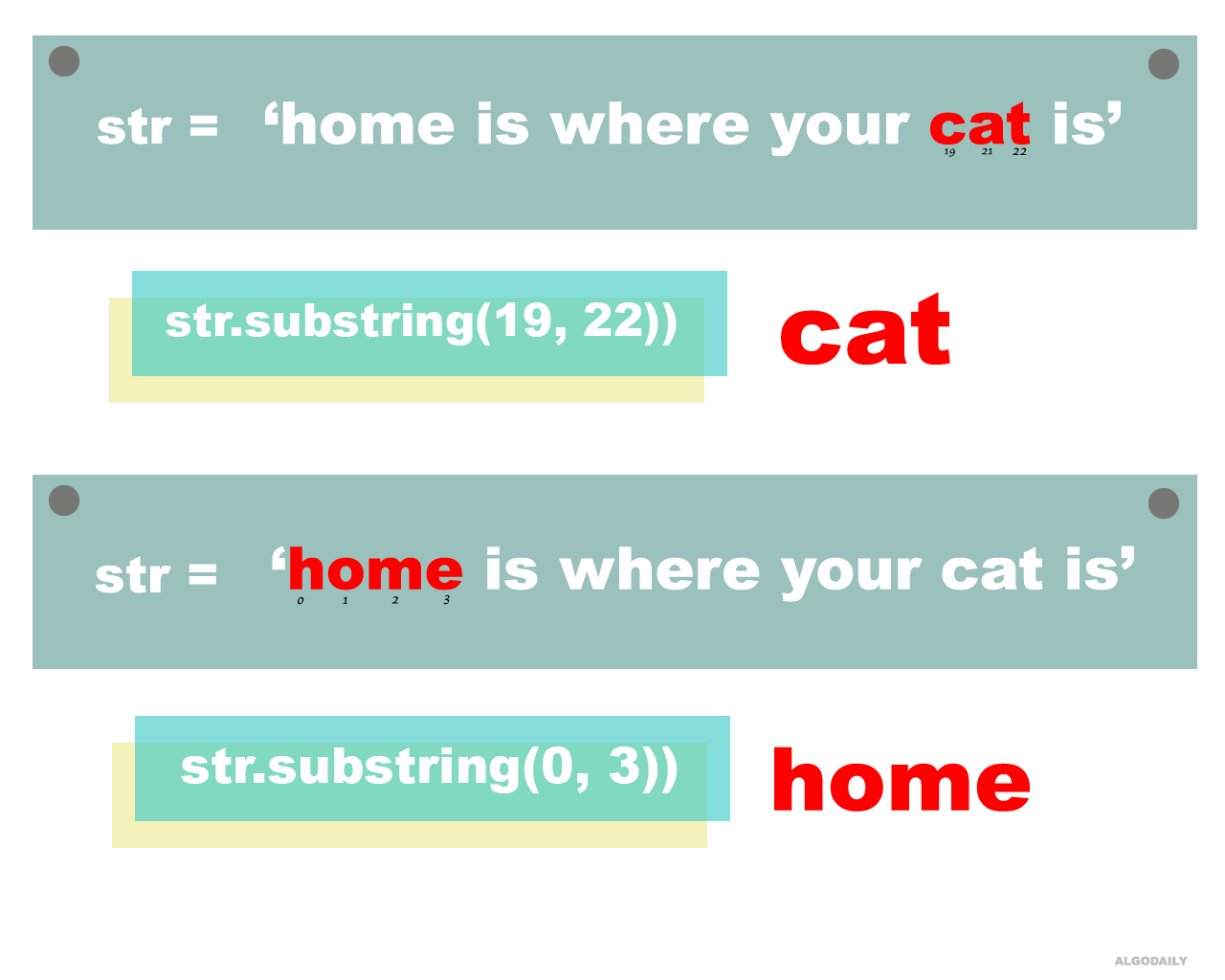
If the substring can be found in the string, return the index at which it starts. Otherwise, return -1.
function detectSubstring(str, subStr) {
  return -1;
}
Important-- do not use the native String class's built-in substring or substr method. This exercise is to understand the underlying implementation of that method.
Constraints
- Length of both the given strings <=
100000 - The strings would never be null
- The strings will only consist of lowercase letters
- Expected time complexity :
O(n) - Expected space complexity :
O(1)
```js
console.log("Running and logging statements.");

function detectSubstring(str, subStr) {
  // Fill in this method
  return str;
}

console.log(detectSubstring("ggraph", "graph"));
console.log(detectSubstring("geography", "graph"));
console.log(detectSubstring("digginn", "inn"));
```
Step Two
We should begin by reasoning out what we need to do in plain English before diving into the logic.
Let's take a simple example:
If we wanted to know if car was in carnival, that's easy. The first few letters are the same.
c a r
c a r n i v a l
^ ^ ^
Step Three
So we'd write a for-loop and check that each index is equal until the shorter word is completed.
What if we wanted to know if graph was in geography? We would still write a for-loop that compares the characters at each index, but we need to account for if there is a match later on.
Here, we can use the two-pointer technique we learned about prior! Why don't we use another pointer for the purpose of seeing how far we can "extend our match" when we find an initial one?
```js
let j = 0;
let str = 'digginn';
let subStr = 'inn';

for (i = 0; i < str.length; i++) {
  // if match, compare next character of subStr with next of string
  if (str[i] == subStr[j]) {
    j++;
  // else no need to see how far to extend
  } else {
    j = 0;
  }
}
```
```py
idx_of_start = 0
j = 0
s = 'digginn'
sub_s = 'inn'

for i in range(len(s)):
  # if match, compare next character of sub_s with next of string
  if s[i] == sub_s[j]:
    j += 1
  else:
    j = 0
```
Step Four
So given string geography and substring graph, we'd step it through like this:
-
gmatchesg, so j = 1 -
edoes not matchr, so j = 0 -
odoes not matchg, so j = 0 -
gdoes matchg, so j = 1 -
rdoes matchr, so j = 2 -
adoes matcha, so j = 3 and so on...
At the same time, we also need to keep track of the actual index that the match starts. The j index will help us get the matching, but we need a idxOfStart variable for just the start.
Putting it all together:
```js
let idxOfStart = 0;
let j = 0;
let str = 'digginn';
let subStr = 'inn';

for (i = 0; i < str.length; i++) {
  // if match, compare next character of subStr with next of string
  if (str[i] == subStr[j]) {
    j++;
  } else {
    j = 0;
  }

  // keep track of where match starts and ends
  if (j == 0) {
    idxOfStart = i;
  } else if (j == subStr.length) {
    console.log(idxOfStart);
    // we know this is the start of match
  }
}
```
```py
idx_of_start = 0
j = 0
s = 'digginn'
sub_s = 'inn'

for i in range(len(s)):
  # if match, compare next character of sub_s with next of string
  if s[i] == sub_s[j]:
    j += 1
  else:
    j = 0

  # keep track of where match starts and ends
  if j == 0:
    idx_of_start = i
  elif j == len(sub_s):
    print(idx_of_start)
    # we know this is the start of match
```
Complexity Of Final Solution
There are still two slight issues with this code. Can you see what they are?
Let's take the examples of a string ggraph and substring graph. On the first iteration, g will match g, which is what we want. However, on the next iteration, we will try to match the second g in ggraph with r in graph.
What should happen is if we don't find a match, we ought to reset i a bit as well-- this is to accommodate duplicate characters. We can reset it specifically to the length of the last processed substring (or j).
The other thing is regarding the index of the start of the match-- we can simply get it from i - (subStr.length - 1). Note that you need to subtract 1 from the substring's length in order to get to the correct index.
Complexity of Final Solution
Let n be the length of the string. In the worst-case scenario, we iterate through all n characters of the string and do not find a match. Many of us will then declare that the time complexity is linear O(n). But think carefully, for each partial matching of substrings, we are traversing through the substring, and then again resetting to the initial pointer i.
To get a more clear insight into this, let's consider an example:
str = "aaaaaa"
subStr = "aab"
The final solution code of the method explained above is given.
```js
function detectSubstring(str, subStr) {
  let idxOfStart = 0,
    j = 0;

  for (i = 0; i < str.length; i++) {
    // if match, compare next character of subStr with next of string
    if (str[i] == subStr[j]) {
      j++;
			if (j == subStr.length) {
      	return i - (subStr.length - 1);
      }
    } else {
      i -= j;
      j = 0;
    }
  }

  return -1;
}
```
Complexity Multiple Choise
How many comparisons will happen for the given code in the given test case?
str = "aaaaaa"
subStr = "aab"
Complexity Calculation
As you can see, there are total 15 comparisons for the given test case. This is not close to the linear 6 comparison time complexity. In fact, this is a complexity of close to 6*3 comparisons. The reason for this is for each starting letter of the main string, we are comparing the whole substring and then resetting back to the initial character. See the image below:

So the time complexity will be O(mn) where m and n are the lengths of the string and substring. For memory, using the two-pointer method, we use a constant O(1) space for our solution.
There is another established algorithm named Rabin-Karp algorithm which uses hashing and two-pointer technique to solve this problem in O(n) time complexity. Feel free to try to implement that algorithm and tell us in the discussion about it.
One Pager Cheat Sheet
One Pager Cheat Sheet
- Write a function
detectSubstringto detect a substring within a given string, avoidingStringclass's built-insubstringorsubstrmethod, withO(n)time complexity andO(1)space complexity, and handle strings of length ≤100000. - We should
reason outwhat we need to do before diving into the logic of solving a simple example like whether acaris incarnival. - We can use the
two-pointer techniqueto compare two strings and check if one is a substring of the other by writing afor-loopto compare the characters at each index and discoverhow far we can extend our matchwhen we find an initial one. - We can use an
idxOfStartvariable and ajindex to determine if a string contains a substring by checking character-by-character whether they match or not. - The code needs two slight adjustments to handle duplicate characters and accurately obtain the index of the start of matches, and its complexity is more accurately expressed as
O(n*m), wheremis the length of the substring. - The number of comparisons made for the given code in the given test case is 12, which is
n * m(6 * 3). - With the two-pointer method, the time complexity for solving the given test case problem is
O(mn)and a constantO(1)space is used, although the Rabin-Karp algorithm may provide a more optimalO(n)time complexity solution.