Flood Fill Paintbucket
Read at your own pace. Code execution, quizzes, progress tracking, and the AI tutor are available in the interactive view with JavaScript enabled.
Description
Imagine the implementation for the paintbucket feature in Microsoft Paint, or how certain image filters work. You click on a specific pixel on a screen, and every similar-colored neighboring pixel would change to your selected color. Let's implement a simpler version of that feature.

You're given a n x n matrix array of numbers. Let's say you'd like to replace all similar and connected cells of a certain number with another, starting at column 0 and row 0.
So here's your input:
const input = [
  [1, 1, 1, 1, 1, 1, 1],
  [1, 1, 1, 1, 1, 1, 0],
  [1, 0, 0, 1, 1, 0, 1],
  [1, 2, 1, 2, 1, 2, 0],
  [1, 2, 1, 2, 2, 2, 0],
  [1, 2, 2, 2, 1, 2, 0],
  [1, 1, 1, 1, 1, 2, 1]
]
And the final result of starting at column 0 and row 0 would be as follows:
// floodFill(matrix, startingRow, startingCol, newValue)
floodFill(input, 0, 0, 3);
// [
//   [3, 3, 3, 3, 3, 3, 3],
//   [3, 3, 3, 3, 3, 3, 0],
//   [3, 0, 0, 3, 3, 0, 1],
//   [3, 2, 1, 2, 3, 2, 0],
//   [3, 2, 1, 2, 2, 2, 0],
//   [3, 2, 2, 2, 3, 2, 0],
//   [3, 3, 3, 3, 3, 2, 1]
// ]
Notice how all the 1s that were bordering the original 1 in column 0 and row 0 have been transformed to 3.
Constraints
- Given matrix contains non negative integers
- The array is
0-indexed - Let
|V|,|E|represent the number of vertices and edges of the graph (if you consider the matrix as a graph) - Expected time complexity :
O(|V|) - Expected space complexity :
O(|V|)considering the call stack
```js
function floodFill(matrix, row, col, newVal) {
  // Fill in this method
  return matrix;
}

function replaceWithMatch(match, matrix, r, c, newVal) {}

const input = [
  [1, 1, 1, 1, 1, 1, 1],
  [1, 1, 1, 1, 1, 1, 0],
  [1, 0, 0, 1, 1, 0, 1],
  [1, 2, 1, 2, 1, 2, 0],
  [1, 2, 1, 2, 2, 2, 0],
  [1, 2, 2, 2, 1, 2, 0],
  [1, 1, 1, 1, 1, 2, 1]
];

console.log(floodFill(input, 0, 0, 3));
```
Step Two
This problem is an implementation of the famous flood-fill algorithm. So we're given a matrix, and we need to traverse an element's neighbors, and then repeat. It's always beneficial to think through a smaller input first.
```js
const input = [
  [1, 1, 1],
  [1, 1, 1],
  [1, 0, 0]
```
Step Three
So starting at index [0][0] (row 0, column 0), we're looking to move right, down, and bottom right (marked with *s):
```js
const input = [
  [1, *, 1],
  [*, *, 1],
  [1, 0, 0]
```
Step Four
We don't need to worry about the other sides (above, left) because those nodes don't exist.
What are we looking to do? We need to visit every neighbor, and then every one of its neighbors. This sounds like a graph traversal problem.
How many times do we need to perform a node operation? As long as there are nodes that match the initial one that we clicked on or started at.
Knowing this, we could go with either go with a Breadth-first search or a Depth-first search approach.
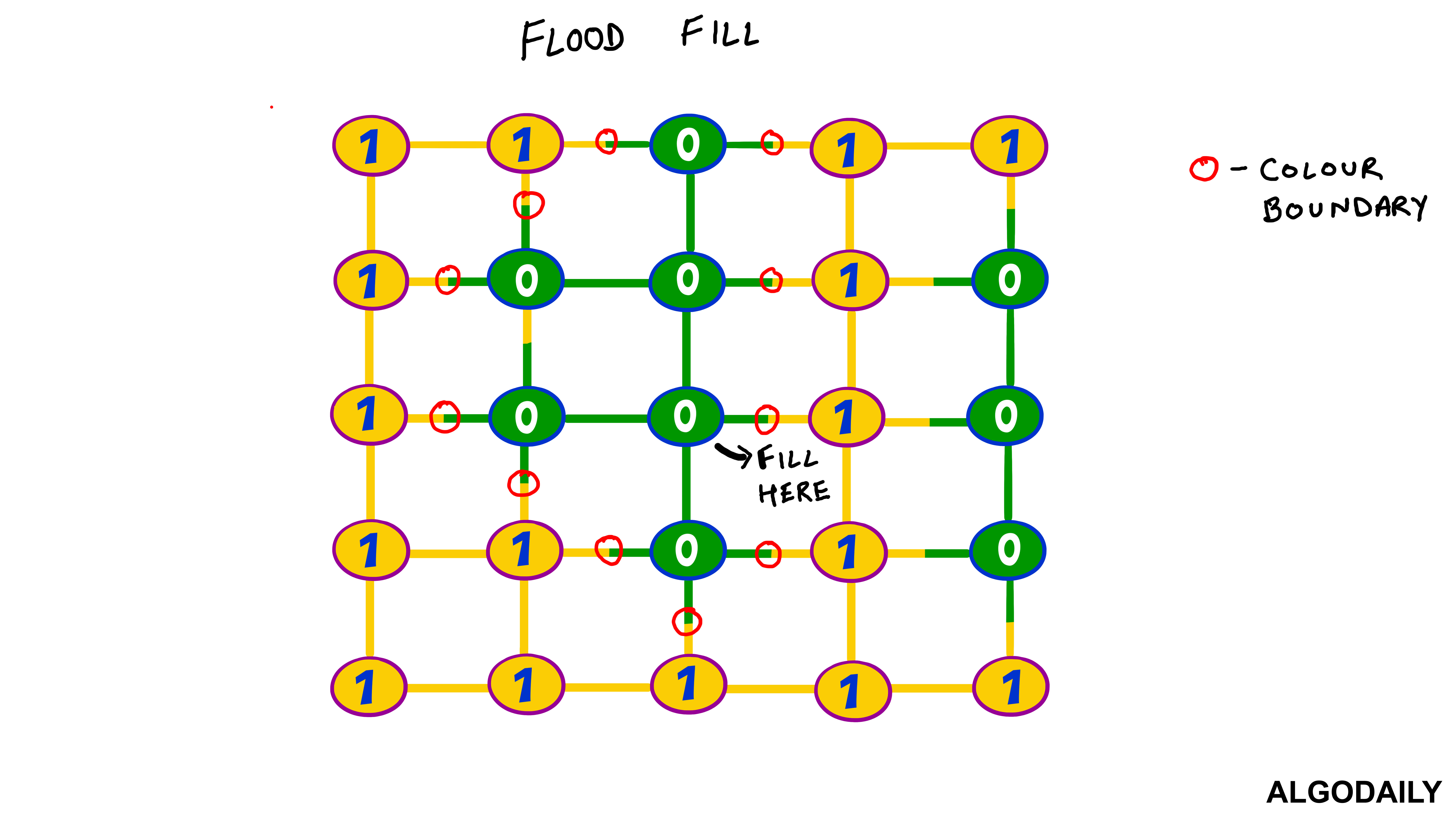
Complexity Of Final Solution
What if we didn't want to use a queue? We can use a recursive depth-first search approach.
The idea here is to use some form of graph traversal mechanism to ensure we cover all necessary vertices within the graph that suit our conditions. Specifically, we are looking for vertices that match our origin point.
With that said, the pseudocode could be as simple as:
- Perform a
DFSby attempting to visit a surrounding neighbor - See if the cell we're in meets this condition
- If yes, repeat step 1 for its neighbors
- If not, no-op and don't do anything
Complexity of Final Solution
Let |V|, |E| represent the number of vertices and edges of the graph, respectively. A DFS for a graph implemented as a 2d matrix has O(|V|) time complexity, and O(|V|) space complexity as in the worst case, we can have |V| recursive calls being stored on the call-stack.
We are also giving the iterative solution using stack in DFS below:
```py
def flood_fill(matrix, x, y, new_val):
    # Check if the source is already in desired color
    old_value = matrix[x][y]
    if new_val == old_value:
        return matrix
    # Stack is used for iterative DFS
    # Start from the source (x,y)
    stack = [(x,y)]

    # While the stack is not empty
    while stack:
        row, col = stack.pop()
        # We move at 8 directions.
        # So we make a list and make these 8 cells iteratively
        for dirx in [-1, 0, 1]:
            for diry in [-1, 0, 1]:
                # Ignore dir=(0,0)
                if dirx == 0 and diry == 0:
                    continue
                cell = (row+diry, col+dirx)
                # Check if the cells are within grid
                if cell[0] >= 0 and cell[0] < len(matrix) and cell[1] >= 0 and cell[1] < len(matrix[0]):
                    # Check if cell is in old_value
                    if matrix[cell[0]][cell[1]] == old_value:
                        matrix[cell[0]][cell[1]] = new_val
                        stack.append(cell)

    return matrix

```
One Pager Cheat Sheet
One Pager Cheat Sheet
- Using the
flood-fill algorithm, we need to think through a smaller input first to traverse an element's neighbors in the given matrix. - We are looking to traverse
row 0,column 0to theright,downandbottom right(*). - We don't need to
traversethegraphwith either aBreadth-first searchorDepth-first searchapproach as long as there are matchingnodesfor the initial one we started with. - We can replace the
queuewe usually use withDFSusing either a recursive approach withO(|V|)time and space complexity, or an iterative approach using astackfor the same complexity.