Validate Palindrome
Read at your own pace. Code execution, quizzes, progress tracking, and the AI tutor are available in the interactive view with JavaScript enabled.
Description
Given a string str, can you write a method that will return True if is a palindrome and False if it is not? If you'll recall, a palindrome is defined as "a word, phrase, or sequence that reads the same backward as forward". For now, assume that we will not have input strings that contain special characters or spaces, so the following examples hold:
let str = 'thisisnotapalindrome';
isPalindrome(str);
// false

str = 'racecar';
isPalindrome(str);
// true
String str = "thisisnotapalindrome";
boolean isPalindrome = isPalindrome(str);
// false

str = "racecar";
isPalindrome = isPalindrome(str);
// true
str = 'thisisnotapalindrome'
is_palindrome = is_palindrome(str)
# False

str = 'racecar'
is_palindrome = is_palindrome(str)
# True
std::string str = "thisisnotapalindrome";
bool isPalindrome = isPalindrome(str);
// false

str = "racecar";
isPalindrome = isPalindrome(str);
// true
For an extra challenge, try to ignore non-alphanumerical characters. The final solution that we present will handle all edge cases.
Constraints
- Length of the given string <=
100000 - The string will consist of ASCII characters (some or all)
- Expected time complexity :
O(n) - Expected space complexity :
O(1)
True or False?
A string is defined as a palindrome if the reversal of the string is equal to the original string.
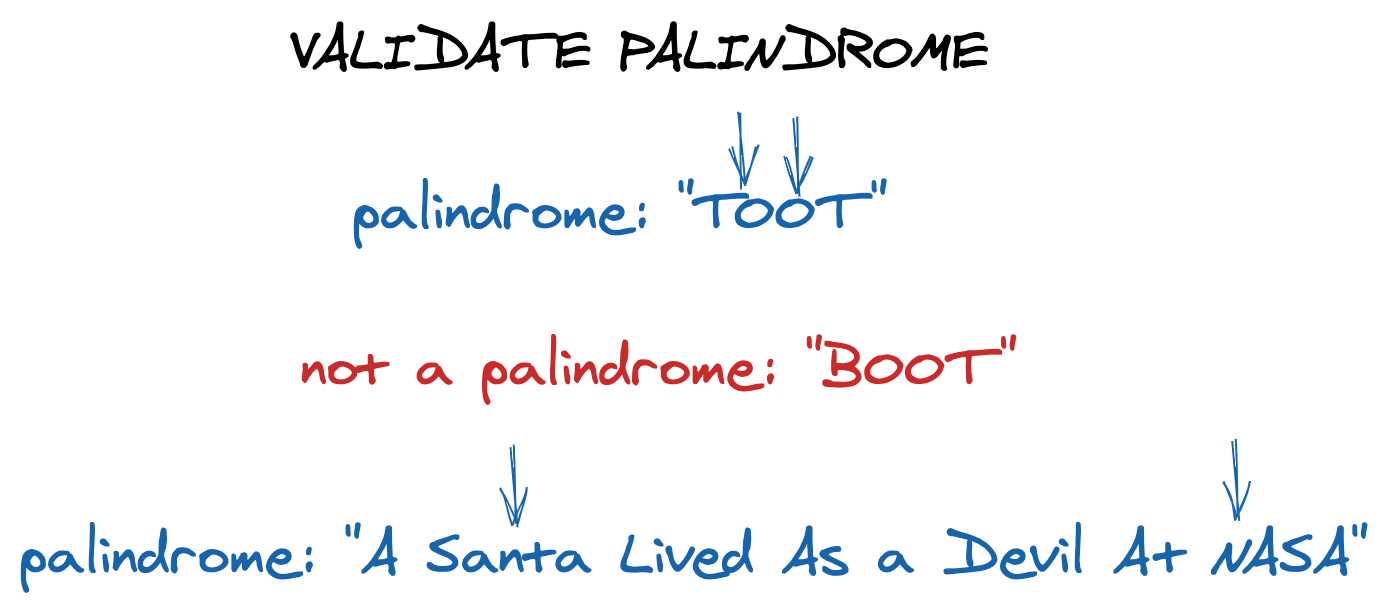
For example, “toot” is a palindrome, but “boot” is not.
Using Built In Methods
This is a classic question, and there are multiple ways to solve this. For the sake of learning, let's cover all of them!
Using built-in methods
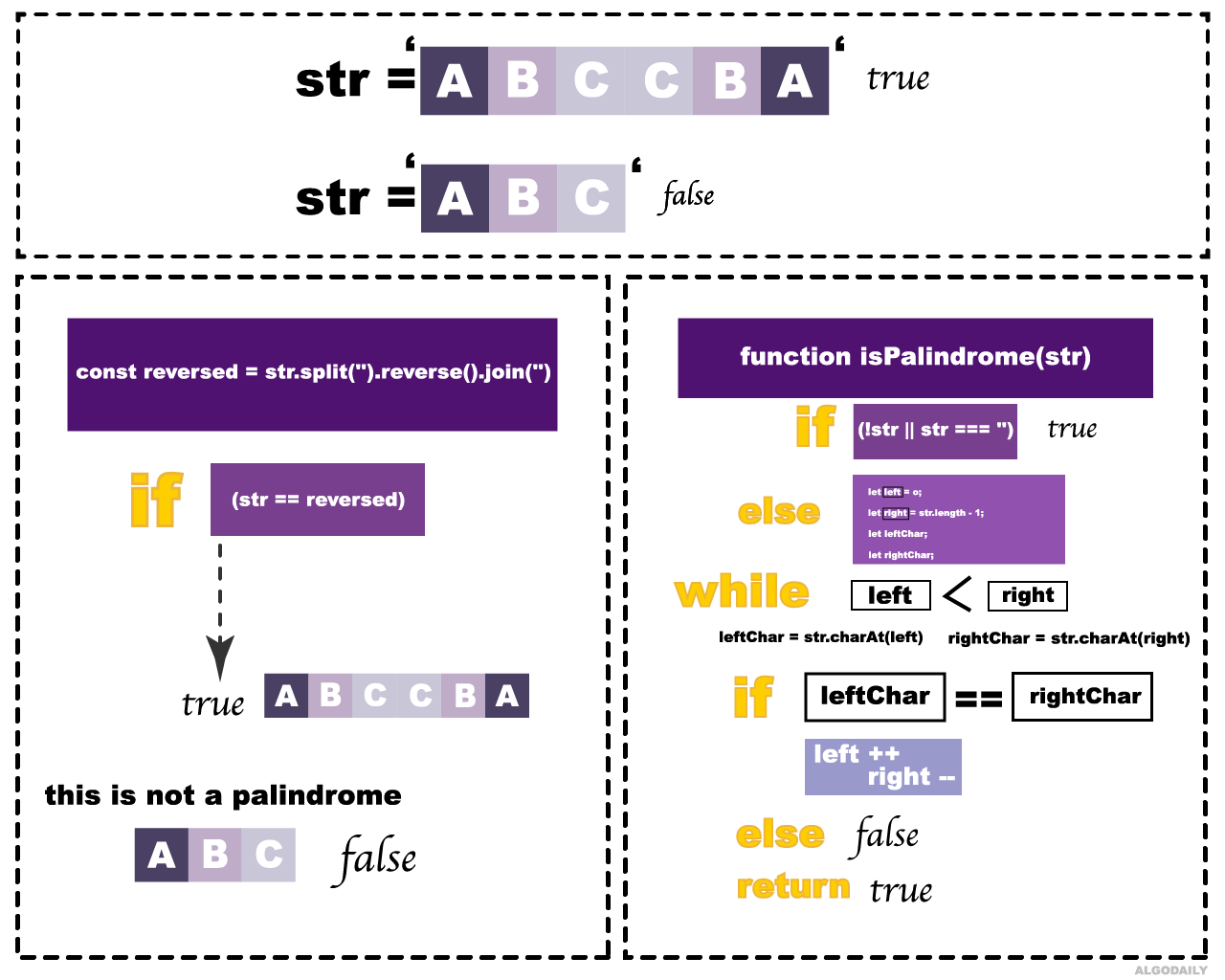
This would probably be invalid in an actual interview, but you can rely on the built-in String method to accomplish a quick reversal. In Javascript, you can simply call reverse() and in Python, you can call [::-1] You can then compare the reversed string to the original:
```js
function isPalindrome(str) {
	// Calling reverse function
	const reversed = str.split('').reverse().join('');

	// Checking if both strings are equal or not
	if (str == reversed) {
		return true;
	}
	return false;
}

console.log(isPalindrome('racecar'));
```
```java
boolean isPalindrome(String s) {
    // Calling reverse function
    String reversed = new StringBuilder(s).reverse().toString();

    // Checking if both strings are equal or not
    if (s.equals(reversed)) {
        return true;
    }
    return false;
}

System.out.println(isPalindrome("racecar"));
```
```python
def isPalindrome(s):
    # Calling reverse function
    reversed = s[::-1]

    # Checking if both strings are equal or not
    if s == reversed:
        return True
    return False

print(isPalindrome("racecar"))
```
```cpp
#include <algorithm>
#include <iostream>

bool isPalindrome(std::string s) {
    // Calling reverse function
    std::string reversed(s);
    std::reverse(reversed.begin(), reversed.end());

    // Checking if both strings are equal or not
    return s == reversed;
}

int main() {
    std::cout << std::boolalpha << isPalindrome("racecar") << std::endl;
}
```
```csharp
using System;

bool IsPalindrome(string s)
{
    // Calling reverse function
    char[] arr = s.ToCharArray();
    Array.Reverse(arr);
    string reversed = new string(arr);

    // Checking if both strings are equal or not
    if (s == reversed)
    {
        return true;
    }
    return false;
}

Console.WriteLine(IsPalindrome("racecar"));
```
```go
package main

import (
	"fmt"
	"strings"
)

func isPalindrome(s string) bool {
	// Calling reverse function
	runes := []rune(s)
	for i, j := 0, len(runes)-1; i < j; i, j = i+1, j-1 {
		runes[i], runes[j] = runes[j], runes[i]
	}
	reversed := string(runes)

	// Checking if both strings are equal or not
	if s == reversed {
		return true
	}
	return false
}

func main() {
	fmt.Println(isPalindrome("racecar"))
}
```
Order
What's the order of successfully finding out if a string is a palindrome?
Multiple Choice
What will the following pseudocode do to an input string?
def reverse_str(str):
  start = 0
  end = len(str)-1
  str_copy = [letter for letter in str]
  while start < end:
    temp = str_copy[start]
    str_copy[start] = str_copy[end]
    str_copy[end] = temp
    start += 1
    end -= 1
  return "".join(str_copy)
public static String reverseStr(String str) {
    int start = 0;
    int end = str.length() - 1;
    char[] strCopy = str.toCharArray();
    while (start < end) {
        char temp = strCopy[start];
        strCopy[start] = strCopy[end];
        strCopy[end] = temp;
        start++;
        end--;
    }
    return new String(strCopy);
}
function reverseStr(str) {
    let start = 0;
    let end = str.length - 1;
    let strCopy = Array.from(str);
    while (start < end) {
        let temp = strCopy[start];
        strCopy[start] = strCopy[end];
        strCopy[end] = temp;
        start++;
        end--;
    }
    return strCopy.join('');
}
#include <algorithm>
std::string reverseStr(std::string str) {
    int start = 0;
    int end = str.length() - 1;
    while (start < end) {
        std::swap(str[start], str[end]);
        start++;
        end--;
    }
    return str;
}
public static string ReverseStr(string str)
{
    int start = 0;
    int end = str.Length - 1;
    char[] strCopy = str.ToCharArray();
    while (start < end)
    {
        char temp = strCopy[start];
        strCopy[start] = strCopy[end];
        strCopy[end] = temp;
        start++;
        end--;
    }
    return new string(strCopy);
}
func reverseStr(str string) string {
    strCopy := []rune(str)
    start := 0
    end := len(str) - 1
    for start < end {
        strCopy[start], strCopy[end] = strCopy[end], strCopy[start]
        start++
        end--
    }
    return string(strCopy)
}
With A While Loop
With a while loop:
We can cut down on the number of operations by recognizing that we don't need to do len(str)-1 iterations. Instead of using just one pointer that simply iterates through the string from its end, why not use two?
```js
function isPalindrome(str) {
	let left = 0;
	let right = str.length - 1;
	let leftChar;
	let rightChar;

	while (left < right) {
		leftChar = str.charAt(left);
		rightChar = str.charAt(right);

		if (leftChar == rightChar) {
			left++;
			right--;
		} else {
			return false;
		}
	}

	return true;
}

console.log(isPalindrome('racecar'));
```
```java
public static boolean isPalindrome(String str) {
    int left = 0;
    int right = str.length() - 1;
    char leftChar;
    char rightChar;

    while (left < right) {
        leftChar = str.charAt(left);
        rightChar = str.charAt(right);

        if (leftChar == rightChar) {
            left++;
            right--;
        } else {
            return false;
        }
    }

    return true;
}

public static void main(String[] args) {
    System.out.println(isPalindrome("racecar"));
}
```
```python
def is_palindrome(str):
    left = 0
    right = len(str) - 1
    while left < right:
        if str[left] != str[right]:
            return False
        left += 1
        right -= 1
    return True

print(is_palindrome('racecar'))
```
```csharp
public static bool IsPalindrome(string s)
{
    int left = 0;
    int right = s.Length - 1;
    while (left < right)
    {
        if (s[left] != s[right])
        {
            return false;
        }
        left += 1;
        right -= 1;
    }
    return true;
}

public static void Main(string[] args)
{
    Console.WriteLine(IsPalindrome("racecar"));
}
```
```cpp
#include <iostream>
#include <string>

bool isPalindrome(std::string s) {
    int left = 0;
    int right = s.length() - 1;
    while(left < right)
    {
        if(s[left] != s[right])
            return false;
        left++;
        right--;
    }
    return true;
}

int main() {
    std::cout << isPalindrome("racecar") << std::endl;
    return 0;
}
```
```go
package main

import (
	"fmt"
)

func isPalindrome(s string) bool {
	left := 0
	right := len(s) - 1
	for left < right {
		if s[left] != s[right] {
			return false
		}
		left++
		right--
	}
	return true
}

func main() {
	fmt.Println(isPalindrome("racecar"))
}
```
Step Seven
What we're doing above is specifying two pointers, start and end. start points to the beginning of the string, and end is a pointer to the last character. Taking the example input racecar, as we run through it, these are the comparisons we'll see:
```
racecar
^     ^
racecar
 ^   ^
racecar
  ^ ^
racecar
   ^
True
```
Multiple Choice
What is the run time of the following code?
def reverse_str(str):
  start = 0
  end = len(str)-1
  str_copy = [letter for letter in str]
  while start < end:
    temp = str_copy[start]
    str_copy[start] = str_copy[end]
    str_copy[end] = temp
    start += 1
    end -= 1
  return "".join(str_copy)
Complexity of Final Solution
Let n be the length of the string. We iterate n/2 times until the left pointer is greater than the right pointer for linear O(n) time complexity, and we use a constant O(1) space for the 2 pointers.
One Pager Cheat Sheet
One Pager Cheat Sheet
- You can write a method using
O(n)time andO(1)space complexity to check if a givenstringof length100000or less is a palindrome, taking into account non-alphanumerical characters. - The
given stringis apalindromeif it reads the same forwards as it does backwards. - With built-in methods, you can easily
reverse()or[::-1]aStringand then compare it to the original to check if it is apalindrome. - By utilizing two variables,
lowandhigh, to represent the starting and ending indices of a string to be checked, and using awhile loopto compare characters at these indices, we can determine if a string is a palindrome or not. - The code reverses a string by looping over the characters, swapping the characters and keeping track of the
startandendindexes using atempvariable, and then joining the characters of thestr_copylist to return the reversed string. - We can reduce complexity by using
two pointersinstead of one and only have to dolen(str)/2iterations of thewhile loopin order to validate if a string is a palindrome. - Comparing characters of a
stringwith two pointers,startpointing to the beginning andendpointing to the last character, the example inputracecarshows us the initial comparisons. - The runtime of the code is
O(n), withO(1)space complexity, wherenis the length of the string, since it iterates linearly with a constant space overhead.