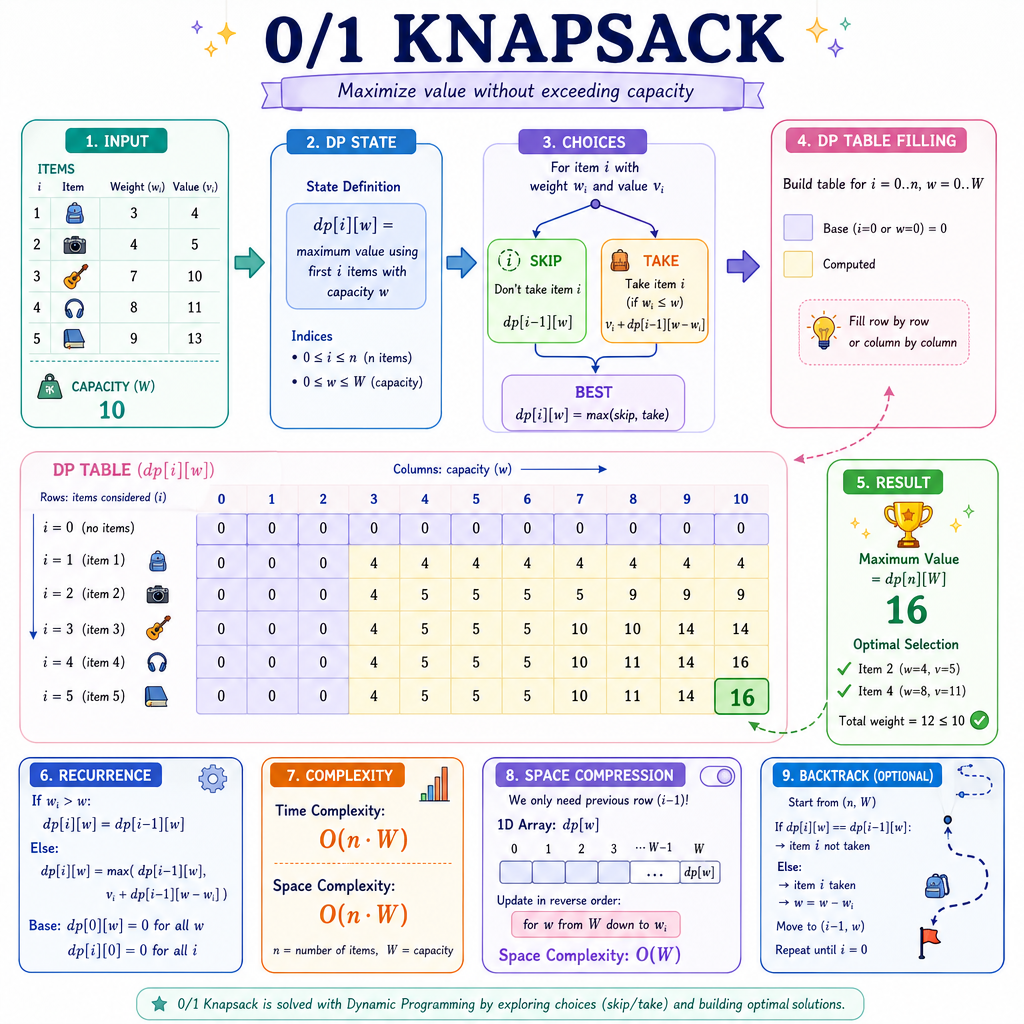
0/1 Knapsack Problem
Read at your own pace. Code execution, quizzes, progress tracking, and the AI tutor are available in the interactive view with JavaScript enabled.
Inventory Decisions
From matching strings to choosing gear
In Longest Common Subsequence, you used a 2D DP table to decide whether characters should align or be skipped.
Now we’ll use the same choose/skip instinct for a classic optimization problem: 0/1 Knapsack.
Imagine packing for an anime convention raid: each item has a weight and a value, but your bag has limited capacity. Which items should you bring to maximize total value?
This lesson matters because 0/1 Knapsack is a template for many interview problems involving:
- limited resources
- binary choices
- maximizing or minimizing value
- overlapping subproblems
The Setup
Problem statement
You are given:
-
weights[i]: weight of itemi -
values[i]: value of itemi -
capacity: maximum total weight allowed
Return the maximum total value you can carry.
Example:
item weight value 0 2 3 1 3 4 2 4 5 3 5 8Capacity: 8
A valid choice is items 1 and 3: weight 3 + 5 = 8, value 4 + 8 = 12.
The 0/1 part means an item is either taken or not taken. No fractions, no duplicates.

Choose The State
For a bottom-up 0/1 Knapsack table, which DP state is most natural?
Choice Recurrence
The two choices
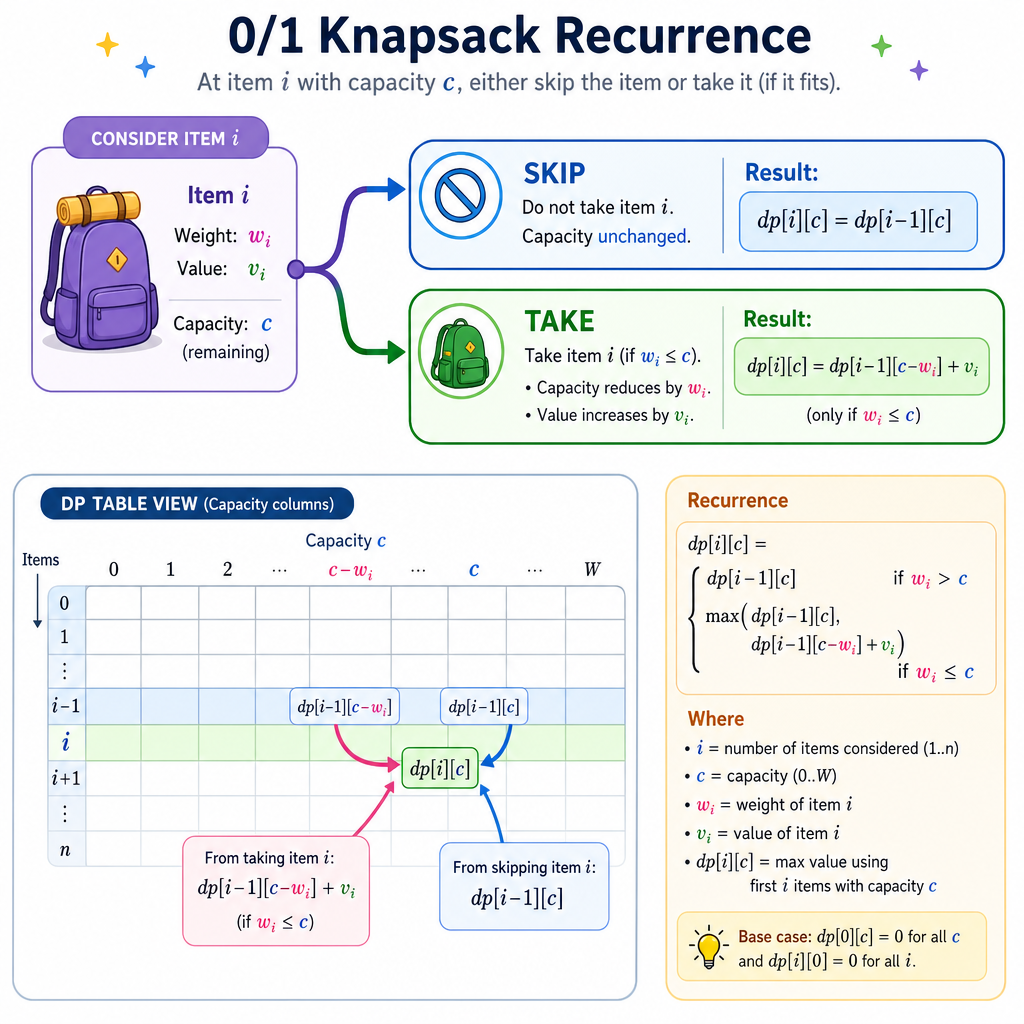
For each item, there are only two possibilities:
- Skip it
- Take it, if it fits
Let:
dp[i][c] = best value using first i items with capacity c
For item i - 1 with weight w and value v:
skip = dp[i - 1][c]
take = v + dp[i - 1][c - w]
So:
if w > c:
    dp[i][c] = dp[i - 1][c]
else:
    dp[i][c] = max(skip, take)
This should feel familiar from LCS: each cell asks, “What smaller decisions already tell me the answer?”
Zero One Meaning
In 0/1 Knapsack, each item can be selected at most ____.
Memoized Solver
Top-down version
Since you already practiced memoization in Fibonacci Series and LCS, the recursive version should look natural.
Define a function:
best_from(i, remaining)
It returns the best value we can get starting at item i with remaining capacity.
```python
from functools import lru_cache

weights = [2, 3, 4, 5]
values = [3, 4, 5, 8]
capacity = 8

@lru_cache(None)
def best_from(i, remaining):
    if i == len(weights) or remaining == 0:
        return 0

    # Option 1: skip current item
    best = best_from(i + 1, remaining)

    # Option 2: take current item, if it fits
    if weights[i] <= remaining:
        take = values[i] + best_from(i + 1, remaining - weights[i])
        best = max(best, take)

    return best

print("Best value:", best_from(0, capacity))
print("Cache stats:", best_from.cache_info())
```
Capacity Changes
True or false: when we take an item in 0/1 Knapsack, the remaining capacity decreases by that item’s weight.
Tabulation Table
Bottom-up version
Now we build the table directly.
Rows represent how many items are available. Columns represent capacity from 0 to capacity.
The base row and base column are 0 because:
- with
0items, value is0 - with capacity
0, value is0
Then every later cell applies the skip/take recurrence.
```python
weights = [2, 3, 4, 5]
values = [3, 4, 5, 8]
capacity = 8
n = len(weights)

dp = [[0] * (capacity + 1) for _ in range(n + 1)]

for i in range(1, n + 1):
    w = weights[i - 1]
    v = values[i - 1]

    for c in range(capacity + 1):
        skip = dp[i - 1][c]

        if w <= c:
            take = v + dp[i - 1][c - w]
            dp[i][c] = max(skip, take)
        else:
            dp[i][c] = skip

print("Max value:", dp[n][capacity])
print("DP table:")
for i, row in enumerate(dp):
    print(f"{i} items:", row)
```
One Row Version
Space compression
The 2D table is clear, but each row only depends on the previous row.
So we can compress to one list:
dp[c] = best value achievable with capacity c so far
Important detail: for 0/1 Knapsack, scan capacities downward. That prevents the current item from being used more than once in the same iteration.
```python
weights = [2, 3, 4, 5]
values = [3, 4, 5, 8]
capacity = 8

dp = [0] * (capacity + 1)

for idx, (w, v) in enumerate(zip(weights, values)):
    for c in range(capacity, w - 1, -1):
        dp[c] = max(dp[c], v + dp[c - w])
    print(f"After item {idx} (w={w}, v={v}):", dp)

print("Max value:", dp[capacity])
```
Loop Direction
In the one-row 0/1 Knapsack version, what can go wrong if capacities are scanned upward from small to large?
Knapsack Takeaways
What you now own
0/1 Knapsack adds a powerful DP pattern to your toolkit:
- State includes an item boundary and a resource limit
- Each item creates a skip/take decision
- The recurrence compares the best value from both choices
- Tabulation runs in
O(n * capacity)time - The 2D table uses
O(n * capacity)space - The one-row version reduces space to
O(capacity)
The core mental move is simple but deep: turn a big optimization problem into many smaller “best possible value under this limit” questions.
Next, we’ll shift from choosing items to choosing the best order of operations in Matrix Chain Multiplication.