Advanced Algorithms and Data Structures
Read at your own pace. Code execution, quizzes, progress tracking, and the AI tutor are available in the interactive view with JavaScript enabled.
Why This Matters
From Python fluency to interview strategy
In Intermediate Python for Google Interviews, you practiced core tools: loops, hashing patterns, mutability, and a steady practice routine.
Now we move up one layer: advanced algorithms and data structures. Google-style interviews often test whether you can recognize the hidden structure of a problem, choose the right tool, and explain the tradeoff clearly.
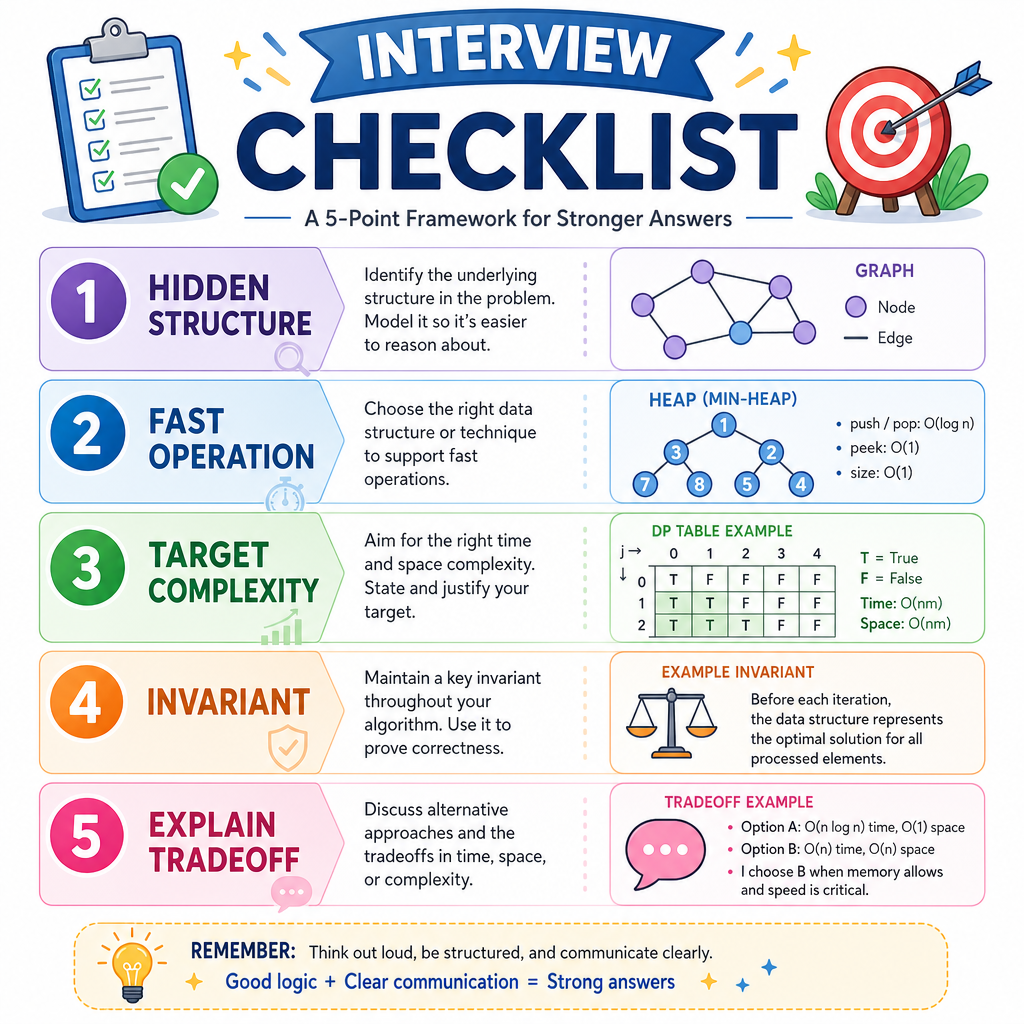
For a part-time coder, the goal is not to memorize every algorithm. The goal is to build a reliable mental checklist:
- Is this a graph, tree, range, ordering, or optimization problem?
- What operation must be fast: lookup, insert, delete, min/max, connectivity, shortest path?
- What changes if the input grows from 100 items to 1,000,000?
Today we focus on patterns that repeatedly appear in Google interview prep.

Pattern Map
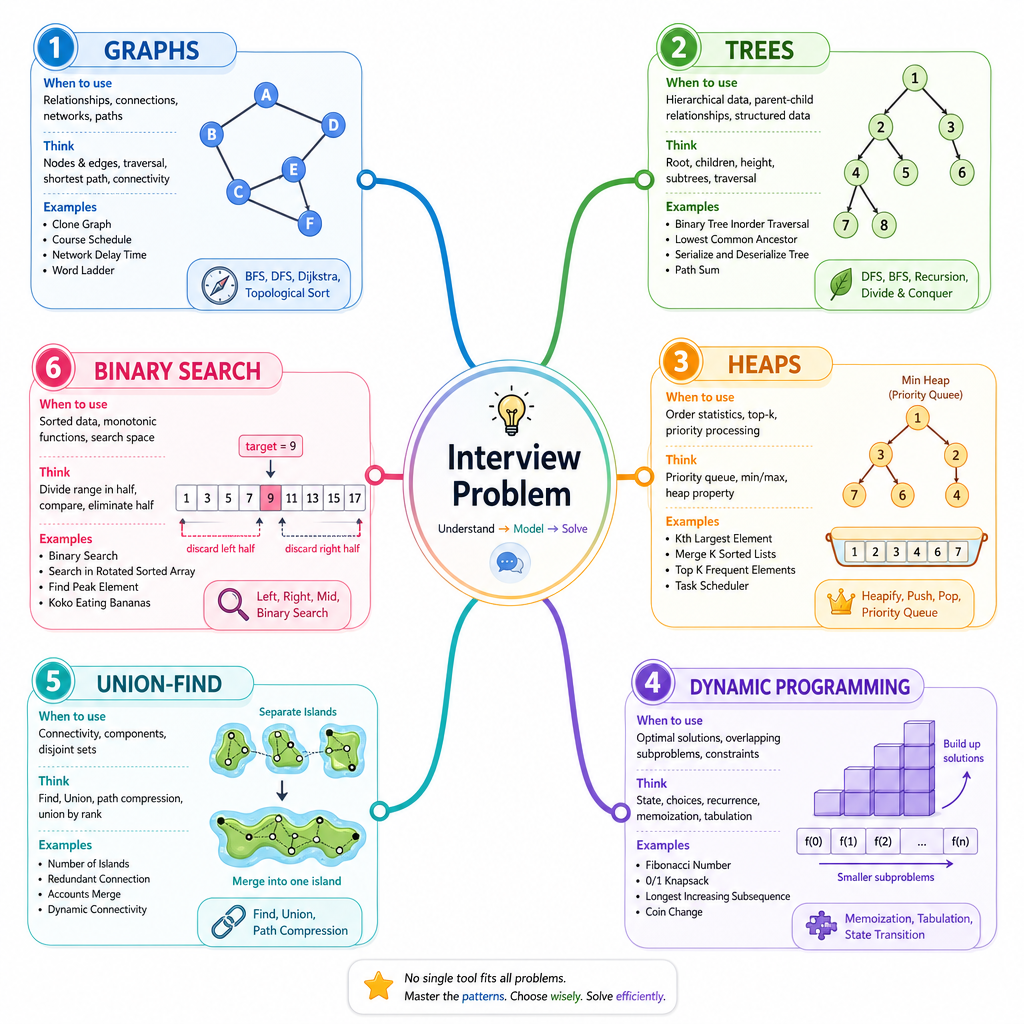
The advanced-algorithm map
Most hard-looking interview problems become manageable once you classify them.
Problem signal                  Likely tool
-----------------------------------------------------
Relationships / routes          Graph traversal
Hierarchy / recursion            Tree DFS/BFS
Repeated best/min/max            Heap / priority queue
Overlapping subproblems          Dynamic programming
Groups merging over time         Union-Find
Sorted search space              Binary search
A strong candidate does not just code. They say something like:
“This looks like a graph because items are connected by relationships. I’ll use BFS if I need the shortest number of steps, DFS if I need to explore components.”
That sentence shows both pattern recognition and control over complexity.
Choose The Tool
You are given a list of cities and direct flights between them. You need to determine the minimum number of flights from city A to city B.
Which approach is the best first choice?
Graph Traversal
BFS and DFS: two interview workhorses
A graph is just things connected to other things. In interviews, graphs may appear as:
- social networks
- grids
- word transformations
- prerequisite chains
- routes and dependencies
Use BFS when you care about the shortest number of moves in an unweighted graph.
Use DFS when you care about exploring a full region, detecting cycles, or trying possibilities deeply.
BFS: explore level by level
A -> B,C -> D,E,F

DFS: go deep before backtracking
A -> B -> D -> backtrack -> C
```python
from collections import deque

# A small unweighted graph.
graph = {
    "A": ["B", "C"],
    "B": ["D", "E"],
    "C": ["F"],
    "D": [],
    "E": ["F"],
    "F": []
}

def bfs(start):
    seen = {start}
    order = []
    q = deque([start])

    while q:
        node = q.popleft()
        order.append(node)
        for nei in graph[node]:
            if nei not in seen:
                seen.add(nei)
                q.append(nei)
    return order

def dfs(start):
    seen = set()
    order = []

    def visit(node):
        seen.add(node)
        order.append(node)
        for nei in graph[node]:
            if nei not in seen:
                visit(nei)

    visit(start)
    return order

print("BFS:", bfs("A"))
print("DFS:", dfs("A"))
```
BFS Claim
True or false?
In an unweighted graph, BFS is a natural choice when you need the minimum number of edges between two nodes.
Heaps For Priority
When “best so far” matters
A heap is useful when you repeatedly need the smallest or largest item without fully sorting everything.
Python’s heapq gives a min-heap:
-
heappush: insert inO(log n) -
heappop: remove smallest inO(log n) - peek smallest:
heap[0]inO(1)
Common interview uses:
- top K frequent/largest/smallest
- merging K sorted lists
- scheduling tasks
- Dijkstra’s shortest path when edges have weights
Below, we keep only the top 3 scores from a stream. This avoids sorting the full list every time.
```python
import heapq

scores = [72, 95, 81, 100, 67, 88, 94]
k = 3
heap = []

for score in scores:
    heapq.heappush(heap, score)
    if len(heap) > k:
        heapq.heappop(heap)  # remove the smallest among the kept scores

print("Top 3 scores, unordered in heap:", heap)
print("Top 3 scores, sorted descending:", sorted(heap, reverse=True))
```
Heap Complexity
Fill in the blank:
In Python’s heapq, inserting one item into a heap of size n takes _____ time.
Dynamic Programming
DP is controlled remembering
Dynamic programming is useful when a recursive search repeats the same smaller questions.
A good DP signal:
“If I solve this subproblem once, I can reuse the result later.”
Two common forms:
- Top-down memoization: write recursion, cache results
- Bottom-up tabulation: build answers from small cases to large cases
Interview tip: before coding DP, define the state in plain English.
Example state:
dp[amount]= minimum number of coins needed to make this amount.
Then your transition asks:
If I use coin
c, can I improvedp[amount]fromdp[amount - c] + 1?
```python
coins = [1, 3, 4]
target = 6

# dp[x] = minimum coins needed to make amount x
INF = float("inf")
dp = [INF] * (target + 1)
dp[0] = 0

for amount in range(1, target + 1):
    for coin in coins:
        if amount - coin >= 0:
            dp[amount] = min(dp[amount], dp[amount - coin] + 1)

print("Coins:", coins)
print("Target:", target)
print("Minimum coins:", dp[target])
print("DP table:", dp)
```
Union Find
Fast connectivity questions
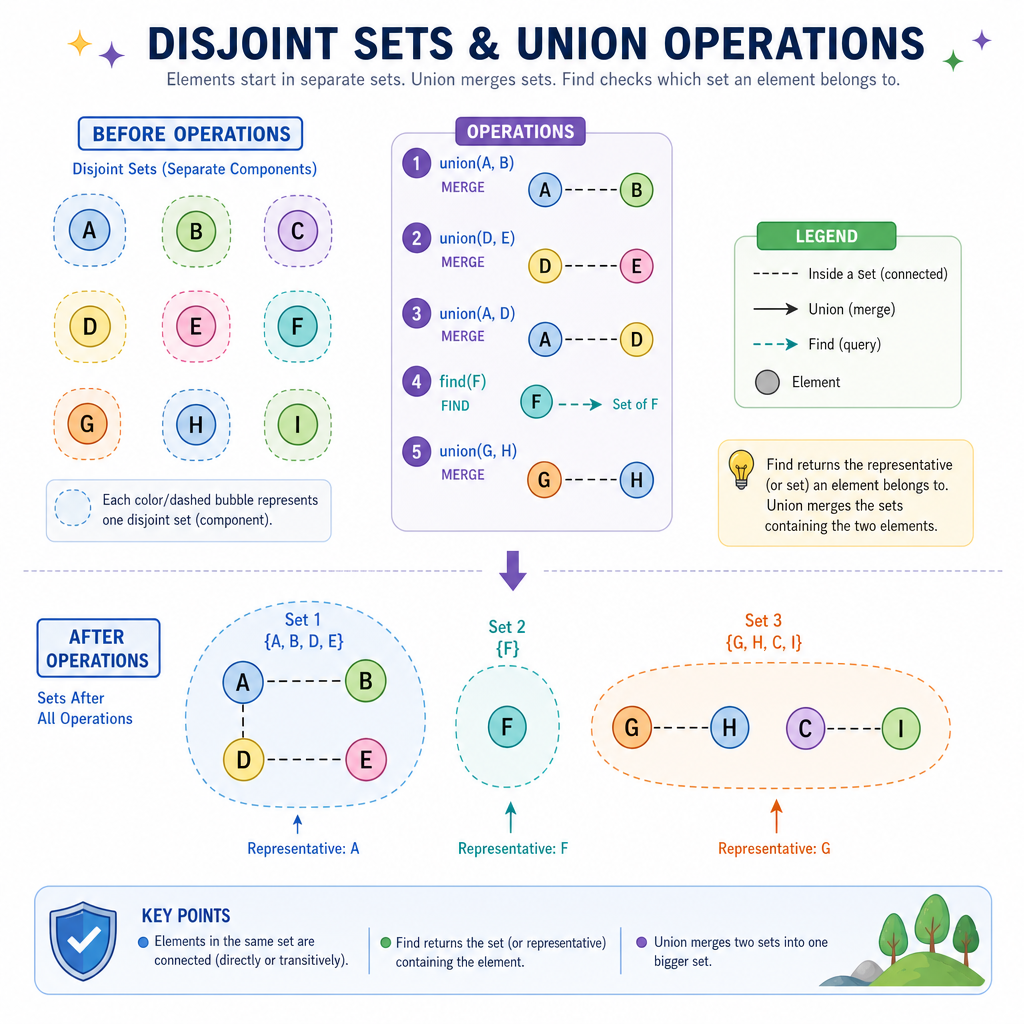
Union-Find, also called Disjoint Set Union, tracks groups that merge over time.
It supports two key operations:
-
find(x): which group isxin? -
union(a, b): merge the groups containingaandb
This appears in problems like:
- number of connected components
- friend circles
- redundant connection
- accounts merge
- islands merging as land is added
Mental model:
Before union(1, 2):    {1} {2} {3,4}
After union(1, 2):     {1,2} {3,4}
In interviews, Union-Find is often chosen when edges arrive and you repeatedly ask, “Are these two things already connected?”
DP Or Not
Which problem statement most strongly suggests dynamic programming?
Interview Checklist
Your advanced-algorithm checklist
When you see a new problem, pause before coding.
Ask:
- What is the hidden structure? Graph, tree, array, sorted space, groups, choices?
- What operation must be fast? Lookup, min/max, merge, shortest path, repeated subproblem?
-
What is the target complexity? Can
O(n²)pass, or do we needO(n log n)/O(n)? - What invariant stays true? A heap keeps the best K, BFS explores by distance, DP reuses solved states.
- Can I explain the tradeoff out loud? This matters in Google interviews.
You now have the algorithm vocabulary needed for harder practice. Later, the course will shift from single-machine coding problems into the System Design Primer for Google Interviews, where the scale and tradeoffs become broader.