Advanced Data Structures: Heaps and Hash Tables
Read at your own pace. Code execution, quizzes, progress tracking, and the AI tutor are available in the interactive view with JavaScript enabled.
Why This Matters
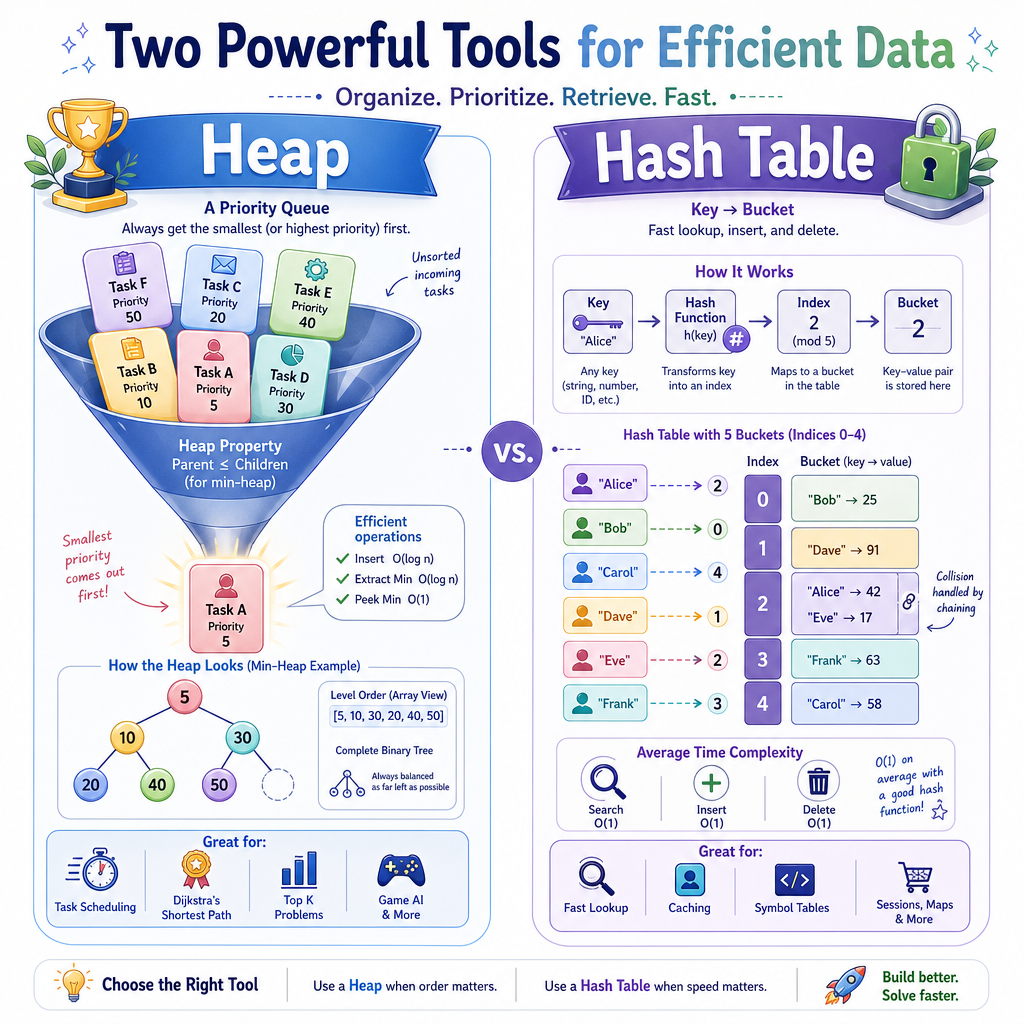
Two tools for speed
Now that you've covered Greedy Algorithms and Their Applications, you're ready for two data structures that make many greedy and lookup-heavy solutions practical:
- Heaps: quickly access the smallest or largest item.
- Hash tables: quickly check, count, group, or retrieve items by key.
In a 30-day crash course, these are high-value because they appear everywhere in easy and medium problems. They also connect naturally to what you've already learned:
- From Algorithm Basics and Complexity Analysis: we care about reducing repeated scans.
- From Trees and Graphs: heaps are tree-shaped internally, even if Python hides the details.
- From Greedy Algorithms: heaps often help us repeatedly choose the best next option.
One brief foreshadow: heaps will show up again when you study shortest paths next lesson.
Heap Mental Model
A heap is a priority machine
A heap is a data structure optimized for repeatedly answering:
What is the highest-priority item right now?
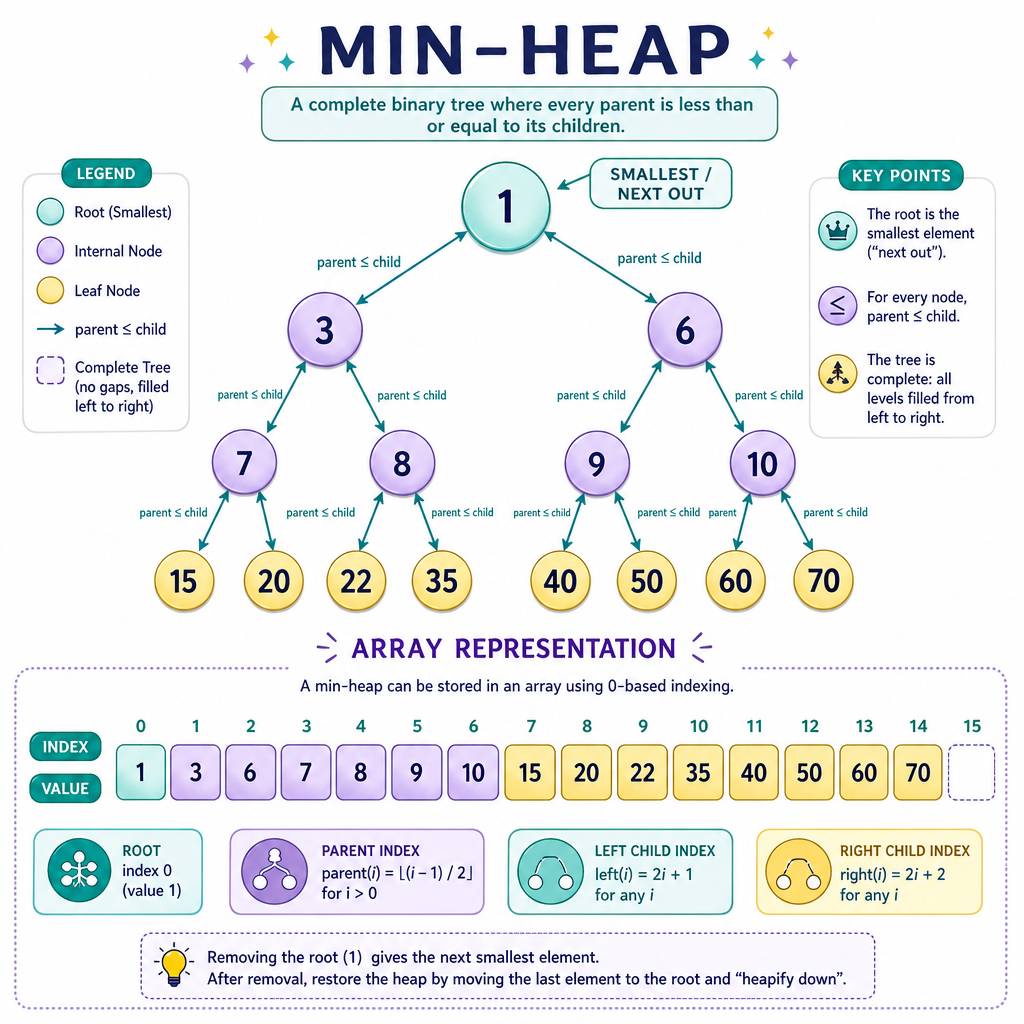
In Python, the built-in heapq module gives you a min-heap by default. That means the smallest item is always available at the front.
Conceptually:
        1
      /   \
     3     2
    / \   /
   8   5 4
The important rule is not full sorting. The heap only guarantees:
- the smallest value is at the root
- each parent is
<=its children - pushing and popping restore that rule
So a heap is perfect when you do not need a fully sorted list, only the next best item repeatedly.
Using Heapq
Python heap basics
Python's heapq works on a normal list, but maintains heap order as you push and pop.
Main operations:
-
heappush(heap, item)inserts an item inO(log n)time. -
heappop(heap)removes and returns the smallest item inO(log n)time. - Looking at
heap[0]gives the smallest item inO(1)time.
A common pattern is storing tuples like (priority, value). Python compares tuple elements from left to right, so the priority comes first.
```python
import heapq

tasks = []
heapq.heappush(tasks, (3, 'write notes'))
heapq.heappush(tasks, (1, 'fix urgent bug'))
heapq.heappush(tasks, (2, 'review code'))

print('Heap list:', tasks)

while tasks:
    priority, task = heapq.heappop(tasks)
    print(f'Priority {priority}: {task}')
```
Heap Operation Check
You have a Python min-heap with n items. What is the usual time complexity of inserting one new item with heapq.heappush?
Hash Table Model
Hash tables trade order for access
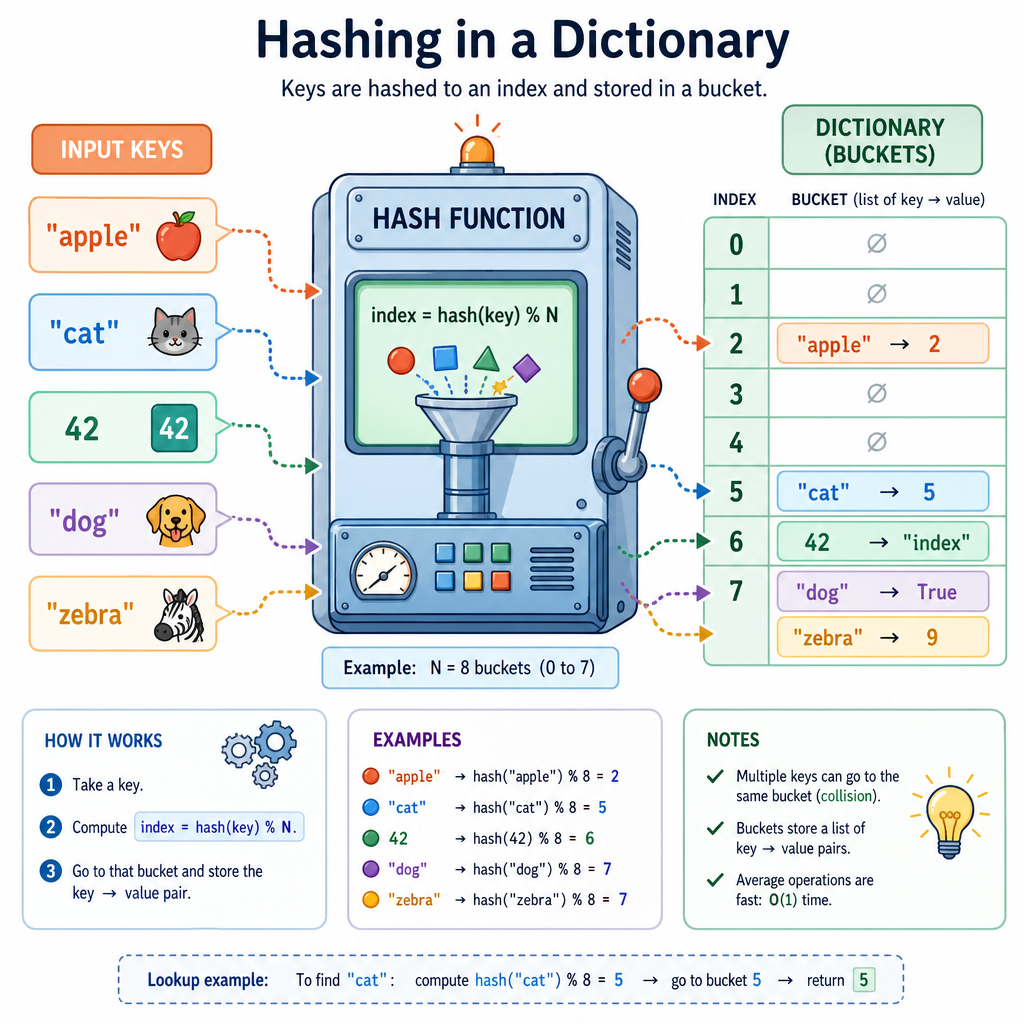
A hash table stores values by using a key. In Python, you use hash tables constantly:
-
dictmaps keys to values. -
setstores unique keys.
The big idea:
key -> hash function -> bucket -> stored value
For coding interviews and daily problem practice, hash tables usually help with questions like:
- Have I seen this before?
- How many times has this appeared?
- Where did this value appear?
- Can I find the complement quickly?
Average-case lookup, insert, and delete are O(1), which is why hash tables often replace nested loops.
Hash Pattern Example
Turning a scan into memory
A classic beginner-to-medium pattern is:
As you scan, store what would help your future self.
For Two Sum, instead of checking every pair, keep a dictionary from number to index. For each number, ask whether its needed complement has already appeared.
This changes the approach from roughly O(n^2) pair checking to O(n) average time.
```python
def two_sum(nums, target):
    seen = {}  # number -> index

    for i, num in enumerate(nums):
        need = target - num

        if need in seen:
            return [seen[need], i]

        seen[num] = i

    return []

print(two_sum([2, 7, 11, 15], 9))
print(two_sum([3, 2, 4], 6))
```
Lookup Complexity
Fill in the blank:
Average-case lookup in a Python dict is usually ___ time.
Fill in the blank: _____________
Heap Direction
True or false?
Python's heapq module creates a max-heap by default, so the largest item is popped first.
Choosing The Tool
Heap or hash table?
Use the question shape to choose the tool.
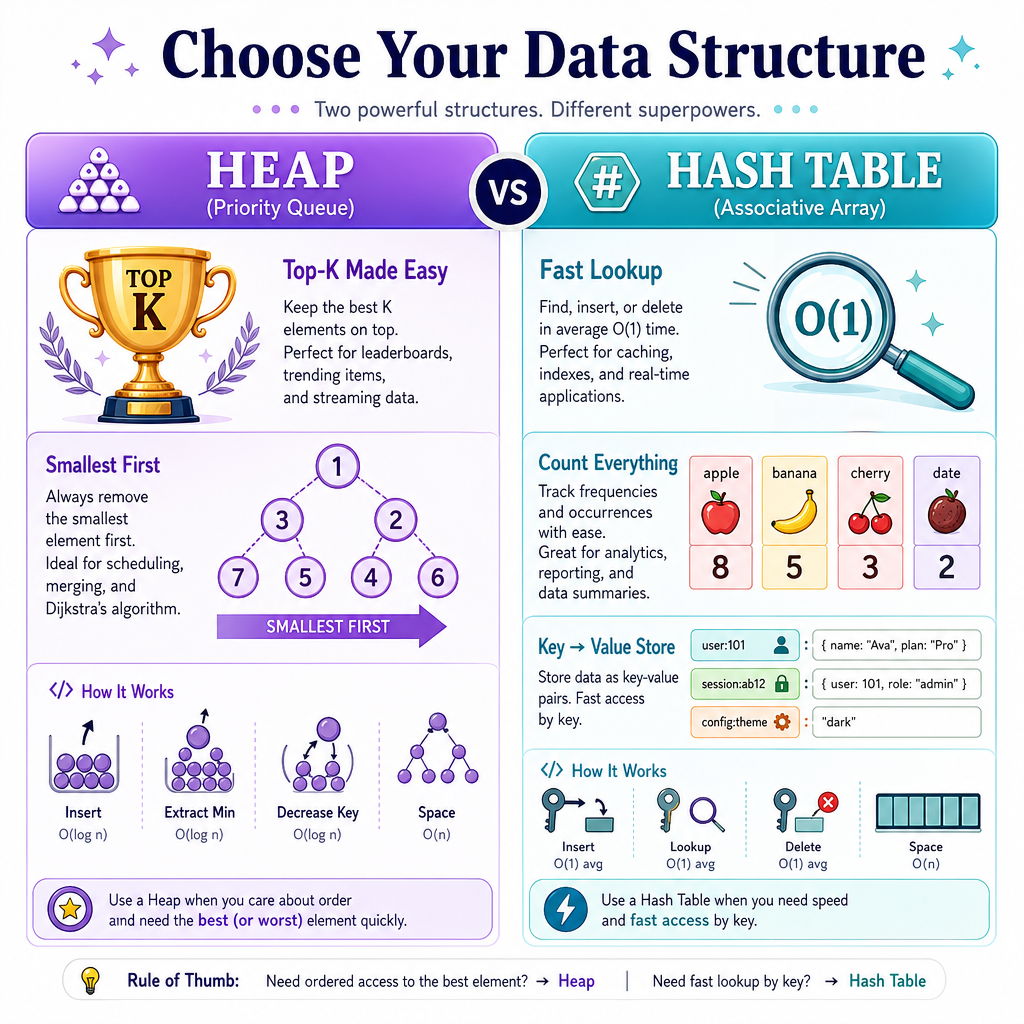
Reach for a heap when...
- you repeatedly need the smallest/largest item
- you are maintaining a top
k - priorities change the processing order
- sorting everything would be more work than needed
Reach for a hash table when...
- you need fast membership checks
- you need counts or frequencies
- you need to map one thing to another
- a nested loop is only checking whether something exists
Common interview smell
If your first solution says, "for each item, scan all previous items," ask:
Could a
dict,set, or heap remember the useful part for me?
Crash Course Practice
Your 2-day revisit loop
Because this course is built for fast proficiency, don't just read this lesson once. Add these to your spaced review list.
Practice today
- Two Sum using a dictionary.
- Contains Duplicate using a set.
- Top K Frequent Elements using a dictionary plus a heap.
- Kth Largest Element using a heap.
Revisit in 2 days
Redo the same problems without looking at your first solution. Your goal is not memorizing code — it is recognizing the trigger:
- "I need fast lookup" → hash table.
- "I need repeated best item" → heap.
Next, you'll use these instincts alongside graph traversal ideas when the course moves into shortest path and connectivity.