Advanced Languages and Frameworks
Read at your own pace. Code execution, quizzes, progress tracking, and the AI tutor are available in the interactive view with JavaScript enabled.
From Architecture To Code
Why this lesson matters
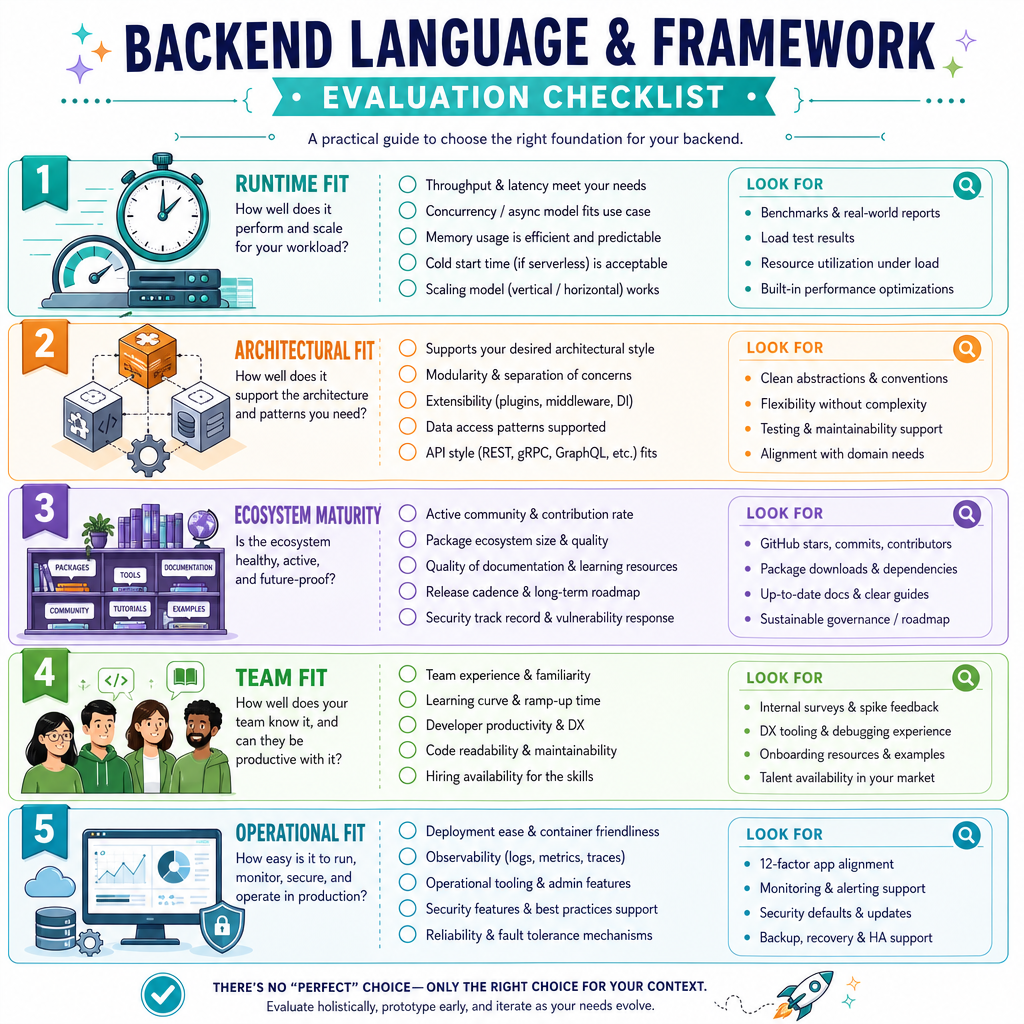
You’ve already covered Introduction to Databases, System Design Principles, and Backend Architecture Patterns. That means you can reason about data, tradeoffs, failure modes, and where responsibilities belong.
Now we zoom into the daily toolset of a senior backend engineer: languages and frameworks.
A senior backend engineer does not just ask:
- “Can this framework build an API?”
- “Can this language connect to a database?”
They ask:
- “Where does this framework shape my architecture?”
- “What runtime assumptions affect latency and throughput?”
- “How do I keep business logic portable?”
- “Which abstractions help the team move faster without hiding danger?”
In this lesson, we’ll use Python as the main lens, but the thinking applies broadly across backend ecosystems.
Senior Language Lens
Languages are operating environments
At a junior level, a programming language often feels like syntax plus libraries.
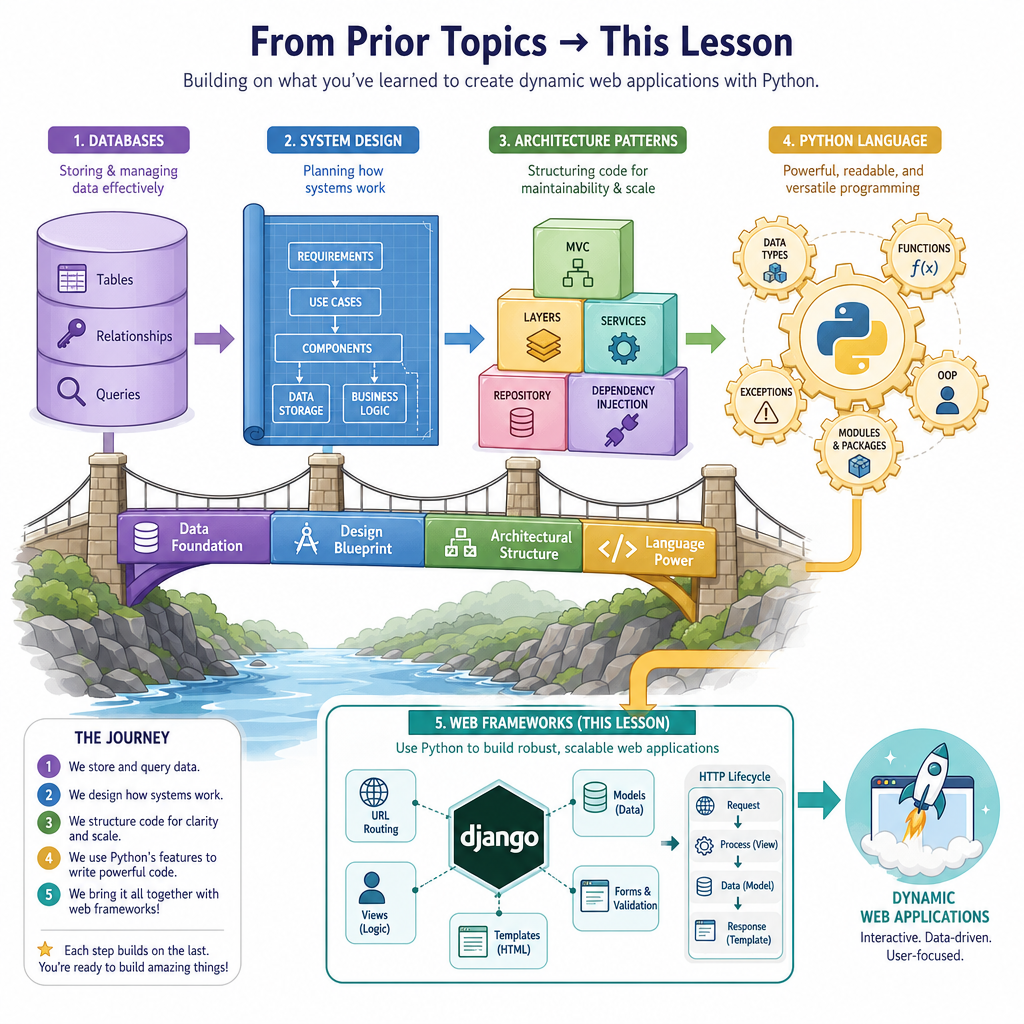
At a senior backend level, a language is a full operating environment with constraints and superpowers:
- Runtime model: threads, event loops, garbage collection, memory behavior
- Type system: what errors can be caught before production?
- Package ecosystem: what is mature, risky, or abandoned?
- Concurrency tools: threads, async I/O, processes, queues
- Framework conventions: where code naturally wants to live
- Operational fit: startup time, observability hooks, deployment model
Python is productive because it has a rich ecosystem and expressive syntax. But senior engineers must also understand where Python needs careful design: CPU-bound work, dependency boundaries, dynamic typing, and framework coupling.
The goal is not to worship or reject a language. The goal is to understand its tradeoffs clearly enough to design reliable backend systems.
Framework Choice
You are choosing a Python web framework for a backend service that must support clear domain boundaries from the Backend Architecture Patterns lesson.
Which question is the most senior-level concern?
Async Runtime Reality
Async helps when work is waiting
Python backend frameworks such as FastAPI, Starlette, and aiohttp often use async I/O.
The key mental model:
Async improves throughput when your service spends time waiting on external I/O: databases, network calls, caches, queues, file systems.
It does not magically make CPU-heavy Python code faster. If the event loop is busy calculating, it cannot switch to other waiting tasks.
Think back to System Design Principles: first identify the bottleneck. If the bottleneck is waiting on remote services, async can help. If the bottleneck is CPU, you may need multiprocessing, native extensions, batching, background workers, or a different architecture.
Here’s a tiny demonstration of concurrent waiting.
```python
import asyncio
import time

async def fetch_user(user_id: int) -> str:
    # Simulates waiting on a database or remote API.
    await asyncio.sleep(1)
    return f'user-{user_id}'

async def main():
    start = time.perf_counter()

    users = await asyncio.gather(
        fetch_user(1),
        fetch_user(2),
        fetch_user(3),
    )

    elapsed = time.perf_counter() - start
    print('users:', users)
    print('elapsed_seconds:', round(elapsed, 2))

asyncio.run(main())
```
Async Misconception
True or false:
If a Python endpoint is slow because it performs heavy CPU calculations, converting the endpoint to async def will usually make that CPU work faster.
Contracts With Types
Types are design communication
Python is dynamically typed, but modern Python supports strong type hints that help teams communicate intent.
For senior backend work, types are less about pleasing a checker and more about making boundaries explicit:
- What does a service require?
- What shape does a command or response have?
- Which dependency is allowed to be substituted?
- What does this function promise to return?
A useful pattern is combining:
-
dataclassfor simple data structures -
Protocolfor dependency contracts - small functions/classes that avoid framework-specific objects
This supports the architectural thinking from Backend Architecture Patterns, especially hexagonal and layered designs.
```python
from dataclasses import dataclass
from typing import Protocol

@dataclass(frozen=True)
class CreateUserCommand:
    email: str
    plan: str

class EmailSender(Protocol):
    def send_welcome(self, email: str) -> None:
        ...

class ConsoleEmailSender:
    def send_welcome(self, email: str) -> None:
        print(f'Sending welcome email to {email}')

def create_user(command: CreateUserCommand, email_sender: EmailSender) -> str:
    # Domain/application logic does not know about HTTP or a framework.
    email_sender.send_welcome(command.email)
    return f'created:{command.email}:{command.plan}'

result = create_user(
    CreateUserCommand(email='ada@example.com', plan='pro'),
    ConsoleEmailSender(),
)
print(result)
```
Structural Contract
In modern Python typing, a structural interface that says “any object with these methods is acceptable” is commonly expressed using ____.
Framework Lifecycle
A framework is a request pipeline
A backend framework is not just a router. It is a lifecycle manager.
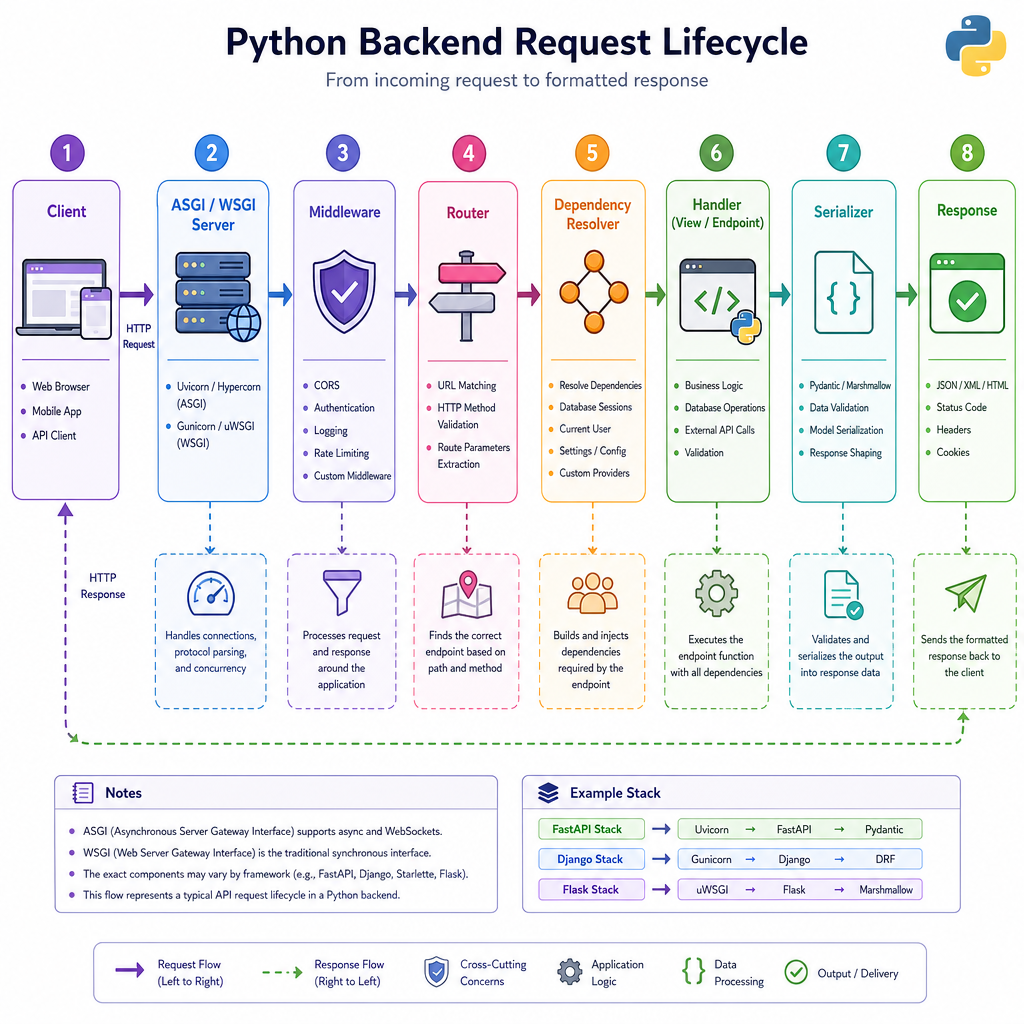
A typical Python web request path looks like this:
Client
  ↓
ASGI/WSGI server
  ↓
Middleware
  ↓
Routing
  ↓
Dependency resolution
  ↓
Handler / controller
  ↓
Serialization
  ↓
Response
Senior engineers care about this lifecycle because each stage has architectural consequences:
- Middleware is good for cross-cutting concerns like auth context, correlation IDs, and request logging.
- Routing maps transport details to application actions.
- Dependency resolution wires implementations to interfaces.
- Handlers/controllers should translate HTTP into use-case calls, not become giant business-logic containers.
- Serialization defines what leaves your system boundary.
This connects directly to the architecture patterns you just studied: frameworks belong mostly at the edges.
Keep Core Portable
Frameworks should compose your app, not own it
A common backend failure mode is letting framework details leak everywhere:
- request objects in domain services
- ORM models as business entities
- decorators controlling core logic
- global framework state hidden inside functions
This feels fast early, but it makes later changes expensive.
A better senior-level habit:
- Put business rules in plain Python modules.
- Define dependency contracts with small interfaces.
- Let the framework adapt HTTP/database/cache details into those contracts.
- Keep handlers thin.
This is the practical code version of the Hexagonal Architecture idea from the previous lesson.
```python
from dataclasses import dataclass
from typing import Protocol

@dataclass(frozen=True)
class User:
    id: int
    email: str

class UserRepository(Protocol):
    def get_by_id(self, user_id: int) -> User:
        ...

class InMemoryUserRepository:
    def __init__(self):
        self.users = {
            1: User(id=1, email='grace@example.com')
        }

    def get_by_id(self, user_id: int) -> User:
        return self.users[user_id]

def user_profile_summary(user_id: int, repo: UserRepository) -> str:
    user = repo.get_by_id(user_id)
    return f'User #{user.id}: {user.email}'

# A web handler could call this function, but the function itself
# does not depend on HTTP, FastAPI, Flask, Django, or an ORM.
repo = InMemoryUserRepository()
print(user_profile_summary(1, repo))
```
Boundary Placement
In a hexagonal-style Python backend, where should framework-specific objects such as an HTTP Request usually live?
Choosing Frameworks Wisely
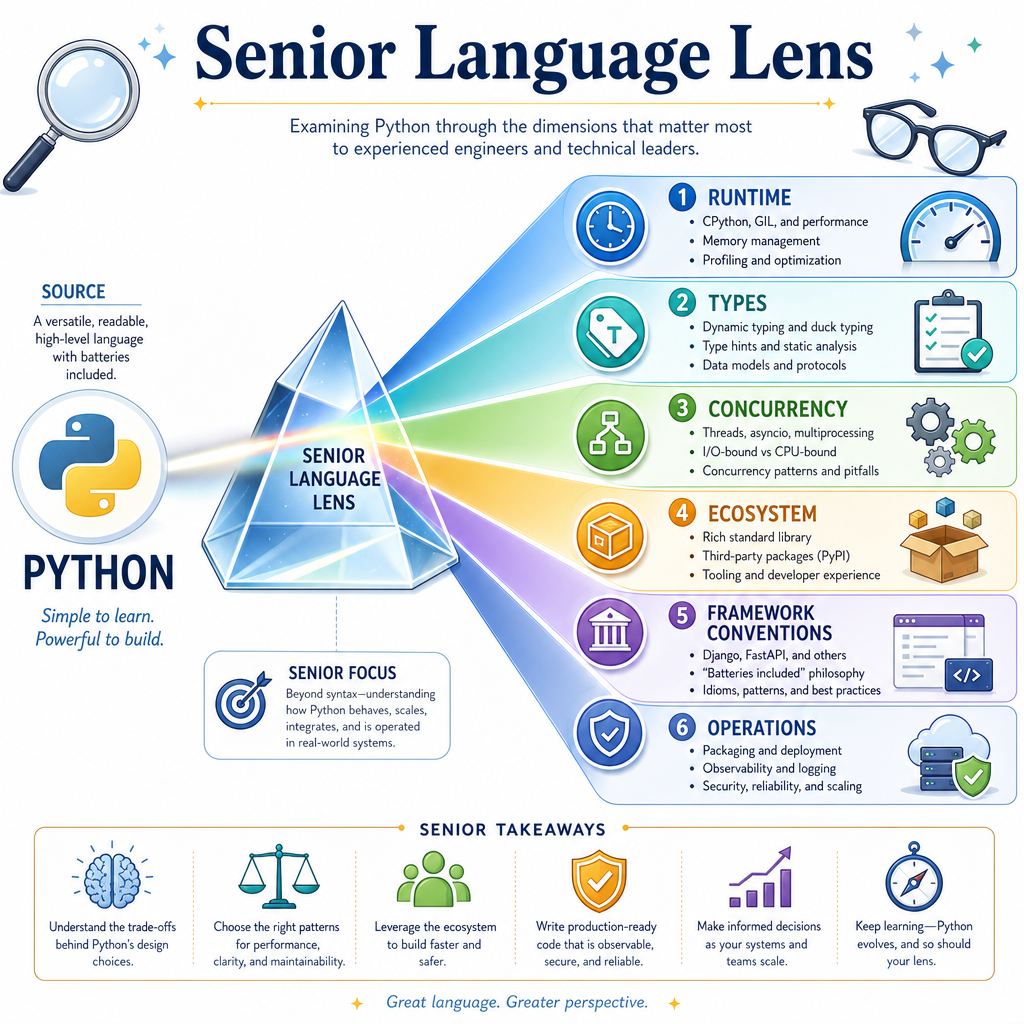
A practical evaluation checklist
When evaluating advanced language/framework choices, use a senior backend checklist:
Runtime fit
- Is the workload I/O-bound, CPU-bound, or mixed?
- Does the concurrency model match the bottleneck?
Architectural fit
- Can we keep business logic outside framework objects?
- Does the framework encourage clear modules and boundaries?
Ecosystem maturity
- Are libraries maintained?
- Is documentation strong?
- Are operational patterns well understood?
Team fit
- Can the team debug it under production pressure?
- Are conventions consistent enough to reduce decision fatigue?
Operational fit
- Does it support logging, metrics, tracing, configuration, and deployment cleanly?
Senior engineers do not choose tools by hype. They choose tools by how well those tools support the system’s constraints, the team’s capabilities, and the product’s evolution.
Next, we’ll move from building with frameworks to verifying and protecting behavior through Testing and Automation.