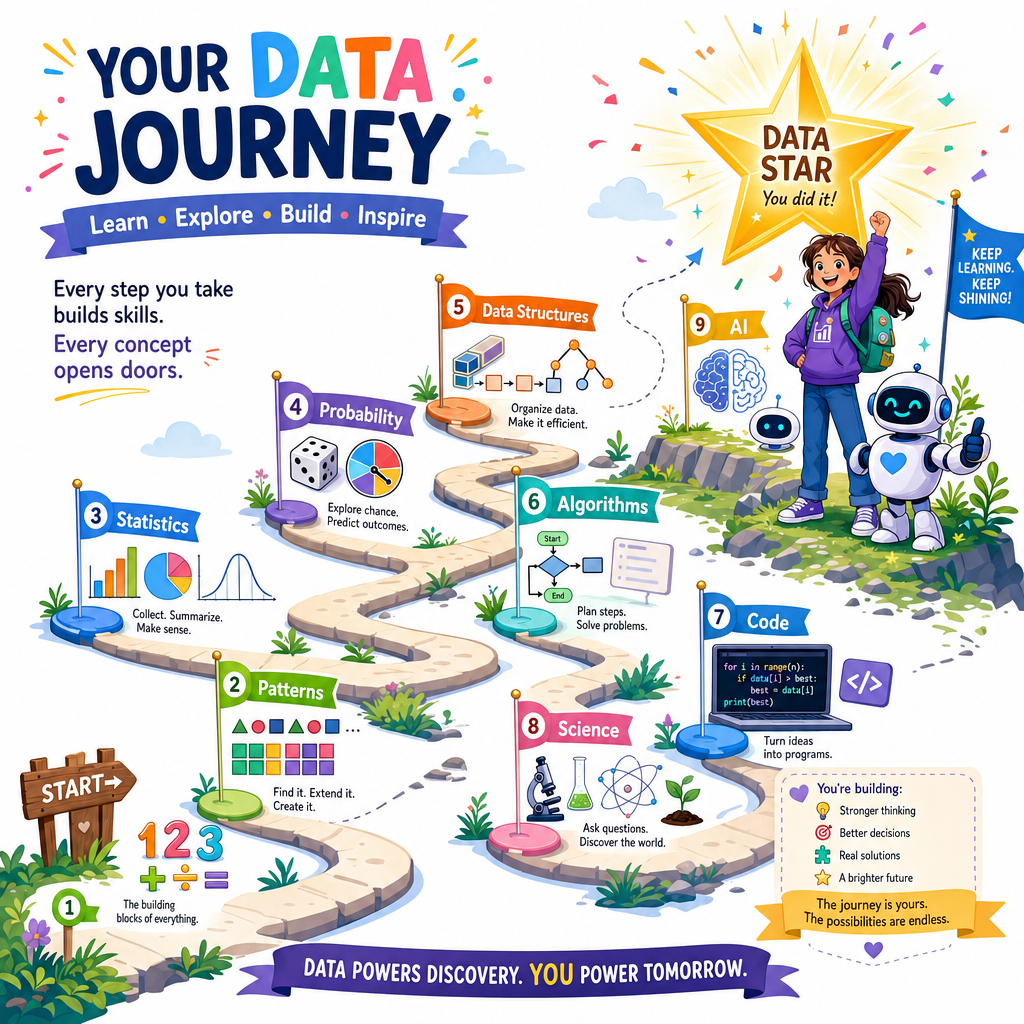
Celebration of Math and Science Connections
Read at your own pace. Code execution, quizzes, progress tracking, and the AI tutor are available in the interactive view with JavaScript enabled.
Final Celebration
You made a tiny data-science toolbox!
Now that we've traveled from Introduction to Numbers and Counting all the way to Numbers Everywhere! From Phones to Cars, we are ready to celebrate the big connection:
Math helps us describe the world. Science helps us ask questions about the world. Computers help us test ideas quickly.
In this final lesson, we will tie everything together into one friendly picture: data science, AI, and machine learning are built from the small ideas you already practiced.
Think of it like building a toy robot:
- Numbers are the tiny screws.
- Shapes, colors, and patterns are the robot's eyes.
- Statistics and probability help the robot make careful guesses.
- Data structures and algorithms organize the robot's thinking.
- Python code lets the robot follow instructions.

Math Meets Science
The big friendship
Math and science are not separate islands. They hold hands.
Science asks:
- What is happening?
- Why might it be happening?
- What should we try next?
Math helps answer:
- How many?
- How often?
- How different?
- How likely?
Data science adds one more helpful friend: computers.
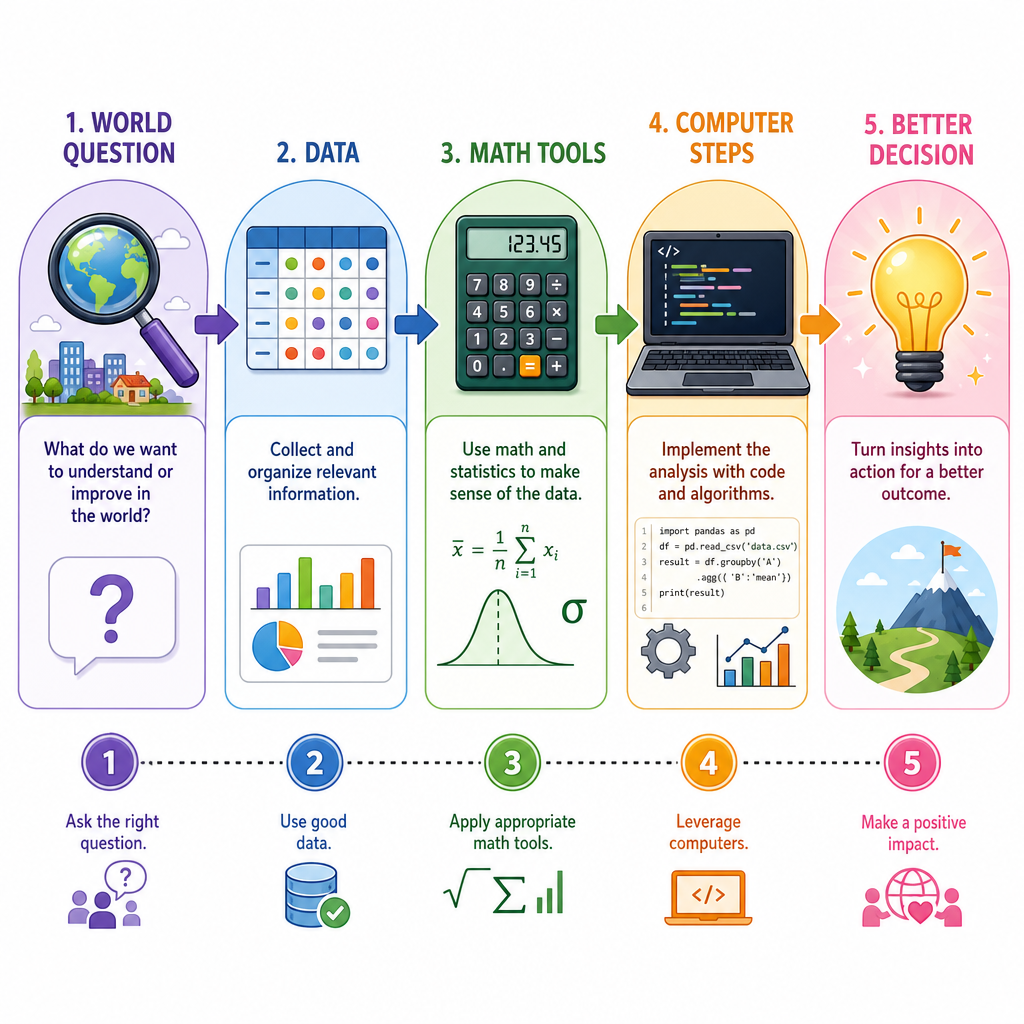
So the whole team looks like this:
World question → Data → Math tools → Computer steps → Better decision
Example from earlier lessons:
- From Introduction to Statistics - Using Bubbles, we used bubble sizes as data.
- From Telling the Story with Data, we turned data into meaning.
- From Using Computers to Solve Problems, we made a step-by-step problem loop.
Together, those are the beginning of real data science.
Spot The Team
A weather app wants to decide whether to show an umbrella warning.
Which group of tools sounds most like the data-science team?
Mini Science Fair
One tiny project uses many lessons
Let's imagine a small science-fair question:
Do longer toy-car ramps make cars go farther?
We can connect earlier tools:
- Numbers and Counting: measure ramp height and travel distance.
- Statistics: find typical distances.
- Sorting: arrange trials from shortest to longest.
- Algorithms: follow the same recipe each time.
- Python: let the computer organize and summarize.
This is not magic. It is careful thinking with data.
```python
# Tiny science-fair dataset: toy car ramp tests
trials = [
    {"ramp_height": 1, "distance": 22},
    {"ramp_height": 2, "distance": 35},
    {"ramp_height": 3, "distance": 48},
    {"ramp_height": 4, "distance": 61},
]

print("Toy car science fair")
print("--------------------")

for trial in trials:
    print("Ramp", trial["ramp_height"], "blocks high ->", trial["distance"], "cm")

# Find the typical distance using an average
all_distances = [trial["distance"] for trial in trials]
average_distance = sum(all_distances) / len(all_distances)

print("\nTypical distance:", average_distance, "cm")

# Sort from shortest to longest distance
sorted_trials = sorted(trials, key=lambda trial: trial["distance"])
print("Shortest test:", sorted_trials[0])
print("Longest test:", sorted_trials[-1])
```
Careful Thinking
True or false?
If two numbers appear together in data, a data scientist should immediately assume one caused the other.
Tiny AI Cycle
How AI learns from examples
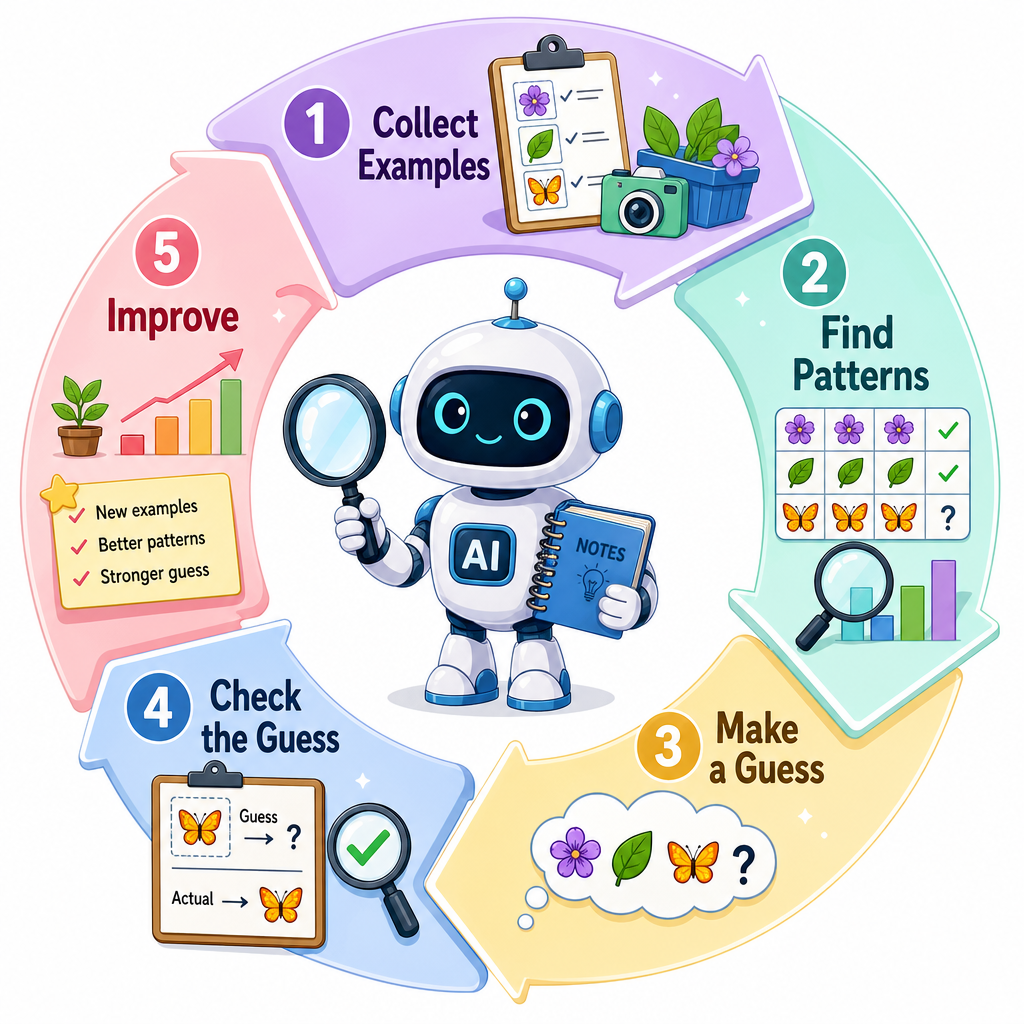
You have already seen the pieces of a simple AI cycle.
Collect examples
      ↓
Find patterns
      ↓
Make a guess
      ↓
Check the guess
      ↓
Improve
That cycle connects many lessons:
- Exploring Data Using Colors and Shapes gave us features: clues that describe things.
- Discover Patterns with Sorting helped patterns become easier to see.
- Getting To Know Probability helped us talk about uncertain guesses.
- Using Computers to Solve Problems gave us the check-and-improve loop.
A real machine-learning system is a much bigger version of this same idea.
Name The Fuel
Fill in the blank.
In data science and machine learning, the collected facts we use as learning fuel are called ____.
Rules And Learning
From fixed rules to learned patterns
In Fun with Algorithms: Cooking Recipes, a rule was like a recipe: do step 1, then step 2, then step 3.
Machine learning still uses steps, but it often builds a rule from examples.
Imagine we want a tiny program to guess whether a toy car went far or not far.
Instead of choosing a number by pure guess, we can look at past distances and use the typical distance as a simple boundary.
```python
# Past toy-car distances in centimeters
past_distances = [22, 35, 48, 61, 64, 70]

# A very simple learned boundary: the average distance
boundary = sum(past_distances) / len(past_distances)

new_distance = 55

print("Past distances:", past_distances)
print("Learned boundary:", boundary)
print("New distance:", new_distance)

if new_distance >= boundary:
    print("Guess: far")
else:
    print("Guess: not far")
```
Best Next Step
A tiny model makes many wrong guesses.
What is the most data-scientist-like next step?
You Are Ready
Your first math-and-data map
You now have a beginner's map for data science, AI, and machine learning.
Numbers count things.
Patterns reveal structure.
Statistics summarize groups.
Probability talks about chance.
Data structures store information.
Algorithms give steps.
Code makes steps run.
Science asks careful questions.
AI uses examples to improve guesses.
That is a lot! But each idea began with something simple: counting toys, spotting colors, sorting shapes, or following a recipe.
Final celebration thought
You do not need to be scared of math. Math is a language for noticing, comparing, measuring, and explaining.
And now, when you see a phone, car, game, weather app, or robot, you can whisper:
Somewhere inside, numbers and patterns are helping it think.