Comparing Performance and Expectations
Read at your own pace. Code execution, quizzes, progress tracking, and the AI tutor are available in the interactive view with JavaScript enabled.
Final Calibration
Why this lesson matters
You have already built the core negotiation toolkit:
- Researching Salary Ranges gave you the market view.
- Determining Your Personal Salary Range turned that market data into your range.
- Preparing for Negotiation and Effective Communication in Negotiation helped you make the ask.
- Understanding Equity in Offers, Following Up After Negotiation, and Leaving a Position in Good Standing covered the package, the process, and the relationship.
Now we close the loop: how do you compare your actual performance against expectations so your compensation request is grounded in evidence, not vibes?
For a senior engineer, this is like reviewing game film after a Steelers drive or a Knicks playoff run: the story matters, but the tape and stats make the case.

Evidence Ledger
Start with receipts
When comparing performance and expectations, avoid arguing from memory. Build an evidence ledger: a compact record of outcomes, scope, and business impact.
Good entries answer:
- What changed? Latency dropped, revenue increased, incidents decreased, onboarding improved.
- How much changed? Use numbers where possible.
- Who benefited? Customers, teammates, managers, sales, support, security, leadership.
- What level of scope? Personal task, team system, cross-functional initiative, org-wide platform.
For someone with 10+ years of coding experience, the strongest evidence is usually not just “I shipped code.” It is “I changed the trajectory of a system, team, or business outcome.”
```cpp
#include <iostream>
#include <vector>
#include <string>
#include <iomanip>

struct Evidence {
    std::string area;
    std::string metric;
    double impact;
    std::string unit;
};

int main() {
    std::vector<Evidence> ledger = {
        {"Platform reliability", "Reduced Sev-1 incidents", 42, "%"},
        {"Developer productivity", "Cut CI runtime", 31, "%"},
        {"Revenue enablement", "Improved checkout conversion", 1.8, "points"},
        {"Mentorship", "Engineers onboarded", 5, "people"}
    };

    std::cout << "Performance Evidence Ledger\n";
    std::cout << "---------------------------\n";

    for (const auto& e : ledger) {
        std::cout << std::left << std::setw(24) << e.area
                  << " | " << std::setw(28) << e.metric
                  << " | " << e.impact << " " << e.unit << "\n";
    }

    std::cout << "\nUse this ledger to connect compensation to measurable value.\n";
    return 0;
}
```
Benchmark Matrix
Compare against multiple expectations
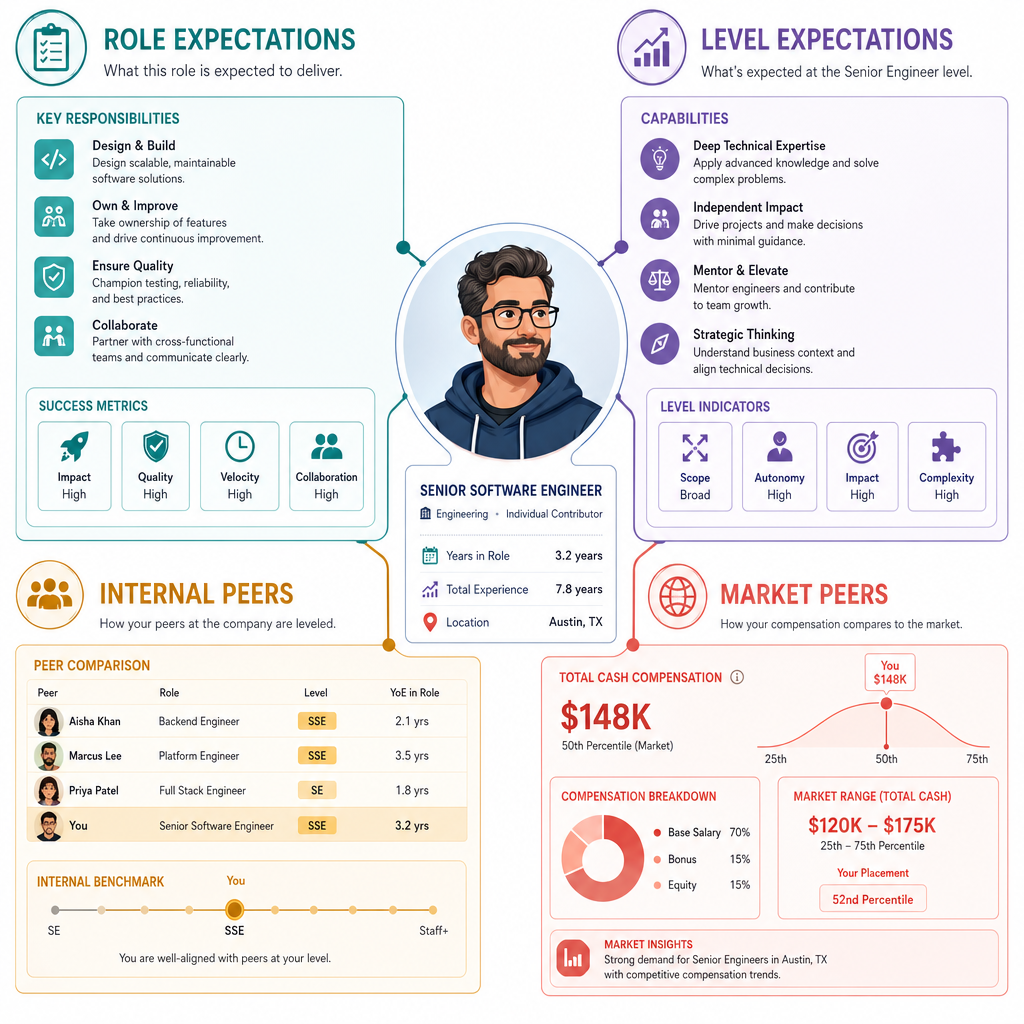
Performance is not judged against one invisible standard. Compare yourself across four benchmark types:
Benchmark What it answers Role expectations Am I meeting the written expectations for my current role? Level expectations Am I already operating at the next level? Internal peers How does my scope and impact compare with people paid similarly or promoted recently? Market peers How does my compensation compare with people doing similar work elsewhere?This builds on Researching Salary Ranges, but now you are pairing market data with performance data.
A practical rule: if your pay is below market and your performance is at or above expectations, your ask becomes much stronger.
Normalize The Comparison
Make unlike data comparable
Your evidence ledger may include latency, revenue, incidents, mentorship, architecture, recruiting, and leadership. Those are not naturally comparable.
So normalize them into a simple question:
Compared with relevant peers and expectations, is this impact below, at, or above the standard?
You do not need perfect math. You need a defensible pattern.
Use a light scoring model:
- 1 = below expectation
- 2 = meets expectation
- 3 = exceeds expectation
- 4 = strongly exceeds / next-level signal
Then weight the signals that matter most for your role. A staff-level backend engineer and a product-focused tech lead should not be scored identically.
```cpp
#include <iostream>
#include <vector>
#include <numeric>
#include <iomanip>

struct SignalScore {
    std::string signal;
    double score;   // 1 to 4
    double weight;  // importance to role
};

int main() {
    std::vector<SignalScore> scores = {
        {"System reliability", 4.0, 0.30},
        {"Cross-team leadership", 3.5, 0.25},
        {"Product impact", 3.0, 0.20},
        {"Mentorship", 3.5, 0.15},
        {"Execution consistency", 3.0, 0.10}
    };

    double weightedTotal = 0.0;
    double totalWeight = 0.0;

    for (const auto& s : scores) {
        weightedTotal += s.score * s.weight;
        totalWeight += s.weight;
    }

    double normalizedScore = weightedTotal / totalWeight;

    std::cout << std::fixed << std::setprecision(2);
    std::cout << "Normalized performance score: " << normalizedScore << " / 4.00\n";

    if (normalizedScore >= 3.5) {
        std::cout << "Pattern: strong next-level compensation signal\n";
    } else if (normalizedScore >= 3.0) {
        std::cout << "Pattern: exceeds current expectations\n";
    } else if (normalizedScore >= 2.0) {
        std::cout << "Pattern: meets expectations\n";
    } else {
        std::cout << "Pattern: address performance gaps before negotiating aggressively\n";
    }

    return 0;
}
```
Best Evidence
You are preparing to ask for a compensation adjustment. Which evidence is strongest?
Expectation Gaps
Interpret the gap honestly
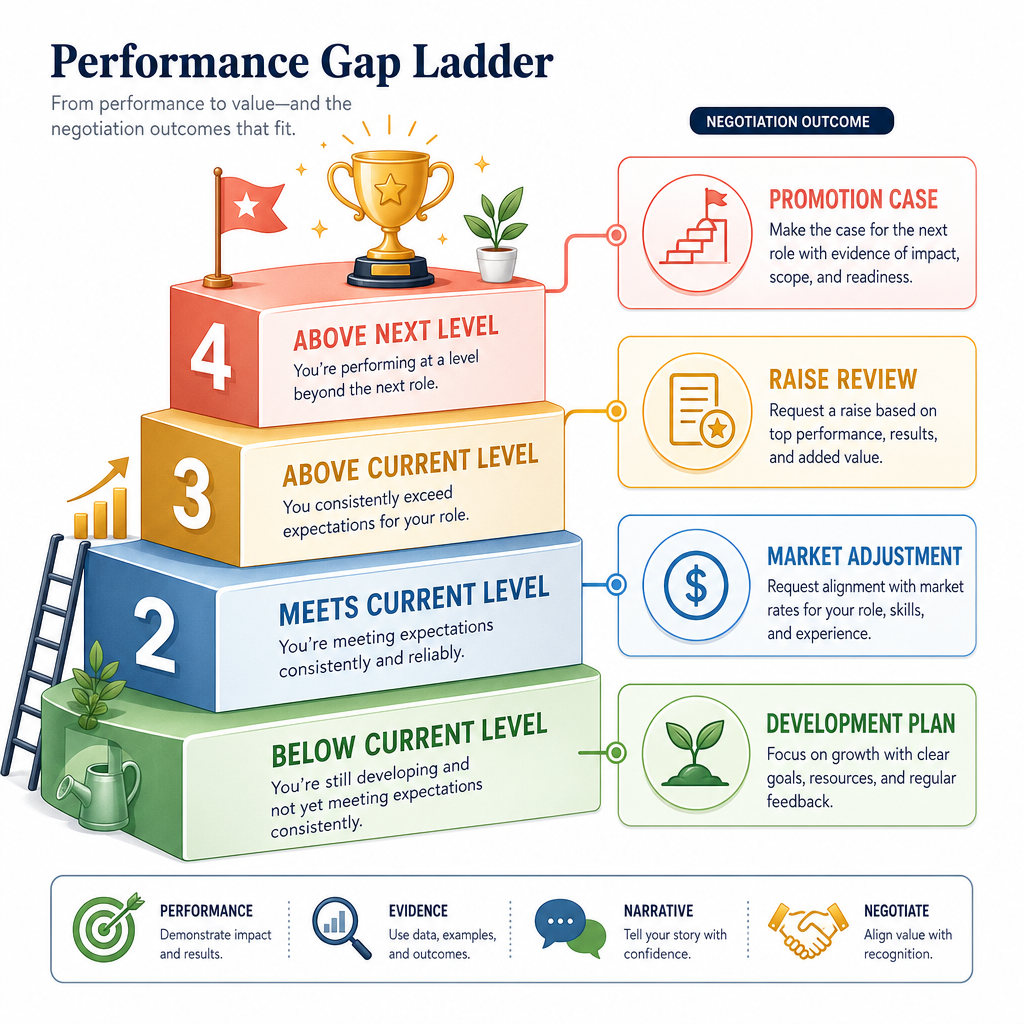
Once you compare performance with expectations, you will usually land in one of four zones:
                Performance vs. Expectations

Above next level     -> Promotion or major adjustment case
Above current level  -> Raise, title review, expanded scope case
Meets current level  -> Market adjustment or retention case
Below current level  -> Development plan before aggressive ask
This is where judgment matters. Do not turn every good outcome into a promotion case. A great negotiation is credible.
If the evidence shows you are meeting expectations but paid below the market range from Researching Salary Ranges, you may still have a strong market adjustment case. If the evidence shows next-level scope, you may have a promotion and compensation case.
Guaranteed Raise?
True or false: If your performance is above expectations, the employer is obligated to approve your requested raise.
Promotion Narrative
Convert data into a concise story
After you have the evidence, compress it into a manager-friendly narrative:
- Current scope: what you are responsible for now.
- Measured impact: the business or technical outcomes you created.
- Comparison: how that maps to level expectations or market benchmarks.
- Request: the compensation, title, or advancement path you want.
This is not a Stephen King novel; suspense is not your friend. Put the main point early, then support it with proof.
```cpp
#include <iostream>
#include <vector>
#include <string>
#include <algorithm>

struct ProofPoint {
    std::string statement;
    int strength; // 1 to 10
};

int main() {
    std::vector<ProofPoint> proof = {
        {"Reduced Sev-1 incidents by 42% through platform reliability work", 10},
        {"Led a migration adopted by three product teams", 9},
        {"Mentored five engineers and improved onboarding speed", 7},
        {"Consistently delivered roadmap commitments", 6}
    };

    std::sort(proof.begin(), proof.end(), [](const ProofPoint& a, const ProofPoint& b) {
        return a.strength > b.strength;
    });

    std::cout << "Compensation Narrative Draft\n";
    std::cout << "----------------------------\n";
    std::cout << "I would like to discuss aligning my compensation with the scope "
              << "and impact of my current role. The strongest signals are:\n";

    for (const auto& p : proof) {
        std::cout << "- " << p.statement << "\n";
    }

    std::cout << "\nRequest: review compensation against senior-level market benchmarks "
              << "and the next-level expectations I am already demonstrating.\n";

    return 0;
}
```
Market Word
Fill in the blank: To make performance data useful in negotiation, compare it against role expectations, level expectations, internal peers, and market ________.
Course Close
Your final negotiation loop
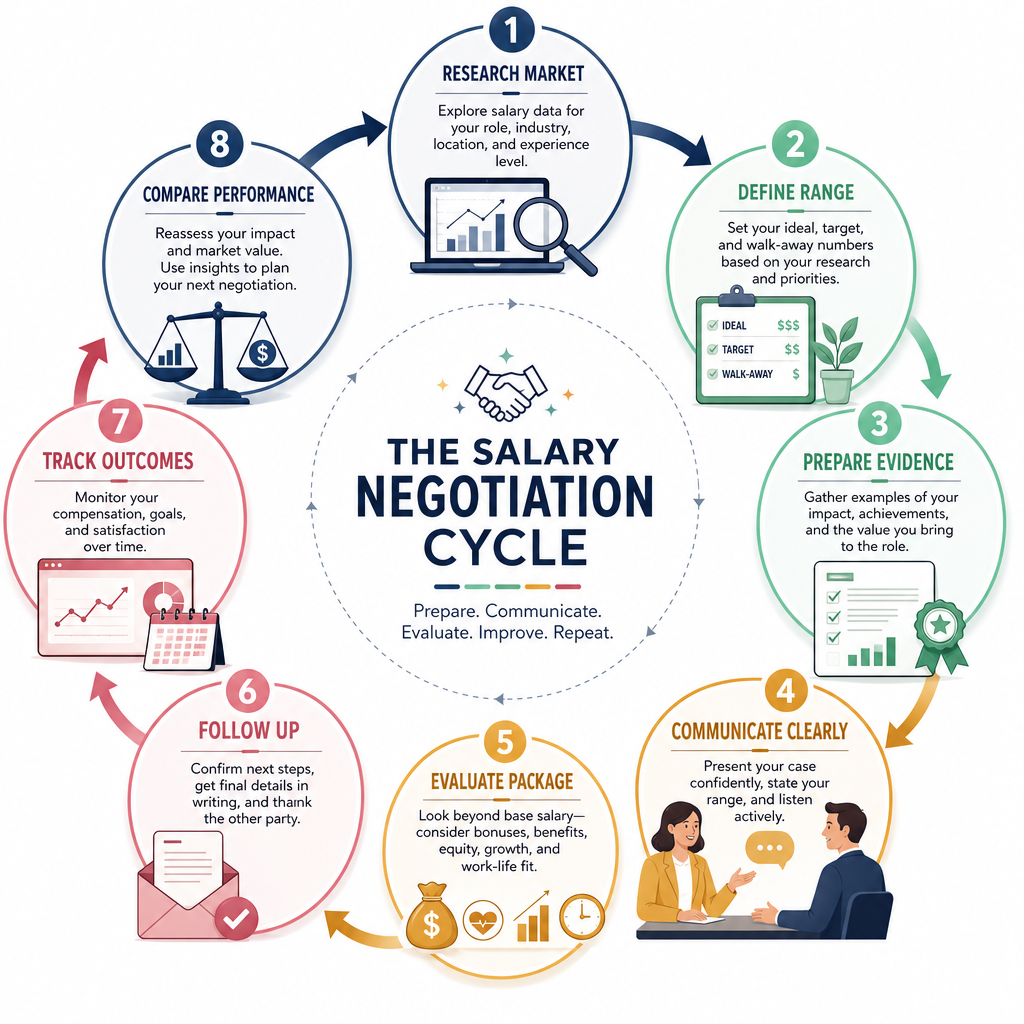
Salary negotiation is not a single dramatic conversation. It is a loop:
Research market -> Define your range -> Prepare evidence -> Communicate clearly
       ^                                                        |
       |                                                        v
Follow up <- Compare offer/package <- Evaluate performance <- Track outcomes
As you finish the course, keep one durable habit: maintain your evidence before you need it.
Update your ledger monthly or after major projects. Save impact metrics, stakeholder feedback, scope changes, and examples of leadership. Then, when a review cycle, offer, promotion conversation, international move, equity grant, or exit decision appears, you are not scrambling.
You are negotiating from preparation, not pressure.