Creating a Practice Demo
Read at your own pace. Code execution, quizzes, progress tracking, and the AI tutor are available in the interactive view with JavaScript enabled.
Demo Time
Your demo is your voiceover handshake
Now that you've covered Discovering Your Money Voice, Marketing and Branding Yourself, Building Your Voiceover Studio, Recording Skills and Studio Etiquette, and Audio Editing Techniques, you're ready to combine everything into a short, focused practice demo.
Think of it like a tight R&B or hip hop sampler: not your whole catalog, just the best 60-90 seconds that prove, “I can deliver this sound on purpose.”
In this lesson, you'll build a practice demo that helps you:
- Hear your strongest lanes clearly
- Practice switching reads with control
- Create material for coaching feedback
- Prepare for the next step: looking for real opportunities
A practice demo is not about pretending to be a polished agency talent overnight. It's about creating a repeatable snapshot of your current best work.

Demo Anatomy
What belongs in a practice demo?
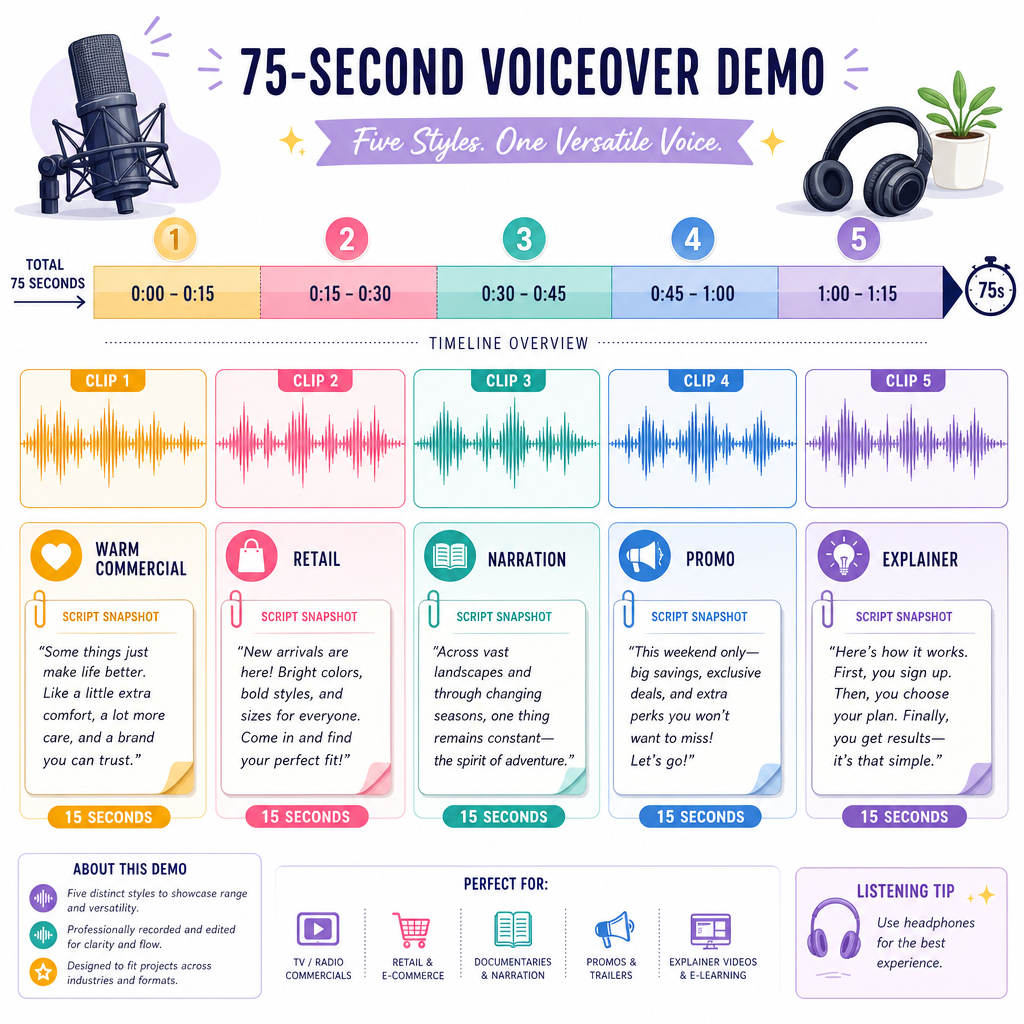
A practice demo is a curated reel of short voiceover moments. Each clip should show a specific marketable quality, not just “I can read words.”
A strong beginner practice demo usually has:
- 3-5 short spots
- 8-15 seconds per spot
- One clear lane per spot
- Clean audio using the editing habits from Audio Editing Techniques
- No long intro — your voice starts quickly
A simple structure
[Clip 1]   warm commercial
[Clip 2]   upbeat retail
[Clip 3]   calm narration
[Clip 4]   confident promo
[Clip 5]   friendly explainer
The listener should understand your sound before they have time to get bored.
Best Demo Goal
For your first practice demo, which goal is strongest?
Pick Your Spots
Choose scripts like a producer
Before recording, pick spots that match evidence you've already gathered from your Money Voice and brand work.
For each possible script, ask:
- Does it fit my natural strengths?
- Does it support my brand promise?
- Can I perform it believably?
- Does it contrast with the other spots?
You want variety, but not chaos. If your sound is melodic, warm, and conversational, you might include a smooth lifestyle ad, a calm explainer, and an upbeat product read — not ten unrelated voices fighting for attention.
Here's a tiny JavaScript scoring model to help you think like a demo curator.
```javascript
const possibleSpots = [
  { title: "Smooth Coffee Ad", fit: 9, contrast: 7, believability: 9 },
  { title: "Extreme Monster Truck Promo", fit: 3, contrast: 8, believability: 4 },
  { title: "Melodic App Explainer", fit: 8, contrast: 6, believability: 9 },
  { title: "Luxury Skincare", fit: 7, contrast: 7, believability: 8 },
  { title: "Cartoon Villain", fit: 4, contrast: 9, believability: 5 }
];

const ranked = possibleSpots
  .map(spot => ({
    ...spot,
    score: spot.fit * 0.45 + spot.believability * 0.40 + spot.contrast * 0.15
  }))
  .sort((a, b) => b.score - a.score);

console.log("Practice demo candidates:");
ranked.forEach((spot, index) => {
  console.log(`${index + 1}. ${spot.title} — score ${spot.score.toFixed(1)}`);
});
```
Include Everything?
True or false: A strong practice demo should include every accent, character, narration style, and commercial read you can possibly perform.
Build The Arc
Sequence matters
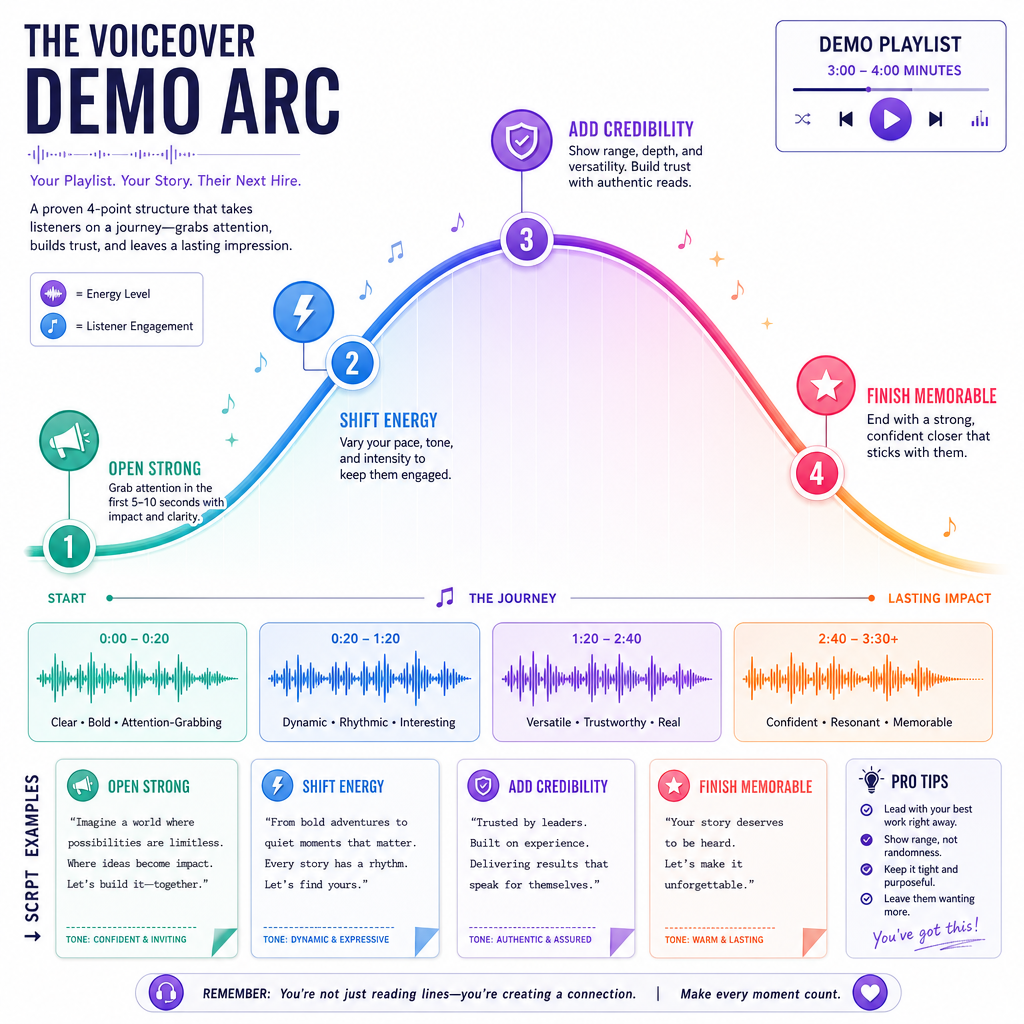
Your demo should feel intentional from the first second. Put your strongest, clearest clip first. Then create contrast without making the reel feel random.
A useful arc:
- Open strong — your most bookable sound
- Shift energy — show range in pace or attitude
- Add credibility — narration, explainer, or grounded read
- Finish memorable — confident, warm, or emotionally clear
Avoid flat sameness
If every spot has the exact same pace, pitch, and smile, the listener learns less about you. If every spot is wildly different, they may not know what they would hire you for.
The goal is controlled contrast: like a good playlist where each track belongs, but no two tracks do the same job.
One Clear Blank
A focused practice demo should prove one clear voiceover ______ at a time.
Time The Reel
Keep it tight
For a practice demo, shorter is usually stronger. You are training yourself to make choices.
A good target:
- Total length: 60-90 seconds
- Clip length: 8-15 seconds
- Silence between clips: very short or none
- Opening: voice begins almost immediately
Use the edit discipline from Audio Editing Techniques: clean cuts, controlled breaths, consistent loudness, and a final quality-control pass.
This code checks whether a proposed demo is in a practical beginner range.
```javascript
const demoClips = [
  { name: "Coffee Ad", seconds: 12 },
  { name: "Retail Sale", seconds: 10 },
  { name: "App Explainer", seconds: 14 },
  { name: "Wellness Narration", seconds: 13 },
  { name: "Brand Promo", seconds: 11 }
];

const totalSeconds = demoClips.reduce((sum, clip) => sum + clip.seconds, 0);
const inRange = totalSeconds >= 60 && totalSeconds <= 90;

console.log(`Total demo length: ${totalSeconds} seconds`);
console.log(inRange ? "Good practice-demo range." : "Adjust the length before exporting.");

console.log("Clip check:");
demoClips.forEach(clip => {
  const ok = clip.seconds >= 8 && clip.seconds <= 15;
  console.log(`${clip.name}: ${clip.seconds}s — ${ok ? "tight" : "revise"}`);
});
```
Review Like Talent
Score the demo before sharing it
Before asking for feedback, do one honest self-review. Don't judge your whole future as a voice actor. Just evaluate the reel in front of you.
Use a 1-5 scale for:
- Performance: believable, specific, connected
- Clarity: easy to understand without strain
- Audio quality: clean, even, not distracting
- Variety: enough contrast to show range
- Brand fit: matches the sound you want to market
If one category is weak, revise that part instead of re-recording everything. Professional habits are built through targeted fixes.
```javascript
const scores = {
  performance: 4,
  clarity: 5,
  audioQuality: 4,
  variety: 3,
  brandFit: 5
};

const entries = Object.entries(scores);
const average = entries.reduce((sum, [, score]) => sum + score, 0) / entries.length;
const weakest = entries.sort((a, b) => a[1] - b[1])[0];

console.log(`Average score: ${average.toFixed(1)} / 5`);
console.log(`Focus your next revision on: ${weakest[0]} (${weakest[1]}/5)`);

if (average >= 4) {
  console.log("Ready to ask for targeted feedback.");
} else {
  console.log("Revise before sharing widely.");
}
```
Your Demo Sprint
Your practice assignment
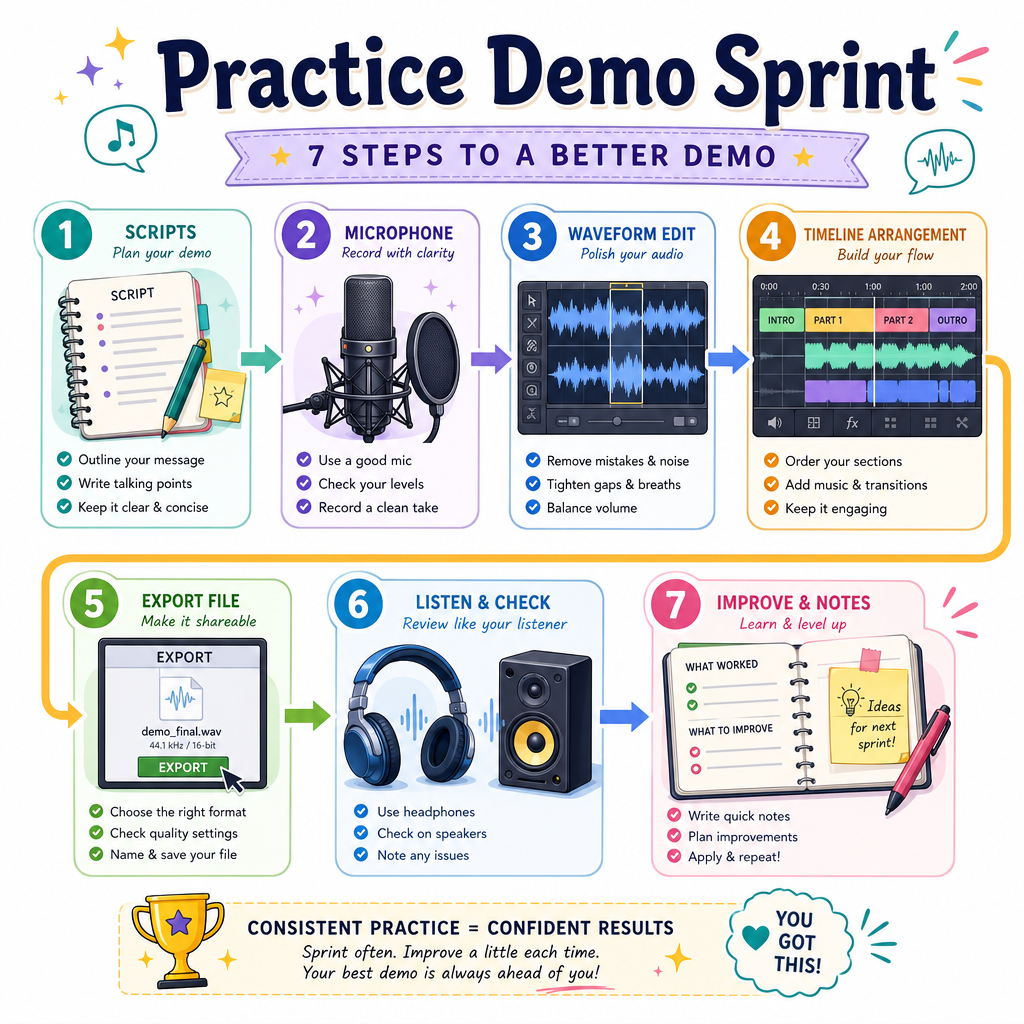
Create one practice demo this week. Keep it simple, clean, and finished.
Step-by-step
- Pick 3-5 short scripts that fit your strongest lane
- Record each one using your session habits from Recording Skills and Studio Etiquette
- Edit for clean starts, clean endings, and consistent loudness
- Arrange the clips into a 60-90 second reel
- Export one file with a clear name, like
FirstName_CommercialPracticeDemo.mp3 - Listen once on headphones and once on speakers
- Write down one thing to keep and one thing to improve
Your goal is not perfection. Your goal is a finished practice asset that teaches you what your voice is already doing well.
Next, you'll learn how to use stronger samples and a clearer brand presence when exploring places to find voiceover jobs.