Dynamic Programming
Read at your own pace. Code execution, quizzes, progress tracking, and the AI tutor are available in the interactive view with JavaScript enabled.
From Order To Reuse
Welcome to Dynamic Programming
Now that we've covered Sorting and Searching Algorithms, you know how structure and order can make a problem faster. Dynamic Programming, or DP, adds a new idea: when a program keeps solving the same smaller questions, store the answers and reuse them.
In programming terms, DP is not magic. It is a disciplined way to combine:
- the decomposition mindset from Algorithmic Thinking
- the memory choices from Data Structures
- the invariants and contracts from Sorting and Searching Algorithms
By the end of this lesson, you should be able to recognize when a problem has repeated subproblems, define a useful DP state, and implement either a memoized or tabulated C# solution.

The DP Signal
When DP Fits
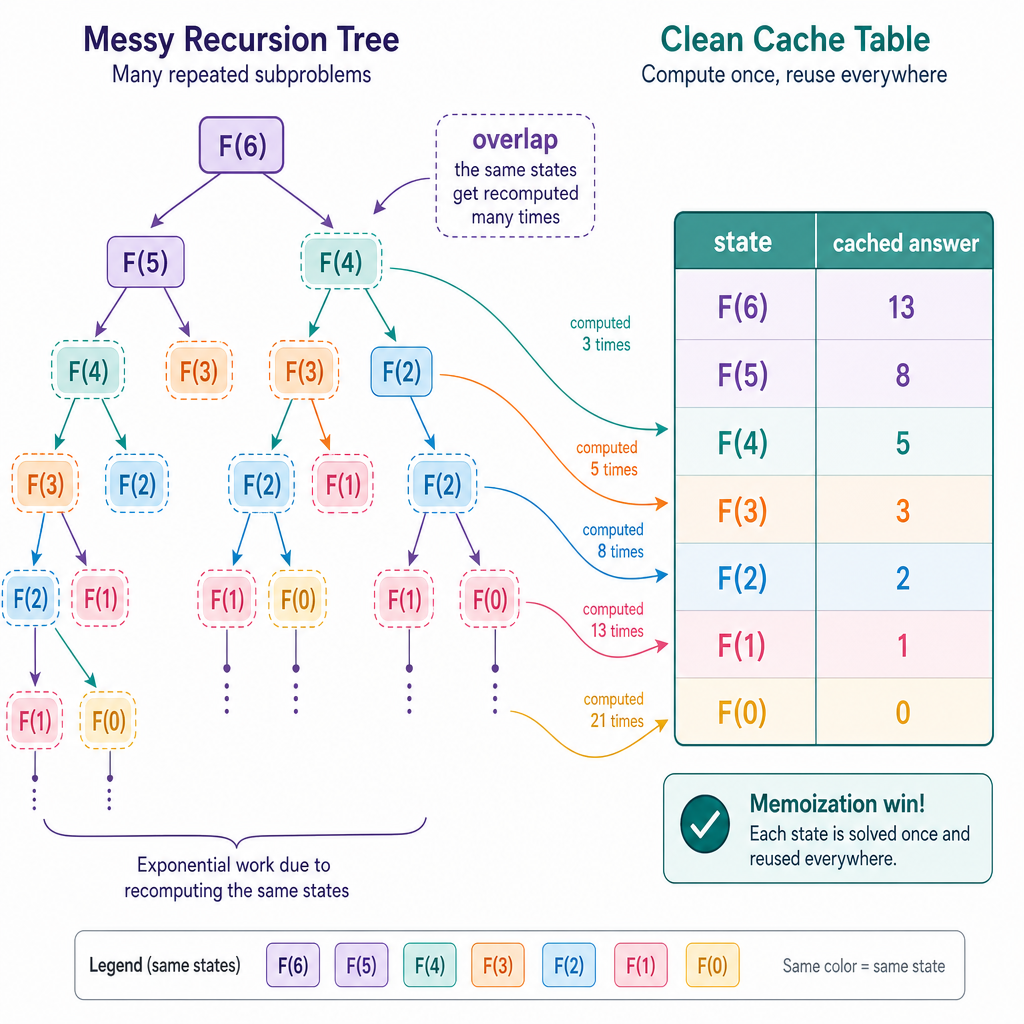
A problem is a good DP candidate when it has two signals:
1. Overlapping subproblems
The same smaller question appears again and again.
Example shape:
Solve(5)
├─ Solve(4)
│  ├─ Solve(3)
│  └─ Solve(2)
└─ Solve(3)   <- repeated
2. Optimal substructure
The answer to the big problem can be built from correct answers to smaller problems.
For example, if Best(n) depends on Best(n - 1) and Best(n - 2), then once those smaller answers are known, the larger answer follows.
DP is the moment where your algorithm says: I should not recompute what I already know.
Spot The Candidate
Which task most strongly suggests a Dynamic Programming approach?
Top Down Memoization
Recursive Thinking + Memory
A top-down DP solution starts with a natural recursive definition, then adds a cache.
This style is called memoization:
- Ask the big question.
- Recursively ask smaller questions.
- Before solving, check whether the answer is already cached.
- Store new answers before returning them.
Here is Fibonacci as a compact example. The point is not Fibonacci itself; it is the pattern of avoiding repeated work.
```csharp
using System;
using System.Collections.Generic;

public class Program
{
    static Dictionary<int, long> memo = new Dictionary<int, long>();

    static long Fib(int n)
    {
        if (n <= 1) return n;

        if (memo.ContainsKey(n))
        {
            return memo[n];
        }

        long answer = Fib(n - 1) + Fib(n - 2);
        memo[n] = answer;
        return answer;
    }

    public static void Main()
    {
        int n = 10;
        Console.WriteLine($"Fib({n}) = {Fib(n)}");
        Console.WriteLine($"Cached states: {memo.Count}");
    }
}
```
Name The Cache
Fill in the blank:
Top-down Dynamic Programming that stores recursive results in a cache is called ______.
Bottom Up Tabulation
Build From Small To Large
A bottom-up DP solution avoids recursion. Instead, it fills a table in an order where every needed smaller answer is already available.
For the stair problem:
-
ways[0] = 1: one way to stay at the ground -
ways[1] = 1: one way to reach step 1 ways[i] = ways[i - 1] + ways[i - 2]
This is the same relationship as the recursive version, but expressed as a loop.
```csharp
using System;

public class Program
{
    static int CountWays(int n)
    {
        if (n < 0) return 0;

        int[] ways = new int[n + 1];
        ways[0] = 1;

        if (n >= 1)
        {
            ways[1] = 1;
        }

        for (int i = 2; i <= n; i++)
        {
            ways[i] = ways[i - 1] + ways[i - 2];
        }

        return ways[n];
    }

    public static void Main()
    {
        for (int steps = 0; steps <= 6; steps++)
        {
            Console.WriteLine($"Ways to climb {steps} steps: {CountWays(steps)}");
        }
    }
}
```
True Or False
Dynamic Programming always requires recursion.
State And Transition
The Core Design Move
Most DP solutions become clearer when you name two things:
State
What does one table entry mean?
Example: dp[amount] means the fewest coins needed to make this amount.
Transition
How do smaller states build the current state?
If we try each coin, then:
dp[amount] = min(dp[amount], dp[amount - coin] + 1)
That sentence is your algorithmic invariant: after processing choices, dp[amount] should hold the best known answer for that amount.
```csharp
using System;

public class Program
{
    static int MinCoins(int[] coins, int target)
    {
        int impossible = target + 1;
        int[] dp = new int[target + 1];

        for (int amount = 1; amount <= target; amount++)
        {
            dp[amount] = impossible;
        }

        dp[0] = 0;

        for (int amount = 1; amount <= target; amount++)
        {
            foreach (int coin in coins)
            {
                if (coin <= amount)
                {
                    dp[amount] = Math.Min(dp[amount], dp[amount - coin] + 1);
                }
            }
        }

        return dp[target] == impossible ? -1 : dp[target];
    }

    public static void Main()
    {
        int[] coins = { 1, 3, 4 };
        int target = 6;
        Console.WriteLine($"Minimum coins for {target}: {MinCoins(coins, target)}");
    }
}
```
Complexity Check
For the coin example with target amount T and C coin types, what is the time complexity of the shown bottom-up solution?
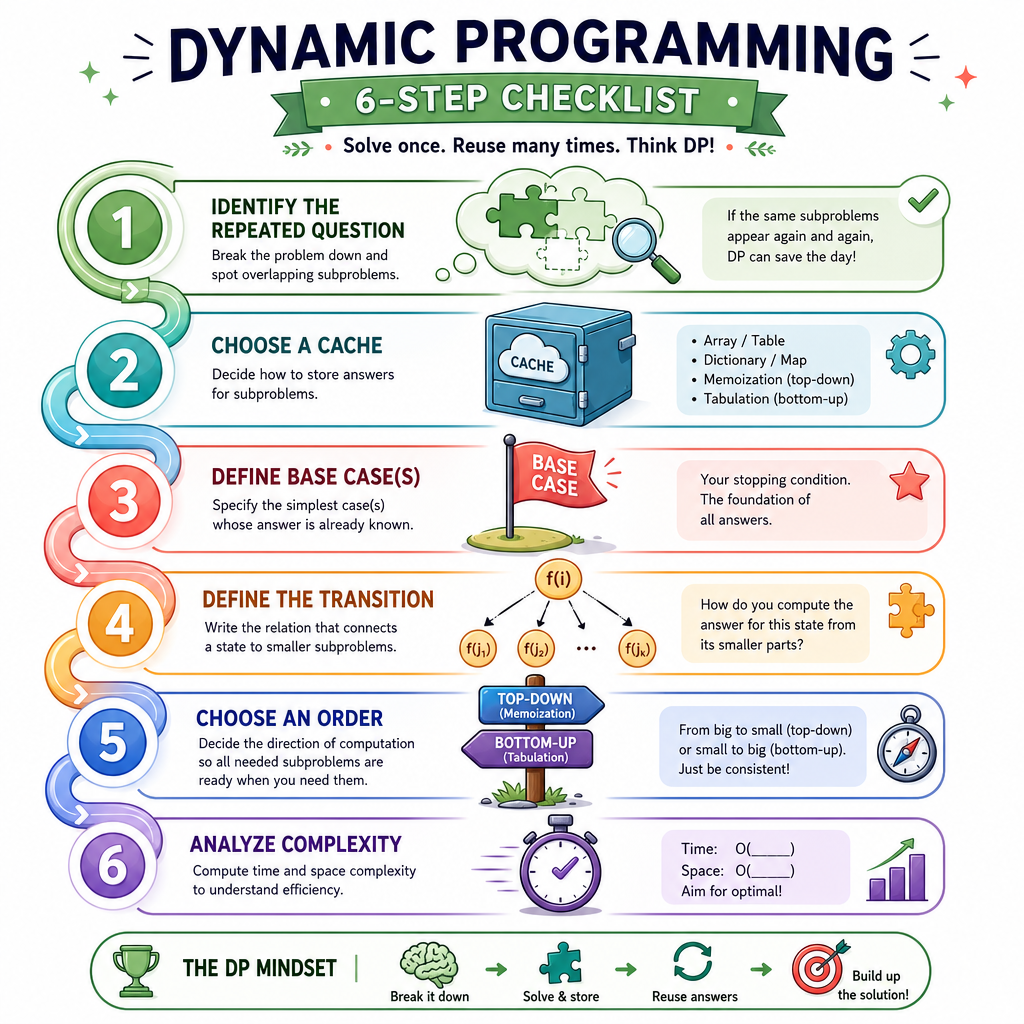
DP Design Checklist
Your DP Checklist
When you suspect a problem needs Dynamic Programming, use this sequence:
- Find the repeated question. What subproblem appears many times?
-
Define the state. What does
dp[i],dp[i][j], or a memo key represent? - Choose base cases. What answers are already known?
- Write the transition. How do smaller states produce a larger one?
- Pick direction. Top-down memoization or bottom-up tabulation?
- Check complexity. How many states exist, and how much work happens per state?
This lesson connects directly to the OODSA habit you've been building: model the problem, choose the right structure, and protect the algorithm with a clear invariant.
Next, we'll move from table-shaped dependencies to relationship-shaped problems in Graph Algorithms.