Dynamic Programming
Read at your own pace. Code execution, quizzes, progress tracking, and the AI tutor are available in the interactive view with JavaScript enabled.
Why DP Now
Why Dynamic Programming Matters
Now that you've finished Recursion and Backtracking, you know how to break a problem into smaller decisions and let the call stack explore them.
Dynamic Programming, usually called DP, is the next upgrade: it teaches you how to avoid solving the same smaller problem again and again.
In interviews, DP often appears when a problem asks for:
- the number of ways to do something
- the best/minimum/maximum result
- whether something is possible
- a sequence decision where today's answer depends on earlier answers
The big idea is simple:
If recursion repeats work, store the result and reuse it.
We'll use Java arrays and recursion concepts you already know, then turn them into efficient interview-ready solutions.

DP Mental Model
The DP Mental Model
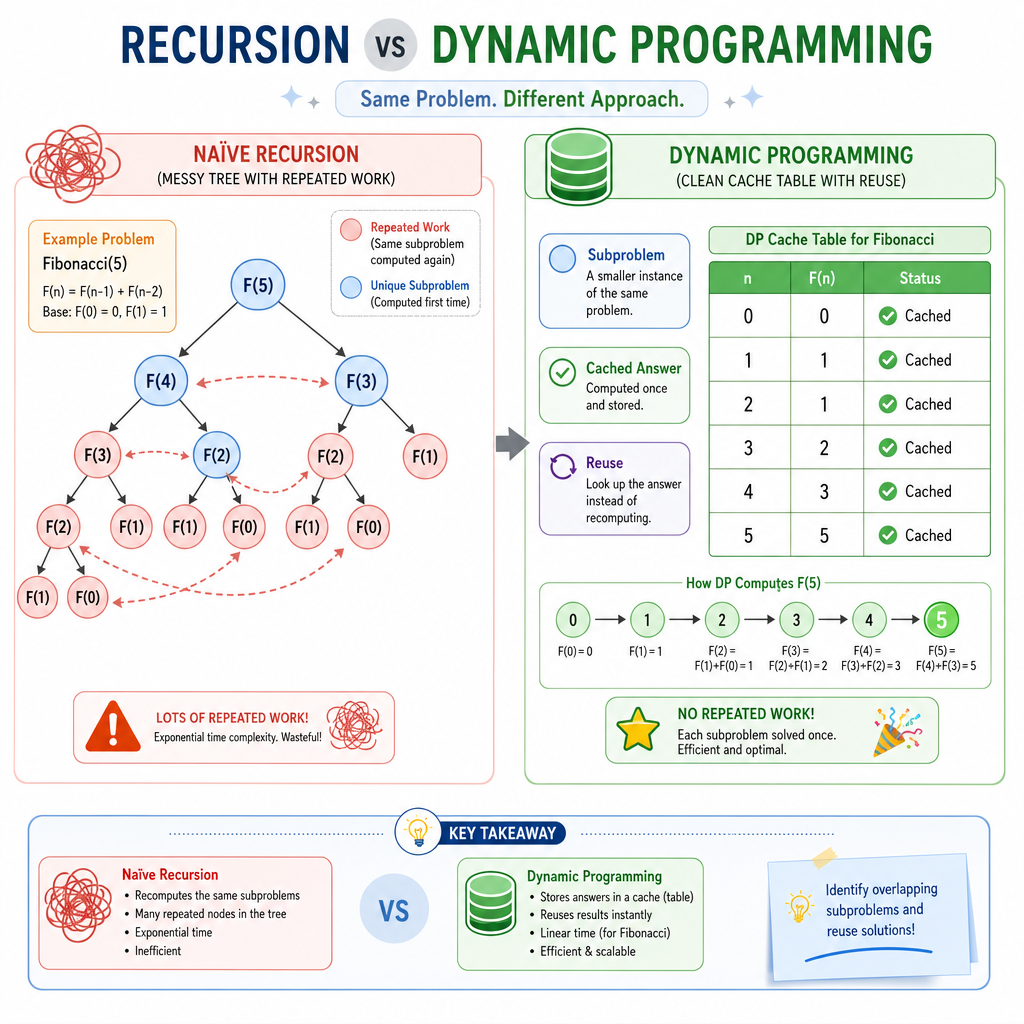
Imagine you're solving fib(5) recursively:
fib(5)
├── fib(4)
│   ├── fib(3)
│   └── fib(2)
└── fib(3)
    ├── fib(2)
    └── fib(1)
Notice the repeated calls: fib(3) and fib(2) appear more than once.
DP is useful when a problem has two properties:
1. Overlapping Subproblems
The same smaller questions appear repeatedly.
Example: fib(3) is needed from multiple paths.
2. Optimal Substructure
The answer to the full problem can be built from answers to smaller problems.
Example: fib(n) = fib(n - 1) + fib(n - 2).
So DP is not a new data structure. It is a problem-solving strategy: define smaller states, solve them once, and reuse them.
Spot DP Problems
Quick Check
Which problem statement most strongly suggests a Dynamic Programming approach?
Top Down Memoization
Top-Down DP: Recursion + Memory
Because you just learned recursion, the most natural DP style is top-down memoization.
The process:
- Write the recursive solution.
- Create a cache, often an array or map.
- Before solving a subproblem, check if it is already cached.
- Store the answer before returning.
For Fibonacci, the state is just n: the answer to the question, "What is the nth Fibonacci number?"
Without memoization, recursion repeats many calls. With memoization, each n is computed once.
```java
import java.util.Arrays;

public class Main {
    static int calls = 0;

    public static int fib(int n, int[] memo) {
        calls++;

        if (n <= 1) return n;

        if (memo[n] != -1) {
            return memo[n];
        }

        memo[n] = fib(n - 1, memo) + fib(n - 2, memo);
        return memo[n];
    }

    public static void main(String[] args) {
        int n = 10;
        int[] memo = new int[n + 1];
        Arrays.fill(memo, -1);

        int answer = fib(n, memo);
        System.out.println("fib(" + n + ") = " + answer);
        System.out.println("recursive calls = " + calls);
        System.out.println("memo = " + Arrays.toString(memo));
    }
}
```
Memoization Check
True or False
Memoization improves a recursive solution by storing answers to subproblems so repeated calls can return immediately.
Bottom Up Tabulation
Bottom-Up DP: Build the Table
The other main DP style is bottom-up tabulation.
Instead of starting from the big problem and recursing downward, you start from the smallest known answers and build upward.
Classic example: climbing stairs.
If you can climb 1 or 2 steps at a time, then to reach step i, your previous move came from:
- step
i - 1, or - step
i - 2
So:
dp[i] = dp[i - 1] + dp[i - 2]
Here dp[i] means: number of ways to reach step i.
```java
import java.util.Arrays;

public class Main {
    public static int climbStairs(int n) {
        if (n <= 1) return 1;

        int[] dp = new int[n + 1];
        dp[0] = 1;
        dp[1] = 1;

        for (int i = 2; i <= n; i++) {
            dp[i] = dp[i - 1] + dp[i - 2];
        }

        System.out.println("dp table: " + Arrays.toString(dp));
        return dp[n];
    }

    public static void main(String[] args) {
        int n = 5;
        System.out.println("ways to climb " + n + " steps = " + climbStairs(n));
    }
}
```
Complete Recurrence
Fill in the Blank
For climbing stairs where you may climb 1 or 2 steps at a time:
dp[i] = __________
Use the standard recurrence.
Designing DP State
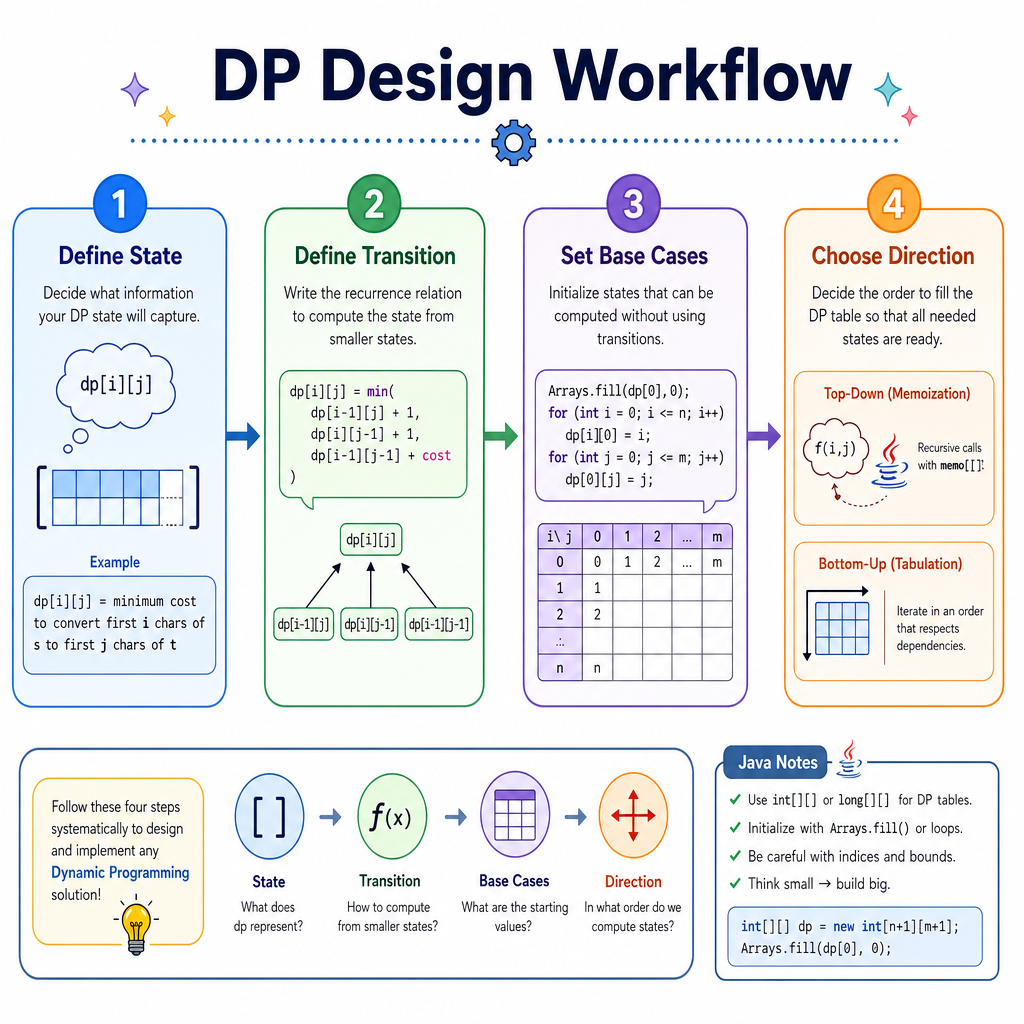
How to Design a DP Solution
Most DP confusion comes from not knowing what to store.
Use this interview workflow:
1. Define the state
Ask: What smaller question am I answering?
Examples:
-
dp[i]= best answer using the firstiitems -
dp[i]= number of ways to reach positioni -
dp[i][j]= answer for prefixes ending atiandj
2. Define the transition
Ask: How does this state use smaller states?
Example:
dp[i] = min(dp[i - 1], dp[i - 2]) + cost[i]
3. Define base cases
Ask: What answers are already known?
Example: dp[0], dp[1].
4. Choose direction
Use top-down if recursion feels natural. Use bottom-up if the order is clear and you want tight control over memory.
Minimum Cost Example
Example: Minimum Cost Climbing Stairs
Let's solve a common interview-style DP problem.
You are given an array cost, where cost[i] is the cost of stepping on stair i. You can climb 1 or 2 steps at a time. Find the minimum cost to reach the top.
State:
dp[i] = minimum cost to stand on stair i
Transition:
dp[i] = cost[i] + min(dp[i - 1], dp[i - 2])
The top is just beyond the last stair, so the final answer is:
min(dp[n - 1], dp[n - 2])
```java
import java.util.Arrays;

public class Main {
    public static int minCostClimbingStairs(int[] cost) {
        int n = cost.length;
        int[] dp = new int[n];

        dp[0] = cost[0];
        dp[1] = cost[1];

        for (int i = 2; i < n; i++) {
            dp[i] = cost[i] + Math.min(dp[i - 1], dp[i - 2]);
        }

        System.out.println("cost: " + Arrays.toString(cost));
        System.out.println("dp:   " + Arrays.toString(dp));

        return Math.min(dp[n - 1], dp[n - 2]);
    }

    public static void main(String[] args) {
        int[] cost = {10, 15, 20};
        int answer = minCostClimbingStairs(cost);
        System.out.println("minimum cost = " + answer);
    }
}
```
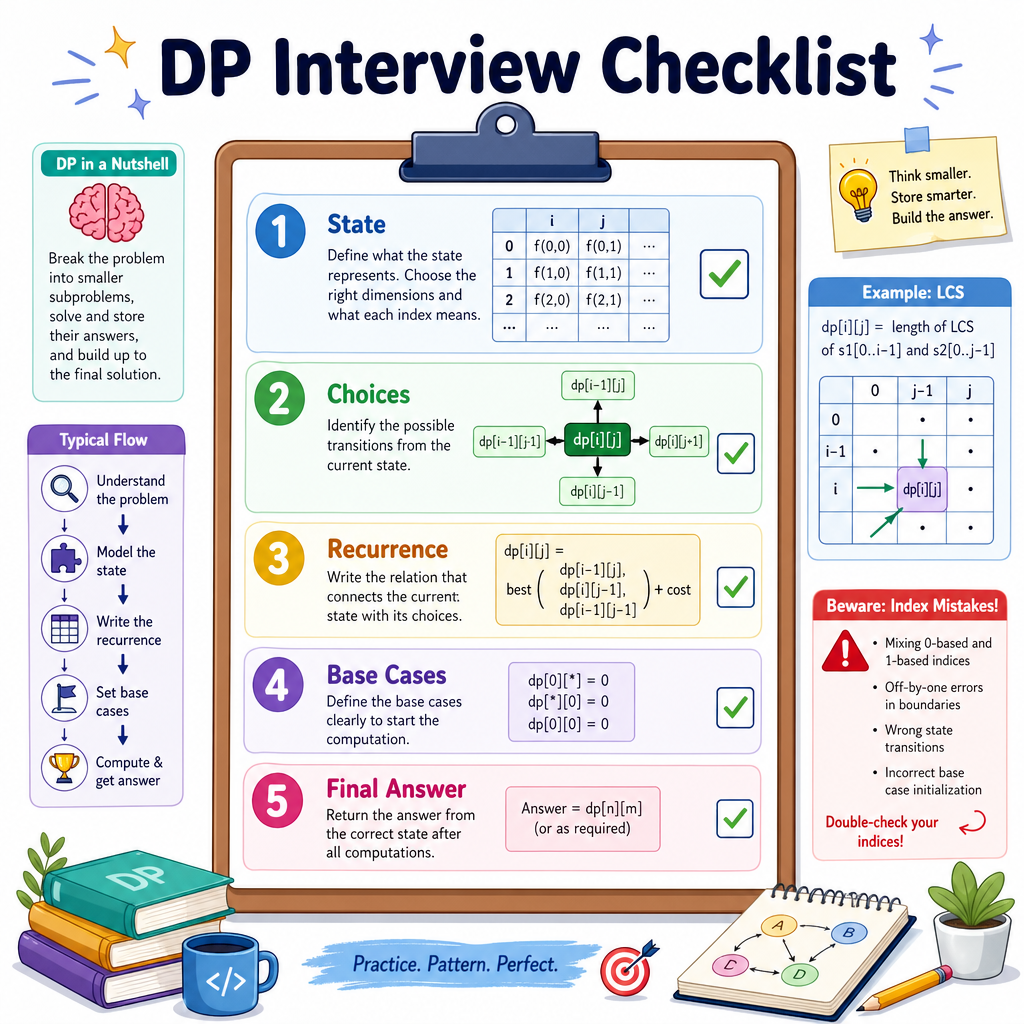
DP Interview Checklist
Your DP Checklist
When a DP problem appears in an interview, slow down and follow the pattern.
Ask these questions
What is the state?
What doesdp[i]ordp[i][j]mean?What are the choices?
From which previous states can I arrive here?What is the recurrence?
How do I combine smaller answers?What are the base cases?
Which answers are known without computation?What is the final answer?
Is itdp[n],dp[n - 1], a max over the table, or something else?
Common beginner mistakes
- Starting code before defining the state
- Forgetting base cases
- Mixing up indexes like
ivsi - 1 - Returning the wrong cell from the DP table
- Using DP when there are no repeated subproblems
Next, you'll study Greedy Algorithms, where the mindset changes: instead of storing many subproblem answers, you make the best local choice when that is safe.