Dynamic Programming Essentials
Read at your own pace. Code execution, quizzes, progress tracking, and the AI tutor are available in the interactive view with JavaScript enabled.
Why DP Now
Dynamic Programming is recursion with a memory
Now that you've covered Mastering Recursion and Divide and Conquer Strategies, you're ready for the next upgrade: solving repeated subproblems only once.
In recursion, we often ask: “What is the answer for a smaller version of this problem?”
In dynamic programming, we add: “Have I already solved that smaller version?”
DP matters in interviews because many easy/medium problems hide the same pattern:
- Count the number of ways
- Find the best/min/max value
- Decide whether something is possible
- Build an answer from earlier answers
Today’s goal: learn the core DP workflow, not memorize 50 formulas.

DP Mental Model
The core idea
Dynamic programming is useful when a problem has:
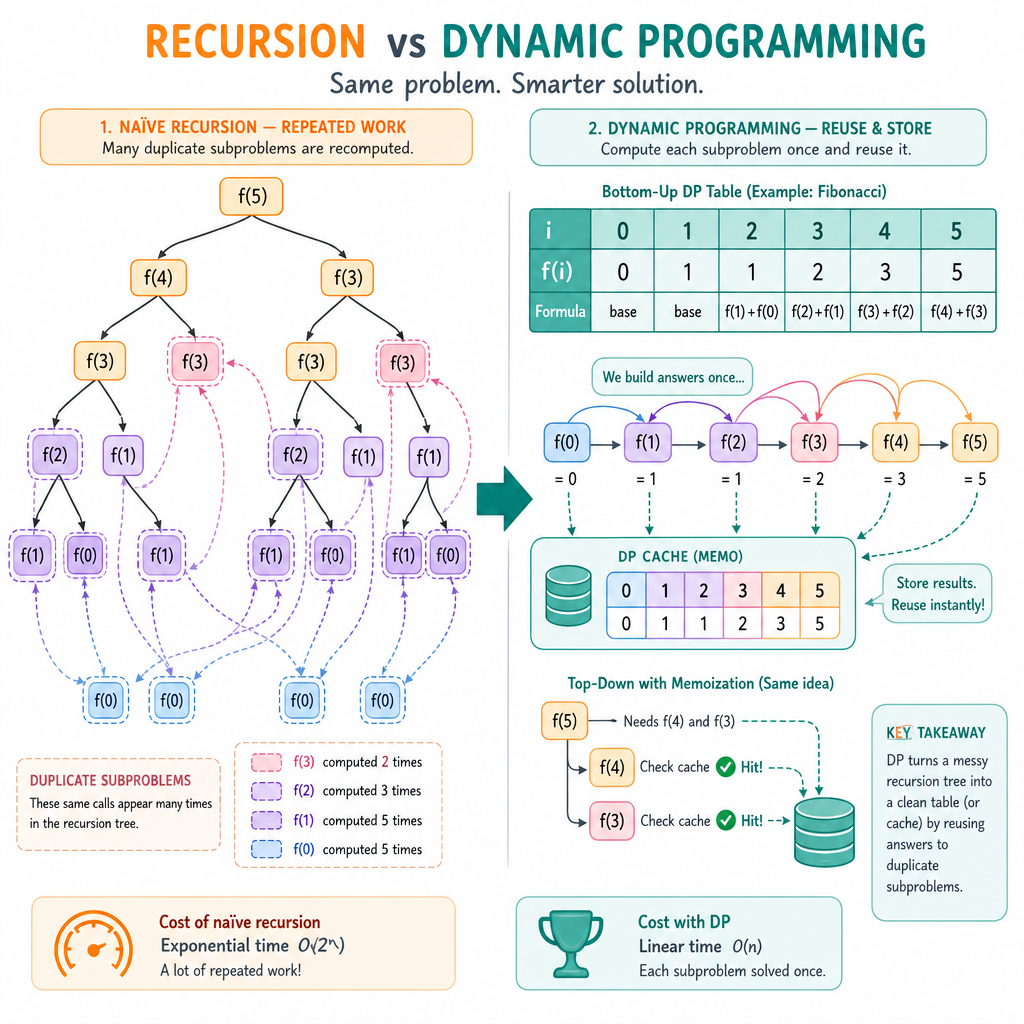
1. Overlapping subproblems
The same smaller questions appear again and again.
Example: fib(5) needs fib(4) and fib(3). But fib(4) also needs fib(3).
fib(5)
├── fib(4)
│   ├── fib(3)
│   └── fib(2)
└── fib(3)   <- repeated
2. Optimal substructure
The answer can be built from correct answers to smaller subproblems.
For example, if the best answer for step i depends on the best answers for earlier steps, DP may fit.
A simple DP question to ask yourself:
“If I knew the answer for smaller positions, could I compute the answer for this position?”
Spot DP Signals
Which problem description is the strongest signal that dynamic programming might help?
Memoization First
Top-down DP
The beginner-friendly way to enter DP is memoization:
- Write the recursive solution.
- Store answers in a dictionary.
- Before solving a subproblem, check whether it is already stored.
This is called top-down because you start from the big question and recursively ask smaller questions.
For Fibonacci, the recurrence is:
fib(n) = fib(n - 1) + fib(n - 2)
Without memory, recursion repeats work. With memory, each n is solved once.
```python
# Top-down dynamic programming: memoized Fibonacci

def fib(n, memo=None):
    if memo is None:
        memo = {}

    if n in memo:
        return memo[n]

    if n <= 1:
        return n

    memo[n] = fib(n - 1, memo) + fib(n - 2, memo)
    return memo[n]

for i in range(8):
    print(i, fib(i))
```
Memoization Check
True or false: memoization can turn some recursive solutions from exponential time into much faster solutions by avoiding repeated subproblems.
Define The State
The most important DP skill
Before coding, define the state.
A state is a precise meaning for one DP entry.
Examples:
-
dp[i]= number of ways to reach stepi -
dp[i]= minimum cost to reach stepi -
dp[i]= best score considering houses up to indexi
Then define the transition:
How do earlier states create the current state?
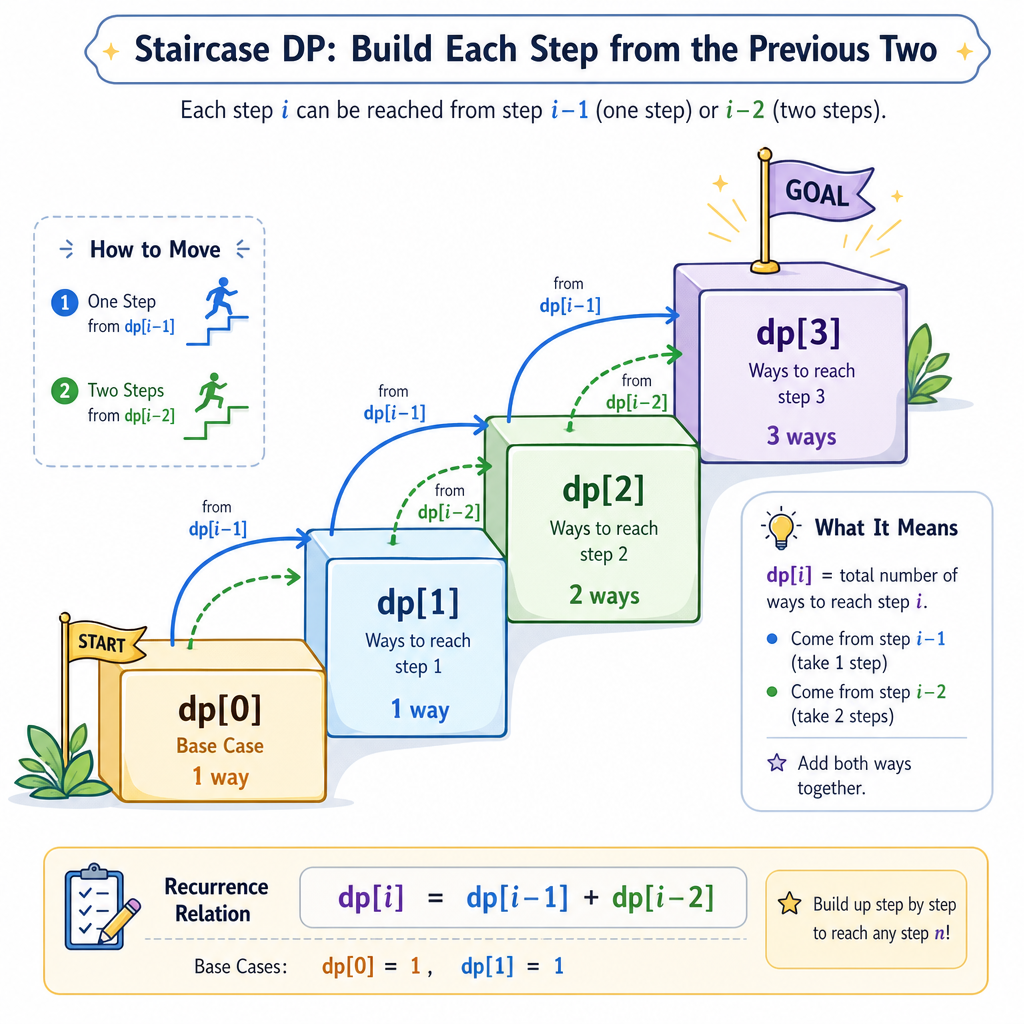
For climbing stairs where you can move 1 or 2 steps:
dp[i] = dp[i - 1] + dp[i - 2]
Why? Every path to step i must come from either step i - 1 or step i - 2.
This is where your recursion training pays off: the recurrence is the same idea, but now we store results deliberately.
Fill Recurrence
In the climbing stairs problem, if each move can be 1 or 2 steps, complete the recurrence:
ways(i) = ____
Tabulation Pattern
Bottom-up DP
Tabulation solves smaller states first, usually in a loop.
This is called bottom-up because you build from base cases toward the final answer.
Use tabulation when:
- The order of states is clear
- You want to avoid recursion depth issues
- The recurrence naturally moves left to right
Example problem: minimum cost climbing stairs.
You can start at step 0 or step 1. Each time, climb 1 or 2 steps. Pay the cost of the step you land on. Find the minimum cost to reach the top.
```python
# Bottom-up dynamic programming: minimum cost climbing stairs

def min_cost_climbing_stairs(cost):
    n = len(cost)
    dp = [0] * (n + 1)

    # dp[i] = minimum cost to reach position i
    # Position n means the top, beyond the last step.
    for i in range(2, n + 1):
        one_step = dp[i - 1] + cost[i - 1]
        two_steps = dp[i - 2] + cost[i - 2]
        dp[i] = min(one_step, two_steps)

    print("dp table:", dp)
    return dp[n]

print(min_cost_climbing_stairs([10, 15, 20]))
print(min_cost_climbing_stairs([1, 100, 1, 1, 1, 100, 1, 1, 100, 1]))
```
Save Space
Do you need the whole table?
Often, a DP recurrence only depends on the last one or two states.
If so, you can compress space:
Full table:  dp[0], dp[1], dp[2], ..., dp[n]
Compressed:  previous, current
Example: House Robber.
You have a row of houses. Each house has money. You cannot rob adjacent houses. Return the maximum money possible.
State idea:
best up to this house = max(
  skip this house,
  rob this house + best before previous house
)
This is a great medium-style DP pattern: at each position, choose between taking and skipping.
```python
# Space-optimized DP: House Robber

def rob(nums):
    two_back = 0  # best before the previous house
    one_back = 0  # best up to the previous house

    for money in nums:
        take = money + two_back
        skip = one_back
        current = max(take, skip)

        two_back = one_back
        one_back = current

    return one_back

print(rob([1, 2, 3, 1]))      # 4
print(rob([2, 7, 9, 3, 1]))   # 12
```
DP Practice Map
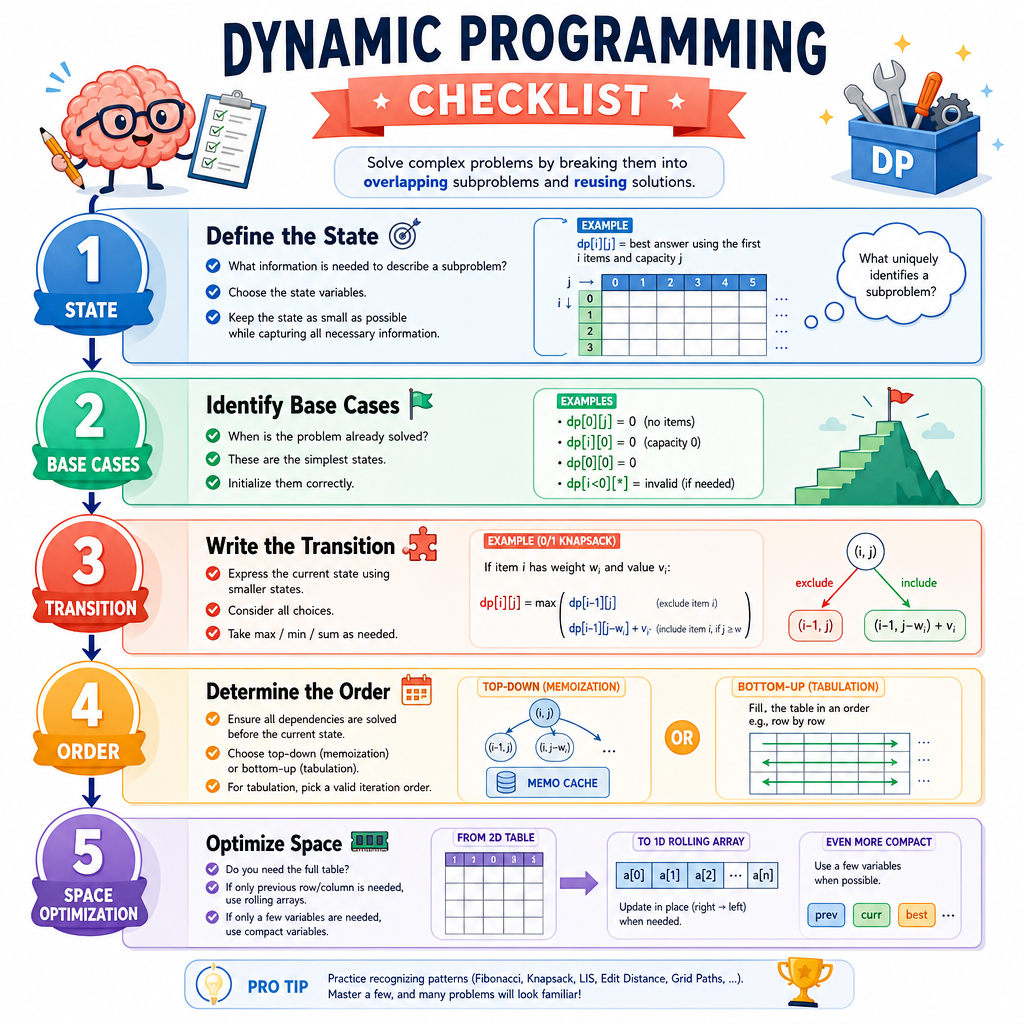
Your DP checklist
When you see a possible DP problem, walk through this checklist:
-
What is the state?
- What does
dp[i]mean?
- What does
-
What are the base cases?
- What answers are immediately known?
-
What is the transition?
- How do smaller answers create the current answer?
-
What order should I compute states?
- Top-down memoization or bottom-up tabulation?
-
Can space be reduced?
- Do you need the whole table, or only recent values?
Two-day drill
To match this crash course’s review rhythm, revisit these every 2 days:
- Fibonacci with memoization
- Climbing stairs
- Minimum cost climbing stairs
- House robber
Next, you’ll focus on turning this review loop into a repeatable habit so these patterns stick under pressure.