Dynamic Programming in Real-World Applications
Read at your own pace. Code execution, quizzes, progress tracking, and the AI tutor are available in the interactive view with JavaScript enabled.
From Practice To Production
From Practice To Production
You’ve now worked through the full DP toolkit: Recursive Approach, Memoization, Top-Down Dynamic Programming, Bottom-Up Dynamic Programming, and Optimization Techniques.
This final lesson is about recognizing where those ideas show up outside interview prompts.
For a full stack engineer working with infrastructure, DP often appears when you need to answer questions like:
- Which tasks should we run with limited capacity?
- What is the cheapest safe path through a workflow?
- How do we compare two strings, configs, or documents efficiently?
- Can we trade memory for speed without changing correctness?
The goal is not to force DP everywhere. It is to recognize when a production problem has the same shape as the problems you’ve already solved.
Systems DP Signals
Systems DP Signals
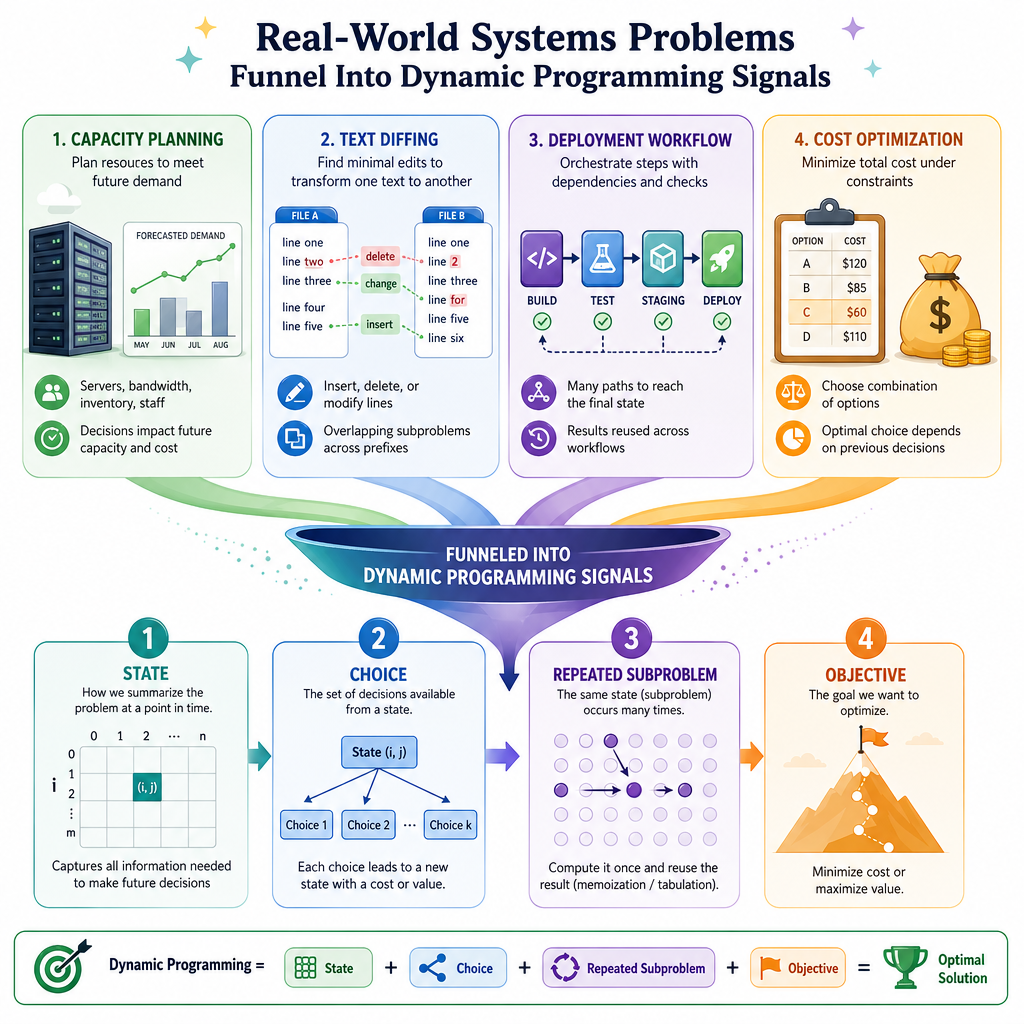
In real-world work, DP rarely announces itself as “Dynamic Programming.” It usually arrives as a planning, matching, pricing, routing, or allocation problem.
Look for the same signals we used throughout the course:
-
A state can summarize the past: for example,
serviceIndexandremainingCpu. - Choices branch: include or skip, retry or rollback, use cache or recompute.
- Subproblems repeat: the same partial capacity, prefix, node, or timestamp appears many times.
- Local decisions combine into a global answer: best total value, minimum cost, maximum reliability.
A useful production question is:
“Can I describe this problem with a small state, then reuse the answer for that state?”
If yes, the DP workflow from the earlier lessons is likely relevant.
Recognize The Candidate
Which scenario is the strongest DP candidate?
Choose the scenario that most clearly has reusable subproblems and an optimization objective.
Capacity Planning Knapsack
Capacity Planning Knapsack
A classic real-world DP shape is resource allocation: limited budget, multiple choices, and a desire to maximize total value.
Imagine a platform team choosing which reliability projects to ship this sprint. Each project consumes engineering capacity and produces estimated value.
This is the same shape as the knapsack-style optimization you saw in Optimization Techniques, but here the “weight” is capacity and the “value” is operational impact.
```javascript
const projects = [
  { name: "upgrade-ingress", effort: 3, value: 25 },
  { name: "add-slo-alerts", effort: 2, value: 20 },
  { name: "db-backup-drill", effort: 4, value: 35 },
  { name: "reduce-image-size", effort: 1, value: 12 },
  { name: "node-autoscaling", effort: 5, value: 45 }
];

const capacity = 7;
const n = projects.length;

const dp = Array.from({ length: n + 1 }, () => Array(capacity + 1).fill(0));

for (let i = 1; i <= n; i++) {
  const project = projects[i - 1];
  for (let remaining = 0; remaining <= capacity; remaining++) {
    const skip = dp[i - 1][remaining];
    const take = project.effort <= remaining
      ? project.value + dp[i - 1][remaining - project.effort]
      : -Infinity;

    dp[i][remaining] = Math.max(skip, take);
  }
}

const selected = [];
let remaining = capacity;
for (let i = n; i > 0; i--) {
  if (dp[i][remaining] !== dp[i - 1][remaining]) {
    const project = projects[i - 1];
    selected.push(project.name);
    remaining -= project.effort;
  }
}

console.log("Max value:", dp[n][capacity]);
console.log("Selected projects:", selected.reverse());
```
State Meets Architecture
State Meets Architecture
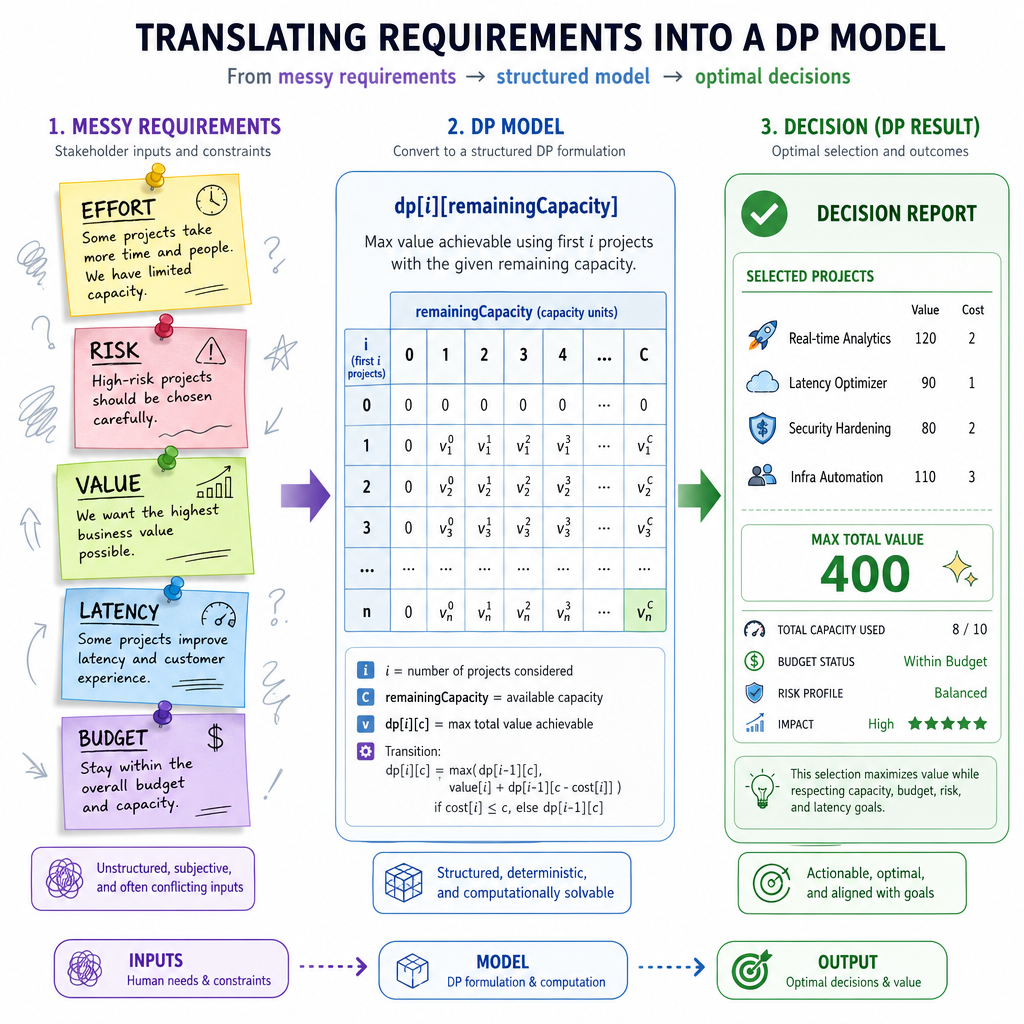
The practical skill is translating messy domain language into a compact DP state.
For the capacity example:
Business language:   "Which projects should we do this sprint?"
DP state:            dp[i][remainingCapacity]
Choice:              skip project i OR take project i
Objective:           maximize total value
Constraint:          total effort <= capacity
This translation matters in production because the DP table is also a design boundary:
- Inputs must be measurable: effort, value, cost, latency, risk.
- The state must be small enough to compute within your service or batch job limits.
- The objective must match the business decision, not just be mathematically convenient.
A technically correct DP can still be the wrong product decision if the scoring function is bad.
Edit Distance Products
Edit Distance Products
Another common production DP is edit distance: how many insertions, deletions, or substitutions are needed to transform one string into another?
You’ll see this idea in:
- Search typo tolerance
- “Did you mean?” suggestions
- Config drift detection
- Document diffing
- Similarity checks for user-generated content
Below, we use the space-optimized style from Optimization Techniques: each row depends only on the previous row and the current row.
```javascript
function editDistance(a, b) {
  let previous = Array.from({ length: b.length + 1 }, (_, j) => j);

  for (let i = 1; i <= a.length; i++) {
    const current = Array(b.length + 1).fill(0);
    current[0] = i;

    for (let j = 1; j <= b.length; j++) {
      if (a[i - 1] === b[j - 1]) {
        current[j] = previous[j - 1];
      } else {
        current[j] = 1 + Math.min(
          previous[j],     // delete from a
          current[j - 1],  // insert into a
          previous[j - 1]  // substitute
        );
      }
    }

    previous = current;
  }

  return previous[b.length];
}

console.log("kitten -> sitting:", editDistance("kitten", "sitting"));
console.log("prod-config -> prod-confg:", editDistance("prod-config", "prod-confg"));
```
Optimization Reality Check
True or false?
If a DP solution uses rolling arrays and reduces memory to O(n), it is automatically safe to run in production regardless of input size.
DAG Workflow Costs
DAG Workflow Costs
DP also appears in directed acyclic graphs: CI/CD pipelines, workflow engines, data processing DAGs, and deployment promotion paths.
If each node’s best answer depends only on earlier nodes, you can process the graph in dependency order.
This is bottom-up DP with architecture vocabulary:
state:      best known cost to reach a workflow step
transition: edge from current step to next step
order:      topological / dependency order
objective:  minimum total risk or cost
```javascript
const graph = {
  build: [
    { to: "unit-tests", risk: 2 },
    { to: "smoke-tests", risk: 4 }
  ],
  "unit-tests": [
    { to: "staging", risk: 3 },
    { to: "security-scan", risk: 5 }
  ],
  "smoke-tests": [
    { to: "staging", risk: 2 }
  ],
  "security-scan": [
    { to: "staging", risk: 1 }
  ],
  staging: [
    { to: "prod", risk: 2 }
  ],
  prod: []
};

const order = ["build", "unit-tests", "smoke-tests", "security-scan", "staging", "prod"];
const best = Object.fromEntries(order.map(step => [step, Infinity]));
const parent = {};
best.build = 0;

for (const step of order) {
  for (const edge of graph[step]) {
    const candidate = best[step] + edge.risk;
    if (candidate < best[edge.to]) {
      best[edge.to] = candidate;
      parent[edge.to] = step;
    }
  }
}

const path = [];
for (let step = "prod"; step; step = parent[step]) {
  path.push(step);
}

console.log("Minimum risk:", best.prod);
console.log("Path:", path.reverse().join(" -> "));
```
Name The Model
Fill in the blank
In DP, the compact description of a subproblem — enough information to compute and reuse its answer — is called the ____.
Final DP Checklist
Final DP Checklist
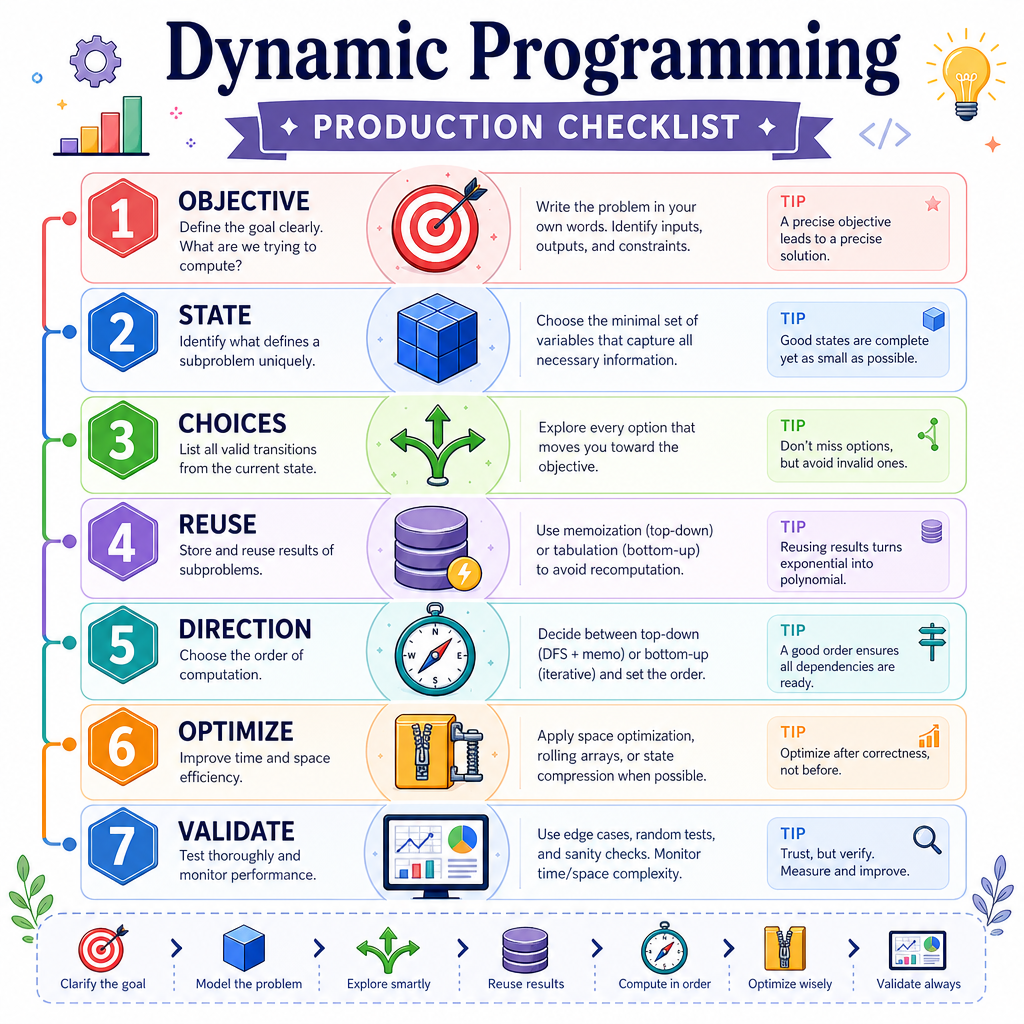
When you encounter a hard problem after this course, use this checklist:
Clarify the objective
Minimize cost? Maximize value? Count ways? Decide if possible?Define the state
What small set of variables uniquely describes a subproblem?List the choices
What transitions move from one state to another?Confirm reuse
Will the same state appear more than once?Choose direction
Use top-down when recursion matches the domain naturally. Use bottom-up when order and memory control matter.Optimize only after correctness
Apply rolling arrays, in-place updates, or transition compression when dependencies allow it.Validate production fit
Check input sizes, latency, memory, observability, and whether the scoring model matches reality.
That is the journey from recursion to production-grade dynamic programming.