Effective Communication in Negotiation
Read at your own pace. Code execution, quizzes, progress tracking, and the AI tutor are available in the interactive view with JavaScript enabled.
From Prep To Voice
Why this lesson matters
In Preparing for Negotiation, you built the plan: your inputs, leverage signals, argument map, pushback responses, and decision boundaries.
Now we move from the packet to the conversation.
A strong salary negotiation is not a monologue. It is a structured exchange where you:
- State your value clearly
- Make a specific request
- Listen for constraints and interests
- Ask questions that reveal options
- Respond without sounding defensive
Think of this like a fourth-quarter drive: the playbook matters, but execution under pressure determines the outcome.

Message Architecture
A clear request has structure
Your communication goal is not to “sound impressive.” It is to make your value easy to understand and your request easy to evaluate.
Use this four-part pattern:
1. Role need      -> What matters to the employer?
2. Evidence       -> What have you done that maps to that need?
3. Request        -> What are you asking for?
4. Pause          -> Give them room to respond.
Example:
“Given the scope of this role—especially leading backend reliability work—I’m excited about the fit. In my last role, I reduced incident response time by 35% and mentored two senior engineers into on-call leadership. Based on the market range and this scope, I’m looking for $178,000. How close can we get to that?”
Notice: confident, specific, and not over-explained.
```cpp
#include <iostream>
#include <string>
using namespace std;

string buildNegotiationMessage(
    const string& roleNeed,
    const string& evidence,
    const string& request,
    const string& question
) {
    return "Given the scope around " + roleNeed + ", "
         + evidence + ". "
         + "Based on that fit, I'm looking for " + request + ". "
         + question;
}

int main() {
    string message = buildNegotiationMessage(
        "scaling backend systems and improving reliability",
        "I led a service migration that cut p95 latency by 42% and reduced paging volume",
        "$178,000",
        "How close can we get to that?"
    );

    cout << message << endl;
    return 0;
}
```
Choose Strong Framing
Which statement is the strongest opening for a salary negotiation conversation?
Listen Like Debugging
Active listening is not passive
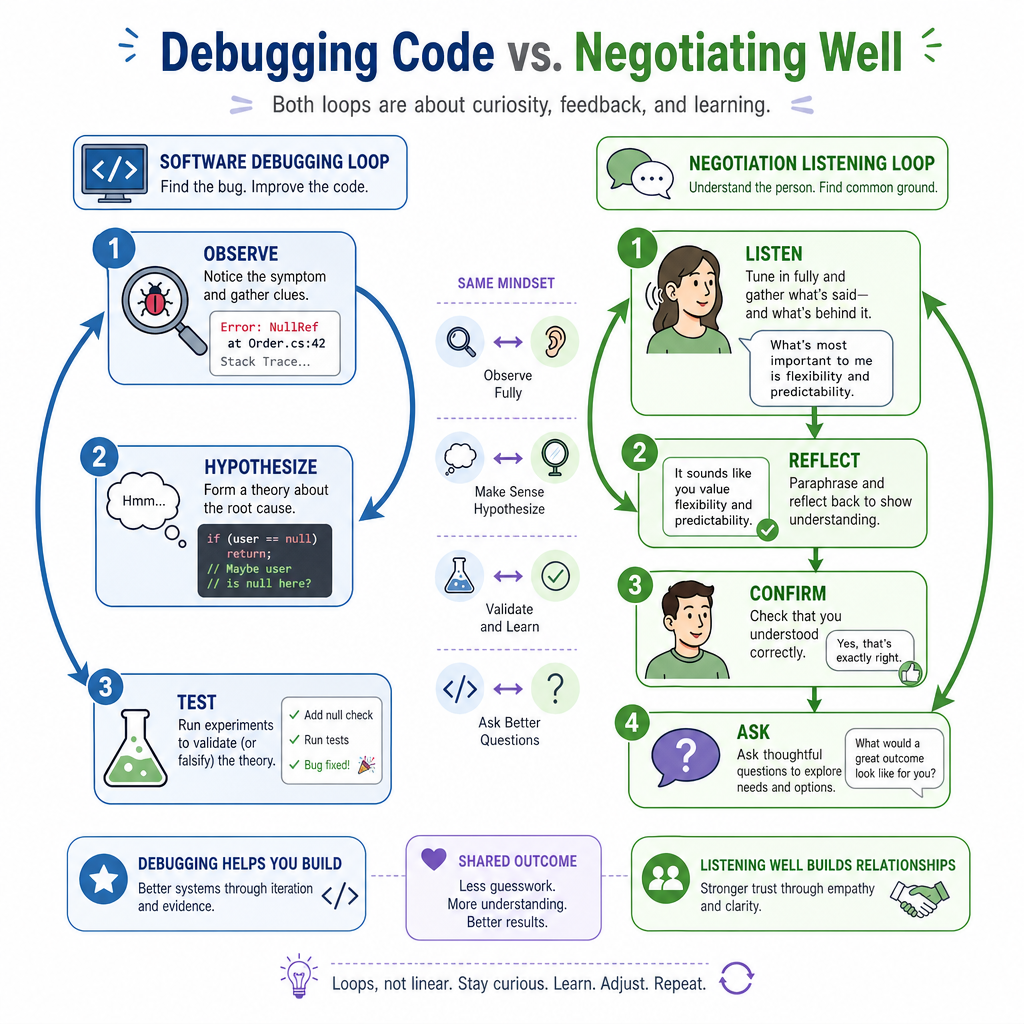
Senior engineers know that debugging is mostly disciplined listening: observe the system, form a hypothesis, test it, and avoid jumping to conclusions.
Negotiation works similarly.
Use the listen-confirm-advance loop:
They speak
   ↓
You reflect the core point
   ↓
You confirm accuracy
   ↓
You ask a next question
Example:
Employer: “We are already near the top of our range.”
You: “It sounds like the base salary range may be constrained. Is that right?”
Employer: “Yes, base is the issue.”
You: “What parts of the package have more flexibility?”
This keeps the conversation collaborative instead of turning every objection into a collision.
Use The Pause
After making a clear salary request, a short pause can be more effective than immediately filling the silence with extra justification.
Powerful Questions
Questions create options
When you hear resistance, do not rush into defense mode. Ask questions that uncover what kind of resistance it is.
Useful question types:
- Clarifying: “When you say the range is fixed, does that mean base salary only?”
- Constraint-finding: “What approval would be needed to revisit the number?”
- Priority-revealing: “Which parts of the package are most flexible?”
- Collaborative: “What would make this easier to support internally?”
For a Steelers fan: this is like reading the defense before the snap. You are not abandoning the play—you are identifying where the opening actually is.
```cpp
#include <iostream>
#include <map>
#include <string>
using namespace std;

int main() {
    map<string, string> questionBySignal = {
        {"budget", "What parts of the package have more flexibility?"},
        {"approval", "What would need to happen for this to be approved?"},
        {"range", "When you say range, are we talking about base salary only?"},
        {"timing", "When would be the right time to revisit compensation?"}
    };

    string signal = "budget";
    cout << "Signal heard: " << signal << endl;
    cout << "Question to ask: " << questionBySignal[signal] << endl;

    return 0;
}
```
Name The Question
A question that often starts with “How” or “What” and invites the other person to help solve the problem is called a ____ question.
Handle Counteroffers
Do not react too fast
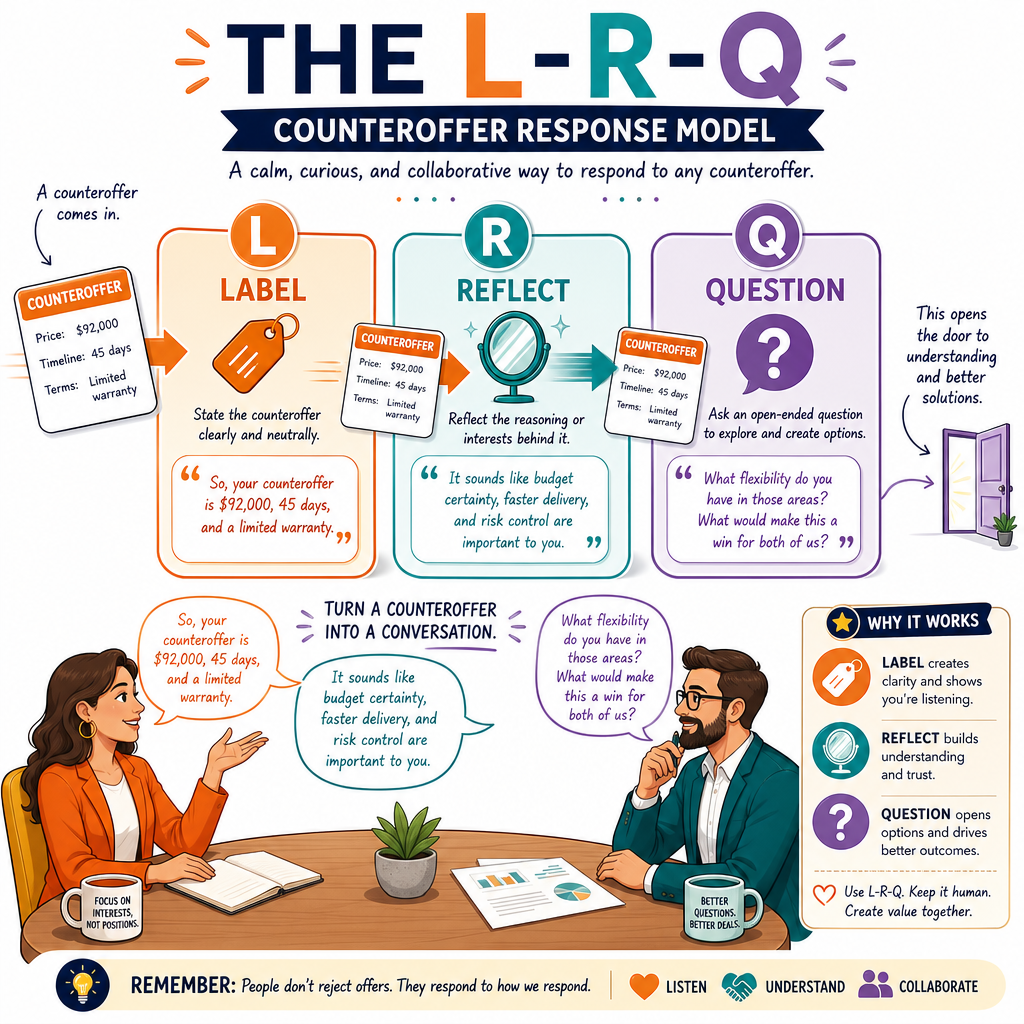
A counteroffer is information, not a verdict.
Use the L-R-Q pattern:
Label     -> Name what you heard
Reflect   -> Show you understand the constraint
Question  -> Ask what is possible next
Example:
“It sounds like $165,000 is the current approved base. I understand there may be internal bands involved. What flexibility exists to get closer to $178,000 based on the scope we discussed?”
If the answer is still no, stay composed. Your decision boundaries from Preparing for Negotiation tell you what to do next; the conversation itself should remain professional.
Rehearse The Exchange
Practice the conversation path
Rehearsal is not about memorizing a script word-for-word. It is about recognizing states.
A simple negotiation conversation often moves through:
Open request -> Employer response -> Clarify -> Counter -> Decide next step
That should feel familiar: like modeling a workflow or state machine. You are preparing to respond thoughtfully instead of branching randomly under pressure.
```cpp
#include <iostream>
#include <string>
using namespace std;

enum class State {
    OpenRequest,
    EmployerPushback,
    ClarifyConstraint,
    RestateValue,
    NextStep
};

string lineFor(State state) {
    switch (state) {
        case State::OpenRequest:
            return "I'm targeting $178,000 based on the role scope and my relevant impact.";
        case State::EmployerPushback:
            return "We may not have budget for that base salary.";
        case State::ClarifyConstraint:
            return "When you say budget, is base salary the main constraint?";
        case State::RestateValue:
            return "The number reflects the reliability leadership and system scale this role requires.";
        case State::NextStep:
            return "What would be the best next step to explore flexibility?";
    }
    return "";
}

int main() {
    State flow[] = {
        State::OpenRequest,
        State::EmployerPushback,
        State::ClarifyConstraint,
        State::RestateValue,
        State::NextStep
    };

    for (State state : flow) {
        cout << "- " << lineFor(state) << endl;
    }

    return 0;
}
```
Respond To Budget
An employer says, “We do not have budget to increase the base salary.” What is the best response?