Fibonacci Series
Read at your own pace. Code execution, quizzes, progress tracking, and the AI tutor are available in the interactive view with JavaScript enabled.
Why Fibonacci Matters
Your first concrete DP power-up
Now that we've covered Introduction to Dynamic Programming, you already know the core signals: repeated work, optimal substructure, memoization, and tabulation.
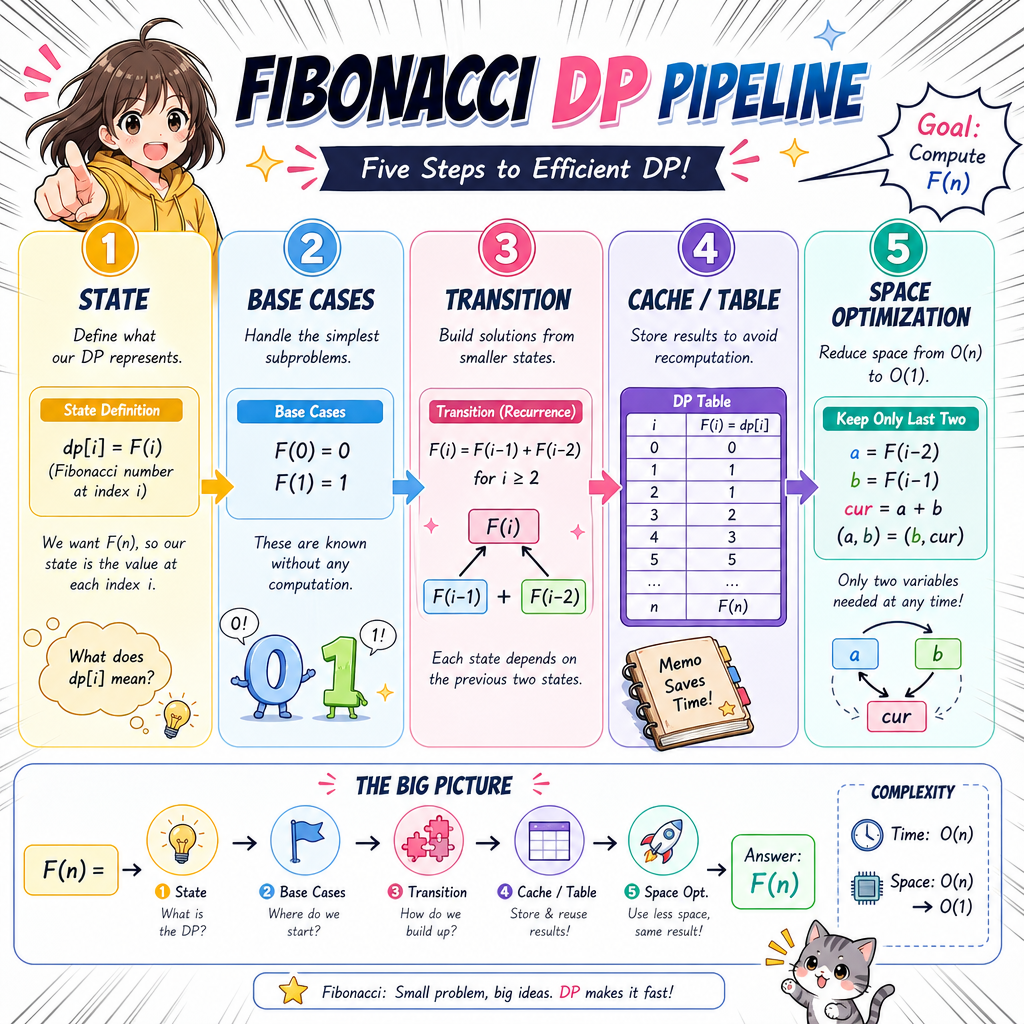
The Fibonacci series is the cleanest arena to practice those ideas without distraction. It is small enough to trace by hand, but it exposes the exact performance trap that DP solves.
Think of this lesson like the first training arc in a shonen anime: the technique looks simple, but mastering the form prepares you for tougher battles later, like sequence alignment and constrained optimization.
The Recursion Trap
Fibonacci as a recurrence
The Fibonacci numbers are defined as:
fib(0) = 0fib(1) = 1-
fib(n) = fib(n - 1) + fib(n - 2)forn >= 2
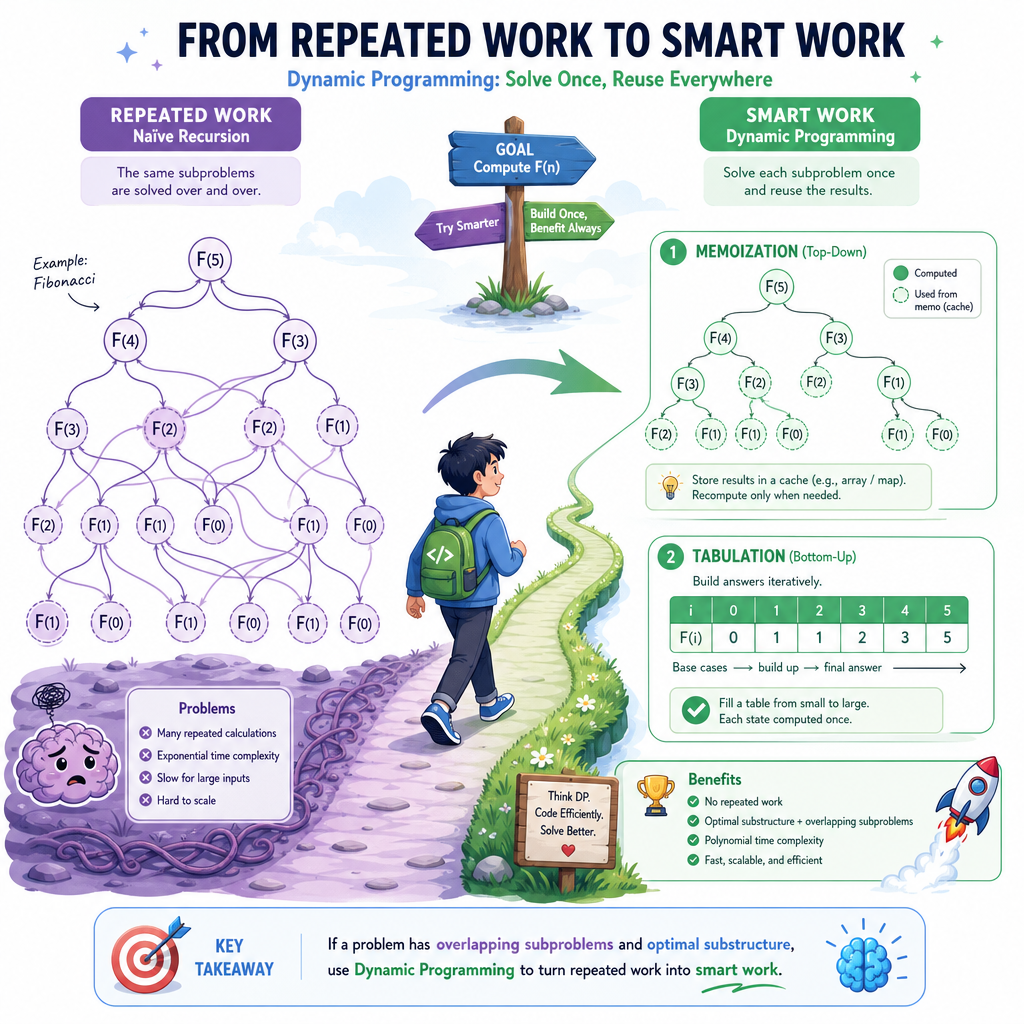
That recurrence translates naturally into recursion. But as you saw in the previous lesson's repeated-work demo, natural recursion can secretly redo the same subproblems many times.
Let's count how many function calls a naive version makes.
```python
calls = 0

def fib_naive(n):
    global calls
    calls += 1

    if n <= 1:
        return n
    return fib_naive(n - 1) + fib_naive(n - 2)

for n in range(8):
    calls = 0
    value = fib_naive(n)
    print(f'fib({n}) = {value}, calls = {calls}')
```
Spot The Overlap
When computing fib(6) with naive recursion, which subproblem is likely computed more than once?
Memoization Fix
Cache each subproblem once
Memoization keeps the recursive shape but adds a cache. The first time we compute fib(k), we store it. Later calls reuse the stored value.
This is the same memoization cache idea from Introduction to Dynamic Programming, now applied to a real recurrence.
Result: each fib(k) for 0 <= k <= n is solved once.
```python
def fib_memo(n, memo=None):
    if memo is None:
        memo = {}

    if n in memo:
        return memo[n]

    if n <= 1:
        memo[n] = n
    else:
        memo[n] = fib_memo(n - 1, memo) + fib_memo(n - 2, memo)

    return memo[n]

n = 10
print(f'fib({n}) = {fib_memo(n)}')
print('First 11 Fibonacci numbers:')
print([fib_memo(i) for i in range(11)])
```
Memoization Cost
True or false: memoized Fibonacci still has exponential time complexity because it uses recursion.
Bottom-Up View
Tabulation builds from the base cases
Memoization starts at fib(n) and recursively asks for smaller answers.
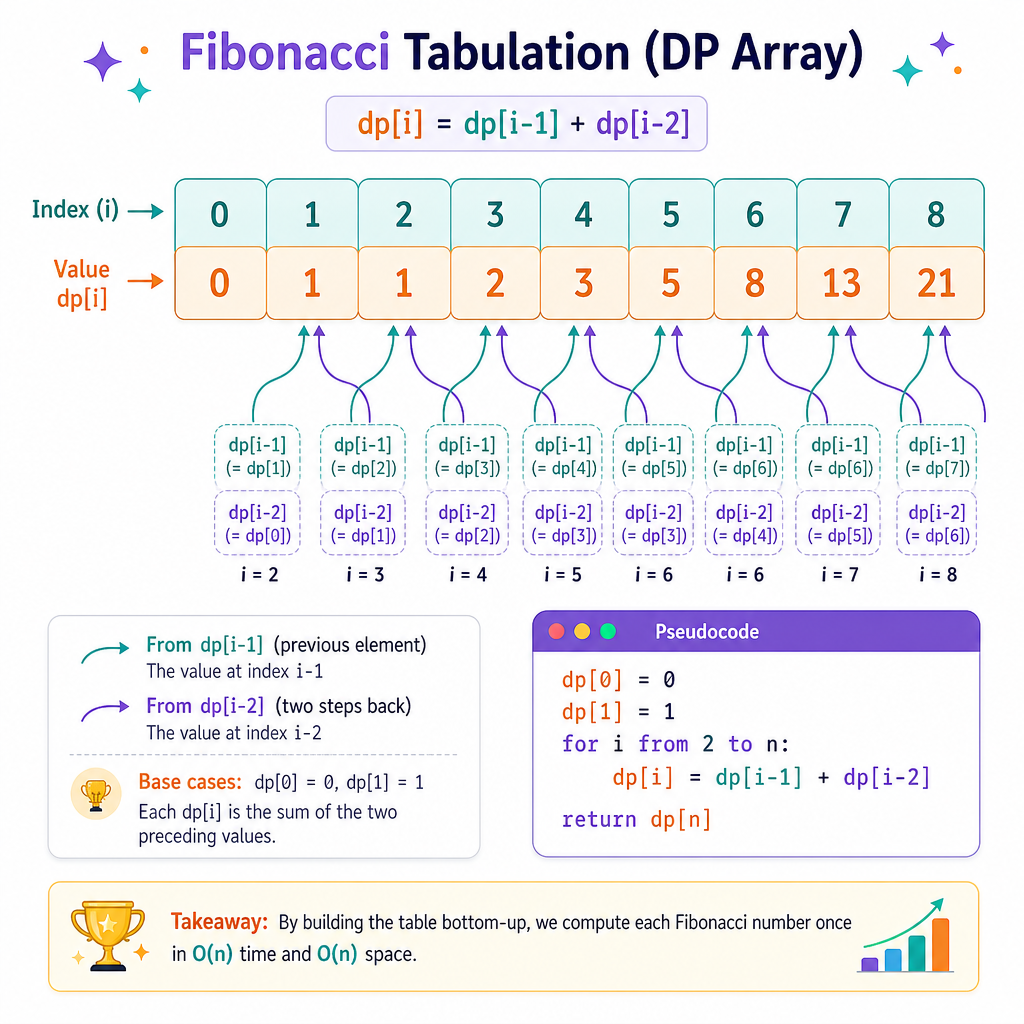
Tabulation goes the other direction:
fib(0)  fib(1)  fib(2)  fib(3)  fib(4)  fib(5)
  0       1       1       2       3       5
Each cell depends only on the two previous cells:
dp[i] = dp[i - 1] + dp[i - 2]
This is the tabulation mindset from the previous lesson, now made concrete.
Base Case Check
Fill in the blank with the standard Fibonacci base-case value:
fib(1) = ____
Tabulation Code
Iterative Fibonacci with a table
Here is the bottom-up version. We create a table where dp[i] stores the answer to the subproblem fib(i).
This version avoids recursion entirely, which also avoids Python recursion-depth concerns for larger n.
```python
def fib_tab(n):
    if n <= 1:
        return n

    dp = [0] * (n + 1)
    dp[0] = 0
    dp[1] = 1

    for i in range(2, n + 1):
        dp[i] = dp[i - 1] + dp[i - 2]

    print('DP table:', dp)
    return dp[n]

n = 10
print(f'fib({n}) = {fib_tab(n)}')
```
Choose The Style
Which statement best compares memoization and tabulation for Fibonacci?
Space Compression
Do we need the whole table?
For Fibonacci, dp[i] only depends on two previous values. That means we can compress space from O(n) to O(1).
This is a common DP optimization pattern: first write the clear table version, then ask which past states are truly needed.
For Fibonacci, the answer is just two numbers.
```python
def fib_space_optimized(n):
    if n <= 1:
        return n

    prev2 = 0  # fib(0)
    prev1 = 1  # fib(1)

    for _ in range(2, n + 1):
        current = prev1 + prev2
        prev2 = prev1
        prev1 = current

    return prev1

for n in [0, 1, 2, 5, 10, 20]:
    print(f'fib({n}) = {fib_space_optimized(n)}')
```
Fibonacci Takeaways
What you should keep
Fibonacci is simple, but it contains the DP pattern in miniature:
- Define the state:
fib(i) - Identify base cases:
fib(0),fib(1) - Write the transition:
fib(i) = fib(i - 1) + fib(i - 2) - Avoid repeated work with memoization or tabulation
- Optimize space when only a small window of states is needed
In the next lesson, we'll move from one-dimensional numeric states to comparing sequences, where the same DP instincts become much more powerful.