Final Project: Building a Complete Algo Trading Application
Read at your own pace. Code execution, quizzes, progress tracking, and the AI tutor are available in the interactive view with JavaScript enabled.
Final Assembly
Your build becomes a system
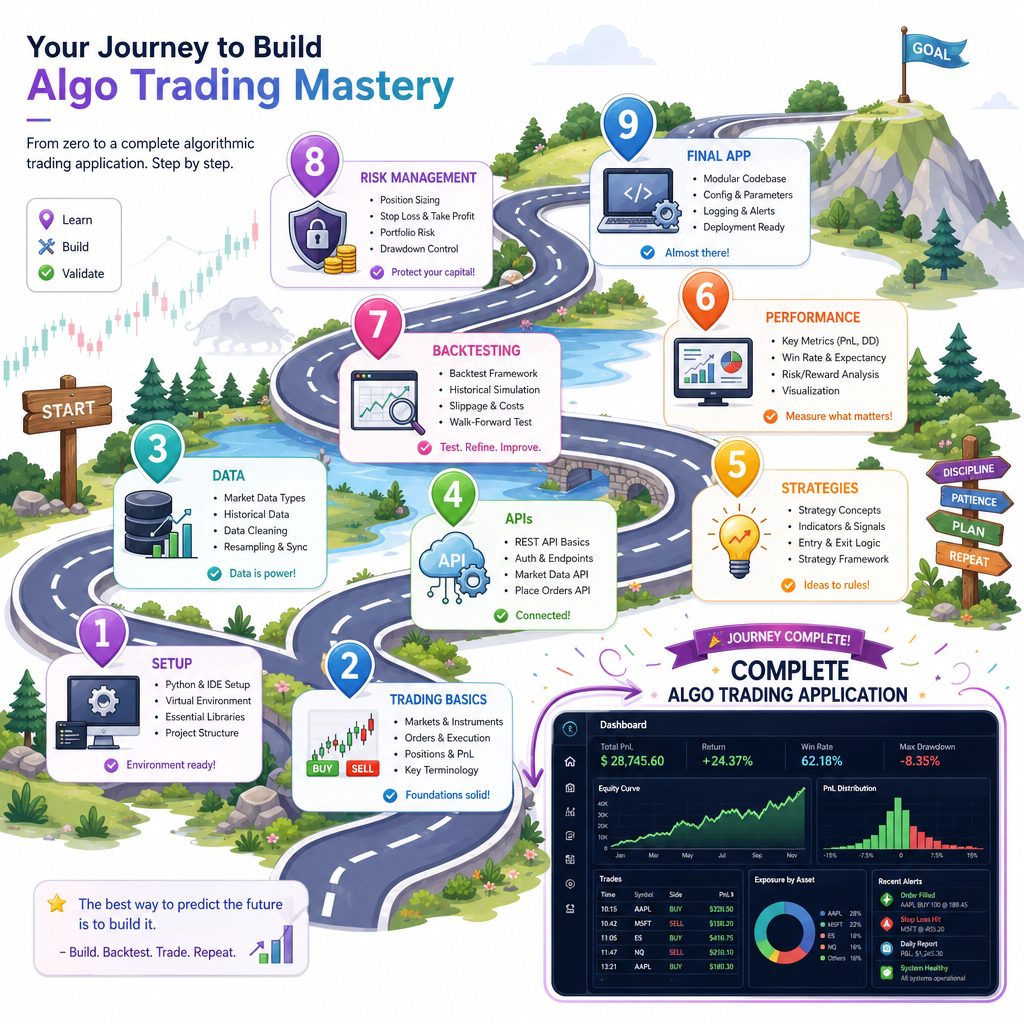
Now that we've covered Course Introduction and Setting Up Development Environment, market basics, data handling, API connectivity, strategy implementation, performance tuning, backtesting, and risk/security, you're ready to assemble the pieces into one coherent algo trading application.
This final project is not about adding a brand-new trading trick. It is about making the application behave like a real system:
- data flows in predictably
- strategy logic stays isolated
- risk checks guard every order
- execution is mode-aware: backtest, paper, or live
- logs and metrics tell you what happened
- secrets and controls are handled safely
Think of this lesson as your production-minded blueprint: small enough to build, structured enough to extend.

System Architecture
The final project shape
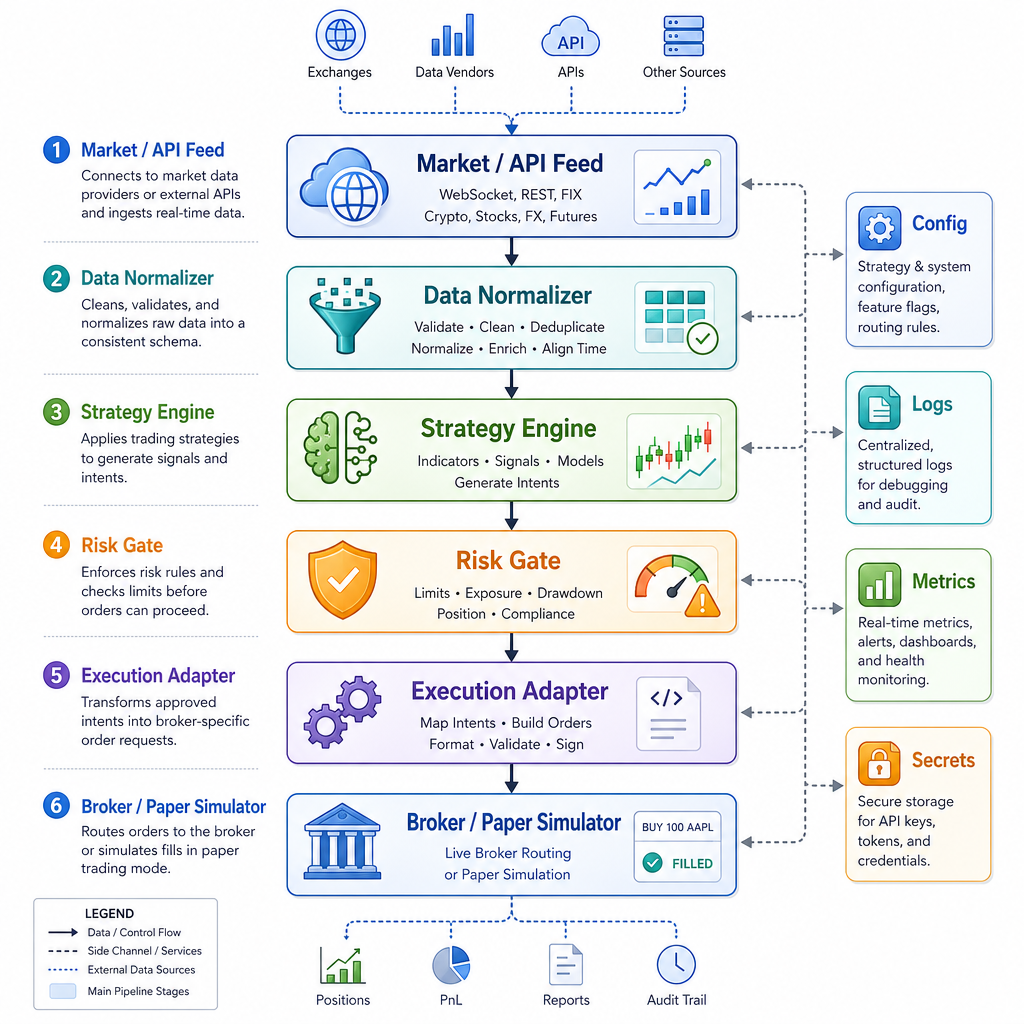
A complete beginner-friendly but realistic layout looks like this:
Market/API Feed
      |
      v
Data Normalizer ---> Storage / Recent Window
      |
      v
Strategy Engine
      |
      v
Risk Gate
      |
      v
Execution Adapter
      |
      v
Broker / Exchange / Paper Simulator

Side channels:
- Config
- Logging
- Metrics
- Secrets
- Backtest runner
The key design principle: each layer has one job.
From Implementing Trading Algorithms, your strategy should not know API authentication details. From Risk Management and Security, your executor should not be able to send an order before the risk gate approves it.
This separation is what lets you test one piece at a time and replace paper trading with live execution later without rewriting the strategy.
Project Skeleton
Organize for speed and clarity
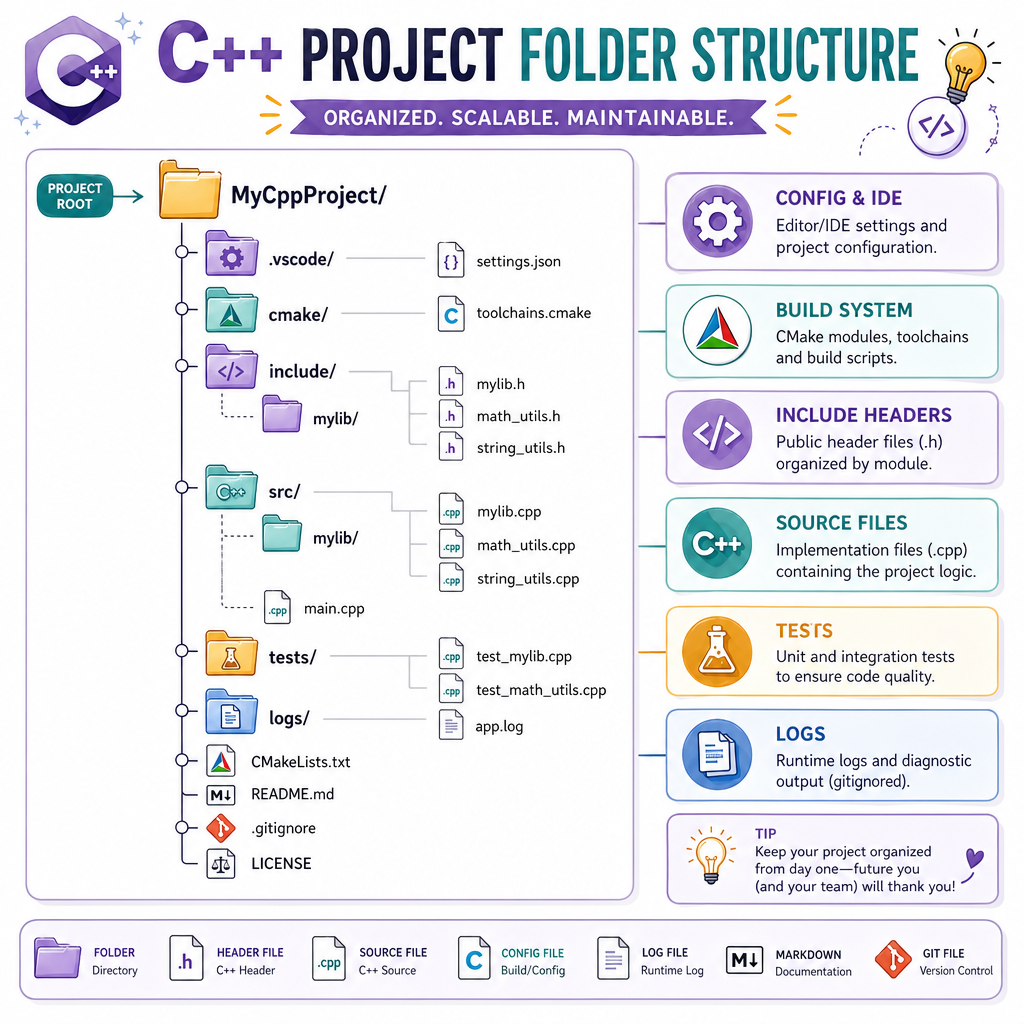
A clean project structure keeps the final application understandable as it grows:
algo_trader/
  CMakeLists.txt
  config/
    paper.json
    live.example.json
  include/
    market_data.hpp
    strategy.hpp
    risk.hpp
    execution.hpp
    metrics.hpp
  src/
    main.cpp
    strategy_sma.cpp
    risk_gate.cpp
    paper_executor.cpp
    api_connector.cpp
  tests/
    strategy_tests.cpp
    risk_tests.cpp
  logs/
For this final project, aim for these deliverables:
- Backtest mode using historical data from earlier lessons
- Paper mode using live-like data and simulated orders
- Live-ready mode with execution disabled until explicitly configured
- One strategy such as SMA crossover
- One risk gate with position and loss limits
- Basic metrics for latency and order decisions
You are building a foundation, not a hedge fund platform on day one.
Core Application
A minimal end-to-end trading loop
Below is a compact final-project prototype. It connects the layers you already learned:
- tick data from Data Handling and Management in C++
- SMA crossover from Implementing Trading Algorithms
- position cap from Risk Management and Security
- paper execution from Connectivity with Financial Market APIs concepts
It is intentionally small, but the boundaries are realistic.
```cpp
#include <cmath>
#include <deque>
#include <iomanip>
#include <iostream>
#include <numeric>
#include <optional>
#include <string>
#include <vector>

struct Tick {
    std::string symbol;
    double price;
};

struct Order {
    std::string symbol;
    std::string side;
    int qty;
    double price;
};

class SmaCrossoverStrategy {
public:
    SmaCrossoverStrategy(std::size_t fastWindow, std::size_t slowWindow)
        : fastWindow_(fastWindow), slowWindow_(slowWindow) {}

    std::optional<Order> onTick(const Tick& tick) {
        push(fast_, fastWindow_, tick.price);
        push(slow_, slowWindow_, tick.price);

        if (slow_.size() < slowWindow_) return std::nullopt;

        const double fastAvg = avg(fast_);
        const double slowAvg = avg(slow_);
        const int signal = fastAvg > slowAvg ? 1 : -1;

        // Avoid signal spam: only trade when direction changes.
        if (signal == lastSignal_) return std::nullopt;
        lastSignal_ = signal;

        return Order{tick.symbol, signal == 1 ? "BUY" : "SELL", 10, tick.price};
    }

private:
    std::size_t fastWindow_;
    std::size_t slowWindow_;
    std::deque<double> fast_;
    std::deque<double> slow_;
    int lastSignal_ = 0;

    static void push(std::deque<double>& q, std::size_t maxSize, double value) {
        q.push_back(value);
        if (q.size() > maxSize) q.pop_front();
    }

    static double avg(const std::deque<double>& q) {
        return std::accumulate(q.begin(), q.end(), 0.0) / q.size();
    }
};

class RiskGate {
public:
    explicit RiskGate(int maxAbsPosition) : maxAbsPosition_(maxAbsPosition) {}

    bool approve(const Order& order) const {
        const int signedQty = order.side == "BUY" ? order.qty : -order.qty;
        const int projected = position_ + signedQty;
        return std::abs(projected) <= maxAbsPosition_;
    }

    void applyFill(const Order& order) {
        position_ += order.side == "BUY" ? order.qty : -order.qty;
    }

    int position() const { return position_; }

private:
    int maxAbsPosition_;
    int position_ = 0;
};

class PaperExecutor {
public:
    void send(const Order& order) const {
        std::cout << "[PAPER EXECUTION] " << order.side << " "
                  << order.qty << " " << order.symbol
                  << " @ " << std::fixed << std::setprecision(2)
                  << order.price << '\n';
    }
};

int main() {
    std::vector<Tick> ticks = {
        {"ABC", 100.0}, {"ABC", 100.5}, {"ABC", 101.0},
        {"ABC", 100.7}, {"ABC", 100.2}, {"ABC", 99.8},
        {"ABC", 100.4}, {"ABC", 101.2}, {"ABC", 101.8}
    };

    SmaCrossoverStrategy strategy(2, 4);
    RiskGate risk(20);
    PaperExecutor executor;

    for (const auto& tick : ticks) {
        auto maybeOrder = strategy.onTick(tick);
        if (!maybeOrder) {
            std::cout << "No order for tick " << tick.symbol
                      << " price=" << tick.price << '\n';
            continue;
        }

        const Order& order = *maybeOrder;
        if (risk.approve(order)) {
            executor.send(order);
            risk.applyFill(order);
            std::cout << "Position now: " << risk.position() << "\n";
        } else {
            std::cout << "[RISK BLOCKED] " << order.side << " "
                      << order.qty << " would exceed position limit\n";
        }
    }

    std::cout << "Final position: " << risk.position() << '\n';
    return 0;
}
```
Boundary Check
In the final project architecture, which boundary is the safest and most maintainable?
Mode Matters
Before connecting real capital, the final project should run in _____ mode with live-like data and simulated orders.
Runtime Controls
Add operational brakes
A complete application needs more than strategy logic. It needs runtime controls that can stop trading quickly.
From Risk Management and Security, you already built the mental model: risk is not a report after the fact; it is a gate before execution.
This sample shows a simple control layer with:
- application mode
- maximum loss
- maximum position
- manual halt flag
In a real system, these values come from validated config, not random constants scattered through code.
```cpp
#include <cmath>
#include <iostream>
#include <string>

struct Order {
    std::string symbol;
    std::string side;
    int qty;
};

enum class Mode { Backtest, Paper, Live };

struct RuntimeState {
    Mode mode = Mode::Paper;
    bool manualHalt = false;
    double dailyPnl = 0.0;
    int position = 0;
};

class RuntimeRiskControl {
public:
    RuntimeRiskControl(double maxDailyLoss, int maxAbsPosition)
        : maxDailyLoss_(maxDailyLoss), maxAbsPosition_(maxAbsPosition) {}

    bool allow(const RuntimeState& state, const Order& order) const {
        if (state.manualHalt) {
            std::cout << "Blocked: manual halt is active\n";
            return false;
        }

        if (state.dailyPnl <= -maxDailyLoss_) {
            std::cout << "Blocked: daily loss limit reached\n";
            return false;
        }

        const int signedQty = order.side == "BUY" ? order.qty : -order.qty;
        const int projected = state.position + signedQty;
        if (std::abs(projected) > maxAbsPosition_) {
            std::cout << "Blocked: position limit would be exceeded\n";
            return false;
        }

        if (state.mode == Mode::Live) {
            std::cout << "Live mode detected: extra production confirmations required\n";
        }

        return true;
    }

private:
    double maxDailyLoss_;
    int maxAbsPosition_;
};

int main() {
    RuntimeRiskControl control(500.0, 30);
    RuntimeState state;
    state.mode = Mode::Paper;
    state.dailyPnl = -120.0;
    state.position = 25;

    Order buy{"ABC", "BUY", 10};
    Order sell{"ABC", "SELL", 10};

    std::cout << "Trying BUY order...\n";
    std::cout << (control.allow(state, buy) ? "Allowed\n" : "Rejected\n");

    std::cout << "Trying SELL order...\n";
    std::cout << (control.allow(state, sell) ? "Allowed\n" : "Rejected\n");

    state.manualHalt = true;
    std::cout << "Trying after manual halt...\n";
    std::cout << (control.allow(state, sell) ? "Allowed\n" : "Rejected\n");

    return 0;
}
```
Risk In Tests
True or false: The final project should bypass risk checks during backtesting so the strategy's raw performance looks clearer.
Observe Everything
Logs and metrics are part of the product
In Optimization and Performance Tuning, we measured before changing code. In the final application, measurement becomes permanent.
Track at least:
- tick receive time
- strategy decision time
- risk approval time
- execution adapter time
- rejected order count
- current position
- active mode
- connection state
You do not need a full monitoring stack to start. Even structured console logs and simple latency summaries can reveal bugs before they become expensive.
```cpp
#include <algorithm>
#include <chrono>
#include <iostream>
#include <numeric>
#include <string>
#include <vector>

class LatencyMetrics {
public:
    void record(const std::string& stage, long long micros) {
        samples_.push_back(micros);
        std::cout << "metric stage=" << stage
                  << " latency_us=" << micros << '\n';
    }

    void summary() const {
        if (samples_.empty()) return;

        const auto [minIt, maxIt] = std::minmax_element(samples_.begin(), samples_.end());
        const long long total = std::accumulate(samples_.begin(), samples_.end(), 0LL);
        const double avg = static_cast<double>(total) / samples_.size();

        std::cout << "--- latency summary ---\n";
        std::cout << "count=" << samples_.size() << '\n';
        std::cout << "min_us=" << *minIt << '\n';
        std::cout << "avg_us=" << avg << '\n';
        std::cout << "max_us=" << *maxIt << '\n';
    }

private:
    std::vector<long long> samples_;
};

int main() {
    LatencyMetrics metrics;

    // In a real app these would come from high_resolution_clock measurements.
    metrics.record("data_normalize", 35);
    metrics.record("strategy_decision", 52);
    metrics.record("risk_check", 11);
    metrics.record("paper_execute", 27);

    metrics.summary();

    std::cout << "Health: OK, mode=paper, connection=connected\n";
    return 0;
}
```
Launch Checklist
Your final project completion checklist
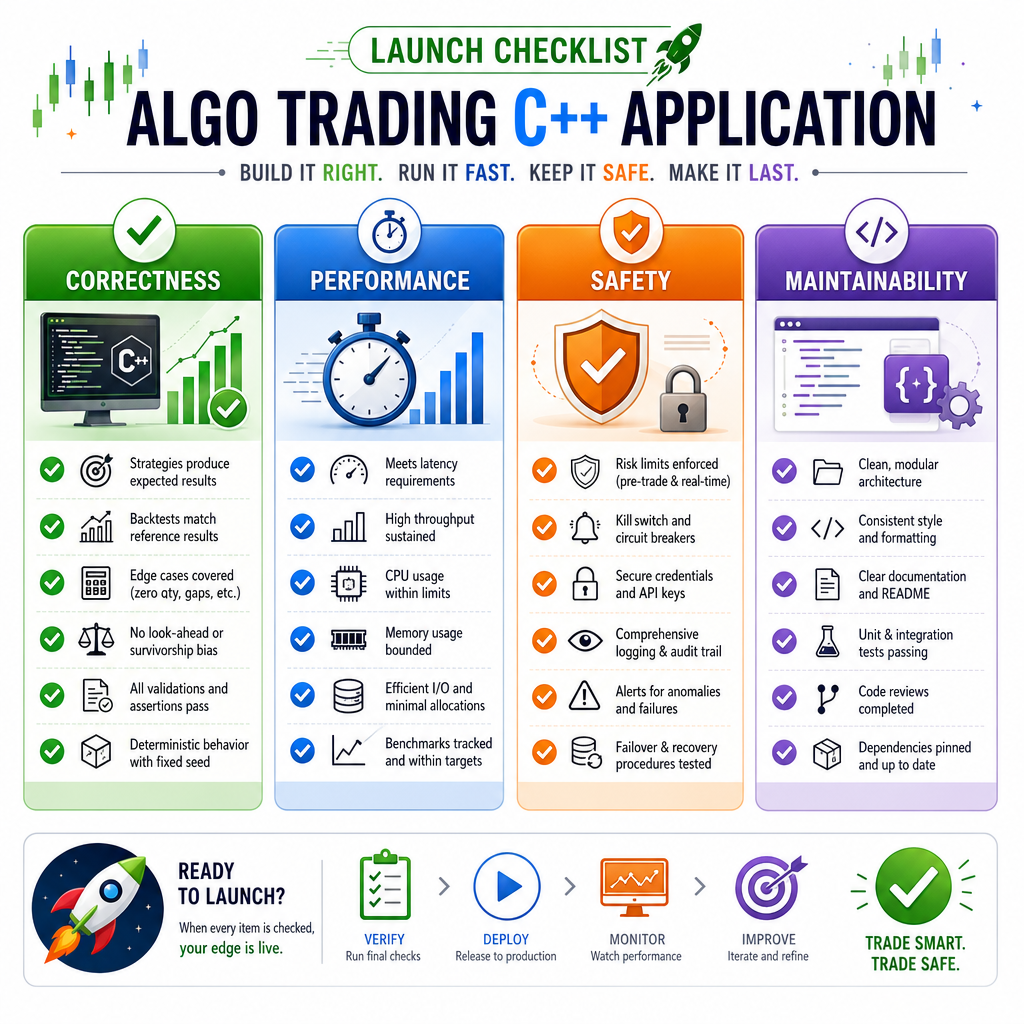
Before you consider the project complete, verify each item:
Correctness
- Strategy output is deterministic on the same input
- Backtest results include costs and slippage assumptions
- Risk gate blocks oversized or unsafe orders
- Paper executor records every simulated fill
Performance
- Hot paths avoid unnecessary allocation
- Latency is measured at key stages
- Logs are useful but not excessive in the trading loop
Safety
- Secrets are not committed
- Live mode requires explicit configuration
- Manual halt works
- Reconnect behavior is tested
Maintainability
- Strategy, risk, data, and execution are separate modules
- Config is validated at startup
- Errors are logged with enough context
- Tests cover strategy and risk behavior
If these are true, you have not just written C++ code — you have built an algo trading application foundation.
Course Wrap
You now have the full path
You started by setting up a C++ workspace and learning how to measure early. Then you moved through market vocabulary, data structures, API connectivity, trading algorithms, optimization, backtesting, and risk/security.
The final project ties them together into this loop:
Receive data -> Normalize -> Decide -> Check risk -> Execute -> Measure -> Improve
Your next best step is practical:
- Build the project skeleton.
- Implement the paper-mode loop first.
- Add one strategy and one risk gate.
- Backtest it.
- Run it in paper mode for many sessions.
- Review logs and metrics.
- Only then think about live execution.
C++ gives you the control and performance needed for millisecond-sensitive systems, but disciplined architecture is what makes that speed usable. Congratulations — you now have a complete roadmap for building your own algo trading application.