Finding Voiceover Jobs
Read at your own pace. Code execution, quizzes, progress tracking, and the AI tutor are available in the interactive view with JavaScript enabled.
From Demo To Work
Why this lesson matters
You now have the core pieces of a beginner voiceover business:
- A sense of your lane from Discovering Your Money Voice
- A brand promise from Marketing and Branding Yourself
- A usable recording workflow from Building Your Voiceover Studio, Recording Skills and Studio Etiquette, and Audio Editing Techniques
- A practice reel from Creating a Practice Demo
Now the question becomes: where do you put that demo so it can turn into paid work?
Finding voiceover jobs is less like waiting to be discovered and more like building a repeatable pipeline: find leads, qualify them, audition or pitch, follow up, deliver clean audio, and ask for the next opportunity.
Think of it like a melodic hook in R&B: the first note matters, but the groove is what keeps it moving.
The Job Ecosystem
Where voiceover jobs come from
Most beginner-friendly jobs live in a few predictable places:
1. Online marketplaces
Examples: freelance platforms, voice casting sites, audiobook platforms, creator marketplaces.
Good for: - Learning how clients describe projects - Practicing auditions - Getting early small wins
Watch for: - Race-to-the-bottom pricing - High competition - Fees or subscriptions
2. Direct outreach
You contact businesses, creators, agencies, video producers, podcasters, app developers, and local brands.
Good for: - Building relationships - Better long-term rates - Less crowded opportunities
3. Referrals
Past clients, friends, theater peers, musicians, business owners, and content creators recommend you.
Good for: - Trust-based jobs - Repeat work - Warmer conversations
4. Agents and production rosters
Usually better after you have stronger demos, client proof, and a reliable studio workflow.
For your first jobs, focus on marketplaces + direct outreach + referrals.

Best First Target
You have a clean practice demo, a simple brand statement, and a home recording setup. Which job source is usually the best beginner focus?
Build A Lead List
Treat leads like a pipeline
A lead is any person or company that might need voiceover.
Instead of randomly searching when you feel motivated, build a simple list and score each lead.
Useful columns:
- Name: company, creator, producer, studio, agency
- Type: ad agency, YouTuber, local business, e-learning company, podcast network
- Fit: does your money voice match their content?
- Need: do they publish videos, ads, courses, or explainers?
- Warmth: do you have a connection or obvious reason to contact them?
- Next action: email, audition, follow-up, referral ask
The goal is not to spam. The goal is to create a focused list of people you can genuinely help.
```javascript
const leads = [
  { name: "Local Fitness Studio", type: "local ad", fit: 8, need: 7, warmth: 6 },
  { name: "Indie Game Team", type: "game", fit: 6, need: 9, warmth: 3 },
  { name: "R&B Producer Channel", type: "YouTube", fit: 9, need: 6, warmth: 7 },
  { name: "Corporate Training Co", type: "e-learning", fit: 7, need: 9, warmth: 4 }
];

const scored = leads
  .map(lead => ({
    ...lead,
    score: lead.fit * 0.4 + lead.need * 0.4 + lead.warmth * 0.2
  }))
  .sort((a, b) => b.score - a.score);

console.log("Top voiceover leads to contact first:");
scored.forEach((lead, index) => {
  console.log(`${index + 1}. ${lead.name} (${lead.type}) - score ${lead.score.toFixed(1)}`);
});
```
Marketplace Reality
Swipe true or false:
A paid voiceover marketplace profile guarantees steady work as long as your demo is uploaded.
Choose Better Auditions
Not every audition deserves your energy
Auditioning is part of the job, but your time is limited. A smart beginner does not chase every listing.
Before auditioning, ask:
- Does this match my money voice?
- Is the rate acceptable for the usage and effort?
- Is the deadline realistic?
- Does the client sound clear and professional?
- Can I deliver the requested file quality from my current studio?
A good audition target should have at least two wins:
Voice fit + clear client + fair pay + doable deadline
If a listing asks for a full unpaid finished project, demands unlimited revisions, or hides usage details, slow down. You are building a business, not just chasing attention.
```javascript
const auditions = [
  { title: "30-sec local radio ad", fit: 9, rate: 8, clarity: 8, deadline: 7 },
  { title: "Huge unpaid character pack", fit: 7, rate: 1, clarity: 3, deadline: 5 },
  { title: "Explainer video", fit: 8, rate: 7, clarity: 9, deadline: 8 },
  { title: "Mystery app voice", fit: 5, rate: 4, clarity: 2, deadline: 9 }
];

function auditionScore(job) {
  return job.fit + job.rate + job.clarity + job.deadline;
}

const worthAuditioning = auditions.filter(job => auditionScore(job) >= 28);

console.log("Auditions worth prioritizing:");
worthAuditioning.forEach(job => {
  console.log(`- ${job.title}: ${auditionScore(job)}/40`);
});
```
The Missing Detail
Complete the sentence:
When evaluating a job listing, always check how the audio will be used. This is called ______.
Outreach That Helps
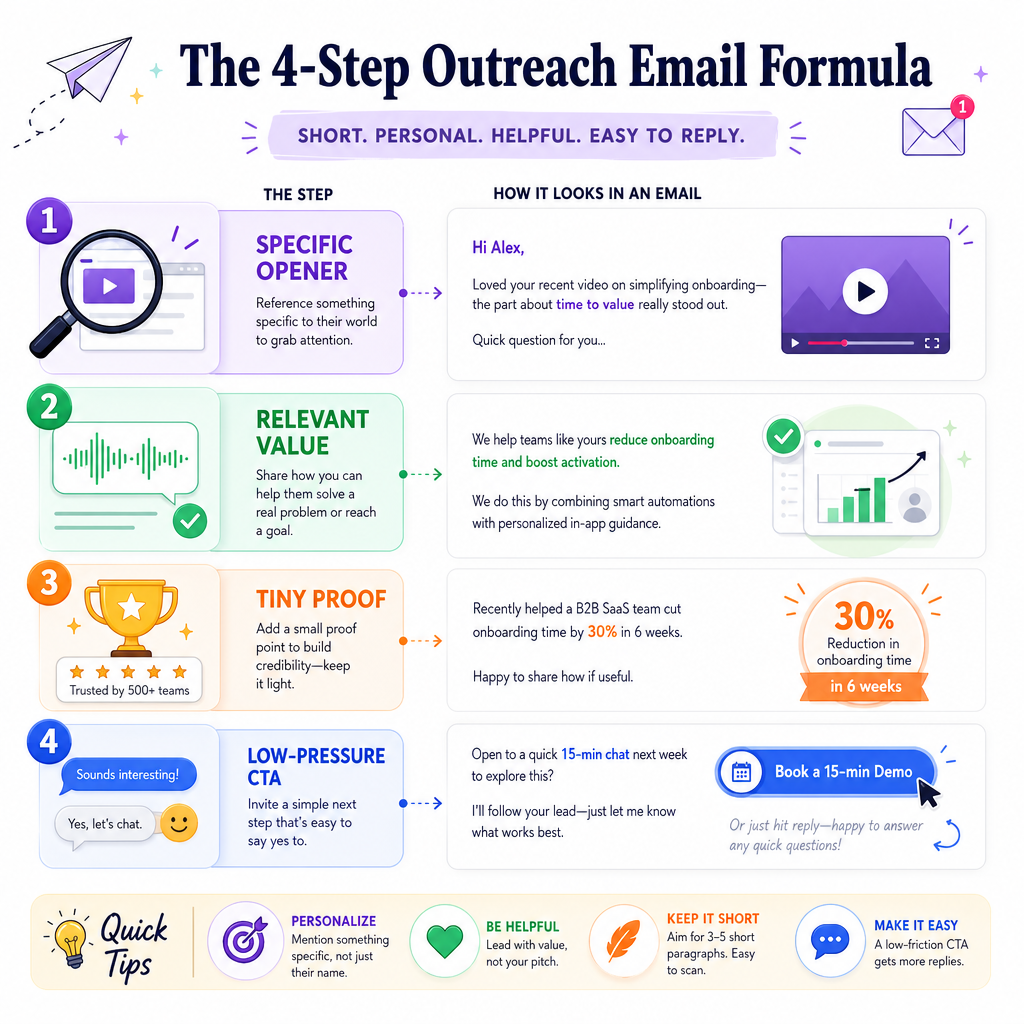
A simple outreach structure
Direct outreach works best when it sounds human, specific, and useful.
Use this four-part structure:
1. Specific opener
Mention something real: a recent video, ad, podcast intro, course, or campaign.
2. Relevant value
Connect your voice to their need.
3. Tiny proof
Share your demo or a short sample. Keep it easy to click.
4. Low-pressure call to action
Ask if they ever need voiceover support — not if they want to hire you immediately.
Example
Hi Maya, I saw the launch video for your new meal prep app. The pacing is clean and upbeat. I’m a voice actor with a warm, conversational sound that fits wellness and lifestyle explainers. Here’s a 45-second demo: [link]. If you ever need voiceover for app videos, ads, or tutorials, I’d be glad to help.
Notice the vibe: confident, clear, and not desperate.
Follow Up Rhythm
Most work comes from rhythm
A single message is like one drum hit. A pipeline has rhythm.
A simple weekly routine:
- Monday: find 10 leads
- Tuesday: send 5 thoughtful messages
- Wednesday: audition for 2–4 well-fit jobs
- Thursday: follow up with older leads
- Friday: review what worked and update your demo/profile notes
Follow-up can be short:
Hi Jordan, just floating this back up in case voiceover support is useful for upcoming videos. Happy to send a custom sample if helpful.
Do not guilt, pressure, or over-message. Two polite follow-ups is usually enough unless they invite more conversation.
```javascript
const weeklyPipeline = {
  Monday: "Find 10 leads",
  Tuesday: "Send 5 targeted messages",
  Wednesday: "Audition for 2-4 fitting jobs",
  Thursday: "Follow up with older leads",
  Friday: "Review results and update notes"
};

console.log("Voiceover job-finding rhythm:");
Object.entries(weeklyPipeline).forEach(([day, task]) => {
  console.log(`${day}: ${task}`);
});

const sent = 20;
const replies = 4;
const booked = 1;

console.log(`\nReply rate: ${((replies / sent) * 100).toFixed(1)}%`);
console.log(`Booking rate: ${((booked / sent) * 100).toFixed(1)}%`);
```
Protect Your Business
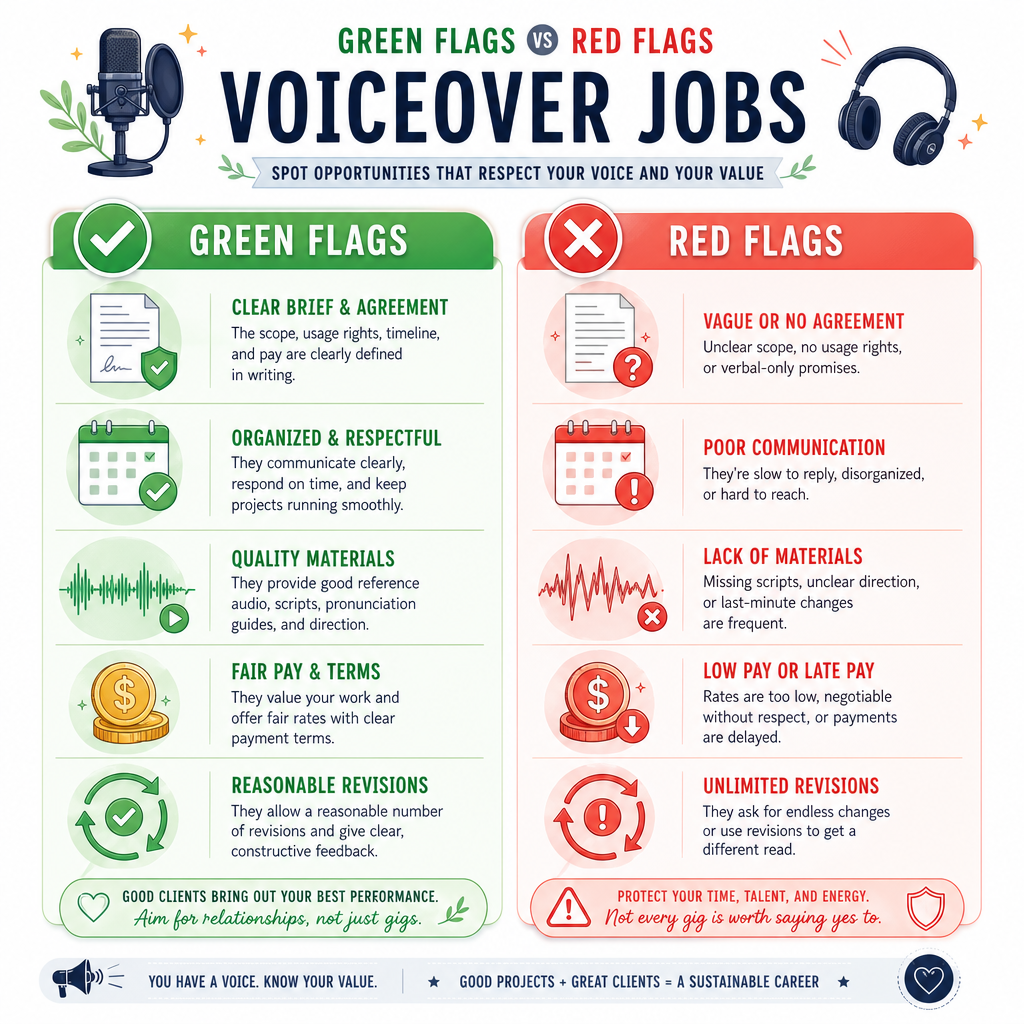
Green flags and red flags
Finding jobs is also learning which jobs to avoid.
Green flags
- Clear script, deadline, and usage
- Professional communication
- Reasonable revision expectations
- Payment terms are stated before recording
- The project fits your current studio quality
Red flags
- “Great exposure” instead of pay
- Full custom read required before hiring
- Vague usage for ads or paid media
- Unlimited revisions with no boundary
- Rush deadline but unclear direction
- Requests that make you uncomfortable
Your early goal is not just to get paid once. It is to become the kind of talent clients trust and rehire.
In the next lesson, we’ll shift from finding work to expanding your performance range by developing characters.