Following Up After Negotiation
Read at your own pace. Code execution, quizzes, progress tracking, and the AI tutor are available in the interactive view with JavaScript enabled.
After The Ask
The negotiation is not over when the call ends
You have already built the core inputs in Researching Salary Ranges, Determining Your Personal Salary Range, Preparing for Negotiation, Effective Communication in Negotiation, and Understanding Equity in Offers.
Now we focus on the part many strong candidates under-handle: the follow-up.
A good follow-up does three things:
- Preserves trust with the employer or manager
- Turns spoken details into written alignment
- Keeps optionality open if salary, equity, timing, or benefits are still moving
Think of it like reviewing a close Steelers game: the fourth quarter matters, but so does the post-game film. Follow-up is where you confirm what actually happened, what is still unresolved, and what the next play is.

Follow-Up State Machine
Treat follow-up like state management
As an experienced developer, you already know that bugs appear when state is implicit. Negotiation follow-up has the same risk.
After a conversation, you want to make the current state explicit:
Conversation happened
        |
        v
Send recap + thanks
        |
        v
Employer responds
   /       |        \
Accept   Counter   Delay
Your goal is not to pressure immediately. Your goal is to reduce ambiguity while keeping the relationship warm.
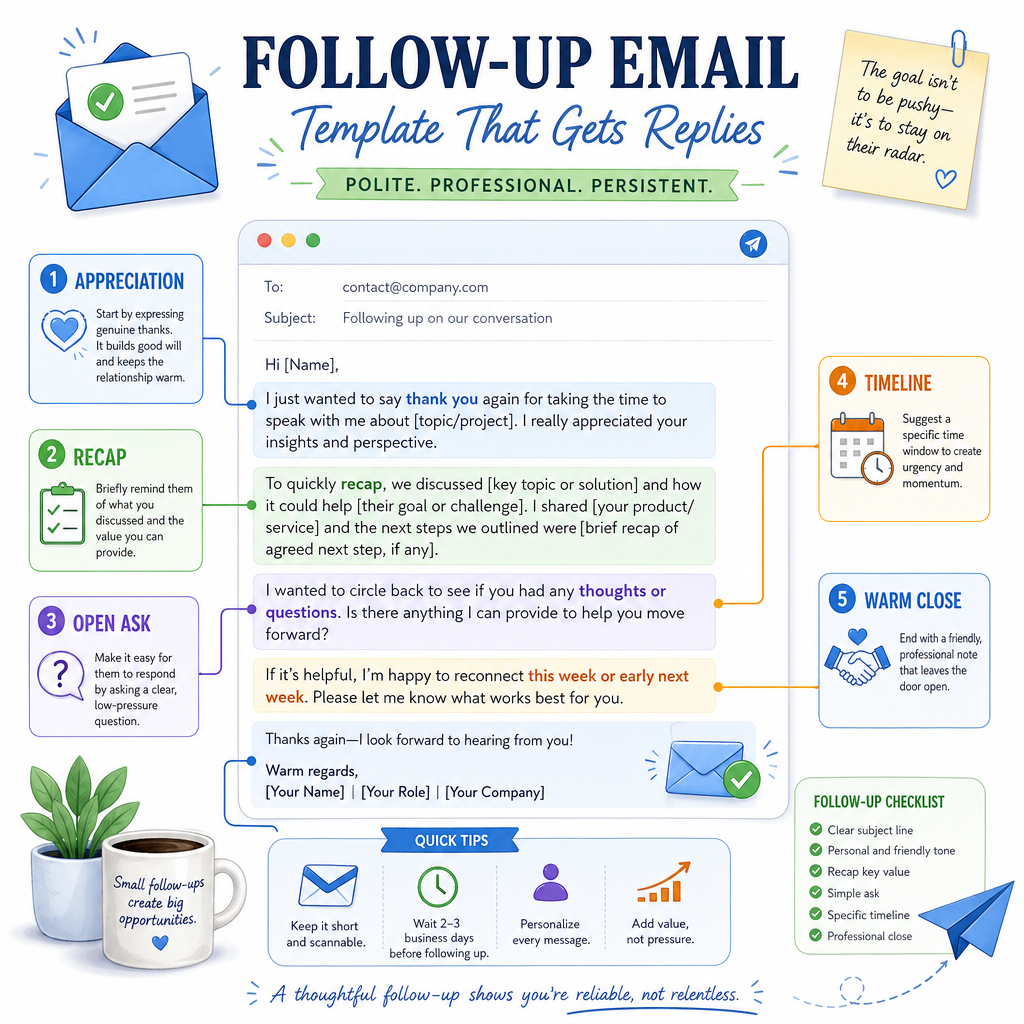
A useful follow-up message usually includes:
- Appreciation
- A brief recap of discussed terms
- Any open question or additional request
- A proposed next step or timeline
```cpp
#include <iostream>
#include <string>
#include <vector>

using namespace std;

enum class FollowUpState {
    ConversationComplete,
    RecapSent,
    WaitingForResponse,
    TermsConfirmed,
    MoreDiscussionNeeded
};

string label(FollowUpState state) {
    switch (state) {
        case FollowUpState::ConversationComplete: return "Conversation complete";
        case FollowUpState::RecapSent: return "Recap sent";
        case FollowUpState::WaitingForResponse: return "Waiting for response";
        case FollowUpState::TermsConfirmed: return "Terms confirmed";
        case FollowUpState::MoreDiscussionNeeded: return "More discussion needed";
    }
    return "Unknown";
}

int main() {
    vector<FollowUpState> flow = {
        FollowUpState::ConversationComplete,
        FollowUpState::RecapSent,
        FollowUpState::WaitingForResponse,
        FollowUpState::MoreDiscussionNeeded
    };

    cout << "Negotiation follow-up flow:\n";
    for (const auto& state : flow) {
        cout << "- " << label(state) << "\n";
    }

    cout << "\nNext message checklist:\n";
    cout << "1. Thank them for the conversation\n";
    cout << "2. Recap the terms discussed\n";
    cout << "3. Clarify the open item\n";
    cout << "4. Suggest a timeline for next steps\n";

    return 0;
}
```
Best First Follow-Up
You just finished a salary negotiation call. The employer said they would “see what they can do” and get back to you soon.
Which follow-up is strongest?
Write The Recap
Your recap is not a transcript
A good recap is short and selective. You are not documenting every sentence. You are capturing the decision-relevant points.
Use this structure:
Subject: Thank you — following up on compensation discussion

Hi [Name],

Thank you again for taking the time to discuss the offer today.
I’m excited about [role/team/company-specific reason].

Based on our conversation, I understand the current offer to be:
- Base salary: [$X]
- Bonus/equity/benefits: [summary]
- Start date or review timing: [summary]

The main item I’d like to revisit is [specific ask].
Would it be possible to review [request] and reconnect by [date]?

Thanks again,
[Your Name]
Notice the tone: clear, warm, and specific. You are creating a clean record while making it easy for the other person to help you.
Verbal Is Enough
True or false: If a hiring manager verbally agrees to improve compensation, you should avoid asking for written confirmation because it may seem distrustful.
Benefits Tradeoffs
If salary stalls, negotiate the package
Earlier, Introduction to Salary Negotiation framed compensation as more than one number. This is where that idea becomes practical.
If base salary cannot move, you may still have room on:
- Signing bonus
- Earlier salary review
- Remote or hybrid flexibility
- Professional development budget
- Additional PTO
- Relocation support
- Job title or level alignment
- Equity refresh timing
The key is to ask for benefits that are both valuable to you and plausible for them.
A Knicks front office cannot trade for every star at once; they rank assets, constraints, and fit. You should do the same with benefits.
```cpp
#include <algorithm>
#include <iostream>
#include <string>
#include <vector>

using namespace std;

struct BenefitAsk {
    string name;
    int valueToYou;        // 1-10
    int employerFlexibility; // 1-10
    int strategicFit;      // 1-10
};

int score(const BenefitAsk& ask) {
    return ask.valueToYou * 3 + ask.employerFlexibility * 2 + ask.strategicFit;
}

int main() {
    vector<BenefitAsk> asks = {
        {"$8k signing bonus", 8, 6, 7},
        {"remote Fridays", 7, 8, 8},
        {"salary review at 6 months", 9, 7, 9},
        {"extra week of PTO", 6, 5, 6},
        {"conference budget", 5, 8, 7}
    };

    sort(asks.begin(), asks.end(), [](const BenefitAsk& a, const BenefitAsk& b) {
        return score(a) > score(b);
    });

    cout << "Ranked benefit asks:\n";
    for (const auto& ask : asks) {
        cout << "- " << ask.name << " | score: " << score(ask) << "\n";
    }

    cout << "\nSuggested move: lead with the top 1-2, not the entire list.\n";
    return 0;
}
```
Name The Artifact
After a negotiation conversation, the short written message that thanks the employer, summarizes discussed terms, clarifies open items, and proposes next steps is often called a ________.
Handle The Outcome
Respond professionally to every result
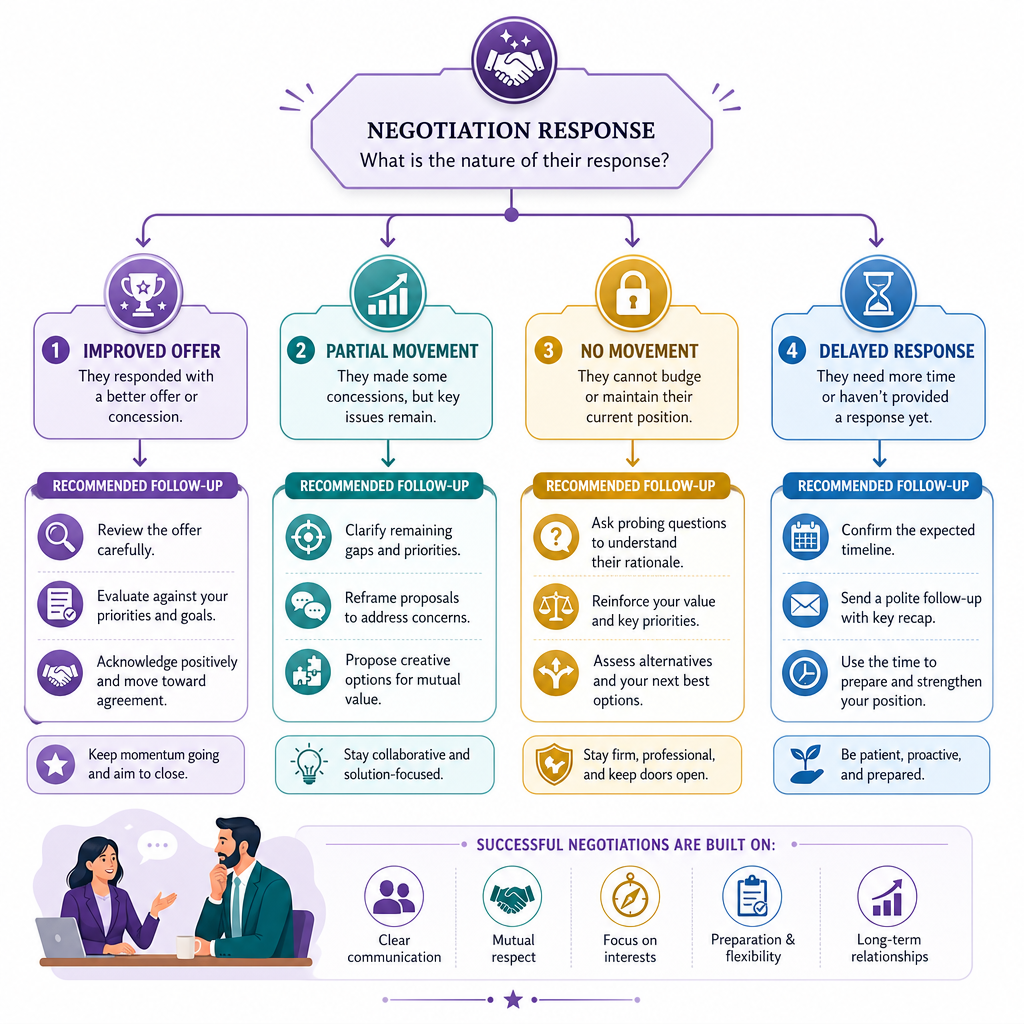
Your follow-up tone should not depend only on whether you “won.” It should reflect the professional reputation you want to keep.
If they improve the offer
Thank them, confirm the revised details, and ask for the complete written offer if you do not already have it.
If they partially improve it
Acknowledge the movement, compare it against your decision boundaries from Preparing for Negotiation, and decide whether to accept, make one more focused ask, or decline.
If they cannot improve it
Stay composed. You can still ask about timing, review cycles, benefits, or future compensation checkpoints.
If they delay
Ask for a specific date. Silence creates anxiety; timelines create clarity.
This professionalism also sets up the next lesson, where we will look at transitions and leaving a role well.
Partial Movement Choice
An employer increases the signing bonus but says base salary cannot move. The total package is close to your target but slightly below your preferred range.
What is the most professional next step?
Close The Loop
Your final follow-up should remove ambiguity
Once you decide, close the loop clearly. Do not leave the other side guessing.
A final response should include:
- Your decision
- Appreciation
- Confirmation of key terms if accepting
- Any immediate administrative next step
- A professional tone regardless of outcome
For Stephen King fans: ambiguity is great in horror, not in compensation. Your goal is not suspense; it is alignment.
```cpp
#include <iostream>
#include <string>

using namespace std;

enum class Decision { Accept, ContinueDiscussion, Decline };

string responseTemplate(Decision decision) {
    switch (decision) {
        case Decision::Accept:
            return "Thank you. I’m excited to accept the offer as outlined. Please send the final written agreement and next onboarding steps.";
        case Decision::ContinueDiscussion:
            return "Thank you for the update. I appreciate the movement and would like to discuss one remaining item before finalizing.";
        case Decision::Decline:
            return "Thank you for the time and consideration. After careful review, I’ve decided not to move forward, but I appreciate the opportunity.";
    }
    return "";
}

int main() {
    cout << "Accepting:\n" << responseTemplate(Decision::Accept) << "\n\n";
    cout << "Continuing:\n" << responseTemplate(Decision::ContinueDiscussion) << "\n\n";
    cout << "Declining:\n" << responseTemplate(Decision::Decline) << "\n";
    return 0;
}
```