Introduction to Algorithmic Trading
Read at your own pace. Code execution, quizzes, progress tracking, and the AI tutor are available in the interactive view with JavaScript enabled.
Course Starting Point
Welcome to algo trading with C++
In trading, time matters. A human may take seconds to read a chart and click a button. A program can evaluate a rule, check risk limits, and prepare an order in milliseconds—or faster.
This first lesson sets the mental model for the course:
- What algorithmic trading means
- Why C++ is used in speed-sensitive systems
- What parts make up a trading application
- What we will build toward in later lessons
You already have intermediate C++ knowledge, so we will connect trading ideas to familiar programming concepts: functions, structs, loops, timing, and clean system design.
Important: this course teaches software engineering for trading systems. It is not financial advice or a guarantee of profit.

What Is Algo Trading
Algorithmic trading in one sentence
Algorithmic trading means using a program to make trading decisions and interact with markets based on predefined rules.
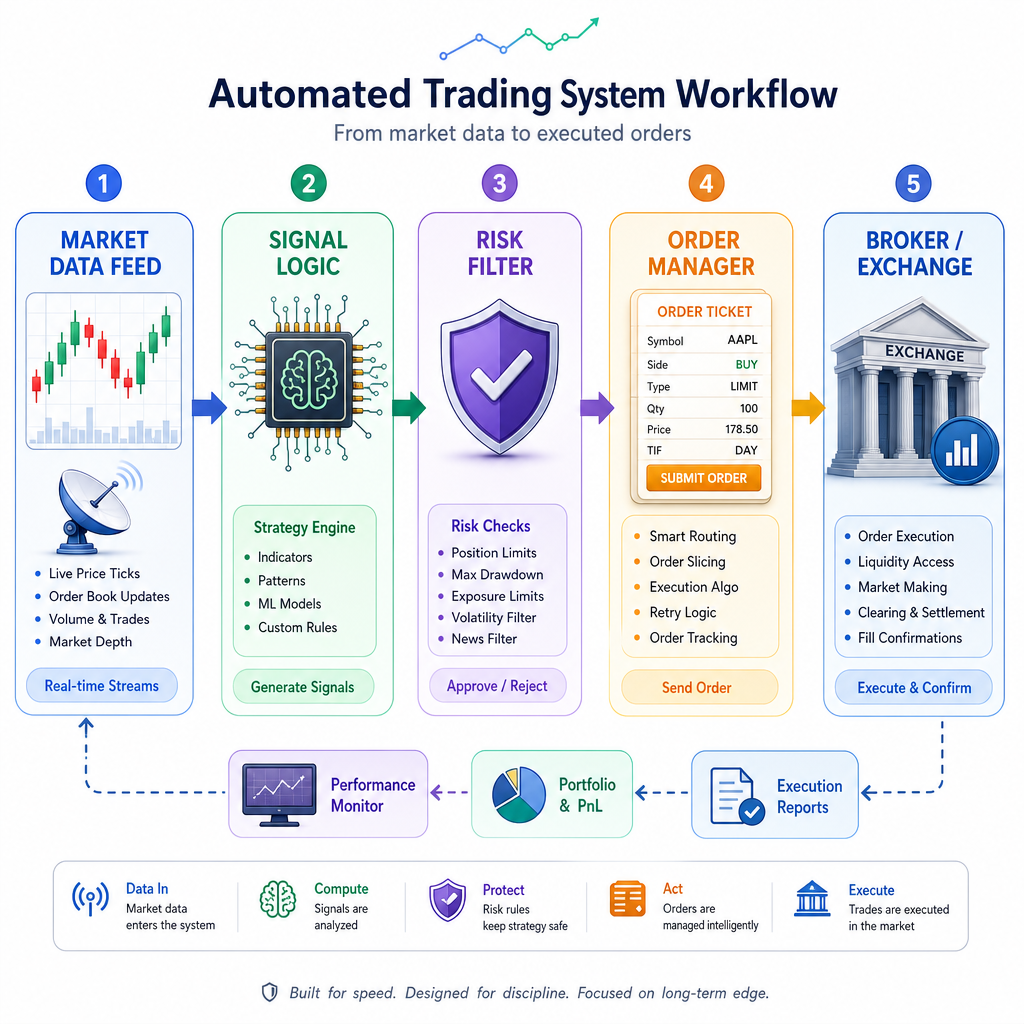
A simplified flow looks like this:
Market data -> Trading logic -> Risk checks -> Order decision -> Exchange/Broker
A trading algorithm might ask questions like:
- Did the price move above a threshold?
- Is volume unusually high?
- Are we already holding too much position?
- Should we buy, sell, or do nothing?
The key idea is not just “automation.” It is repeatable decision-making under strict time and risk constraints.
In this lesson, we stay at the system level. Later lessons will go deeper into environment setup, data structures, market data, strategy logic, risk management, backtesting, and deployment.
Core Idea Check
Which statement best describes algorithmic trading?
Why C++ Matters
Speed is useful—but predictability matters too
C++ is popular in high-performance trading systems because it gives developers strong control over:
- Memory allocation
- CPU usage
- Data layout
- System-level networking
- Latency-sensitive execution paths
In trading systems, two timing ideas matter:
- Latency: how long one operation takes
- Throughput: how many operations can be handled per second
For example, if new prices arrive very quickly, your application must process them without falling behind.
The small program below measures how long a simple decision loop takes. This is not a real trading strategy—it is just a first look at thinking in terms of measured execution time.
```cpp
#include <chrono>
#include <iostream>
#include <vector>

int main() {
    std::vector<double> prices = {100.10, 100.25, 100.40, 100.15, 100.60};
    double threshold = 100.30;
    int signals = 0;

    auto start = std::chrono::high_resolution_clock::now();

    for (double price : prices) {
        if (price > threshold) {
            ++signals;
        }
    }

    auto end = std::chrono::high_resolution_clock::now();
    auto nanos = std::chrono::duration_cast<std::chrono::nanoseconds>(end - start).count();

    std::cout << "Signals found: " << signals << '\n';
    std::cout << "Decision loop time: " << nanos << " ns\n";

    return 0;
}
```
Speed Myth
True or false: If an algo trading application is fast, it is automatically safe and profitable.
Application Building Blocks
A trading application is a system
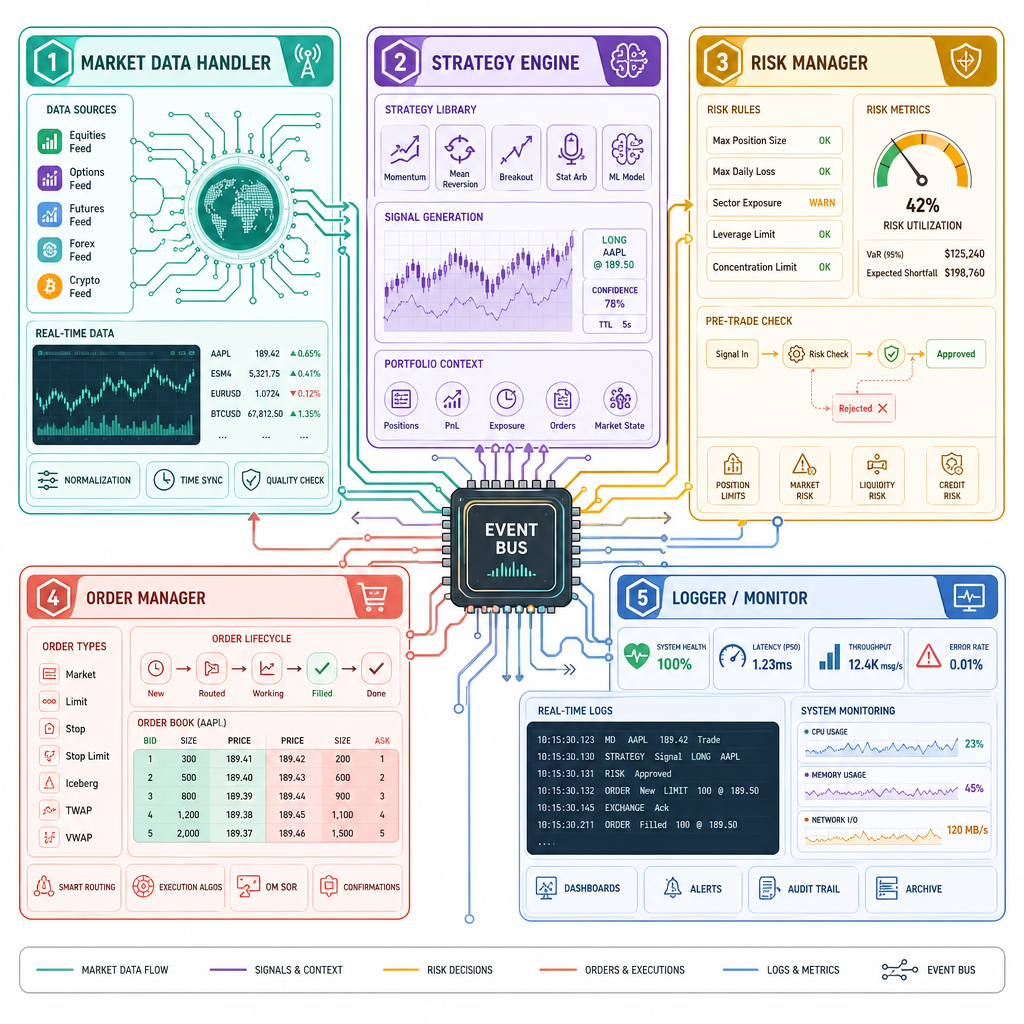
Even a simple algo trading application usually has several cooperating parts:
Component Responsibility Market data handler Receives price and volume updates Strategy engine Decides whether conditions are interesting Risk manager Blocks dangerous or oversized actions Order manager Prepares and tracks orders Logger/monitor Records behavior for debugging and auditA common beginner mistake is to think only about the “buy/sell formula.” In real applications, the surrounding system is just as important.
For now, remember this mental model:
Input data + decision rules + risk boundaries + execution path
This course will gradually turn that model into C++ code.
A Tiny Decision Engine
From market observation to action label
At the heart of many trading systems is a small piece of logic that converts incoming information into an action.
In real trading, this decision must consider data quality, costs, position size, risk limits, exchange rules, and many other details. Here we use a deliberately tiny example to show the shape of the idea in C++.
The program receives a mock price tick and prints one of three possible actions: BUY, SELL, or HOLD.
```cpp
#include <iostream>
#include <string>

struct Tick {
    std::string symbol;
    double price;
};

enum class Action {
    Buy,
    Sell,
    Hold
};

std::string toString(Action action) {
    switch (action) {
        case Action::Buy: return "BUY";
        case Action::Sell: return "SELL";
        case Action::Hold: return "HOLD";
    }
    return "UNKNOWN";
}

Action decide(const Tick& tick, double buyLevel, double sellLevel) {
    if (tick.price <= buyLevel) {
        return Action::Buy;
    }
    if (tick.price >= sellLevel) {
        return Action::Sell;
    }
    return Action::Hold;
}

int main() {
    Tick tick{"ABC", 99.75};

    double buyLevel = 100.00;
    double sellLevel = 103.00;

    Action action = decide(tick, buyLevel, sellLevel);

    std::cout << "Symbol: " << tick.symbol << '\n';
    std::cout << "Price: " << tick.price << '\n';
    std::cout << "Decision: " << toString(action) << '\n';

    return 0;
}
```
Key Term
Fill in the blank:
The time delay between receiving information and producing a response is called ____.
Real-World Constraints
Trading software has consequences
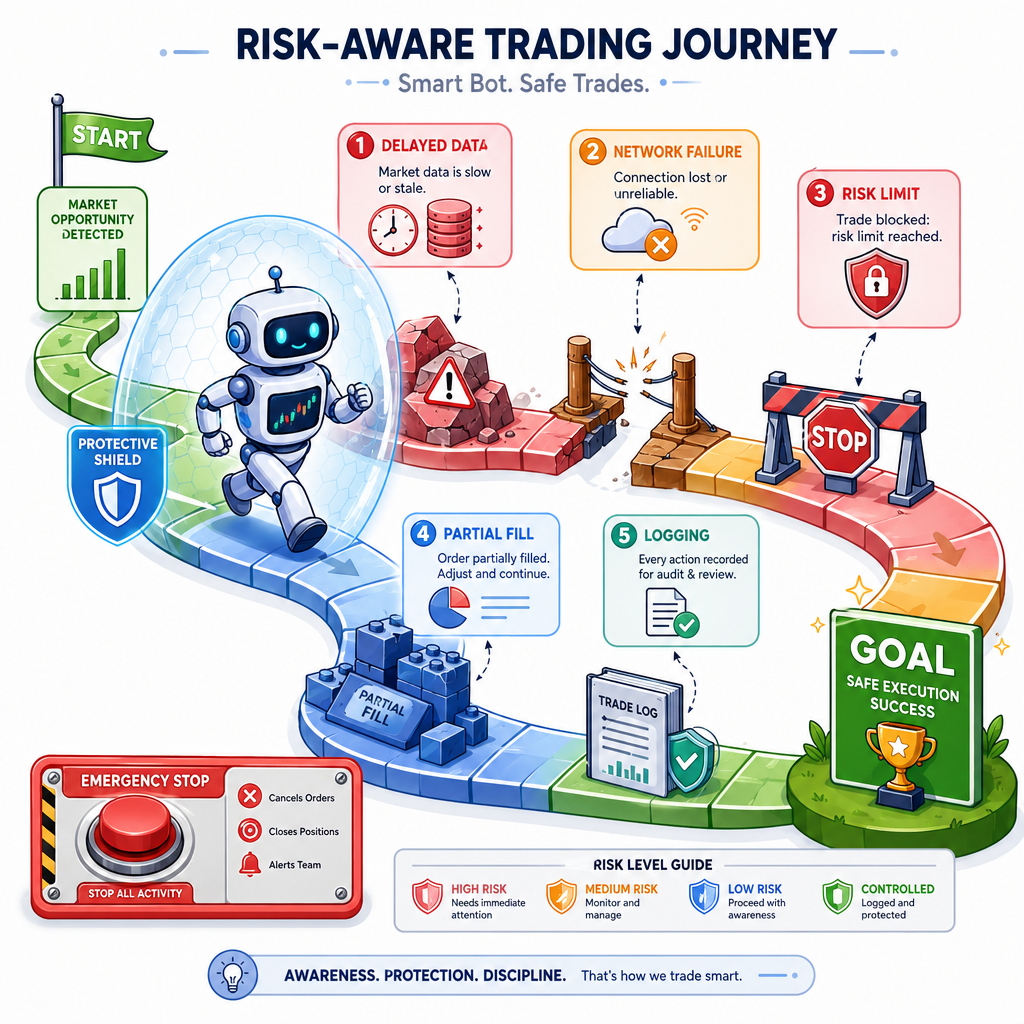
Algo trading is exciting because it combines programming, data, math, systems design, and markets. But real systems must handle messy conditions.
Examples include:
- Missing or delayed data
- Sudden price gaps
- Network disconnects
- Duplicate messages
- Orders that are partially filled
- Logic bugs that repeat too quickly
- Market rules and broker restrictions
This is why professional systems are built defensively. They do not simply ask, “Can we trade fast?” They ask:
- Is the input valid?
- Is the decision explainable?
- Is the risk acceptable?
- Can we stop safely?
- Can we inspect what happened afterward?
As we progress, you will see how C++ helps us build systems that are not only fast, but also structured and measurable.
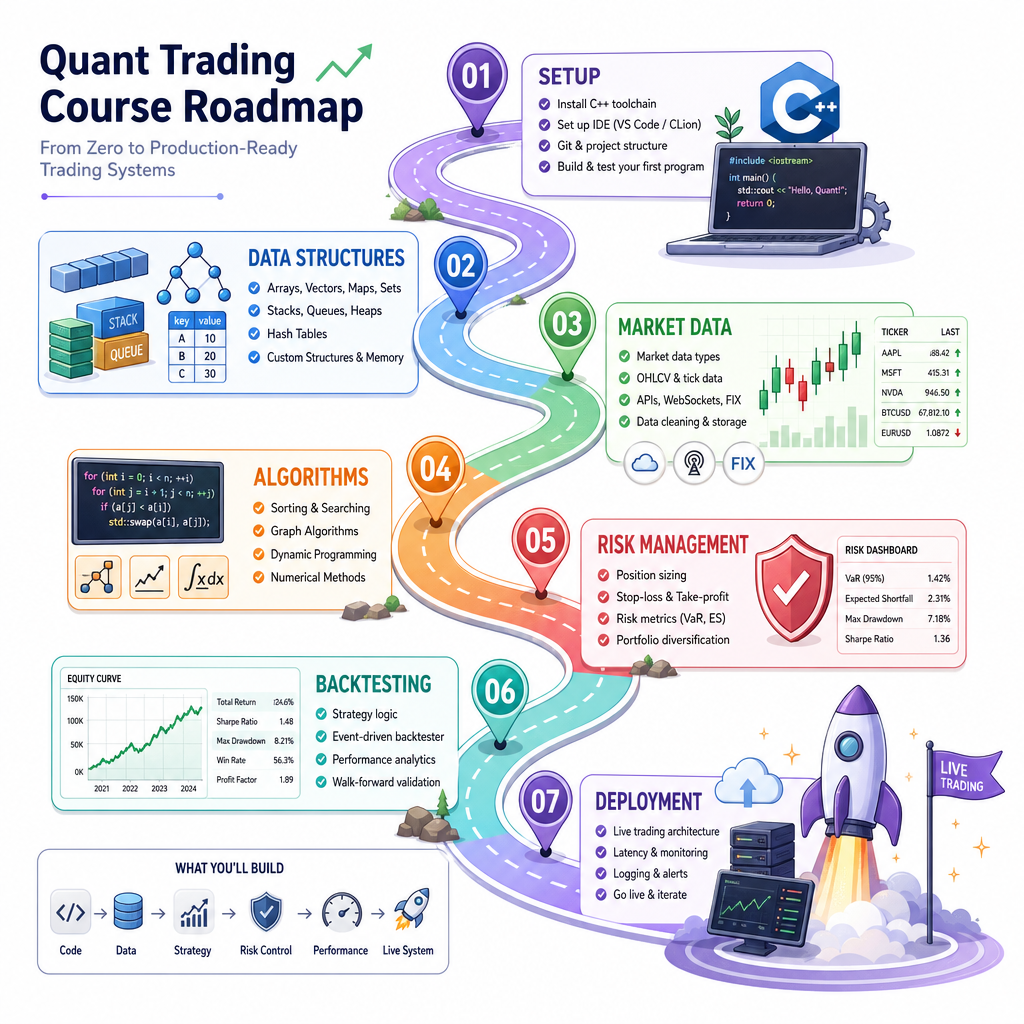
Course Roadmap
Where we go from here
You now have the big picture: an algo trading application is a fast, rule-driven system that processes market data, makes decisions, checks risk, and communicates with trading infrastructure.
Next, we will prepare the C++ development environment so the rest of the course has a reliable foundation.
After that, each lesson adds one layer:
- Set up the C++ tooling
- Choose data structures for fast processing
- Acquire and represent market data
- Develop trading logic
- Add risk management
- Backtest and optimize
- Deploy the application carefully
Keep this lesson’s core model in mind:
Market data -> Decision logic -> Risk control -> Order handling -> Monitoring
That flow will guide the entire course.