Introduction to Data Engineering
Read at your own pace. Code execution, quizzes, progress tracking, and the AI tutor are available in the interactive view with JavaScript enabled.
Course Starting Point
Welcome to Data Engineering
This first lesson sets the mental model for the whole course: data engineering is about making data usable, reliable, and available at the right time.
You already know Python, SQL, and Spark, so we will not treat data as a mystery. Instead, we will focus on how production data systems are designed:
- Where data comes from
- How it moves
- Where it is stored
- How people query and trust it
- How pipelines stay reliable as volume grows
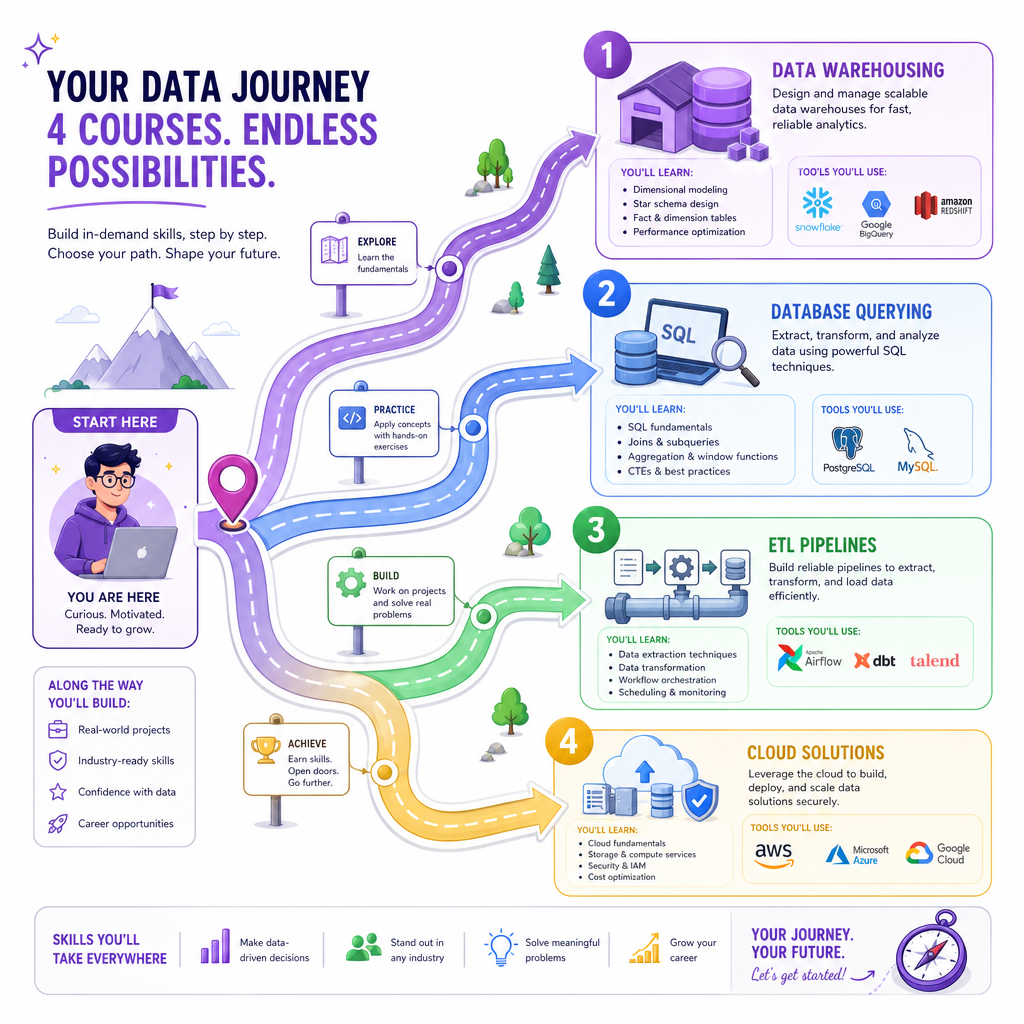
In later lessons, we will zoom into data warehousing, database querying, ETL pipelines, and cloud solutions. For now, we are building the map.

What Engineers Build
Data engineering turns raw data into dependable systems
A data engineer designs and maintains the infrastructure that lets an organization use data repeatedly and safely.
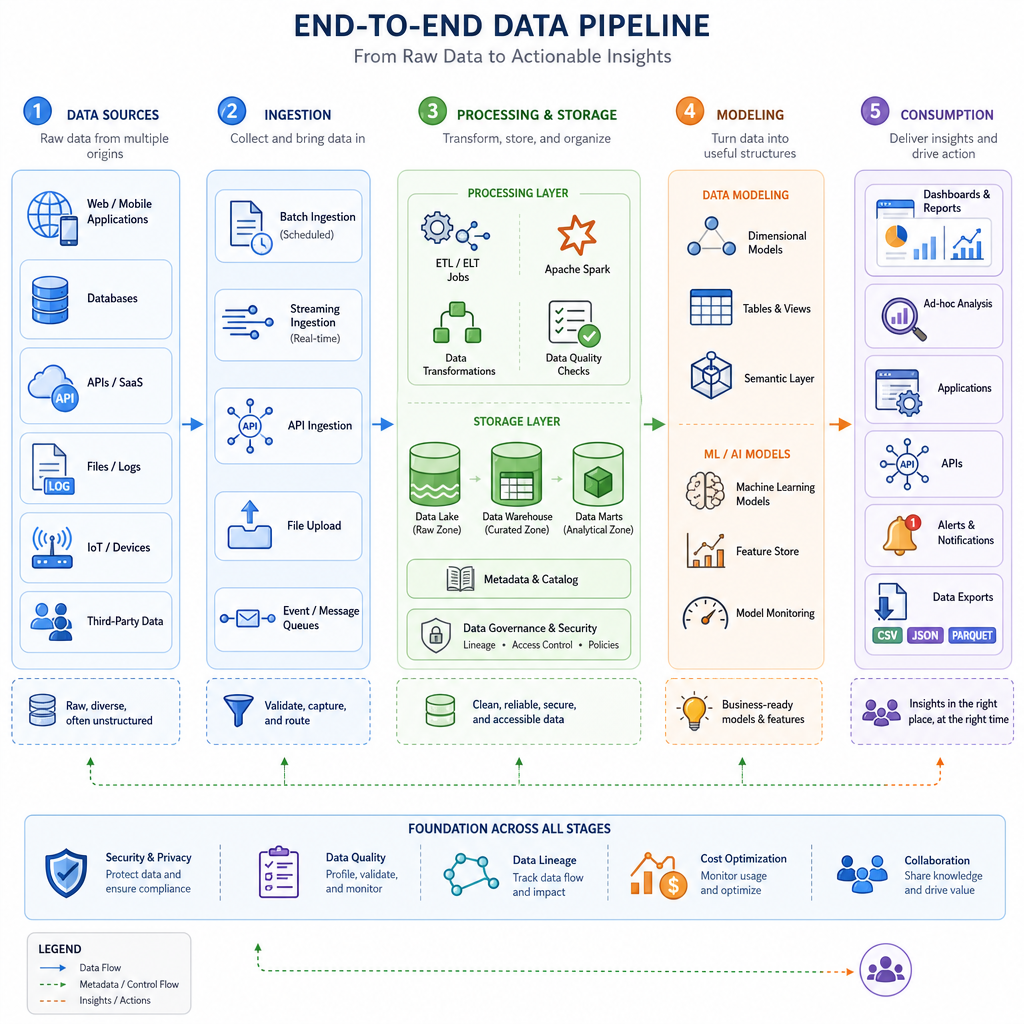
A common flow looks like this:
Applications / APIs / Logs / Files
              |
              v
        Data Ingestion
              |
              v
      Processing & Cleaning
              |
              v
      Storage & Modeling
              |
              v
 Analytics / ML / Dashboards / Products
The key idea: data engineering is not just moving bytes around. It is about building repeatable, observable, and trustworthy paths from source systems to data consumers.
A Tiny Pipeline
The smallest useful data pipeline
At its simplest, a data pipeline does three things:
- Read data from somewhere
- Transform it into a better shape
- Produce output someone can use
Here is a tiny Python example. It turns raw event records into a basic metric: total purchase revenue.
```python
raw_events = [
    {"user_id": 1, "event": "view", "amount": 0},
    {"user_id": 1, "event": "purchase", "amount": 29.99},
    {"user_id": 2, "event": "purchase", "amount": 15.00},
    {"user_id": 3, "event": "view", "amount": 0},
]

purchase_events = [
    event for event in raw_events
    if event["event"] == "purchase"
]

total_revenue = sum(event["amount"] for event in purchase_events)

print(f"Purchases: {len(purchase_events)}")
print(f"Total revenue: ${total_revenue:.2f}")
```
Role Check
Which task is most characteristic of a data engineer?
Core Responsibilities
What data engineers are accountable for
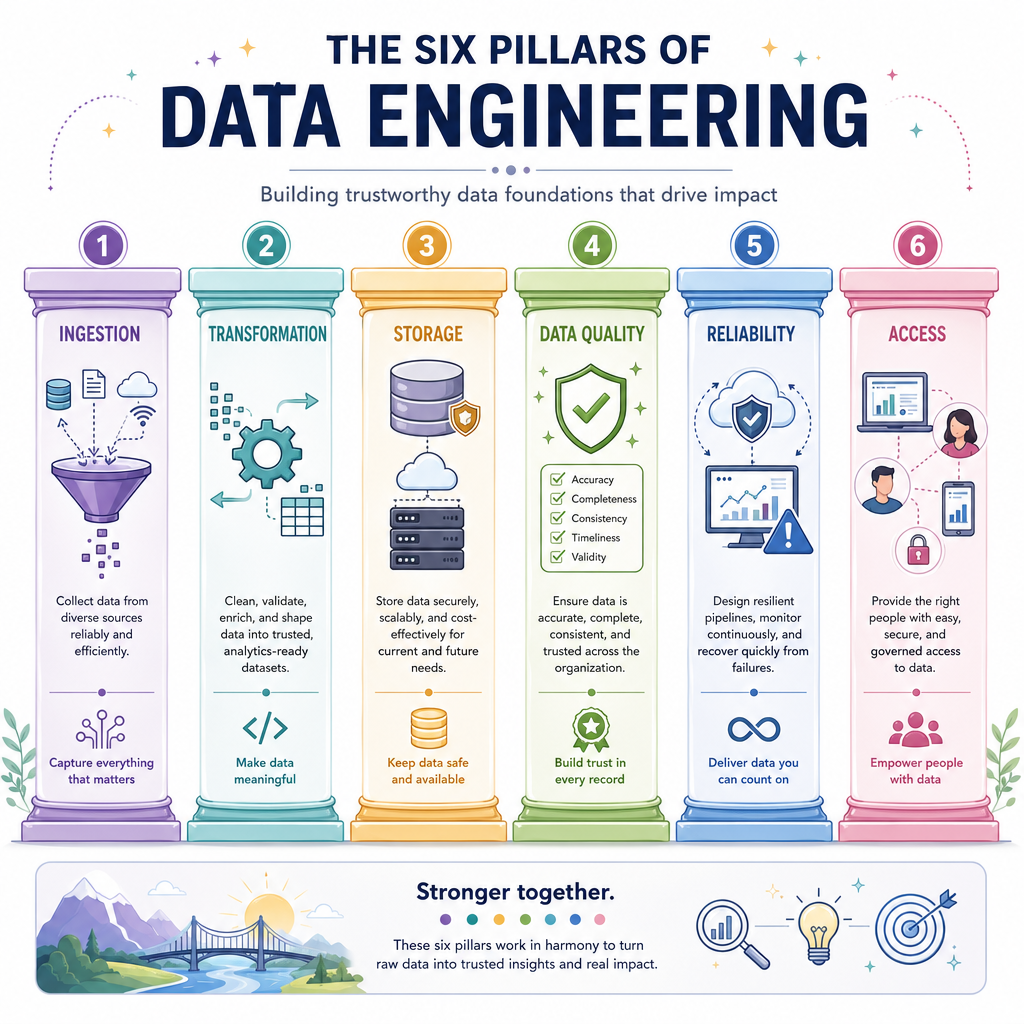
Data engineers usually work across several responsibilities:
Responsibility Practical meaning Ingestion Bring data from files, APIs, applications, logs, or databases into controlled systems Transformation Clean, standardize, join, aggregate, or reshape data Storage Choose structures that support efficient access and long-term use Data quality Detect missing, malformed, duplicated, or suspicious data Reliability Make jobs repeatable, monitored, and recoverable Access Help analysts, scientists, apps, and teams use the right data safelyYou can think of data engineering as the connective tissue between operational systems and decision-making systems.
Batch Only?
True or false: Data engineering is only about writing scheduled batch scripts that run once per day.
Data Contracts
Trust starts with expectations
A production data system needs more than a script that works once. It needs expectations about what valid data looks like.
A simple data contract might say:
-
user_idmust be present -
eventmust be one of a known set of values -
amountmust be numeric and non-negative
In real systems, these expectations prevent bad upstream changes from silently breaking dashboards, models, or reports.
```python
allowed_events = {"view", "add_to_cart", "purchase"}

records = [
    {"user_id": 1, "event": "view", "amount": 0},
    {"user_id": 2, "event": "purchase", "amount": 19.99},
    {"user_id": None, "event": "signup", "amount": -5},
]

def validate(record):
    errors = []

    if record.get("user_id") is None:
        errors.append("missing user_id")

    if record.get("event") not in allowed_events:
        errors.append("unknown event")

    amount = record.get("amount")
    if not isinstance(amount, (int, float)) or amount < 0:
        errors.append("invalid amount")

    return errors

for i, record in enumerate(records, start=1):
    errors = validate(record)
    status = "valid" if not errors else f"invalid: {errors}"
    print(f"record {i}: {status}")
```
Name The System
Fill in the blank:
A repeatable process that moves and transforms data from sources to useful destinations is commonly called a data ______.
Reliability Mindset
Data engineering is production engineering
A useful pipeline should behave predictably when it runs more than once.
One important property is idempotency: rerunning the same job with the same input should not create duplicate or inconsistent output.
Below, the pipeline stores events by event_id. If the same event arrives again, it updates the existing record instead of duplicating it.
```python
incoming_events = [
    {"event_id": "e1", "user_id": 10, "event": "view"},
    {"event_id": "e2", "user_id": 10, "event": "purchase"},
    {"event_id": "e1", "user_id": 10, "event": "view"},  # duplicate
]

stored_events = {}

for event in incoming_events:
    stored_events[event["event_id"]] = event

print(f"Incoming records: {len(incoming_events)}")
print(f"Stored unique events: {len(stored_events)}")
print("Event IDs:", sorted(stored_events.keys()))
```
What Comes Next
Your course map
You now have the core frame: data engineering builds reliable paths from raw data to usable data products.
Next, we will explore the major areas that make this possible:
- Data Warehousing: where analytical data lives and how it is organized
- Database Querying: how data is retrieved, filtered, joined, and inspected
- ETL Pipelines: how data movement and transformation are structured in practice
- Cloud Solutions: how modern infrastructure supports scalable data systems
Keep the big question in mind throughout the course: How do we make data trustworthy and useful at scale?