Introduction to Data Structures
Read at your own pace. Code execution, quizzes, progress tracking, and the AI tutor are available in the interactive view with JavaScript enabled.
Crash Course Start
Welcome to Day 1
This 30-day crash course is about building enough data structures and algorithms fluency to solve easy and medium problems with confidence.
Today starts with the mental toolkit: data structures.
A data structure is a way to organize data so certain actions become easier:
- Find something quickly
- Add or remove items cleanly
- Keep order
- Avoid duplicates
- Model relationships
Over the next lessons, we will build on this foundation with recursion, sorting, hash tables, graphs, divide and conquer, and dynamic programming. For now, focus on one question:
What structure makes this problem easier?

Why Structures Matter
Data is not enough
Imagine you have a pile of names:
Mia, Omar, Chen, Ava, Leo
If you only need to print them, almost any format works.
But if you need to answer questions like:
- Who came first?
- Is Ava present?
- Remove the most recent person
- Process people in arrival order
- Count each name once
Then the organization matters.
A good data structure matches the problem's most important operations.
Lists Are Workhorses
Python lists
A Python list is usually your first go-to structure.
It is useful when you need:
- Ordered items
- Access by position
- Appending to the end
- Iterating through everything
Think of a list as a row of boxes, each with an index.
index:   0    1    2    3
value:  10   20   30   40
Lists are excellent for many beginner problems, but not every operation is equally cheap. For example, adding to the end is usually simple, while inserting at the front may require shifting many elements.
```python
numbers = [10, 20, 30, 40]

print("Full list:", numbers)
print("First item:", numbers[0])
print("Last item:", numbers[-1])

numbers.append(50)
print("After append:", numbers)

removed = numbers.pop()
print("Removed:", removed)
print("Final list:", numbers)
```
Pick The Structure
You are modeling people waiting in line at a coffee shop.
The first person who arrives should be the first person served.
Which structure best matches this behavior?
Stacks And Queues
Two simple patterns
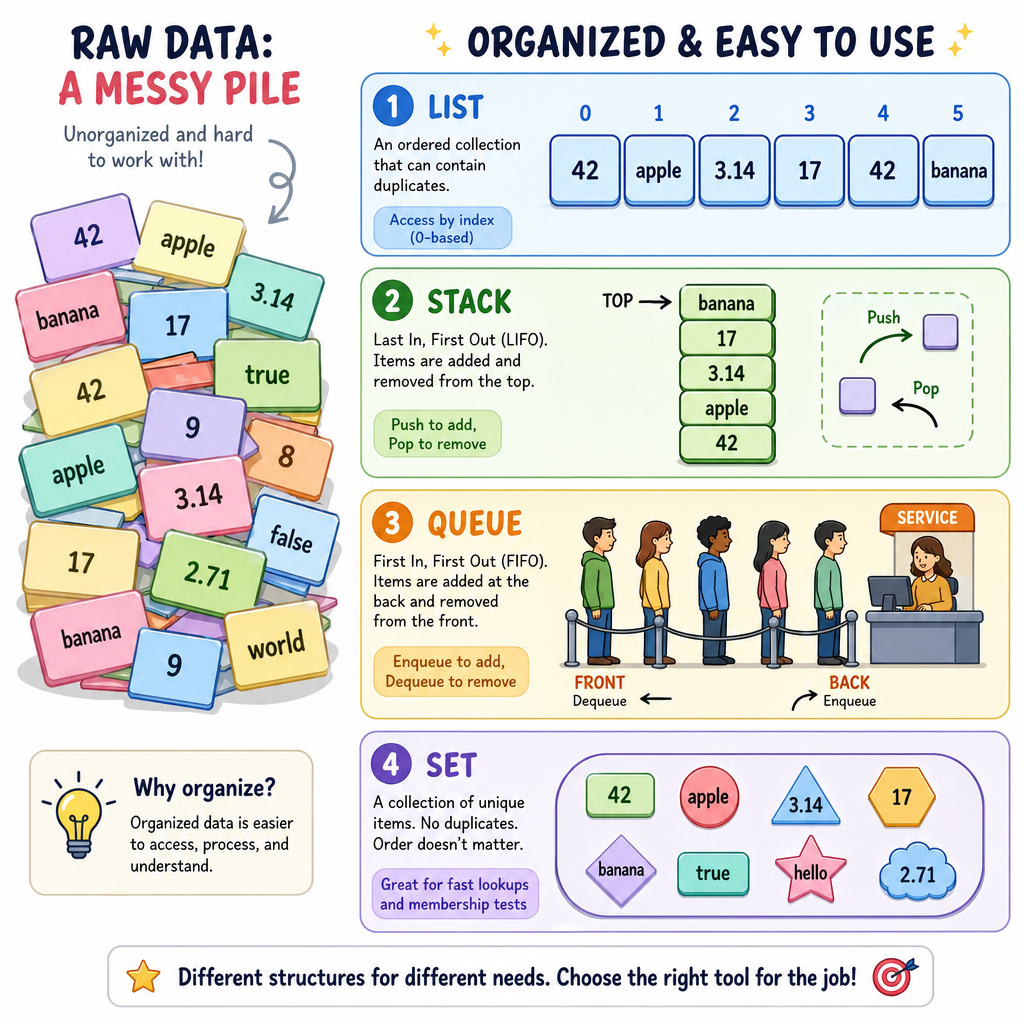
Two classic structures appear constantly in algorithm problems:
Stack
A stack is last in, first out.
push A, push B, push C
pop -> C
Use this when the most recent item matters.
Queue
A queue is first in, first out.
enqueue A, enqueue B, enqueue C
dequeue -> A
Use this when arrival order matters.
In Python, collections.deque is a strong practical choice for queues because removing from the left is efficient.
```python
from collections import deque

# Stack using a list
stack = []
stack.append("A")
stack.append("B")
stack.append("C")
print("Stack pop:", stack.pop())
print("Stack now:", stack)

# Queue using deque
queue = deque()
queue.append("A")
queue.append("B")
queue.append("C")
print("Queue popleft:", queue.popleft())
print("Queue now:", list(queue))
```
Index Access
True or false:
If you already know the index, getting items[3] from a Python list is usually fast because Python can jump directly to that position.
Sets And Maps
Membership and labels
Two other everyday structures are set and dict.
Set
A set stores unique values.
Good for questions like:
- Have I seen this before?
- Remove duplicates
- Is this value present?
Dictionary
A dict stores key-value pairs.
Good for questions like:
- What count belongs to this word?
- What user data belongs to this ID?
- What index belongs to this value?
We will study hash tables more deeply later. For now, treat sets and dictionaries as tools for fast membership and lookup.
```python
names = ["Ava", "Leo", "Ava", "Mia", "Leo"]

unique_names = set(names)
print("Unique names:", unique_names)

counts = {}
for name in names:
    counts[name] = counts.get(name, 0) + 1

print("Counts:", counts)
print("Have we seen Mia?", "Mia" in unique_names)
print("Have we seen Omar?", "Omar" in unique_names)
```
Stack Acronym
Fill in the blank:
A stack is often described as last in, first out, abbreviated as ____.
Choose By Operation
Ask the practical question
When solving algorithm problems, beginners often ask:
What data structure should I use?
A better version is:
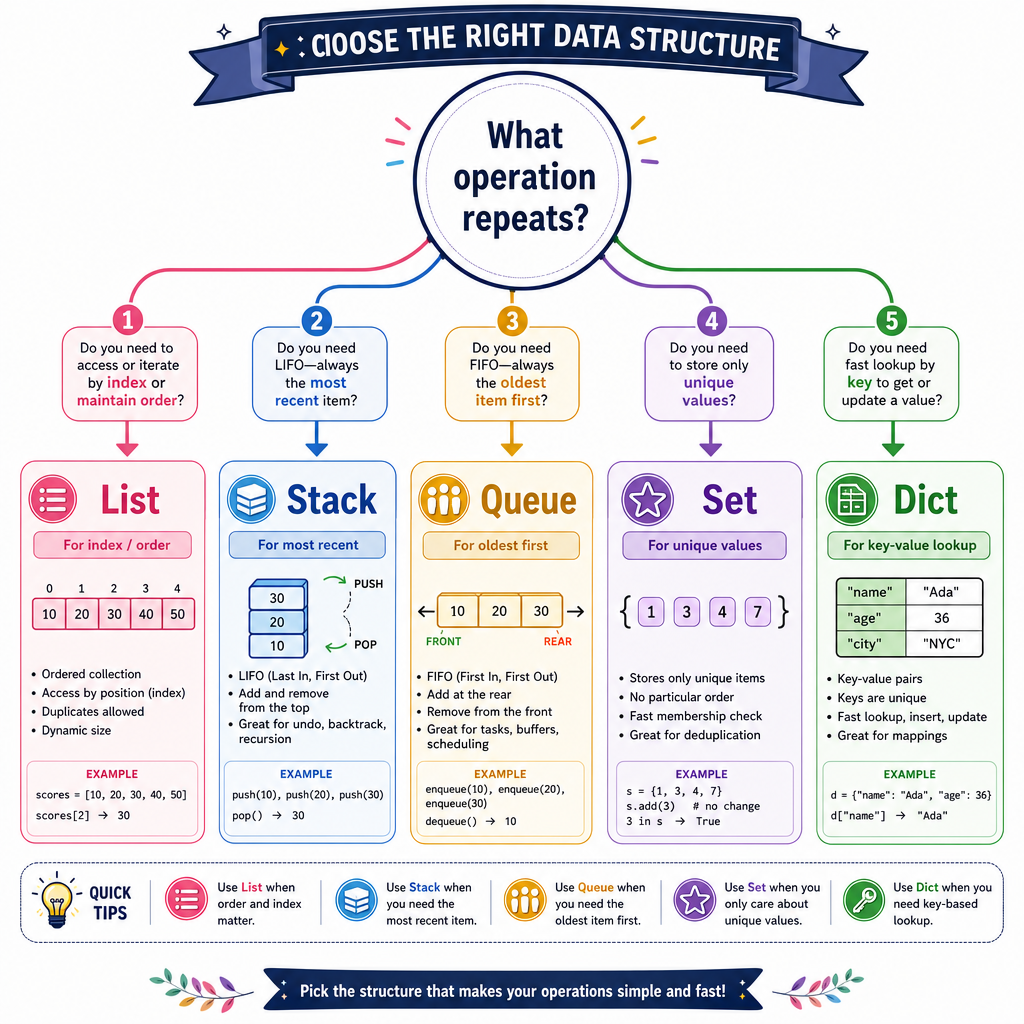
What operation do I need to do over and over?
Use this quick guide:
Need Consider Keep order and access by indexlist
Add/remove most recent item
stack
Process oldest item first
queue / deque
Track unique values
set
Associate keys with values
dict
This habit will make upcoming lessons easier because algorithms are often just smart operation choices repeated many times.
Your Review Loop
How to practice today
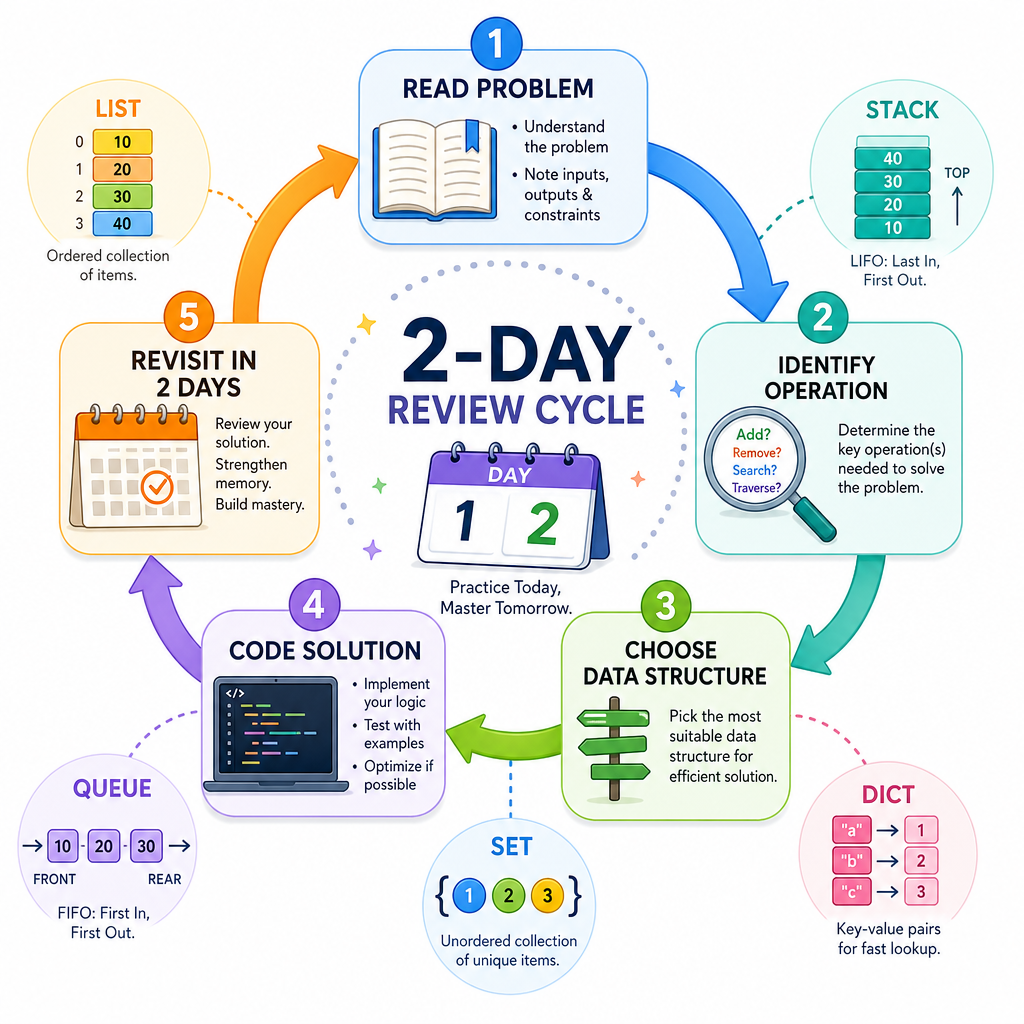
For this course, you are not just learning concepts once. You are building a review loop.
For today's data structures, practice recognizing the pattern:
- Read the problem statement.
- Identify the repeated operation.
- Pick a structure that makes that operation natural.
- Implement the simplest working version.
- Revisit the same problem in about 2 days.
That last step matters. Repetition turns recognition into speed.
In the next lesson, we will move from storing data to solving problems where functions call themselves: recursion.