Introduction to Dynamic Programming
Read at your own pace. Code execution, quizzes, progress tracking, and the AI tutor are available in the interactive view with JavaScript enabled.
Course Orientation
Why this lesson matters
Dynamic Programming, or DP, is one of the biggest jumps many engineers make when moving from everyday application logic to advanced algorithmic problem solving.
As a full stack engineer, you already think in terms of decomposition: routes, components, services, queues, caches, and infrastructure layers. DP uses a similar instinct, but applies it to optimization problems where the same smaller decisions keep showing up.
In this first lesson, we will set the mental model:
- What Dynamic Programming is
- What kinds of problems it solves
- Why repeated subproblems matter
- How storing earlier answers changes performance
Later lessons will go deeper into recursion, memoization, top-down DP, bottom-up DP, and optimization techniques.
The Core Idea
Dynamic Programming in one sentence
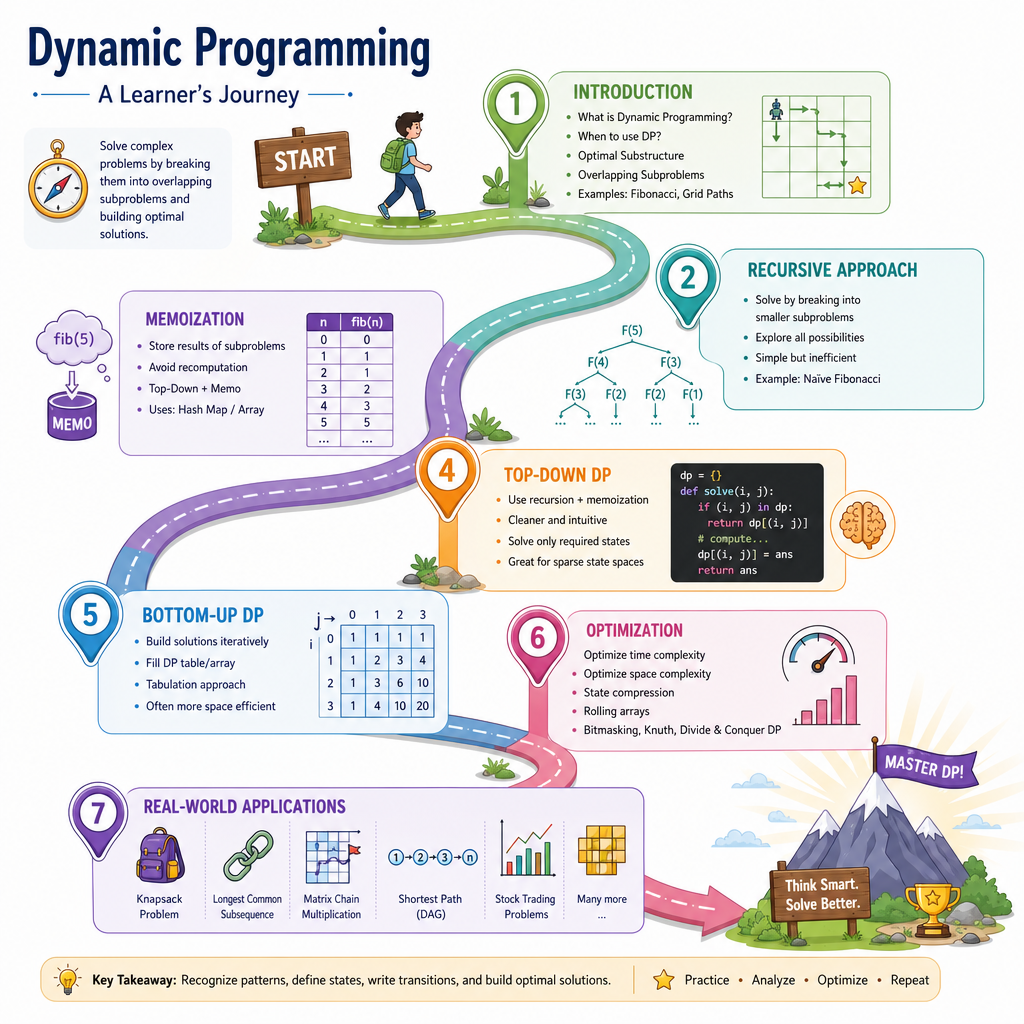
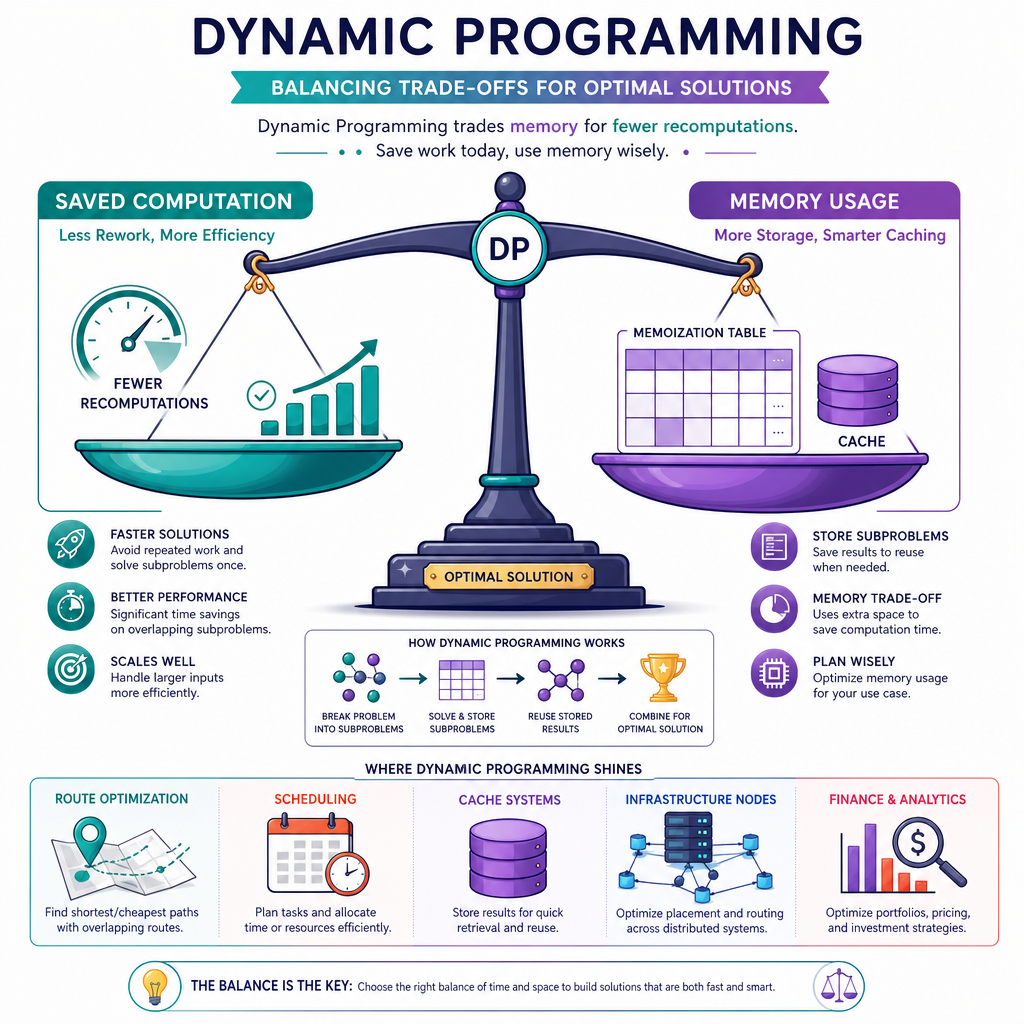
Dynamic Programming solves a large problem by solving smaller, reusable subproblems and combining their answers.
The key word is reusable.
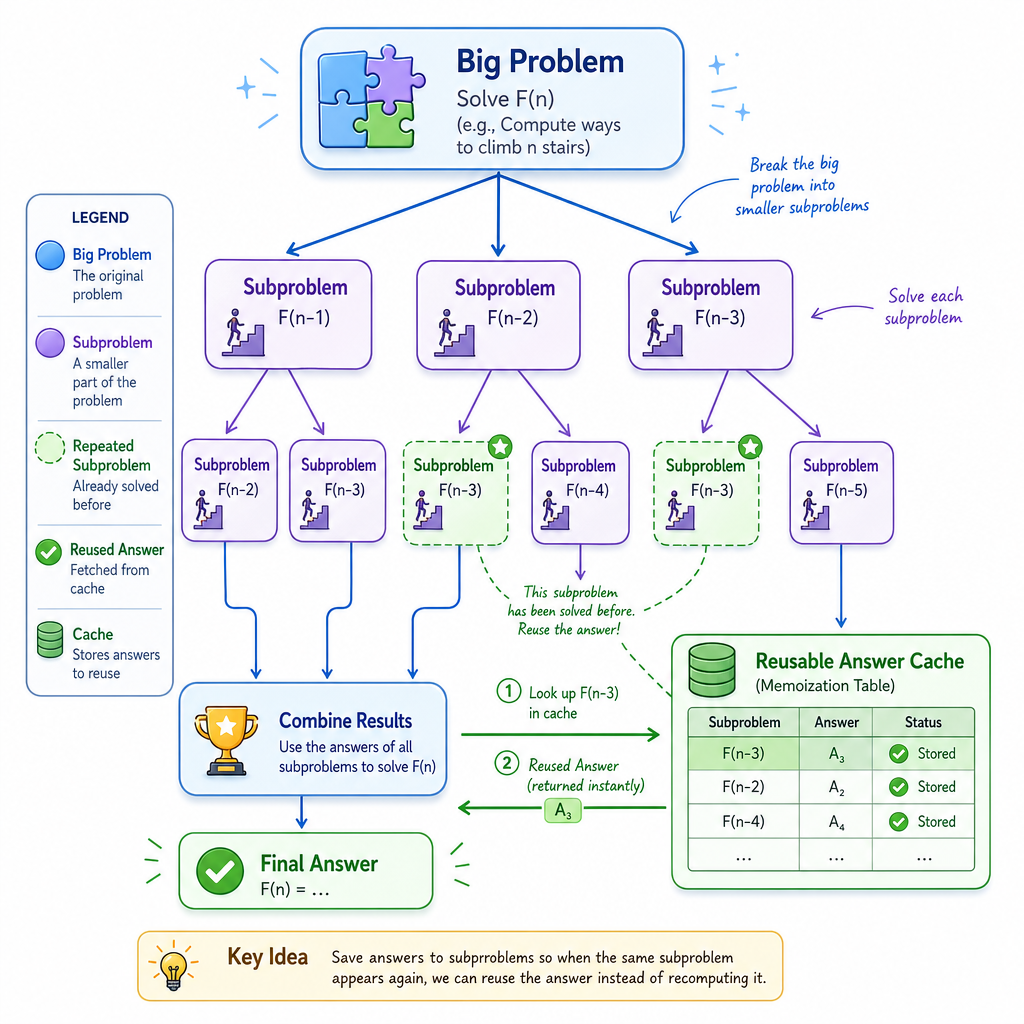
If every smaller problem is unique, storing answers does not help much. But if the same subproblem appears again and again, DP can avoid doing the same work repeatedly.
A rough mental model:
Big problem
├── subproblem A
│   ├── subproblem C
│   └── subproblem D
├── subproblem B
│   ├── subproblem C   <- same work appears again
│   └── subproblem E
DP says: once we solve subproblem C, keep the answer. Next time, reuse it.
Two Useful Signals
When should DP come to mind?
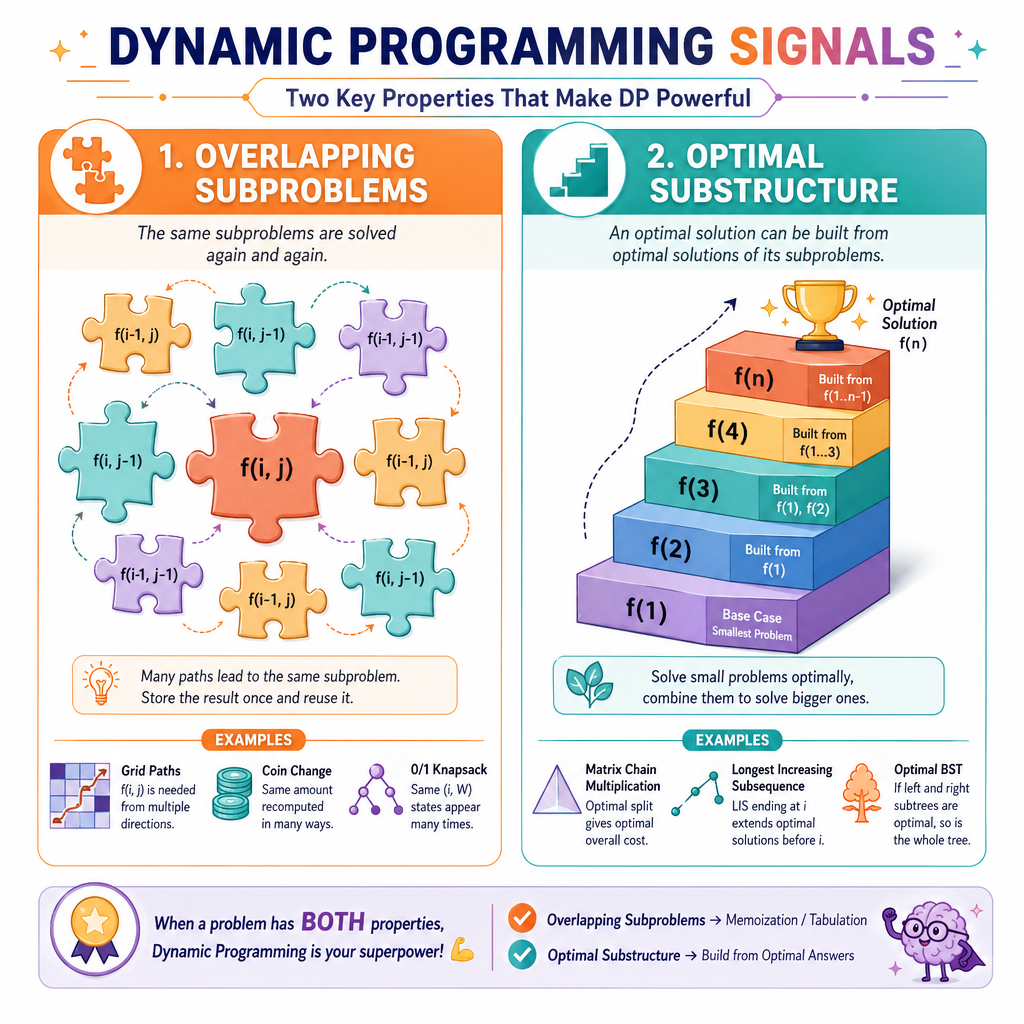
Dynamic Programming is especially useful when a problem has two properties.
1. Overlapping subproblems
The same smaller problems appear multiple times.
Example: calculating a value for n = 5 may require values for n = 4 and n = 3; calculating n = 4 may also require n = 3. That repeated n = 3 work is a clue.
2. Optimal substructure
The best answer to the big problem can be built from best answers to smaller problems.
For example, the cheapest path across a network can often be described as:
cheapest way to get here + cost of the next hop
You do not need to memorize formal definitions yet. For now, train your eye to ask:
- Am I recomputing the same smaller thing?
- Can a larger answer be assembled from smaller answers?
Spot The Signal
Which situation is the strongest clue that Dynamic Programming may help?
Repeated Work
Seeing repeated subproblems
Here is a small JavaScript example that intentionally does repeated work.
Do not focus on mastering recursion yet; that comes next. For now, notice how often the same input value is requested.
The function below computes Fibonacci numbers in a straightforward way, then counts how many times each n was evaluated.
```javascript
const calls = new Map();

function fib(n) {
  calls.set(n, (calls.get(n) || 0) + 1);

  if (n <= 1) return n;
  return fib(n - 1) + fib(n - 2);
}

const result = fib(6);

console.log('fib(6) =', result);
console.log('Call counts:');

for (const [n, count] of [...calls.entries()].sort((a, b) => a[0] - b[0])) {
  console.log(`n=${n}: called ${count} time(s)`);
}
```
DP Means Reuse
True or false: Dynamic Programming is mainly about finding repeated subproblems and reusing their answers instead of recomputing them.
A Tiny DP Table
Storing answers explicitly
A common DP move is to create a place where solved subproblems live.
Imagine a service can scale from 0 to n replicas. Each operation can add either 1 or 2 replicas. How many distinct scaling sequences reach exactly n replicas?
For n = 4, examples include:
1 + 1 + 1 + 1
1 + 1 + 2
1 + 2 + 1
2 + 1 + 1
2 + 2
The number of ways to reach i replicas depends on already-solved smaller values:
ways[i] = ways[i - 1] + ways[i - 2]
This is a first glimpse of the DP style: define smaller states, store their answers, and build toward the target.
```javascript
function countScalingSequences(targetReplicas) {
  const ways = Array(targetReplicas + 1).fill(0);

  ways[0] = 1; // one way to do nothing
  ways[1] = 1; // one operation: +1

  for (let i = 2; i <= targetReplicas; i++) {
    ways[i] = ways[i - 1] + ways[i - 2];
  }

  console.log('DP table:', ways);
  return ways[targetReplicas];
}

console.log('Ways to reach 4 replicas:', countScalingSequences(4));
console.log('Ways to reach 6 replicas:', countScalingSequences(6));
```
Name The Pattern
A problem has ____ when the same smaller problems appear again and again inside the larger problem.
The DP Workflow
A practical checklist
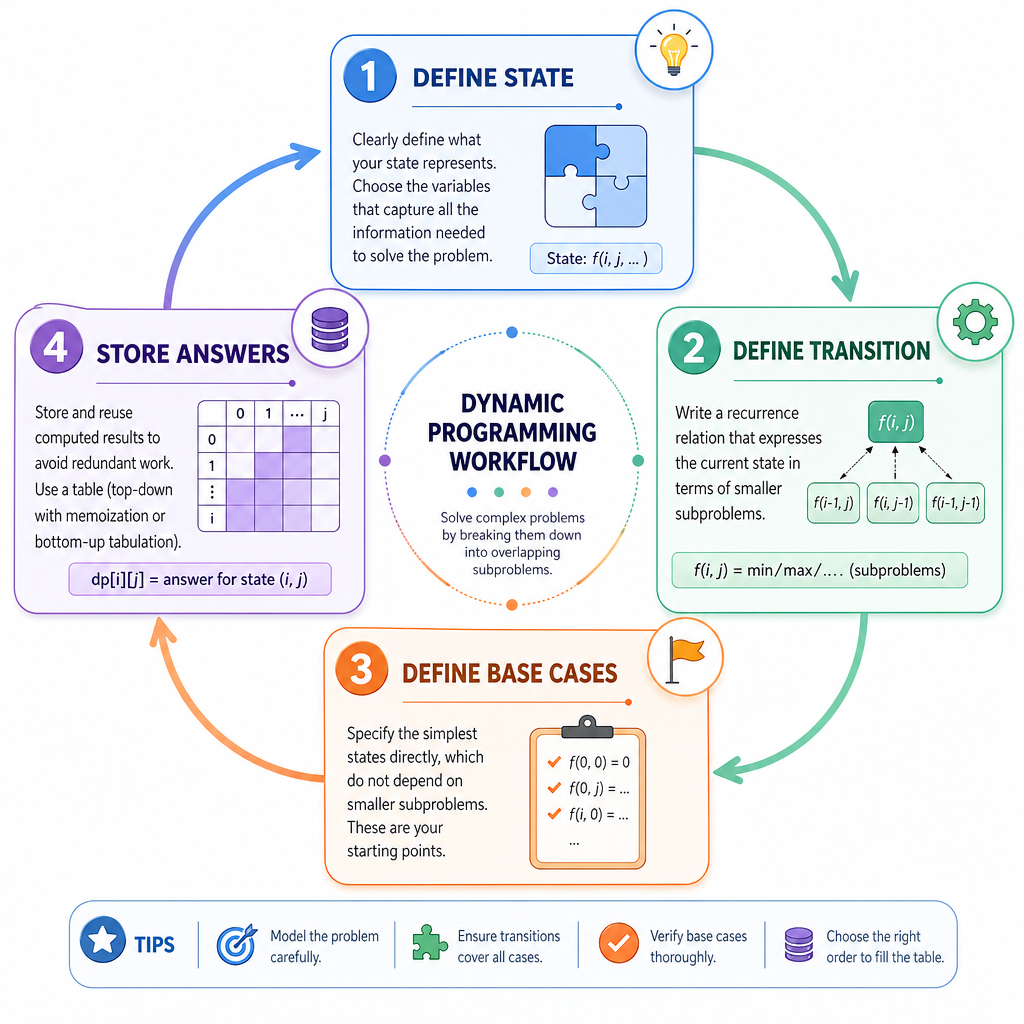
When approaching a DP problem, use this lightweight workflow.
1. Define the state
What smaller question are you answering?
Example: ways[i] means the number of ways to reach exactly i replicas.
2. Define the transition
How does one state depend on earlier states?
Example: ways[i] = ways[i - 1] + ways[i - 2].
3. Define base cases
What answers are known without further work?
Example: ways[0] = 1, ways[1] = 1.
4. Decide how answers are stored
This could be a table, array, map, or another structure.
We will revisit these ideas in more detail when we compare recursive, memoized, top-down, and bottom-up approaches.
Common Misconceptions
What DP is not
Dynamic Programming can feel mysterious because people often describe it as a bag of tricks. It is better to think of it as a disciplined way to avoid repeated work.
DP is not just recursion
Many DP solutions start with recursive thinking, but DP is about reusable subproblem results. Recursion is one possible path to get there.
DP is not always faster by magic
Storing answers uses memory. The tradeoff is usually: spend extra space to save a lot of repeated computation.
DP is not only for math puzzles
You can see DP-like thinking in scheduling, routing, cost optimization, inventory planning, infrastructure capacity planning, and UI state flows.
The algorithmic version is more formal, but the engineering instinct is familiar: cache useful intermediate results when repeated work becomes expensive.
Choose The Definition
Which definition best describes Dynamic Programming?