Introduction to Website Development
Read at your own pace. Code execution, quizzes, progress tracking, and the AI tutor are available in the interactive view with JavaScript enabled.
Your Final Bridge
Why website development completes the loop
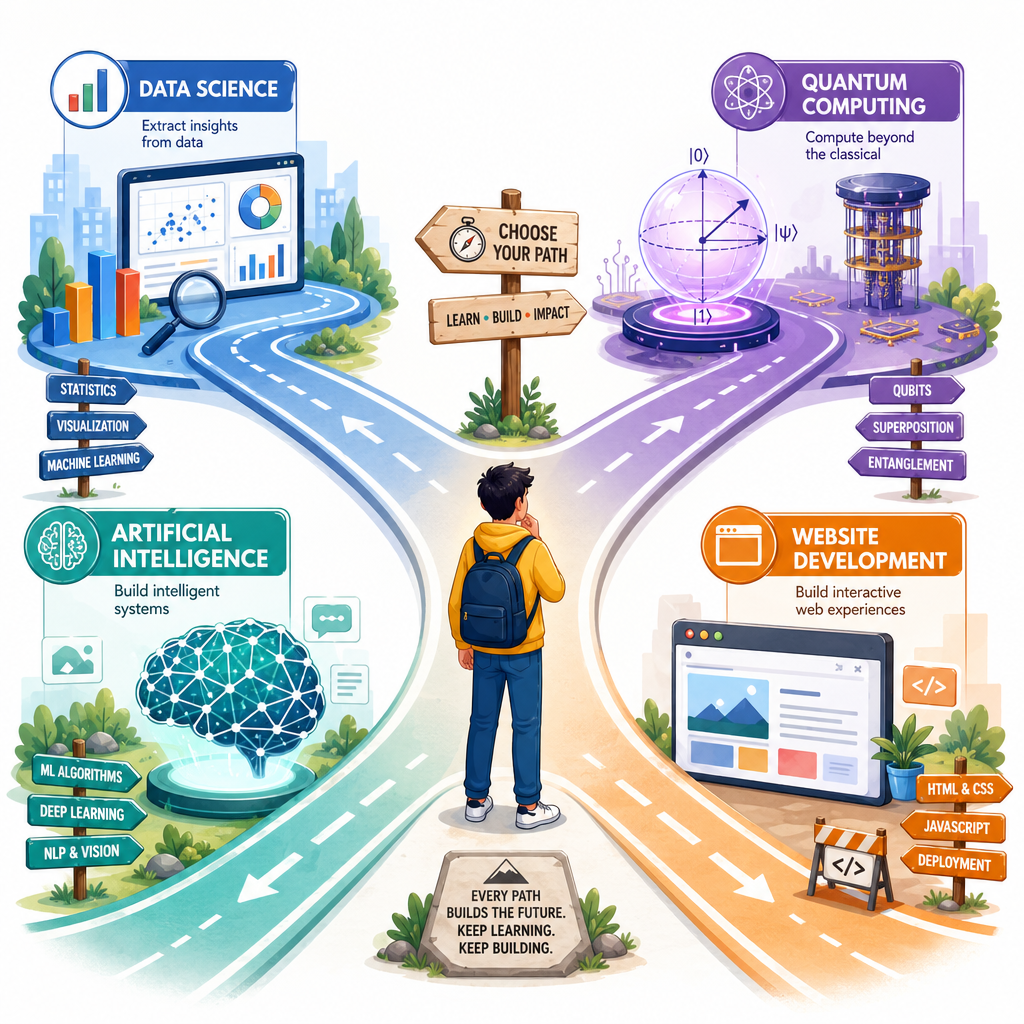
You’ve already explored three powerful programming directions:
- Introduction to Data Science: turning raw observations into insight
- Introduction to Quantum Computing: thinking beyond classical bits
- Introduction to Artificial Intelligence: building systems that learn and decide
Now we connect those ideas to the place users often experience them first: the web.
A website is not just markup and styling. In modern software, it is often the interface to models, datasets, workflows, payments, dashboards, recommendations, and experiments.
Given your Angular and .NET background, this lesson will frame website development in familiar architectural terms while using Python to make the mechanics visible.

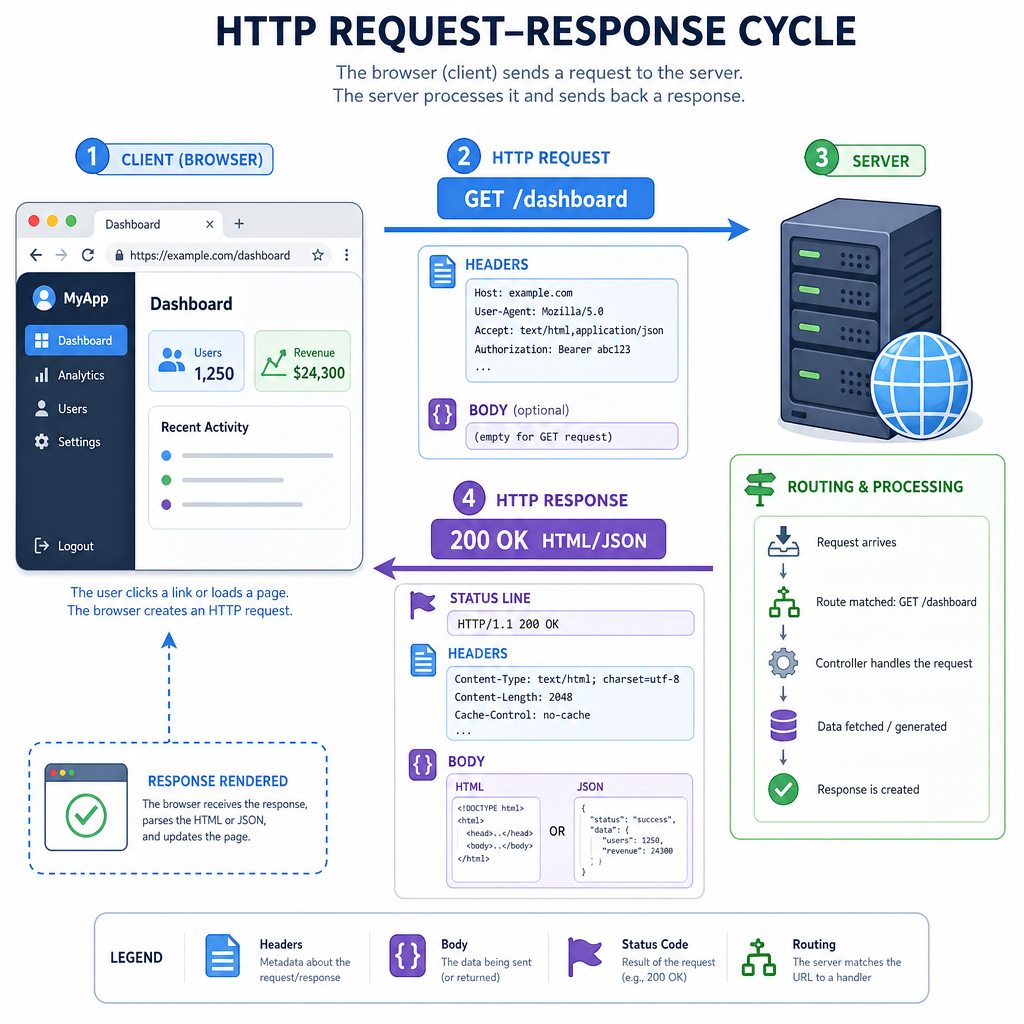
The Web Conversation
Website development is request/response design
At its core, the web is a structured conversation:
Browser / Client  ── HTTP Request ──>  Server
Browser / Client  <─ HTTP Response ──  Server
A request usually asks for something:
- an HTML page
- a CSS file
- JavaScript
- JSON data
- an image
- a model prediction
A response returns a status, headers, and a body.
For a senior Angular/.NET developer, the pattern is familiar: components call services, services call APIs, APIs call application logic, and application logic calls data stores or external systems.
The key shift in this Python-based introduction is not the architecture itself — it is seeing the smallest working version of the web stack.
Tiny Python Server
A complete web interaction in Python
This example starts a tiny local HTTP server, makes a request to it, prints the response, and shuts down.
No framework is involved. That is intentional: before abstractions like Angular, ASP.NET, Django, or FastAPI, the web still comes down to a client asking and a server responding.
```python
from http.server import BaseHTTPRequestHandler, HTTPServer
from threading import Thread
from urllib.request import urlopen

class Handler(BaseHTTPRequestHandler):
    def do_GET(self):
        html = """
        <html>
          <body>
            <h1>Hello from Python</h1>
            <p>This page came from a tiny HTTP server.</p>
          </body>
        </html>
        """.strip()

        self.send_response(200)
        self.send_header("Content-Type", "text/html")
        self.end_headers()
        self.wfile.write(html.encode("utf-8"))

    def log_message(self, format, *args):
        pass  # keep output focused

server = HTTPServer(("localhost", 0), Handler)
port = server.server_port

thread = Thread(target=server.handle_request)
thread.start()

with urlopen(f"http://localhost:{port}/") as response:
    body = response.read().decode("utf-8")
    print("Status:", response.status)
    print("Content-Type:", response.headers.get("Content-Type"))
    print("Body preview:", body[:80].replace("\n", " "))

thread.join()
server.server_close()
```
Dynamic Responsibility
A user opens /recommendations in a browser. The server calculates personalized results and returns HTML or JSON.
Which statement best describes the server’s role?
APIs As Contracts
Frontends and backends need stable agreements
In production web systems, the frontend and backend usually communicate through an API contract.
That contract defines things like:
- endpoint paths:
/api/predictions - HTTP methods:
GET,POST,PUT,DELETE - request shape: what the client sends
- response shape: what the server returns
- status codes: success, validation failure, authentication failure, server error
This is where your earlier lessons connect naturally:
- A data science dashboard might expose cleaned metrics through an API.
- An AI feature might return classifications, recommendations, or generated text.
- A quantum simulation tool might expose experiment results to a browser UI.
The browser does not need to know every implementation detail. It needs a reliable contract.
```python
import json

def prediction_endpoint(payload):
    """Pretend this is the logic behind POST /api/predictions."""
    score = payload.get("engagement_score", 0)

    if score >= 80:
        label = "high_interest"
    elif score >= 50:
        label = "medium_interest"
    else:
        label = "low_interest"

    return {
        "status": "ok",
        "input": payload,
        "prediction": {
            "label": label,
            "model_version": "demo-1.0"
        }
    }

request_body = {"user_id": 42, "engagement_score": 87}
response_body = prediction_endpoint(request_body)

print(json.dumps(response_body, indent=2))
```Layered Web Architecture
A practical mental model
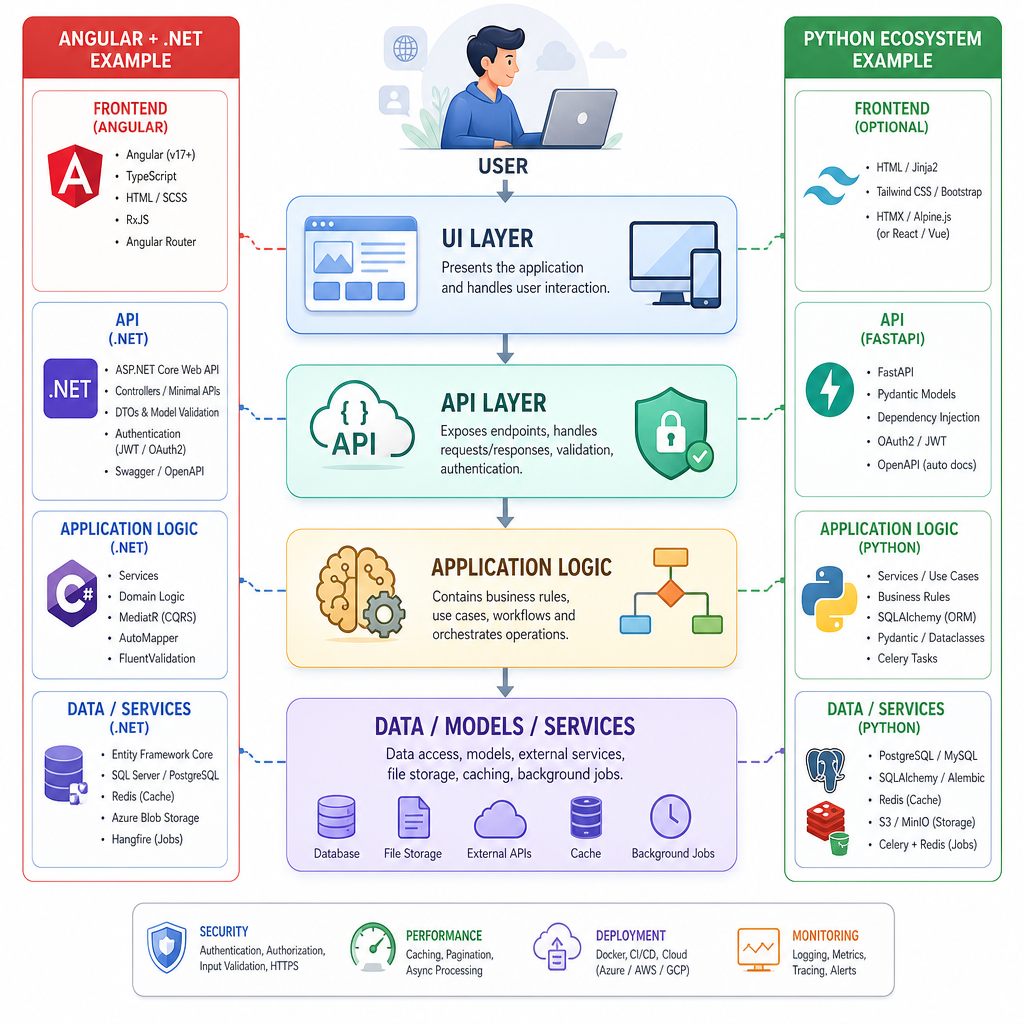
A modern website is usually easier to reason about as layers:
User
 ↓
UI Layer
 ↓
API Layer
 ↓
Application Logic
 ↓
Data / Models / Services
In your Angular and .NET experience, this might map to:
- Angular components and services
- ASP.NET controllers or minimal APIs
- C# application services
- databases, queues, third-party APIs, ML systems
In Python ecosystems, similar roles may be played by:
- templates or frontend assets
- FastAPI, Flask, or Django routes
- Python domain logic
- Postgres, Redis, cloud services, notebooks, or model servers
The names change. The architectural questions stay remarkably consistent.
HTTP Verb Check
Fill in the blank:
The common HTTP method used to retrieve a resource without changing it is _____.
Production Thinking
Website development is more than making pages render
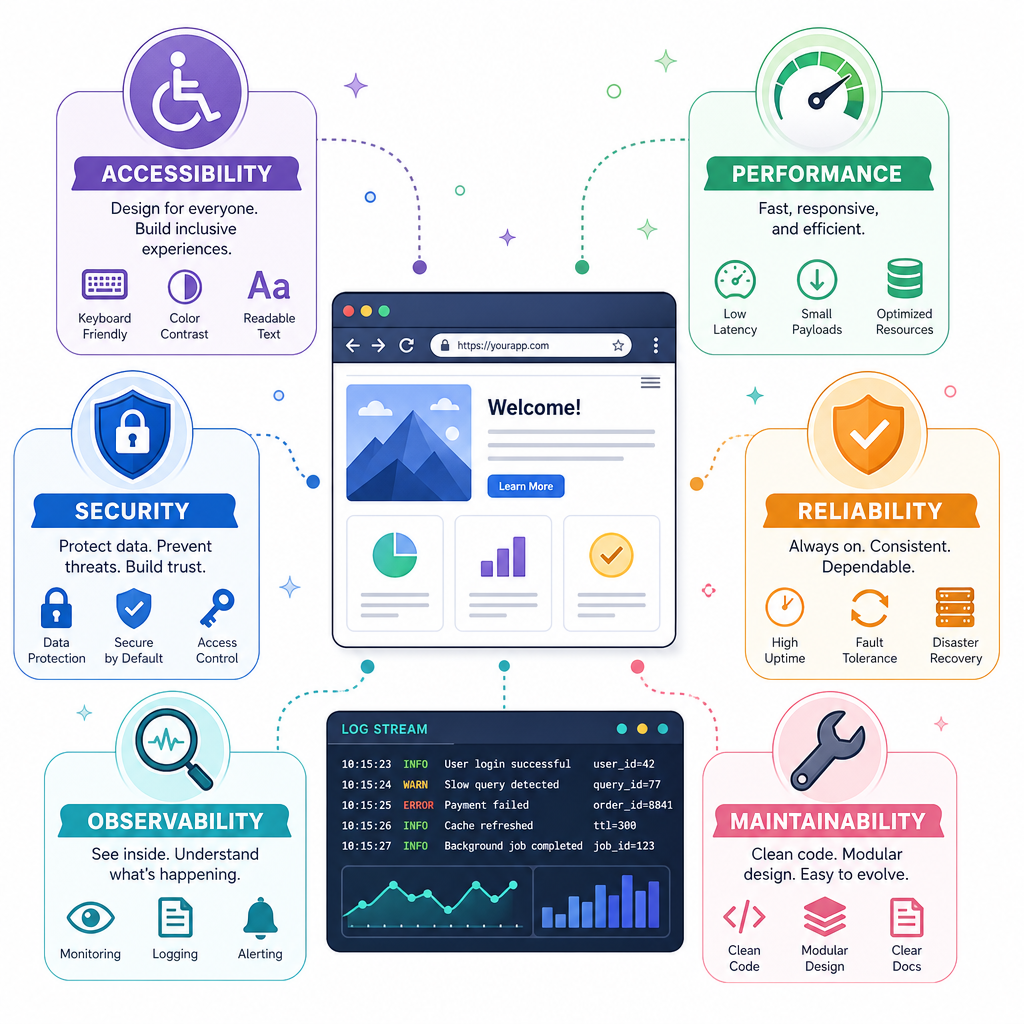
A professional web developer thinks beyond “does it work on my machine?”
Important production concerns include:
- Accessibility: Can users with assistive technologies use it?
- Performance: Does it load quickly and respond smoothly?
- Security: Are inputs validated, secrets protected, and permissions enforced?
- Reliability: What happens when a dependency fails?
- Observability: Can you debug issues through logs, metrics, and traces?
- Maintainability: Can another engineer safely change it later?
This is also where AI and data features need extra care. A beautiful interface cannot compensate for unclear model behavior, unsafe outputs, or misleading metrics.
Render A Dashboard
Bringing the course together
Let’s close with a small example that echoes the whole section.
A website can present:
- data science metrics
- AI predictions
- quantum experiment summaries
- user-facing explanations
This Python snippet renders a tiny HTML dashboard from structured data. It is not a full framework, but it shows the basic idea behind many server-rendered pages: data becomes interface.
```python
from html import escape

cards = [
    {
        "title": "Data Science",
        "summary": "Daily active users increased by 12%.",
        "status": "insight"
    },
    {
        "title": "Artificial Intelligence",
        "summary": "Recommendation model version demo-1.0 is live.",
        "status": "model"
    },
    {
        "title": "Quantum Computing",
        "summary": "Single-qubit simulation completed successfully.",
        "status": "experiment"
    }
]

def render_card(card):
    return f"""
    <section class='card {escape(card['status'])}'>
      <h2>{escape(card['title'])}</h2>
      <p>{escape(card['summary'])}</p>
    </section>
    """.strip()

html = "<main>\n" + "\n".join(render_card(card) for card in cards) + "\n</main>"

print(html)
```
Course Wrap
You now have a map of four major programming frontiers
This section introduced four paths that often reinforce each other:
- Data Science helps you understand what is happening.
- Quantum Computing expands how you think about computation itself.
- Artificial Intelligence builds systems that learn patterns and make decisions.
- Website Development delivers those systems to people through usable interfaces.
The common thread is not a specific framework or language. It is the ability to model a problem, represent information, write clear logic, and communicate results.
As you continue, your strongest projects will likely combine these areas: a web dashboard for data insights, an AI-powered product feature, an interactive quantum simulator, or a Python service behind a polished frontend.
That is the real power of programming: turning abstract ideas into systems people can use.