Mock Interview Practice and Problem-Solving Strategies
Read at your own pace. Code execution, quizzes, progress tracking, and the AI tutor are available in the interactive view with JavaScript enabled.
Final Interview Mode
This is where everything connects
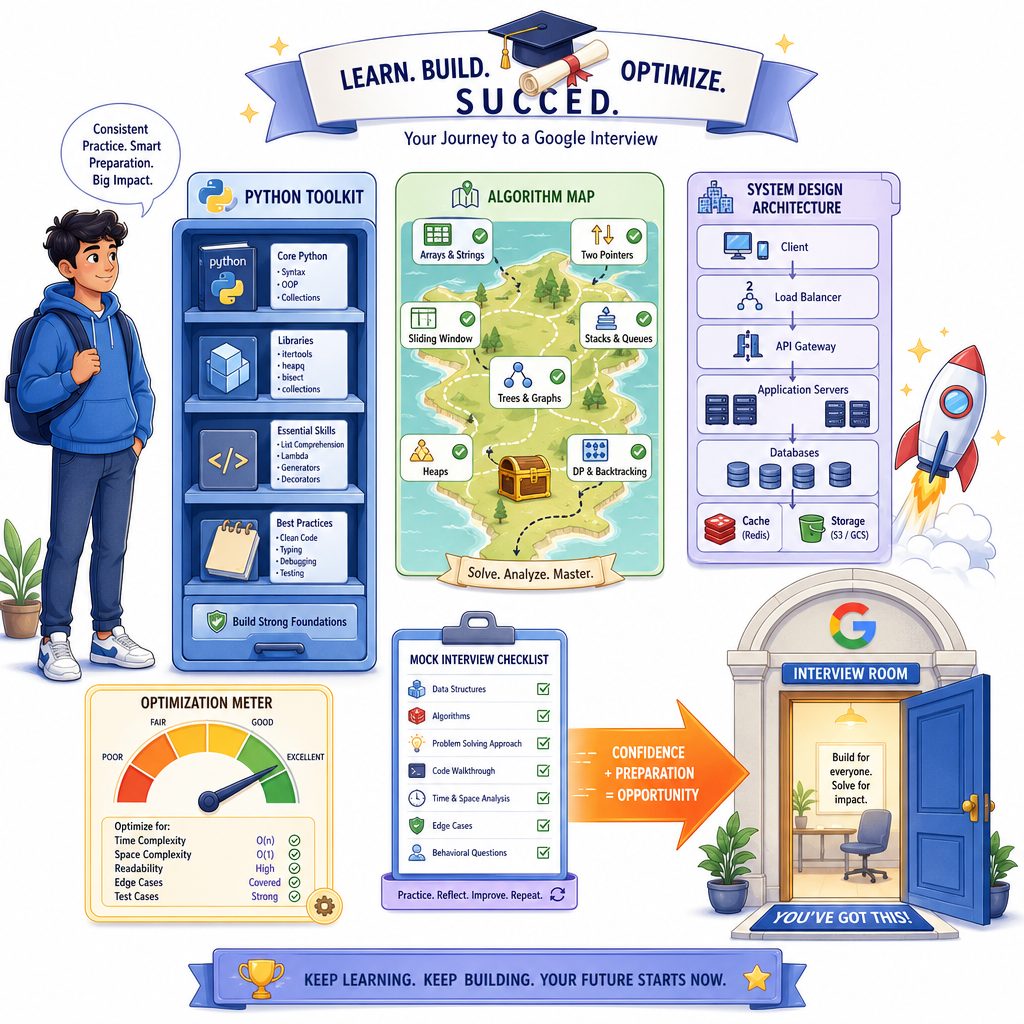
You have already built the toolkit:
- Intermediate Python for Google Interviews gave you clean loops, hashing patterns, and mutability awareness.
- Advanced Algorithms and Data Structures gave you the pattern map: graphs, heaps, DP, union find, and more.
- System Design Primer for Google Interviews gave you a structured way to reason about scale and architecture.
- Python Best Practices and Optimization Techniques taught you to choose readable, purposeful code.
Now we convert knowledge into interview behavior.
For a part-time coder, the biggest risk is not “not knowing enough.” It is often:
freezing, rushing, staying silent, or coding before the problem is understood.
This lesson gives you a repeatable mock interview routine so your practice starts feeling like the real thing.

The Interview Loop
Use one loop every time
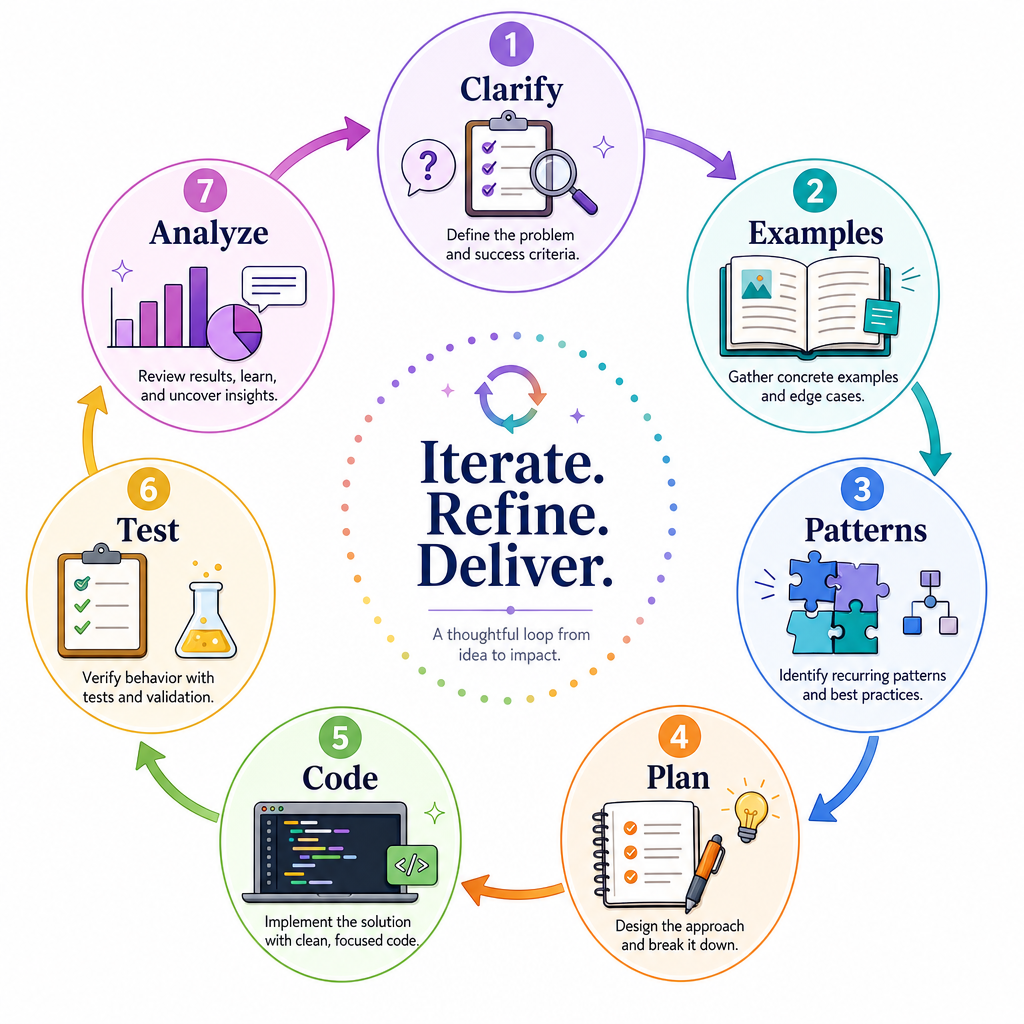
A strong Google-style problem-solving session is not random. Use this loop:
Clarify -> Examples -> Patterns -> Plan -> Code -> Test -> Analyze
What this sounds like
- Clarify: “Can inputs be empty? Are duplicates allowed?”
- Examples: “Let me walk through a small case.”
- Patterns: “This looks like hashing / two pointers / BFS / DP because...”
- Plan: “I’ll maintain X invariant while scanning Y.”
- Code: “I’ll write the simplest correct version first.”
- Test: “Let’s test normal, edge, and tricky cases.”
- Analyze: “Time is..., space is..., and here is why.”
The goal is not to sound robotic. The goal is to make your thinking visible.
Clarify Before Coding
A tiny example: make the problem smaller
Suppose the interviewer asks:
Return indices of two numbers that add to a target.
You already saw hashing patterns earlier, so we will not re-teach the idea. Instead, notice the interview behavior:
- Ask assumptions.
- State the invariant.
- Code cleanly.
- Test immediately.
A good invariant here:
At each index,
seenstores numbers from earlier positions and their indices.
That sentence proves you understand why the solution works.
```python
def two_sum(nums, target):
    seen = {}
    for i, value in enumerate(nums):
        need = target - value
        if need in seen:
            return [seen[need], i]
        seen[value] = i
    return []

cases = [
    ([2, 7, 11, 15], 9),
    ([3, 2, 4], 6),
    ([3, 3], 6),
    ([], 10),
]

for nums, target in cases:
    print(nums, "target=", target, "->", two_sum(nums, target))
```
First Move Check
You receive a new coding problem in a mock interview. What is usually the best first move?
Think Aloud
True or false: In a Google-style interview, it is better to stay mostly silent until your code is finished, then explain everything afterward.
Time Box Wisely
A 45-minute coding interview rhythm
Use time boxes so you do not spend 30 minutes polishing the wrong idea.
Time Goal 0-5 min Clarify, examples, constraints 5-10 min Identify pattern and plan 10-28 min Implement cleanly 28-38 min Test and debug 38-45 min Complexity, alternatives, final polishIf you get stuck, say something like:
“Let me step back and compare this to the patterns I know: hashing, two pointers, graph traversal, heap, DP.”
That sentence turns panic into structured search.
```python
milestones = [
    (5, "Clarify problem and examples"),
    (10, "Choose pattern and state plan"),
    (28, "Finish first clean implementation"),
    (38, "Test edge cases and debug"),
    (45, "Explain complexity and tradeoffs"),
]

print("Mock interview timeline:")
previous = 0
for minute, goal in milestones:
    print(f"Minutes {previous:02d}-{minute:02d}: {goal}")
    previous = minute
```
Debugging Ritual
Debug like a professional
When code fails, do not randomly edit. Use a ritual:
- Restate expected behavior.
- Print or inspect one variable at the failing point.
- Check boundaries: empty input, one item, duplicates, off-by-one.
- Run the smallest failing case.
- Make one change at a time.
This connects directly to Python Best Practices and Optimization Techniques: readable code is easier to debug under pressure.
Below is a small test harness style you can use in practice sessions.
```python
def count_even(nums):
    count = 0
    for n in nums:
        if n % 2 == 0:
            count += 1
    return count

tests = [
    ([], 0),
    ([1, 3, 5], 0),
    ([2, 4, 6], 3),
    ([1, 2, 3, 4], 2),
    ([0, -2, 7], 2),
]

for nums, expected in tests:
    actual = count_even(nums)
    status = "PASS" if actual == expected else "FAIL"
    print(f"{status}: nums={nums}, expected={expected}, actual={actual}")
```
Complexity Check
Fill in the blank.
A one-pass hash map solution that scans n items once and does constant-time average lookups has time complexity ____.
Mock Drill Setup
Your weekly mock interview drill
Do this once or twice per week until interview day.
Setup
- Pick one problem by pattern: arrays, hashing, BFS/DFS, heap, DP, or intervals.
- Set a 45-minute timer.
- Record yourself or pair with a friend.
- Use the interview loop: clarify, examples, pattern, plan, code, test, analyze.
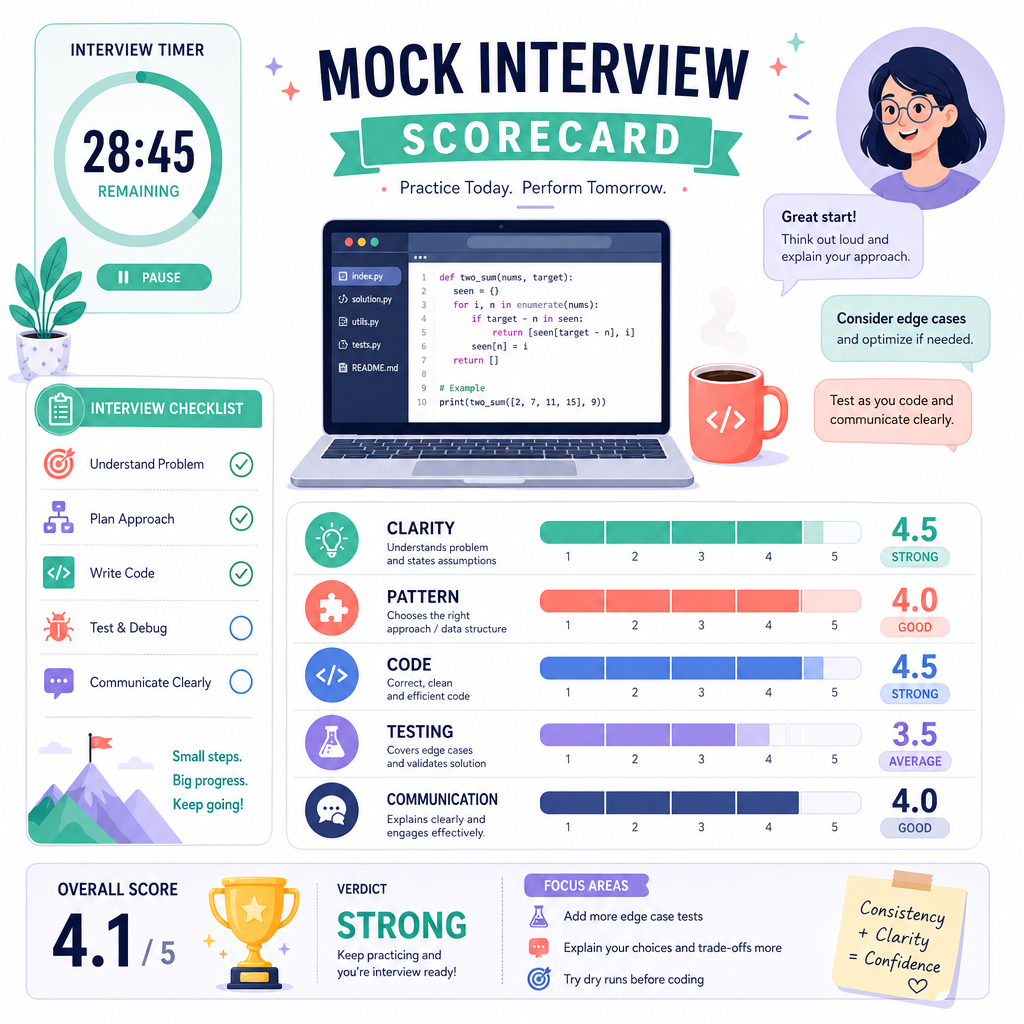
Score yourself from 1-5
Skill Question Clarity Did I ask assumptions before coding? Pattern Did I identify the right family of solution? Code Was it readable and correct? Testing Did I test edge cases? Communication Could an interviewer follow my thinking?A mock interview is not a performance. It is a feedback machine.
Recovery Strategy
During a mock interview, you realize your current solution is becoming messy and may be wrong. What is the strongest recovery move?
Course Wrap
You now have an interview system
This course started with Python fundamentals for interviews and ended with mock interview execution.
Your final operating system is:
Python fluency
+ algorithm patterns
+ system design structure
+ readable optimization
+ mock interview discipline
= interview readiness
Your next 14 days
- Day 1-3: Redo 3 medium problems you previously struggled with.
- Day 4-6: Do one graph or tree problem daily.
- Day 7: Run a full 45-minute mock.
- Day 8-10: Focus on your weakest pattern.
- Day 11-13: Mix random problems to simulate uncertainty.
- Day 14: Full mock interview plus written reflection.
You do not need to become a full-time coder overnight. You need a repeatable process, honest feedback, and enough reps to stay calm when the problem is unfamiliar.
That is how you turn 90 days of preparation into interview confidence.