Negotiating Outside Your Home Country
Read at your own pace. Code execution, quizzes, progress tracking, and the AI tutor are available in the interactive view with JavaScript enabled.
Across Borders
From voice to context
In Effective Communication in Negotiation, you practiced turning preparation into a clear, confident conversation. Now we add a new layer: what changes when the job, employer, manager, or payroll system is outside your home country?
International salary negotiation is not just the same playbook with a different currency symbol. You may be dealing with:
- Different norms for directness, hierarchy, silence, and timing
- Local salary bands that do not map cleanly to your home market
- Taxes, benefits, social insurance, visa rules, and contract law
- Currency volatility and cost-of-living differences
Think of this like deploying production software in a new region: your core logic still matters, but the environment variables can change the behavior dramatically.

Local Variables
Treat the country as part of the offer
Earlier, in Researching Salary Ranges, you learned to define the comparable. Internationally, the comparable must include where and how the role is paid.
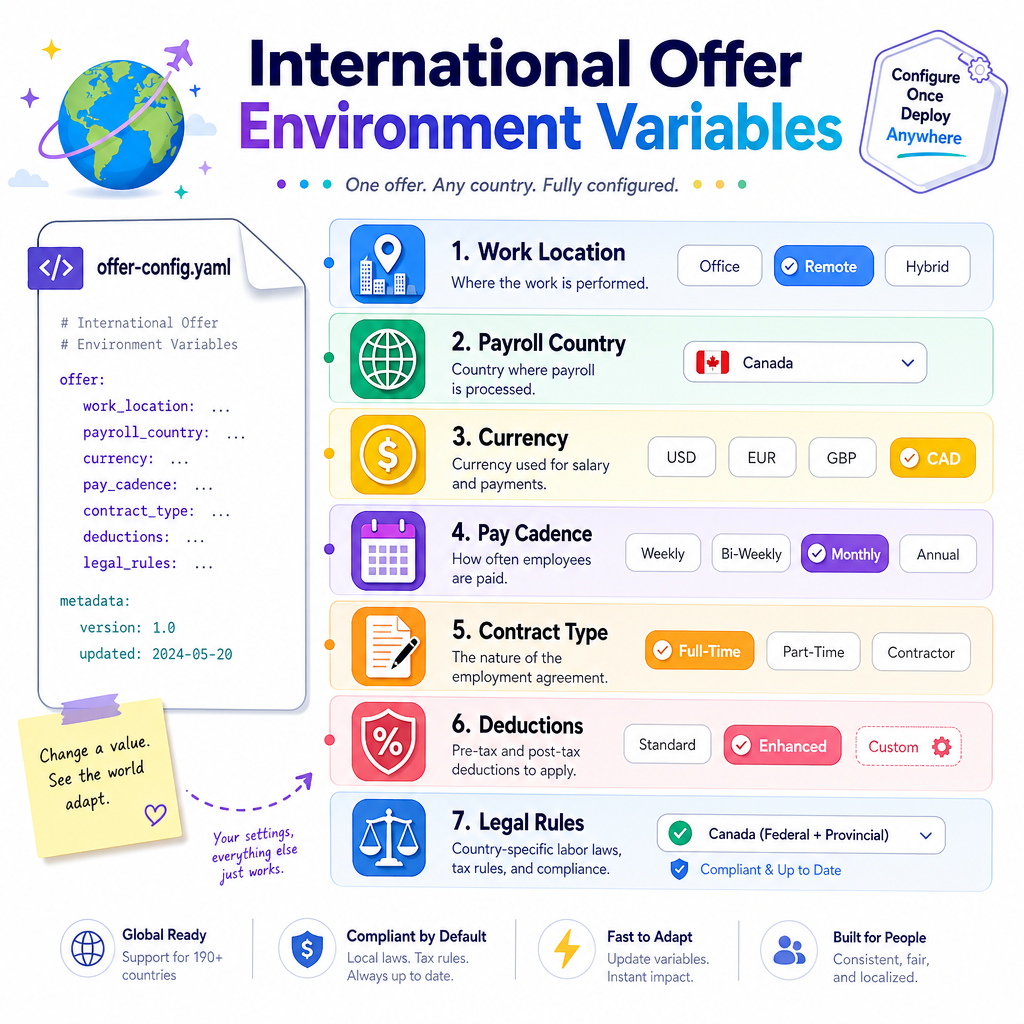
Before you state a number, identify these local variables:
- Work location: local office, remote from home country, hybrid, or relocation
- Payroll country: which country actually employs and pays you
- Currency: local currency, home currency, or a company-standard currency
- Pay cadence: monthly, 13th-month salary, annual bonus, or commission cycle
- Contract type: employee, contractor, fixed-term, expatriate assignment
- Mandatory deductions: taxes, pension, social insurance, healthcare contributions
- Legal constraints: salary disclosure rules, probation period, notice period, visa sponsorship
Your goal is not to become an international labor lawyer. Your goal is to avoid comparing a Steelers playbook to a Knicks playbook and pretending the field, clock, and scoring rules are identical.
Normalize The Offer
Convert before you compare
You already practiced normalization in Researching Salary Ranges. Outside your home country, normalization becomes even more important because the headline salary can mislead you.
A useful first-pass comparison is:
local salary
→ convert currency
→ estimate take-home pay
→ adjust for cost of living
→ compare against your personal range
This is not a final financial model. It is a sanity check that prevents a large-looking number from hiding lower real purchasing power.
```cpp
#include <iostream>
#include <iomanip>
#include <string>
using namespace std;

struct Offer {
    string location;
    double annualLocal;
    double fxToUSD;
    double estimatedTaxRate;
    double costOfLivingIndex; // 100 means baseline cost
};

double normalizedPurchasingPowerUSD(const Offer& offer) {
    double grossUSD = offer.annualLocal * offer.fxToUSD;
    double takeHomeUSD = grossUSD * (1.0 - offer.estimatedTaxRate);
    return takeHomeUSD / (offer.costOfLivingIndex / 100.0);
}

int main() {
    Offer berlin {"Berlin", 95000, 1.08, 0.38, 82};
    Offer newYork {"New York", 150000, 1.00, 0.34, 135};

    cout << fixed << setprecision(0);
    cout << berlin.location << " normalized purchasing power: $"
         << normalizedPurchasingPowerUSD(berlin) << "\n";
    cout << newYork.location << " normalized purchasing power: $"
         << normalizedPurchasingPowerUSD(newYork) << "\n";

    return 0;
}
```
Best Response
A recruiter in another country asks, "What are you earning in your home country right now?" You want to avoid anchoring the negotiation to a market that may not be comparable.
Which response is strongest?
Cultural Protocols
Same message, different protocol
Your core message from Effective Communication in Negotiation still matters: value, evidence, curiosity, and clarity. But the delivery may need to change.
Watch for differences in:
- Directness: In some cultures, a direct salary request is normal. In others, it may be better to frame the ask through questions and shared problem-solving.
- Hierarchy: The person you speak with may not be the decision-maker, even if they are senior in the conversation.
- Silence: A pause may mean disagreement, reflection, translation, or a normal decision rhythm.
- Timing: Negotiation may happen only after a formal offer, or earlier with the recruiter.
- Documentation: Some markets rely heavily on written terms; others discuss verbally before formal paperwork.
A good international negotiator is not less assertive. They are more observant. They adjust the interface without changing the underlying value proposition.

Same Script?
True or false: The best international negotiation strategy is to use the exact same script in every country so you appear consistent.
Benefits Differ
Salary is only one local artifact
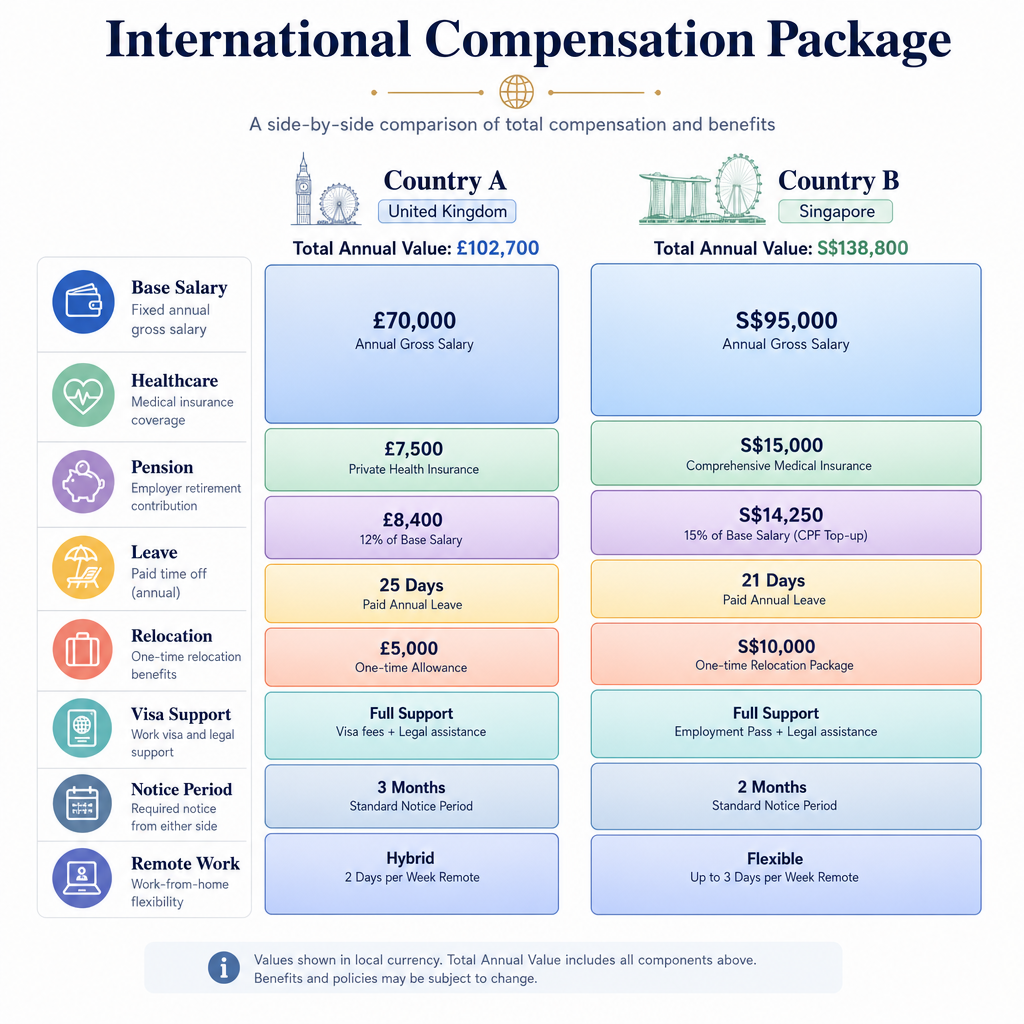
In Determining Your Personal Salary Range, you separated your floor, target, and strong ask. Internationally, benefits can move those boundaries because some items that are private costs in one country may be employer-covered or public benefits in another.
Ask about:
- Health insurance and whether dependents are covered
- Pension, retirement, or mandatory employer contributions
- Paid leave, holidays, parental leave, and sick leave norms
- Relocation support, housing stipend, language support, or schooling support
- Visa sponsorship, legal fees, and work authorization timelines
- Probation period, notice period, severance, and non-compete terms
- Remote-work equipment, travel expectations, and home-office setup
If equity appears in the offer, note it as a separate line item for now. We will focus on how equity works in the next lesson.
Package Score
Score what the headline misses
A senior engineer would not judge system health from one metric. Likewise, do not judge an international offer only by base salary.
Use a lightweight scoring model to compare what matters to you. Keep it simple: salary fit, benefits strength, mobility support, and contract clarity. This does not replace judgment, but it makes tradeoffs visible.
```cpp
#include <iostream>
#include <iomanip>
#include <string>
#include <vector>
using namespace std;

struct Package {
    string name;
    double salaryFit;       // 0 to 10
    double benefitsStrength;// 0 to 10
    double mobilitySupport; // 0 to 10, visa/relocation/help settling in
    double contractClarity; // 0 to 10
};

double weightedScore(const Package& p) {
    return 0.45 * p.salaryFit
         + 0.25 * p.benefitsStrength
         + 0.20 * p.mobilitySupport
         + 0.10 * p.contractClarity;
}

int main() {
    vector<Package> offers = {
        {"Offer A", 8.0, 6.0, 3.0, 7.0},
        {"Offer B", 7.0, 8.5, 9.0, 8.0}
    };

    cout << fixed << setprecision(2);
    for (const auto& offer : offers) {
        cout << offer.name << " package score: "
             << weightedScore(offer) << "/10\n";
    }

    return 0;
}
```
Key Term
Fill in the blank: Converting offers into a common basis so you can compare them fairly is called ________.
International Ask
Make the ask specific and locally informed
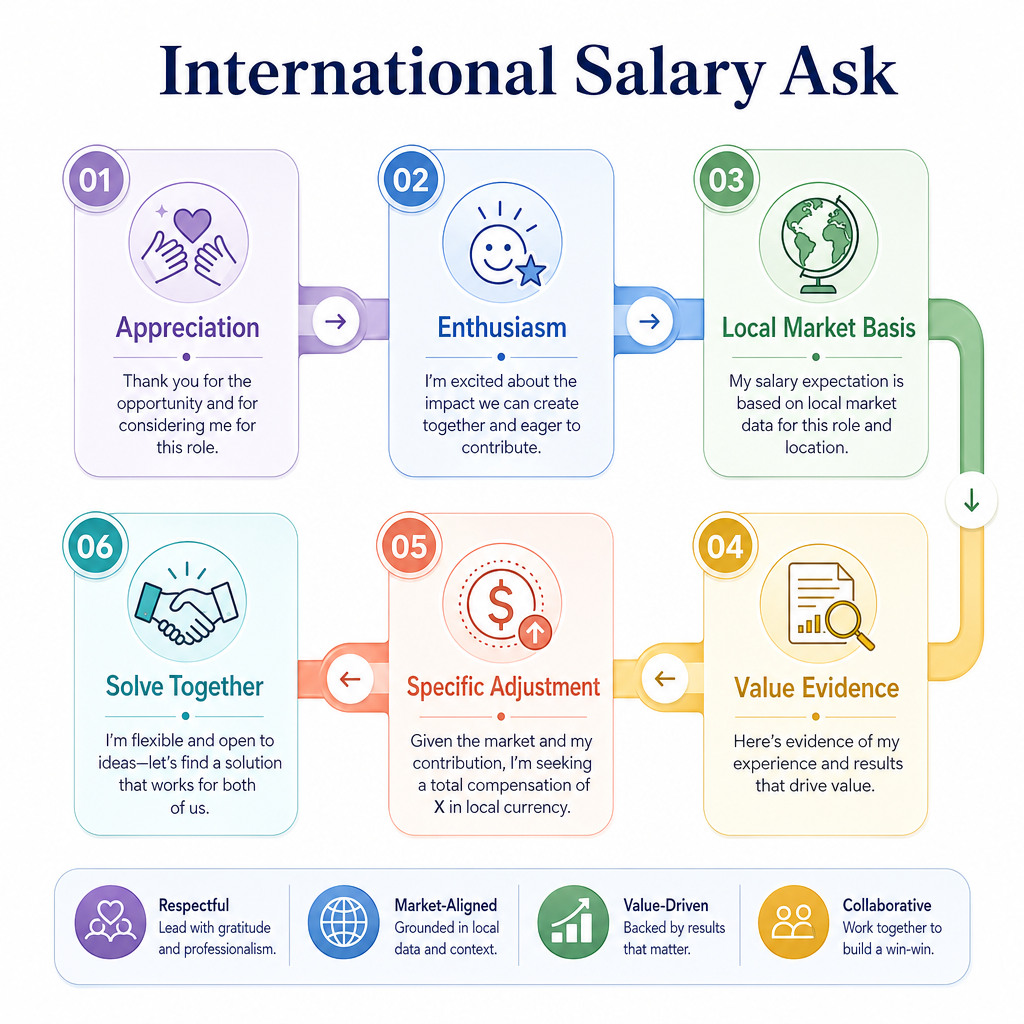
Your international negotiation should sound prepared, not presumptive. Combine your earlier prep packet with local context.
A practical structure:
1. Appreciation
2. Role-specific enthusiasm
3. Local-market basis for the request
4. Your value evidence
5. Specific compensation or package adjustment
6. Invitation to solve together
Example:
"I’m excited about the platform role and the chance to help scale the team across regions. Based on the scope, my experience leading production systems, and the compensation norms for senior engineers in this market, I was expecting a package closer to [target]. Is there flexibility to adjust the base salary or relocation support to get closer to that range?"
Before you send or say it, verify:
- The number is in the correct currency and pay period
- You know whether it is gross or net of taxes
- You understand the benefits that materially affect your floor
- You have not anchored to an irrelevant home-country salary
- You are respecting the local decision process
The mindset stays the same: negotiate for a package that works for both you and the employer. The execution becomes more precise because the context is more complex.