Preparation for Advanced Learning
Read at your own pace. Code execution, quizzes, progress tracking, and the AI tutor are available in the interactive view with JavaScript enabled.
Your Launchpad
You have the full beginner loop
Now that you've completed Fundamental Understanding, Skill Development, Application Mastery, and Project Execution, you are no longer just reading about machine learning.
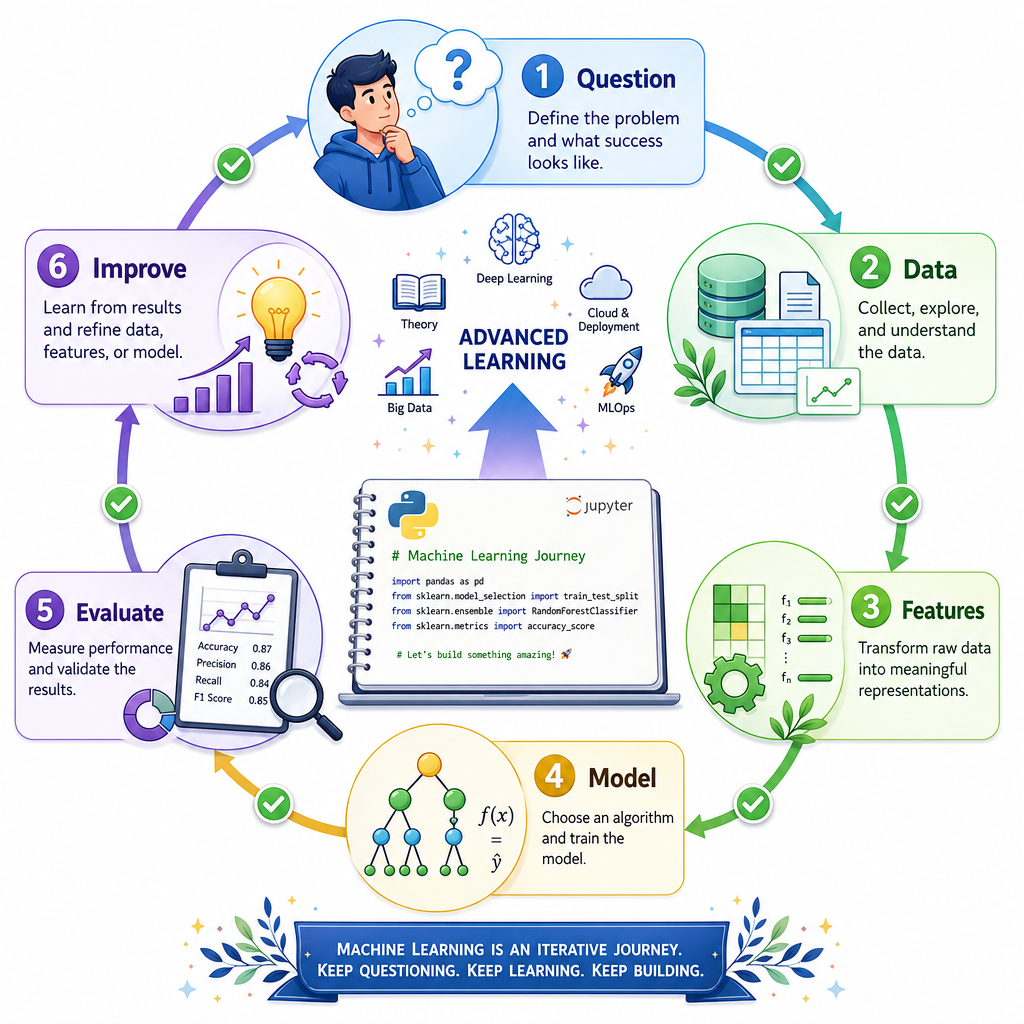
You can now trace the core path:
question → data → features → model → evaluation → prediction → improvement
This final lesson is about preparing for advanced learning without losing the practical habits you've built.
Advanced ML is not a separate world. It is the same workflow, with sharper tools, deeper assumptions, and larger consequences.

The Big Map
Where advanced ML fits
Earlier lessons gave you the working pieces:
- Fundamental Understanding: statistics, probability, vectors, and the ML loop
- Skill Development: Python structures, transformations, and readable pipelines
- Application Mastery: prediction workflows, baselines, fitting, and interpreting results
- Project Execution: comparing models, packaging predictors, and shipping a small project
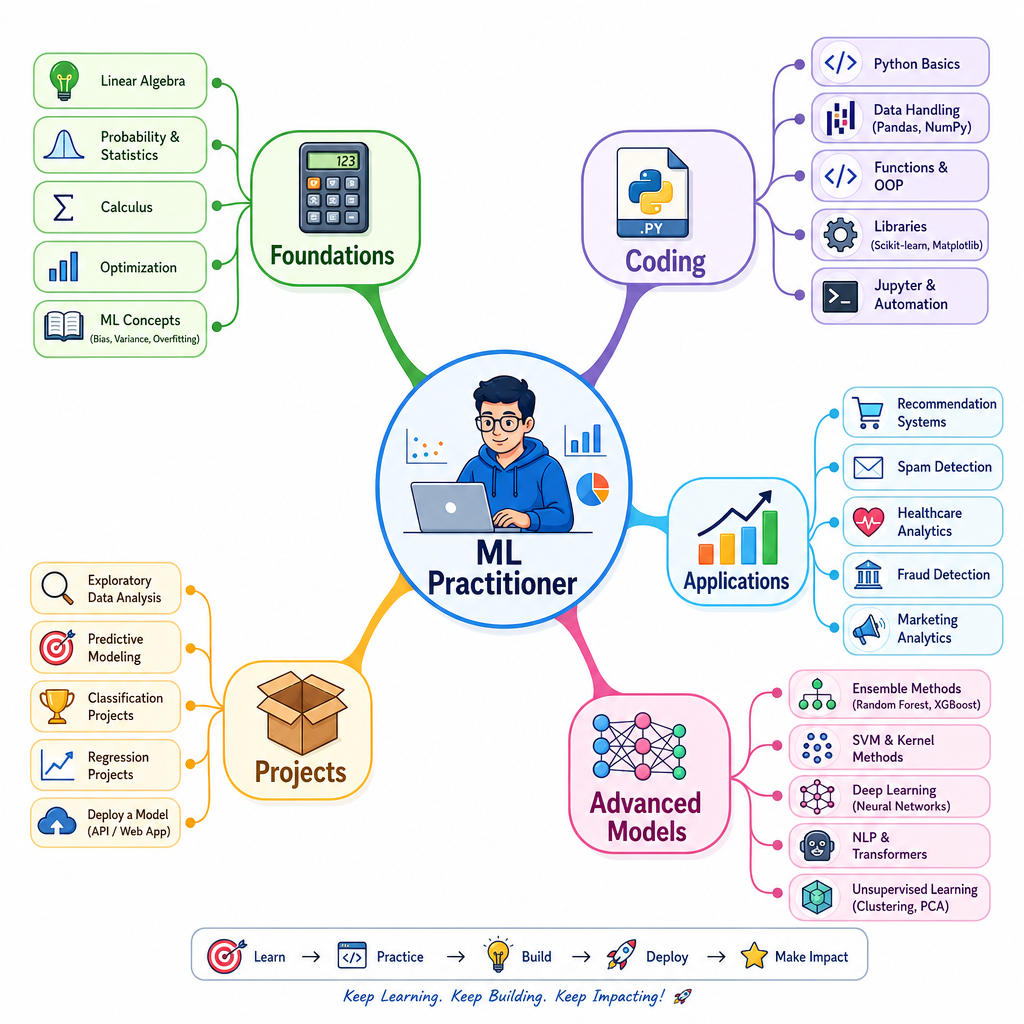
Advanced learning expands each piece:
Foundations       → stronger math and uncertainty
Coding           → cleaner pipelines and larger datasets
Applications     → domain-specific modeling choices
Projects         → monitoring, deployment, and iteration
Modeling         → ensembles, neural networks, and representation learning
Your job now is not to memorize every algorithm. Your job is to keep asking: What problem am I solving, and how do I know the model helped?
Choose The Compass
Which question best guides advanced ML learning?
You are deciding what to study next after building a basic predictive model.
Advanced Roadmap
What to learn next
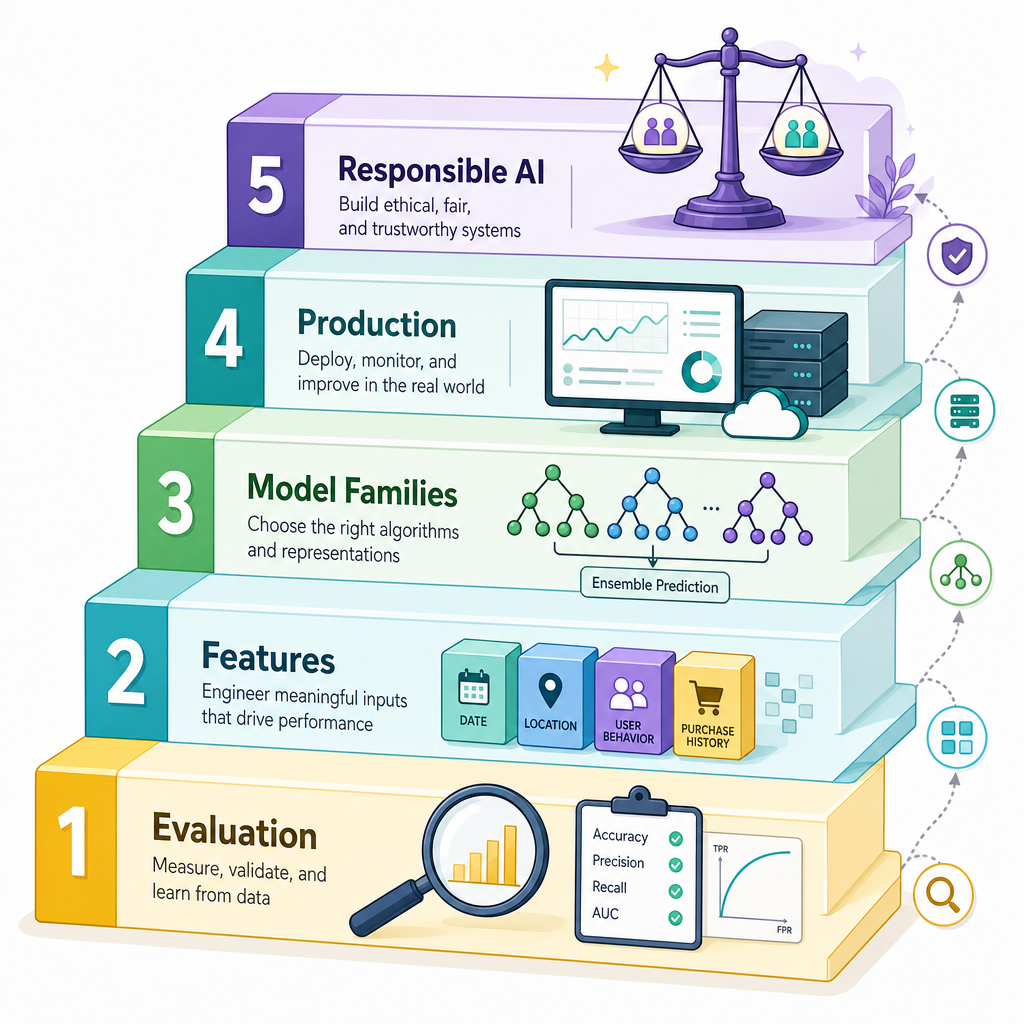
Here is a practical roadmap for the next stage. Think of these as layers, not strict steps.
1. Stronger evaluation
Learn cross-validation, better metrics, error analysis, and leakage detection. This deepens what you practiced in Application Mastery and Project Execution.
2. Better features
Explore encoding, scaling, text features, date features, and feature selection. This builds on Rows Become Vectors and Transform With Care.
3. More model families
Study trees, random forests, gradient boosting, regularized regression, clustering, and eventually neural networks.
4. Production thinking
Learn how models fail after deployment: changing data, stale assumptions, slow predictions, and unclear ownership.
5. Responsible AI
Ask who is affected, what errors cost, whether the data is representative, and how predictions should be used.
Not Always Complex
True or false?
A more advanced model is automatically better than a simple baseline.
Readiness Audit
Turn your progress into a plan
Before jumping into advanced topics, audit your current skills. This tiny Python script creates a learning plan from self-ratings.
Use ratings from 1 to 5:
-
1: I need review -
3: I can do this with notes -
5: I can explain and apply it
This is not a grade. It is a compass.
```python
skills = {
    "Python data handling": 3,
    "Feature thinking": 3,
    "Train/test evaluation": 4,
    "Baseline comparison": 4,
    "Explaining results": 2,
    "Project packaging": 3,
    "Responsible AI questions": 2,
}

print("ML Readiness Audit")
print("-" * 20)

for skill, rating in skills.items():
    if rating <= 2:
        action = "review soon"
    elif rating == 3:
        action = "practice with a small project"
    else:
        action = "keep strengthening"
    print(f"{skill:28} rating={rating} → {action}")

lowest = min(skills, key=skills.get)
print("\nNext best focus:", lowest)
```
Improvement Ladder
How to improve without guessing
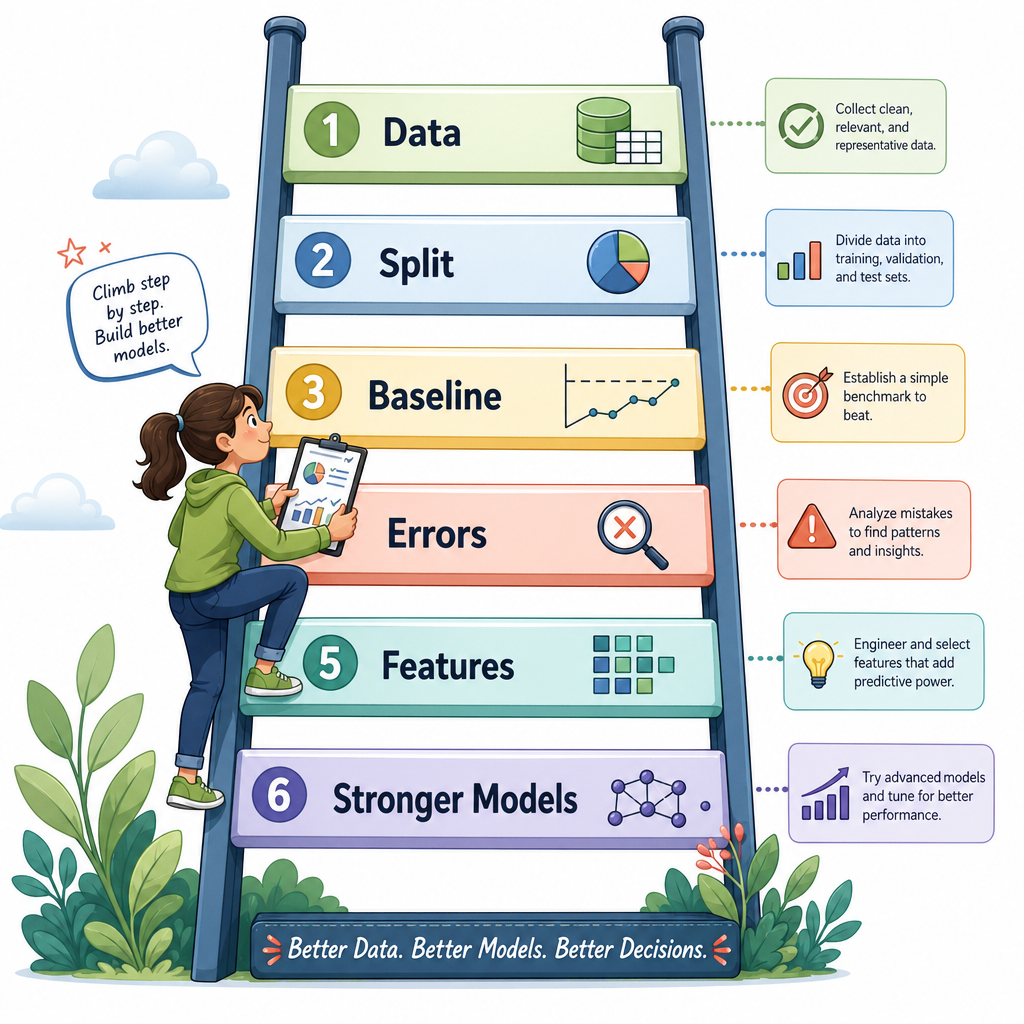
When a model disappoints you, avoid randomly trying algorithms. Use a ladder.
1. Check the data
   Are labels correct? Are rows missing? Is there leakage?

2. Check the split
   Does evaluation match the real prediction situation?

3. Check the baseline
   Is the model actually better than a simple rule?

4. Check the errors
   Where does the model fail? Which examples are hardest?

5. Improve features
   Can the input represent the signal more clearly?

6. Try stronger models
   Only after the earlier checks are reasonable.
This ladder protects you from the most common beginner trap: treating model choice as the whole project.
Missing Word
Fill in the blank
A simple rule or simple model used as a reference point for judging whether a more complex model is useful is called a ____.
Experiment Log
Keep a trail of your thinking
Advanced ML work becomes messy fast. You may test different features, models, metrics, and splits.
A simple experiment log helps you remember what changed and whether it helped.
The format below is intentionally plain Python. The habit matters more than the tool.
```python
experiments = [
    {
        "name": "baseline_mean_prediction",
        "features": "none",
        "model": "mean rule",
        "metric": "MAE",
        "score": 12.8,
        "note": "Reference point from training labels"
    },
    {
        "name": "linear_two_features",
        "features": "age, monthly_usage",
        "model": "linear regression",
        "metric": "MAE",
        "score": 9.6,
        "note": "Clear improvement over baseline"
    },
    {
        "name": "linear_extra_features",
        "features": "age, usage, region_code",
        "model": "linear regression",
        "metric": "MAE",
        "score": 9.9,
        "note": "Extra feature did not help"
    }
]

best = min(experiments, key=lambda row: row["score"])

print("Experiment Summary")
print("-" * 22)
for row in experiments:
    print(f"{row['name']}: {row['score']} {row['metric']} — {row['note']}")

print("\nBest experiment:", best["name"])
print("Best score:", best["score"], best["metric"])
```
Course Wrap
You are ready for the next climb
You started with limited Python and a curiosity about predictive analytics. You now have the beginner-level structure needed to keep growing:
- You understand the ML loop.
- You can think of rows as feature vectors.
- You can build careful transformations.
- You know why baselines and evaluation matter.
- You have practiced comparing models.
- You have packaged prediction logic into a usable form.
Your next project challenge
Pick a small dataset and write a one-page model report:
- What are you predicting?
- What features are available?
- What baseline did you use?
- Which model improved on it?
- Where did the model fail?
- What would you try next?
That report is the bridge from beginner ML to serious ML practice.
Keep the loop close. Let evidence guide you. Build models that are useful, understandable, and responsible.