R Vs Python for Machine Learning
Read at your own pace. Code execution, quizzes, progress tracking, and the AI tutor are available in the interactive view with JavaScript enabled.
Introduction
R Vs Python for Machine Learning
So you're thinking of building a machine learning project, and it's time to decide on a programming language. Although programming languages R and Python offer similar capabilities, they differ in syntax, libraries and community support. Let's take a closer look at the two.

Description
Description
What is R?
R is a language and environment for statistical computing and graphics. It was created by statisticians for statistics, specifically for working with data. It is used by companies like Deloitte, Facebook, Instagram and Google.
What is Python?
Python is a general purpose programming language. It was developed with the goal of improving code readability. It is used by companies like Dropbox, YouTube, Instagram and Google.
Libraries
Libraries
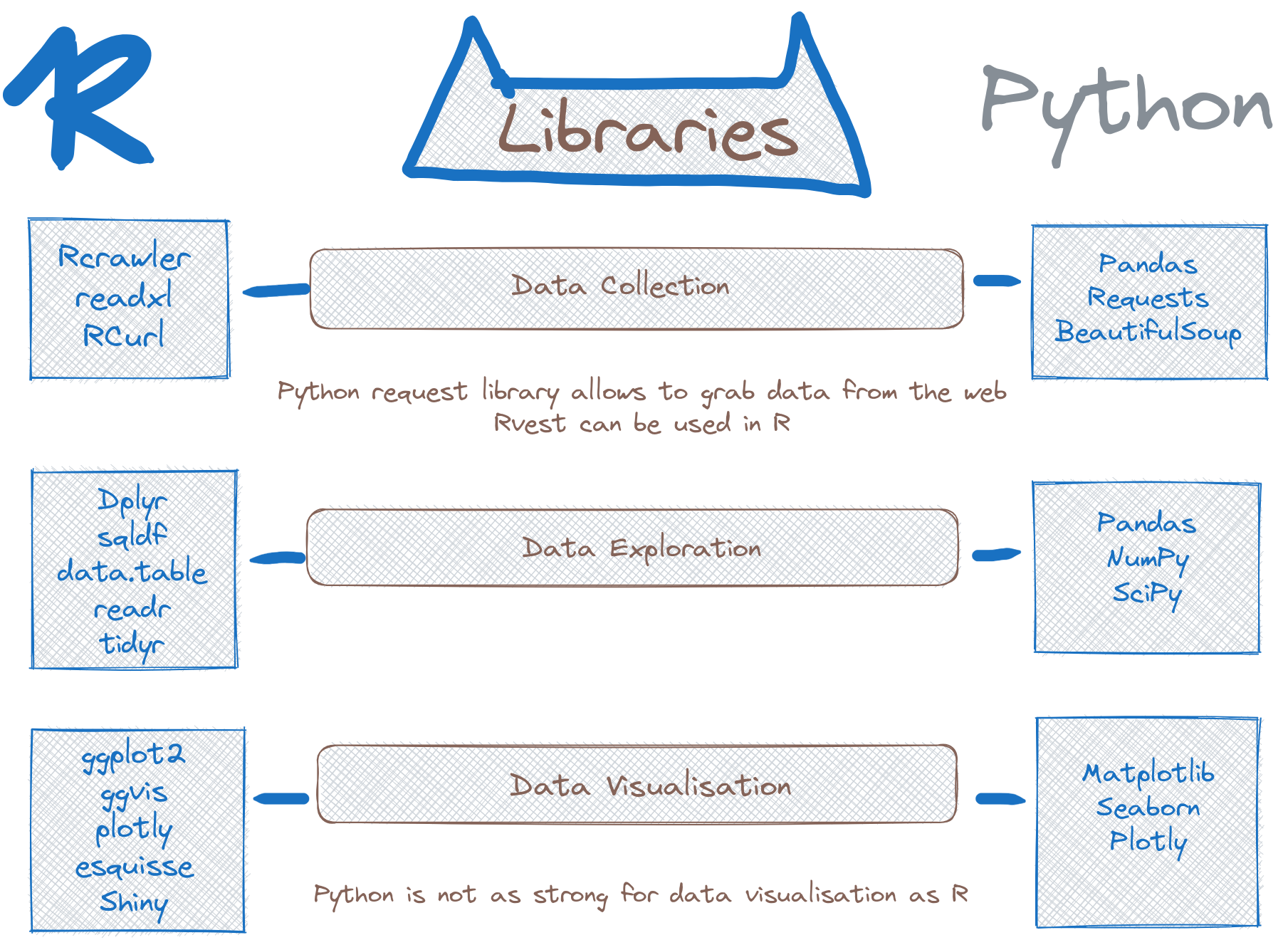
Data Collection
R supports Excel, CSV and text files, as well as files built in Minitab or in SPSS format.
Python in comparison supports all kinds of data formats, from CSV files to JSON sourced from the web, and SQL tables. Python's request library allows you to easily grab data from the web, although modern R packages like Rvest can be used for basic web scraping.
Data Wrangling/Exploration
R allows you to build probability distributions, apply different statistical tests, and use standard ML and data mining techniques. It is optimized for statistical analysis of large datasets, and it offers a number of different options for exploring data.
Python in comparison allows you to explore data with the data analysis library Pandas. With this library you can filter, sort and display data in a matter of seconds.
Data Visualization
Since R was built to demonstrate the results of statistical analysis, you can easily create basic charts and plots with the base graphics module. Using the library ggplot2 more advanced plots can be created, such as complex scatter plots with regression lines.
Python in comparison is not as strong for data visualization. The Matplotlib library for generating basic graphs and charts. The Seaborn library allows you to draw more attractive and informative statistical graphics in Python.
True or False?
R allows for more advanced data visualization capabilities in comparison to Python.
True or False?
R is designed to be highly readable in comparison to Python.
Code/Syntax
Code/Syntax
As Python was created with emphasis on code readability it is regarded as easier to pick up in comparison to R. Let's take a look at the actual coding syntax for importing a csv file and finding the mean.
R Code
library(readr)

nba_data <- read_csv("nba_2013.csv")

library(purr)
library(dplyr)

nba_data %>%
  select_if(is.numeric) %>%
  map_dbl(mean, na.rm = TRUE)
Python Code
import pandas

nba_data = pandas.read_csv("nba_2013.csv")

nba_data.mean()
Comparing both languages, you can see why Python is regarded as easier to read and pick up in comparison to R.
Advantages & Disadvantages
Advantages & Disadvantages

R
Advantages - Open source. - Strong for statistical analysis. - Hundreds of well established packages/libraries devoted to analytics. - Easy to build visualizations.
Disadvantages - Steeper learning curve since it is a more challenging language to learn. - Need knowledge of a large amount of packages. - Can run slowly due to how R stores data.
Python
Advantages - Open source. - General-purpose language thus regarded as a better choice over R if your project demands more than just statistics. - Easy to read and learn thus programming skills can be developed faster and it is a more productive language. - Integrates better in comparison to R for example with lower level languages like C, C++. - Growing number of libraries for data analysis.
Disadvantages - Processing speed can be slow. - Uses a large amount of memory. - It includes fewer statistical model packages in comparison to R.
Project Fit
Project Fit
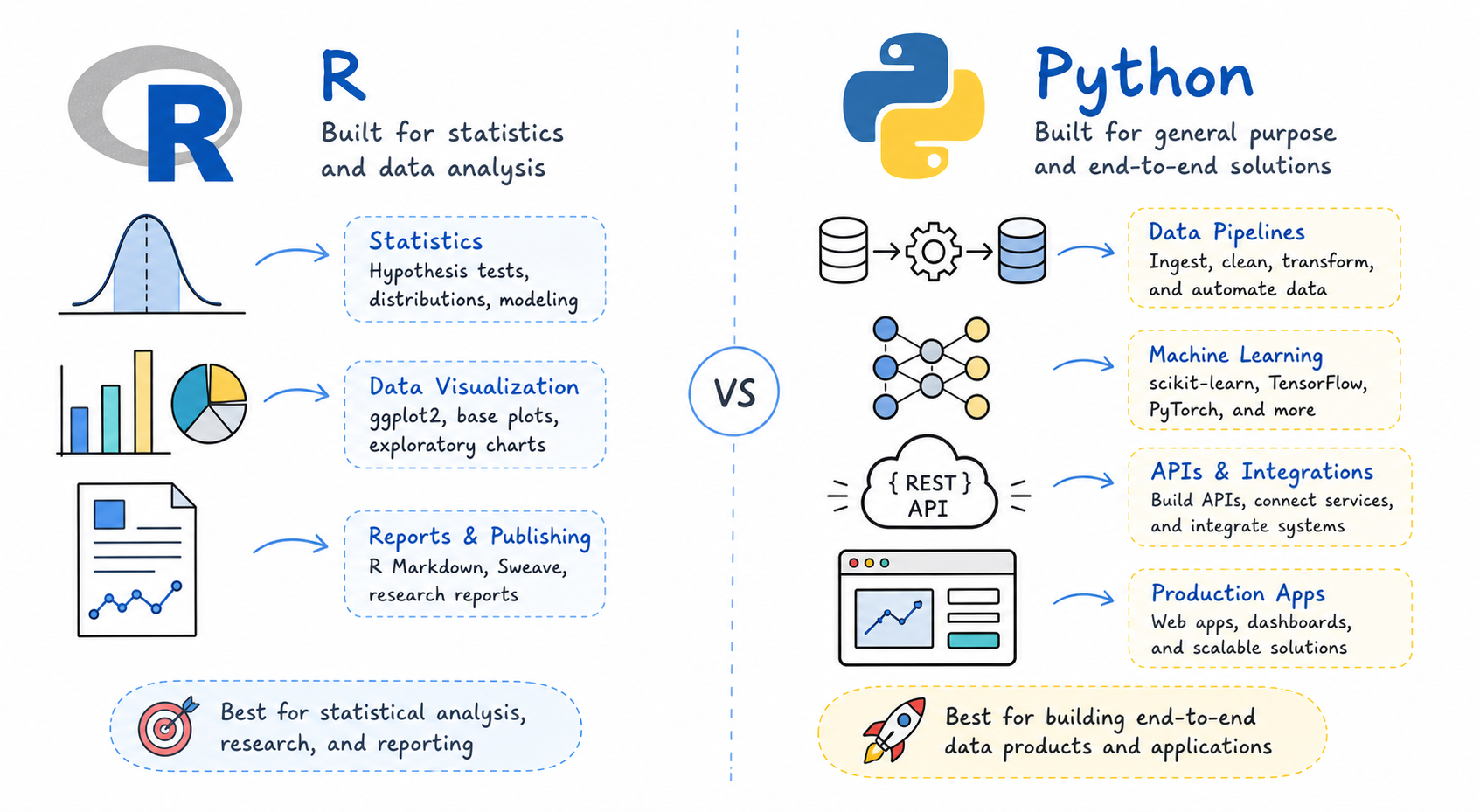
A simple way to choose between R and Python is to think about what your project needs most.
Project Need Better Fit Why Statistical reports and academic analysis R R was built for statistics and has strong visualization packages. Data cleaning, modeling and deployment Python Python works well across data science, APIs, automation and production systems. Quick exploratory charts R Packages likeggplot2 make polished charts straightforward.
Larger ML applications
Python
Libraries like Scikit-learn, TensorFlow and Keras are widely used in ML workflows.
In this course, we will mostly use Python because it gives us an easy path from reading data, to training models, to eventually building larger machine learning projects.
Choose One
A team wants to build a machine learning model and later connect it to a larger web application. Which language is usually the better match?
True or False?
Both R and Python are open source programming languages.
Conclusion
Conclusion
So which is better, is it Python or R? Well the honest answer is that it really depends on your ML project.
If your project is heavily statistics based then R is most suitable, whereas if you are looking to build larger scale, production ready, ML projects Python is the best match.
One Pager Cheat Sheet
One Pager Cheat Sheet
- R and Python both offer great capabilities for
machine learningprojects, but have different syntax, libraries, and community support. - R is a statistical language and
environmentwhile Python is a general purpose programming language. - R and Python both provide a variety of
librariesfor data collection, data wrangling/exploration, and data visualization. - R offers
ggplot2for more complex graphical representations, whereas Python relies onMatplotlibandSeabornfor basic and more advanced visualizations, respectively. - R is generally considered to be less readable and accessible than Python due to its complex syntax and low-level programming language abstractions.
- Python is
regarded as easier to readandpick upthan R due to its emphasis on code readability. - Python and R are both
open source, however Python is generally considered easier to read and learn with a growing number of libraries for data analysis while R has more packages available devoted to analytics but can run slowly due to data storage. - The software code of
open sourceprogramming languages like R and Python can be freely used, modified, and distributed without any restriction, encouraging collaboration and enabling commercial and research applications. - It
really dependson yourML project, but generally speaking, R is best for heavily statistics-based projects, while Python is better forlarger-scale, production-readyprojects.