Recursion: Principles and Algorithms
Read at your own pace. Code execution, quizzes, progress tracking, and the AI tutor are available in the interactive view with JavaScript enabled.
Why Recursion Now
From connected data to self-repeating problems
In Introduction to Data Structures, you saw that the way we organize information changes the code we write. In Graphs: Concepts and Operations, you worked with nonlinear relationships and traversal ideas.
Now we add a new problem-solving tool: recursion.
Recursion is when a function solves a problem by solving smaller versions of the same problem. It shows up in graph traversal, file folders, game decisions, puzzles, and many interview-style algorithms.
Think of a true-crime investigation board: to understand one suspect, you may need to investigate their contacts; for each contact, you repeat the same process on a smaller part of the case.

The Recursive Contract
Every safe recursion needs three parts
A recursive function is like making a promise:
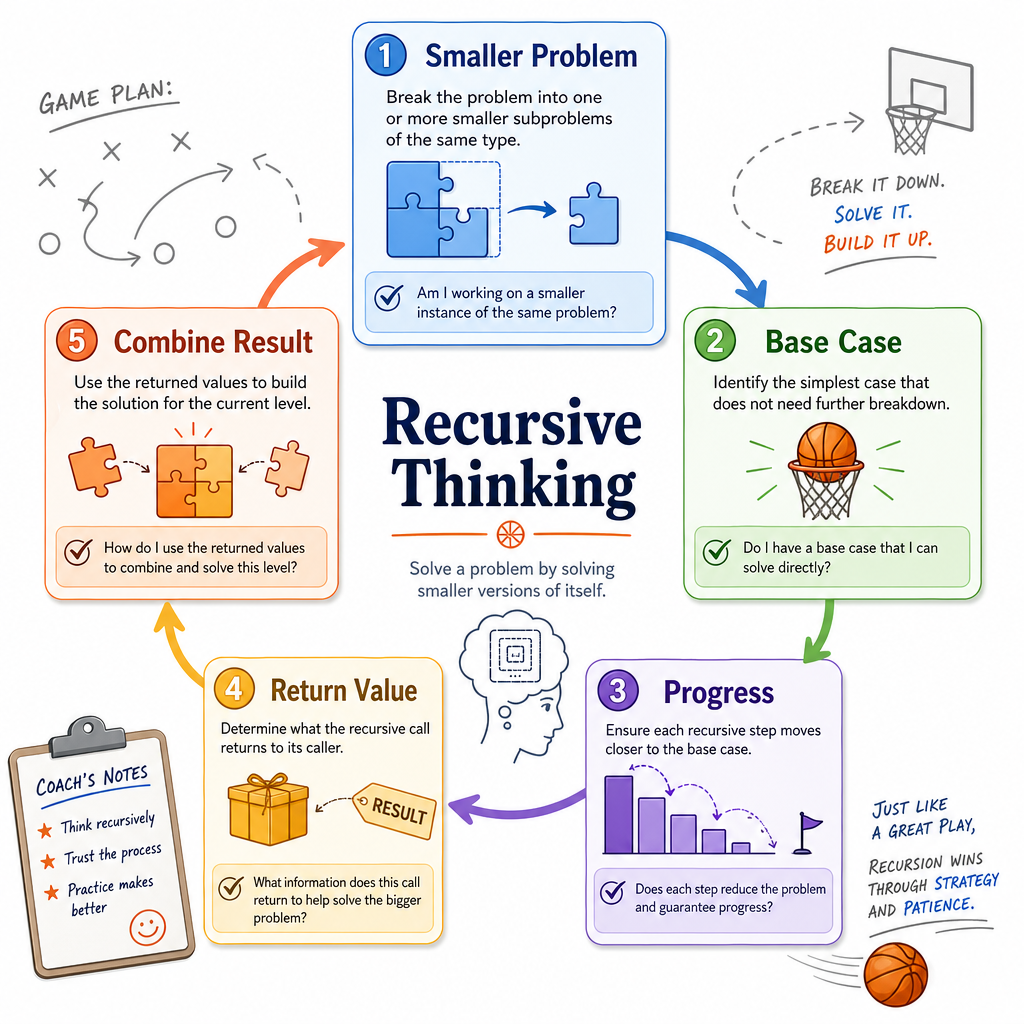
- Base case — When do we stop?
- Progress — How does each call move closer to stopping?
- Recursive call — Where do we solve a smaller version of the same problem?
Without a base case, recursion can keep calling itself until Python raises an error. Without progress, the base case may never be reached.
A useful mental model:
solve(big problem)
  -> solve(smaller problem)
      -> solve(even smaller problem)
          -> base case
      <- return result
  <- combine result
Spot The Stop
A recursive function is supposed to count down from n to 0.
Which condition is the most direct base case?
Factorial By Recursion
A classic first recursive algorithm
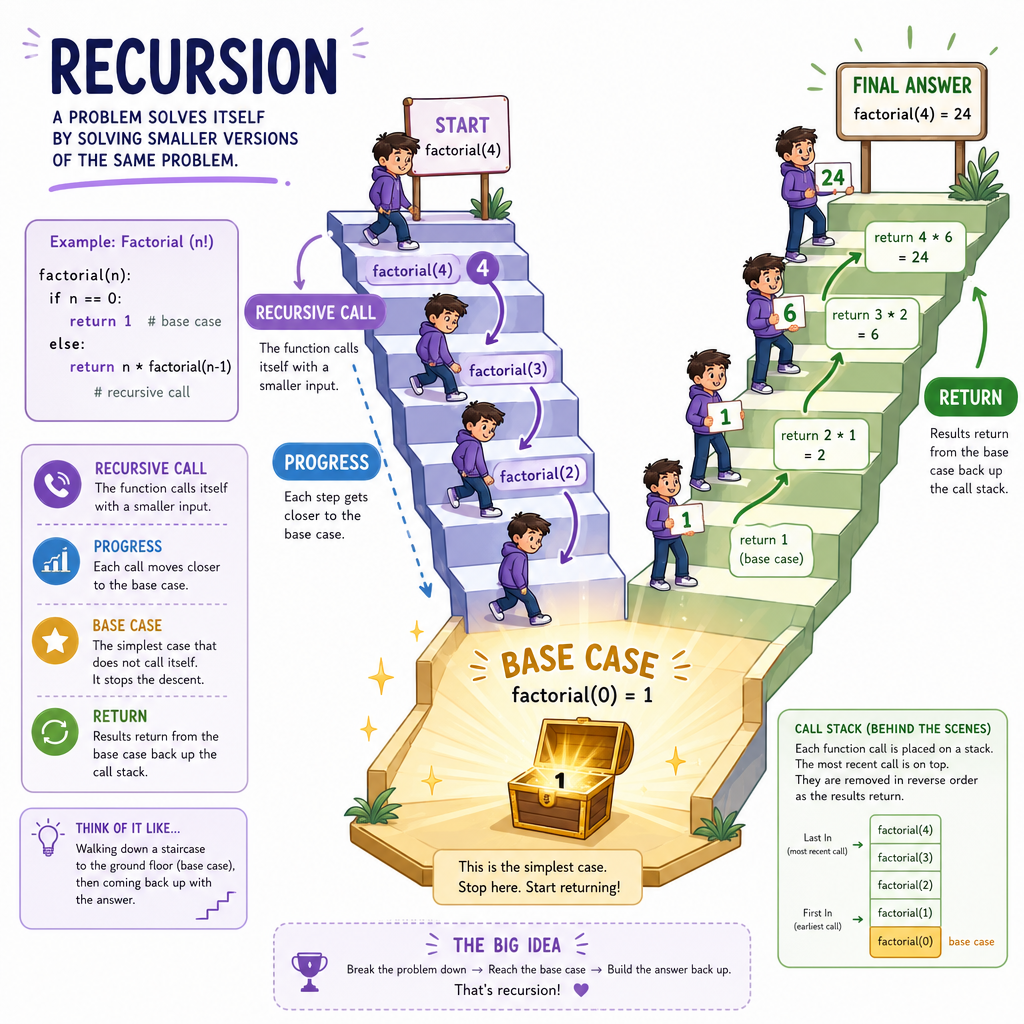
The factorial of a number multiplies that number by every positive integer below it.
5! = 5 × 4 × 3 × 2 × 1 = 120
Recursive idea:
factorial(n) = n × factorial(n - 1)
But we still need the base case:
factorial(0) = 1
Why 1? Because multiplying by 1 does not change the result, so it cleanly ends the chain.
```python
def factorial(n):
    if n == 0:
        return 1
    return n * factorial(n - 1)

print("factorial(5) =", factorial(5))
print("factorial(0) =", factorial(0))
```
Fill The Base
Complete the missing base-case return value:
factorial(0) should return ____.
Recursion Or Iteration
Recursion is not magic
Many recursive solutions can also be written with loops.
The difference is usually about how the work is expressed:
- Iteration repeats using a loop.
- Recursion repeats using function calls.
For a simple countdown, either version works. Recursion becomes especially elegant when the problem naturally contains smaller versions of itself.
```python
def countdown_recursive(n):
    if n == 0:
        return ["Tipoff!"]
    return [str(n)] + countdown_recursive(n - 1)


def countdown_iterative(n):
    result = []
    while n > 0:
        result.append(str(n))
        n -= 1
    result.append("Tipoff!")
    return result

print("Recursive:", " -> ".join(countdown_recursive(3)))
print("Iterative:", " -> ".join(countdown_iterative(3)))
```
Always Better
True or false:
A recursive solution is always faster and better than an iterative solution.
Branching Calls
Some recursion grows quickly
Factorial makes one smaller call each time:
factorial(5) -> factorial(4) -> factorial(3) -> ...
But some algorithms make multiple recursive calls.
The Fibonacci sequence is a famous example:
fib(n) = fib(n - 1) + fib(n - 2)
That branching can repeat the same work many times. Later, when we study hashmaps, you will see how fast lookup can help avoid repeated calculations.
```python
calls = 0

def fib(n):
    global calls
    calls += 1

    if n <= 1:
        return n

    return fib(n - 1) + fib(n - 2)

for n in [4, 6, 8]:
    calls = 0
    value = fib(n)
    print(f"fib({n}) = {value}, function calls = {calls}")
```
Recursive Graph Search
Applying recursion to a familiar structure
In Graphs: Concepts and Operations, you learned that adjacency lists describe who connects to whom.
Recursion gives us a natural way to explore those connections: visit a node, then recursively visit its neighbors.
Here, we search for whether a path exists from one person to another in a small investigation network.
```python
graph = {
    "Detective": ["Witness", "Analyst"],
    "Witness": ["Neighbor"],
    "Analyst": ["Phone Records", "Security Footage"],
    "Neighbor": [],
    "Phone Records": [],
    "Security Footage": ["Suspect"] ,
    "Suspect": []
}


def has_path(graph, current, target, visited=None):
    if visited is None:
        visited = set()

    if current == target:
        return True

    if current in visited:
        return False

    visited.add(current)

    for neighbor in graph[current]:
        if has_path(graph, neighbor, target, visited):
            return True

    return False

print("Path to Suspect?", has_path(graph, "Detective", "Suspect"))
print("Path to Coach?", has_path(graph, "Detective", "Coach" if "Coach" in graph else "Coach"))
```
Recursion Checklist
Before writing recursive code, ask:
- What is the smaller version of this problem?
- What is the base case?
- Does every call move closer to that base case?
- What should each call return?
- Do I combine returned values, or just pass success/failure upward?
Recursion is a lens: it helps you see repeated structure inside a problem.
You have now added a major algorithmic pattern to your toolkit. Next, we move to Hashmaps: Efficient Data Retrieval, where the focus shifts from repeated structure to fast lookup.