Scrum, Kanban, and Lean: Process Cheat Sheet
Read at your own pace. Code execution, quizzes, progress tracking, and the AI tutor are available in the interactive view with JavaScript enabled.
Why Process Matters
Why Process Matters
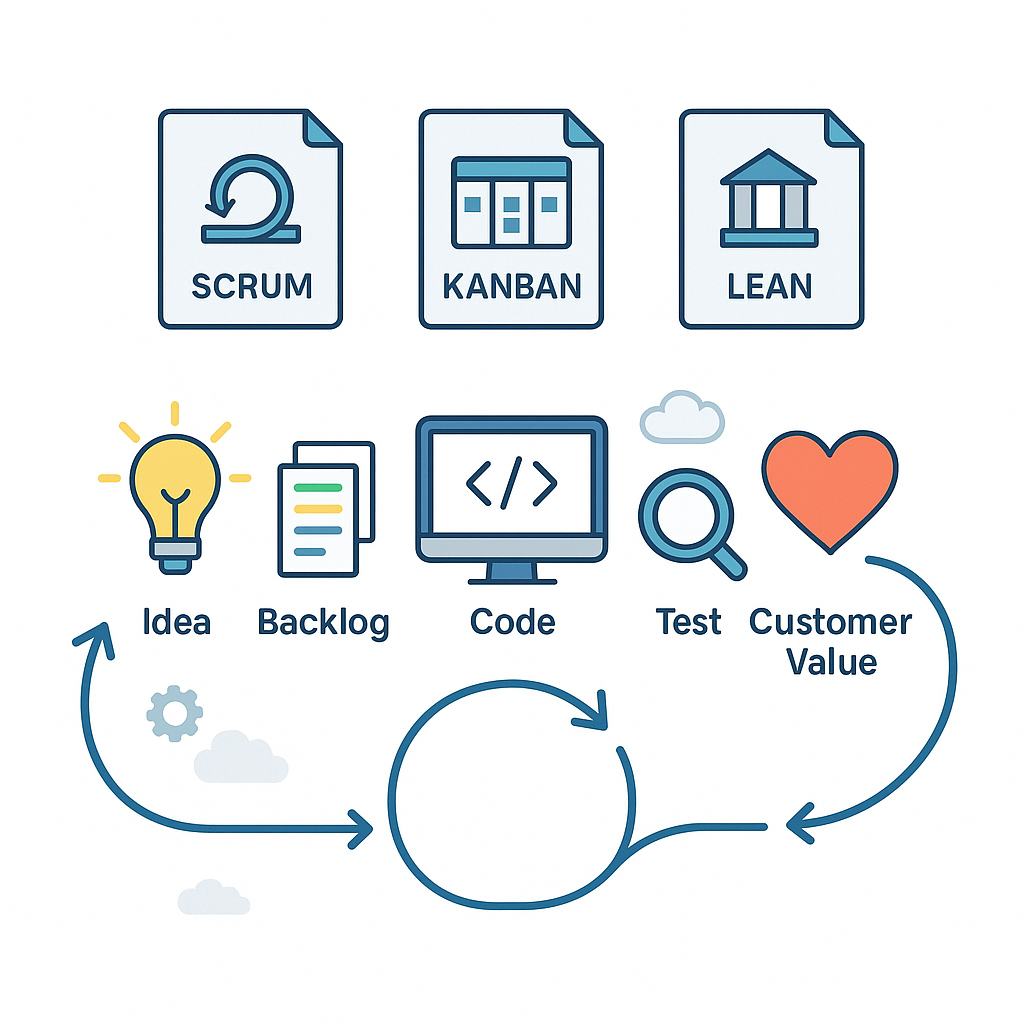
Software is a team sport. Without a playbook, even great players trip over each other. Scrum, Kanban, and Lean are three popular playbooks for coordinating how work flows from idea to production—faster, safer, and with less drama.
In DevOps, the goal is speed with stability. These methods help you reduce chaos, expose bottlenecks, and ship value on purpose instead of by accident.
Think of them as three siblings: Scrum loves timeboxes, Kanban loves flow, and Lean loves eliminating waste. Pick one, blend them, or rotate as your work changes.
Expand the Acronym
In Agile flow discussions, what does WIP stand for?
Core Definitions
Core Definitions
Before we start rearranging sticky notes like it’s modern art, let’s define a few recurring terms:
-
Backlog: An ordered list of work items, ideally by value, not whim. -
Sprint: A fixed timebox (1–4 weeks) in which Scrum teams deliver a slice of value. -
WIP(Work in Progress): The number of items being worked at the same time. Too much WIP = stalled flow. -
Lead time: Time from request to delivery. Customer’s stopwatch. -
Cycle time: Time from “started” to “done.” Team’s stopwatch. -
Throughput: Number of items completed per time period. -
Flow efficiency: Active time / total time. The “how much waiting is ruining our vibe” metric.
Mental Model: Flow Factory
Mental Model: Flow Factory
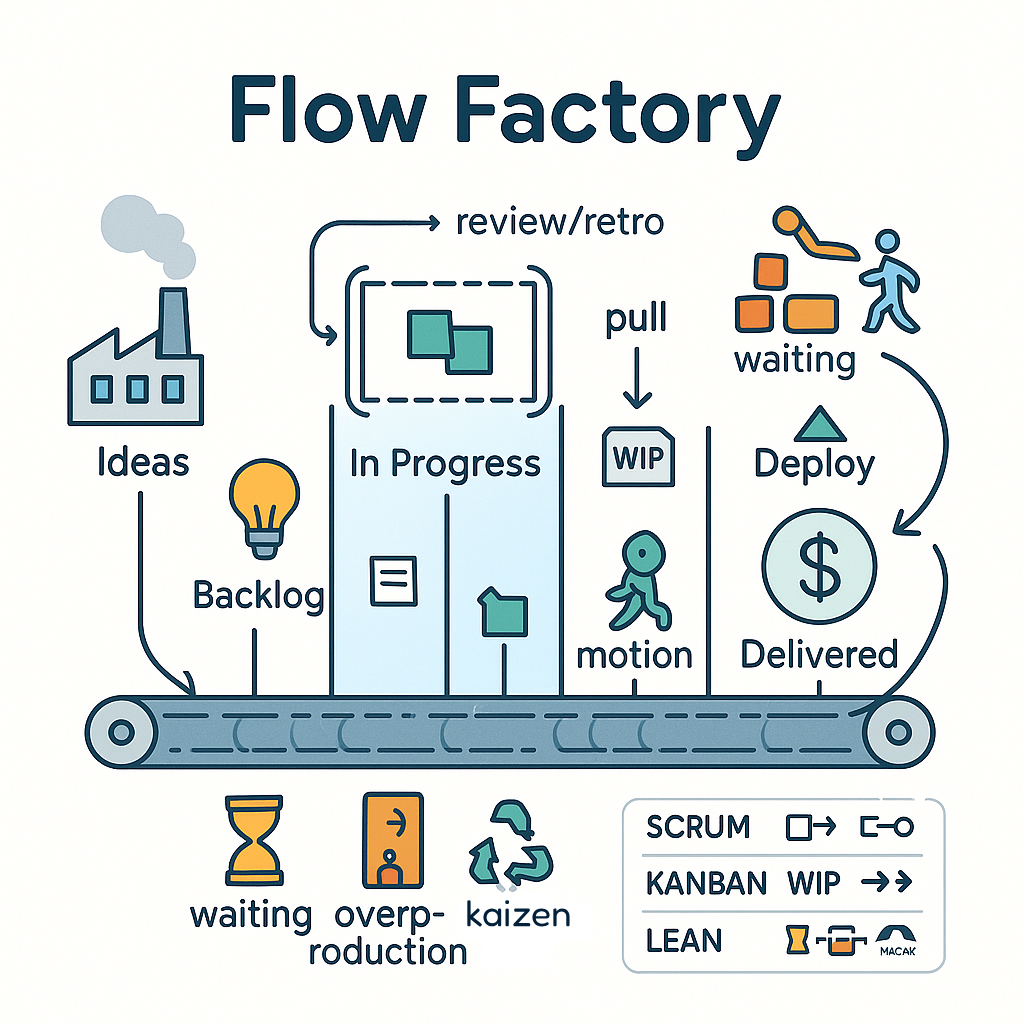
Imagine your team as a small factory that produces changes—features, fixes, infra updates. Raw ideas go in; shiny value comes out.
- Scrum optimizes with timeboxes and feedback loops.
- Kanban optimizes flow by limiting WIP and visualizing bottlenecks.
- Lean optimizes the whole system by removing waste and improving the value stream.
Different tools, same goal: deliver value with less friction.
Scrum Sprint Outcome
What should a Scrum team produce by the end of each sprint?
Scrum At A Glance
Scrum At A Glance
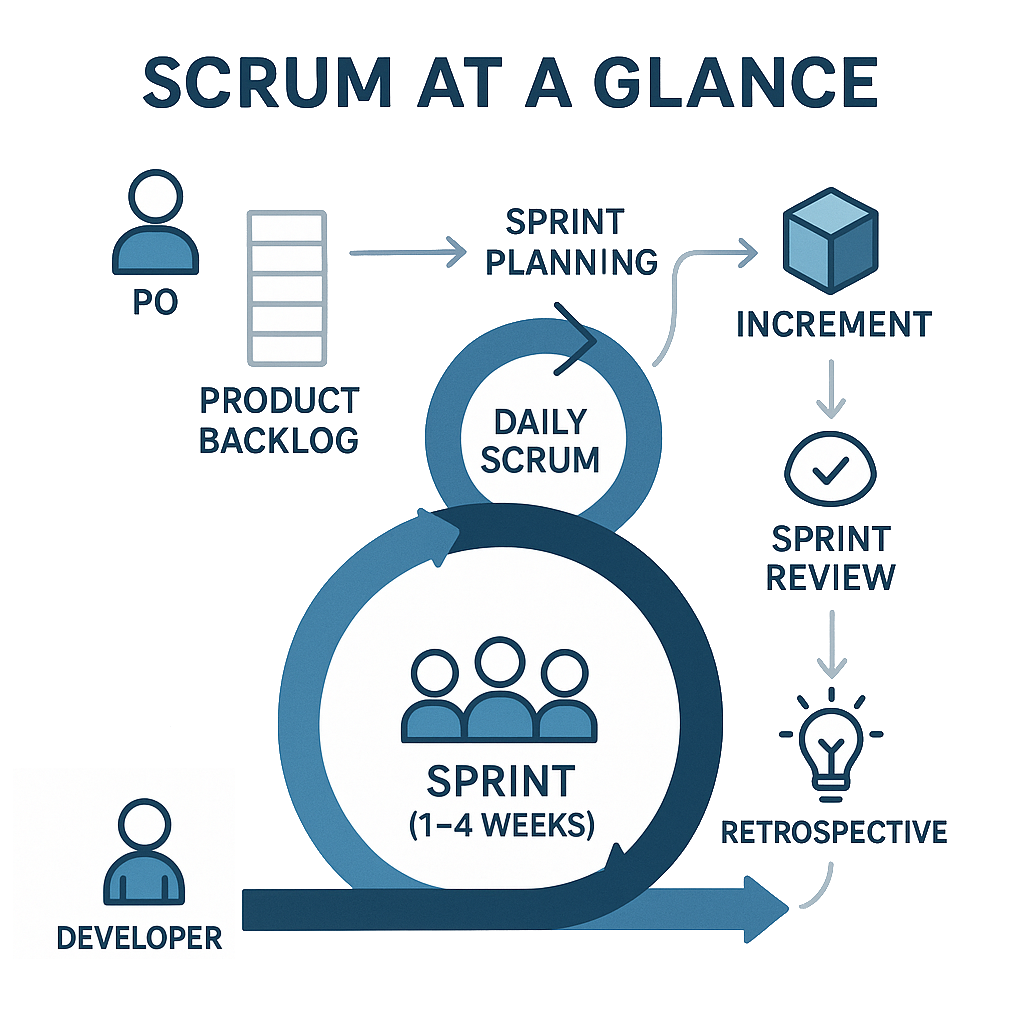
What it is: A lightweight framework using fixed-length sprints to deliver increments of value and learn quickly.
Core pieces:
- Timeboxed sprints (1–4 weeks)
- Product Backlog prioritized by value
- Sprint Backlog committed for the sprint
- Increment that is potentially shippable
Strengths: Predictable cadence, clear roles, frequent feedback, good for complex work with unclear paths.
Tradeoffs: Can struggle with unplanned ops work, rigid if treated as ceremony theater, needs disciplined backlog management.
Scrum Roles & Artifacts
Scrum Roles & Artifacts
Roles:
- Product Owner: Orders the backlog to maximize value.
- Scrum Master: Coaches the team, improves flow, removes impediments.
- Developers: Everyone building the Increment (coders, testers, ops, designers).
Artifacts:
- Product Backlog: Ordered list of work.
- Sprint Backlog: Selected work + plan for achieving the Sprint Goal.
- Increment: The result of the sprint, meeting the team’s Definition of Done.
Tip: Make Definition of Done explicit (tests, security checks, docs, deployment). Shipability is a feature.
Scrum Events That Matter
Scrum Events That Matter
-
Sprint Planning: What can we deliver and how? -
Daily Scrum: 15 minutes to inspect and adapt the plan. Not a status theater. -
Sprint Review: Show real working software to stakeholders. Feedback > applause. -
Sprint Retrospective: Improve the system, not just the people. Change one thing next sprint.
Cadence builds habit. Habit builds velocity (the sustainable kind).
Sequence the Scrum Events
Put these Scrum events in their typical order within a sprint.
Kanban At A Glance
Kanban At A Glance
What it is: A method to improve flow by visualizing work and limiting WIP. No timeboxes required.
Core pieces:
- Board with columns that reflect your workflow
- WIP limits per column
- Explicit policies for moving work
- Continuous delivery—pull when ready
Strengths: Great for mixed/interrupt-driven work (ops, SRE, platform), adapts quickly, exposes bottlenecks fast.
Tradeoffs: Less built-in ceremony; discipline needed to inspect metrics and improve.

Kanban Timeboxes
Kanban requires fixed-length sprints to deliver value.
Classes of Service
Which of the following is NOT a typical Kanban class of service?
Kanban: Policies & WIP
Kanban: Policies & WIP
Set the rules of the road:
- WIP limits: “Only 2 items in Code Review,” not “as many as fit on my second monitor.”
- Pull policies: Upstream pulls from downstream. Avoid pushing half-baked work.
- Classes of service: Expedite, Fixed date, Standard, Intangible (tech debt).
When blocked, swarm to unblock before starting new work. Starting is fun; finishing pays.
Lean At A Glance
Lean At A Glance
What it is: A mindset and practices to maximize value and minimize waste across the whole system.
Core principles:
- Define value from the customer’s perspective
- Map the value stream
- Create flow
- Establish pull
- Pursue perfection through continuous improvement
Lean isn’t a board. It’s how you decide what to build and how to build it with less nonsense.
Lean: Waste & Value Stream
Lean: Waste & Value Stream
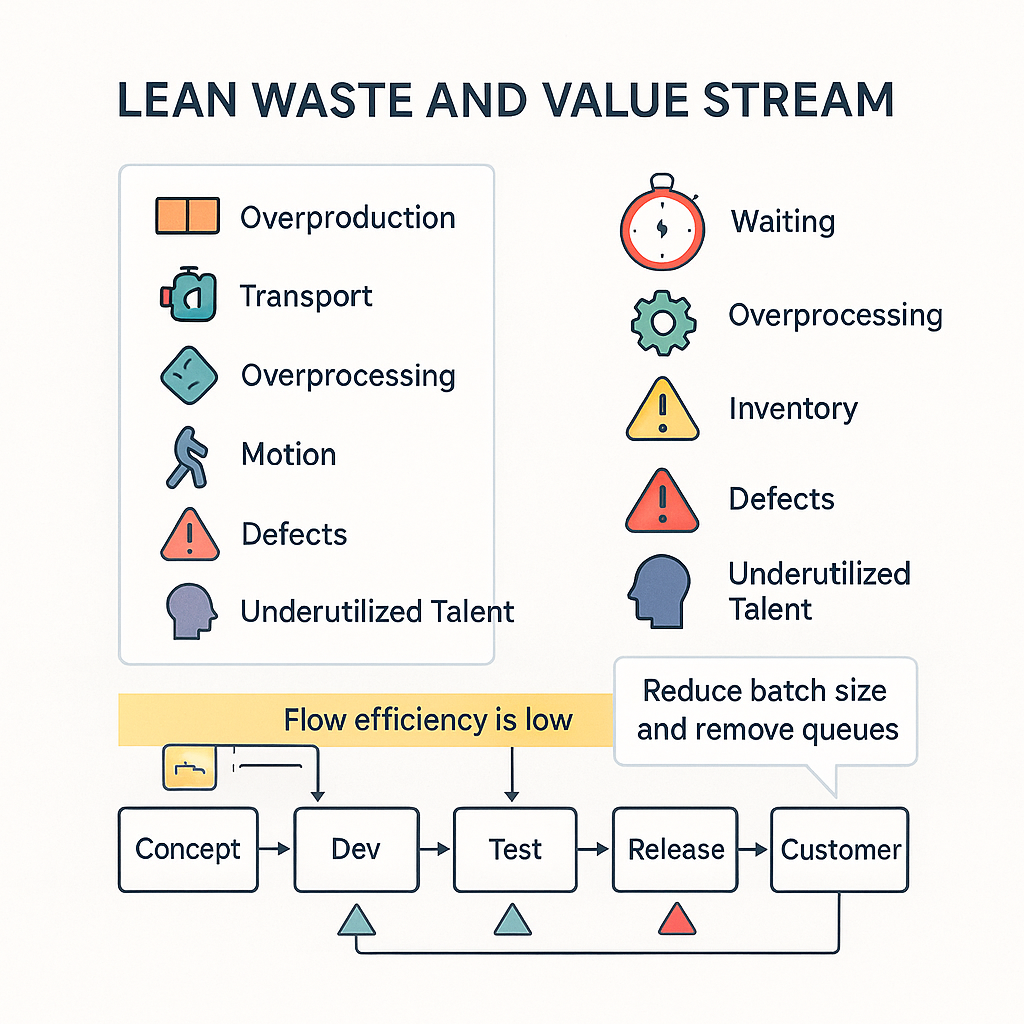
Seven common wastes (plus one):
- Overproduction: Building features no one uses
- Waiting: Approval queues, handoffs
- Transport: Useless ticket ping-pong
- Overprocessing: Gold-plating, redundant checks
- Inventory: Massive backlogs you’ll never do
- Motion: Context switching, chasing info
- Defects: Rework, bugs
- Underused talent: Not involving people in improvement
Value Stream Mapping: Draw steps from idea to prod. Time each step. The big delays are your gold mines for improvement.
Metrics That Matter
Metrics That Matter
Measure to learn, not to punish:
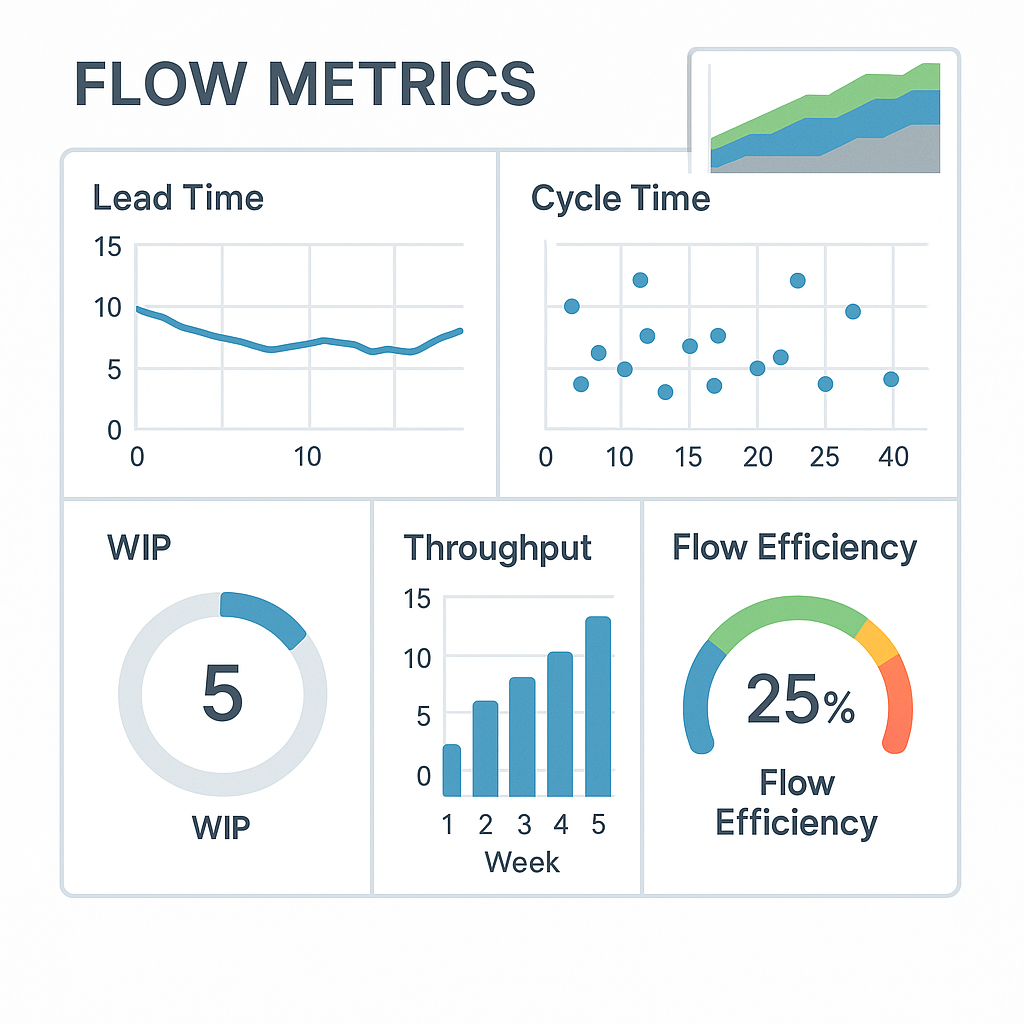
- Lead time: Business urgency perspective
- Cycle time: Team flow perspective
- Work item age: How long current items have been in progress
- Throughput: Items completed per week/sprint
- WIP: Active items right now
- Flow efficiency: Active vs waiting time
- Blocker frequency/duration: How sticky are your bottlenecks?
Shorten feedback loops first; speed follows.
Pick the Right Flow Metric
Which metric best reflects the team’s flow perspective for how long work takes from start to finish?
Choosing the Fit
Your SRE team handles frequent interrupts and incidents. Which approach is the best starting point?
Choosing The Fit
Choosing The Fit
Use Scrum when: - Work benefits from timeboxed goals and demos - Stakeholders want regular, predictable checkpoints - Team is cross-functional and product-focused
Use Kanban when: - Work is variable, interrupt-driven, or queue-based (incidents, infra) - You need continuous flow, not timeboxes - You want to start improving tomorrow with what you have
Use Lean always: - It guides how to remove waste and improve the system regardless of method
Blending Approaches: Scrumban
Blending Approaches: Scrumban
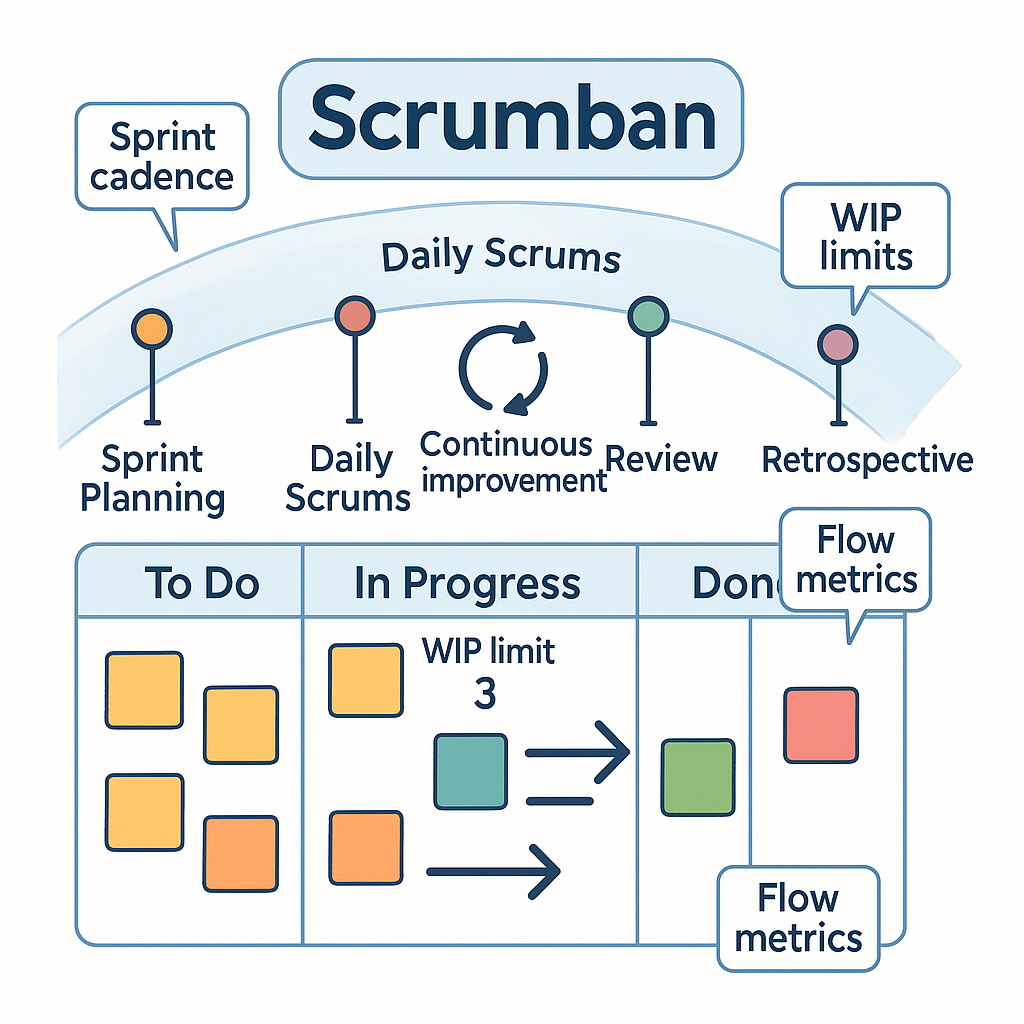
Yes, you can mix them:
- Keep Scrum’s sprint cadence for planning, review, retro
- Use Kanban WIP limits, flow metrics, and pull within the sprint
- Apply Lean to prioritize and remove waste across the value stream
Rule of thumb: Borrow on purpose, not by accident. Document the process and refine it.
Example: Feature Delivery
Example: Feature Delivery
Scenario: Product team delivering a new onboarding flow.
- Scrum fit: Plan a 2-week
sprintwith a clearSprint Goal(reduce time-to-first-value). Demo working slices each sprint. - Kanban assist: Add WIP limit of 1–2 in
Code ReviewandTesting. Trackcycle timeto see where work stalls. - Lean lens: Remove rework by automating acceptance tests and feature flags to reduce
waitinganddefects.
Result: Steady cadence, visible flow, fewer surprises.
Example: Incidents & Ops
Example: Incidents & Ops
Scenario: SRE team handling alerts, maintenance, and small improvements.
- Kanban fit: Visualize
Expeditelane for incidents, strict WIP limits,pullpolicies. - Metrics: Watch
work item ageandlead timefor expedited work. Keep a smallStandardWIP for improvements. - Lean lens: Reduce
waitingby automating runbooks; cutmotionby centralizing dashboards.
Result: Faster recovery, fewer half-started tasks, space for proactive work.
Example: Platform/Infra
Example: Platform/Infra
Scenario: Platform team providing CI/CD, environments, and shared services.
- Blend: Monthly Scrum
planning/review/retrofor roadmap; Kanban for daily flow. - Policies:
Classes of serviceto balance fixed-date migrations vs standard requests. - Lean lens: Value Stream Map the deployment path; remove
overprocessing(duplicate approvals) andtransport(handoffs).
Result: Predictable outcomes with flexible intake.
Scaling Without Drama
Scaling Without Drama
Multiple teams? Keep it simple:
- Align on Definition of Done and work item sizing heuristics
- Use a rolling wave roadmap; avoid massive batch planning
- Sync on dependencies via a weekly cross-team flow review (not status—focus on risks, blockers, and options)
- Limit WIP at both team and program levels
Scaling is adding constraint elegance, not meetings.
Anti-Patterns To Avoid
Anti-Patterns To Avoid
-
Zombie Scrum: All ceremonies, no working increments -
Kanban Wallpaper: Pretty board, unlimited WIP -
Cargo Cult Metrics: Measuring what’s easy, ignoring flow -
Hero Culture: Fixing symptoms instead of systems -
Batch-and-Queue: Giant PRs, giant projects, giant regrets -
Backlog Hoarding: Thousands of tickets you’ll never do—archive or say no
If everything is priority, nothing flows.
Anti-Pattern Check
“Zombie Scrum” describes teams doing ceremonies without delivering working increments.
Tooling & Board Design
Tooling & Board Design
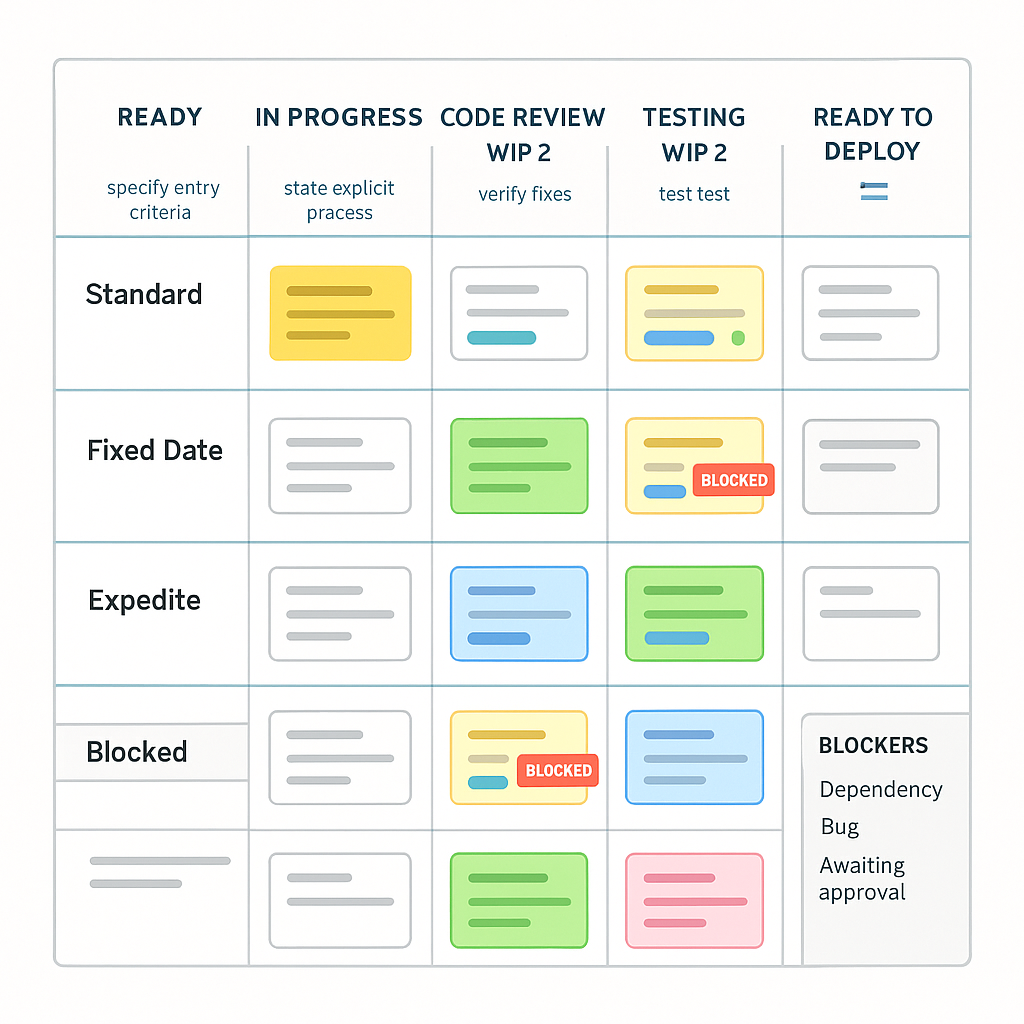
Make the board reflect reality:
- Columns mirror actual workflow (e.g., Ready, In Progress, Code Review, Testing, Ready to Deploy, Done)
- Add Blocked flags and track blocker reasons
- Set WIP limits where work waits longest
- Use swimlanes for classes of service
- Automate status changes via CI/CD where possible
The board is a model. Keep the model honest.
Quick-Start Cheat Sheets
Quick-Start Cheat Sheets
Scrum (start tomorrow):
- Choose 2-week sprints
- Define a crisp Sprint Goal
- Pull only what fits; leave slack for unplanned work
- Ship a real Increment
- Do a 30-minute retro: pick one improvement
Kanban (start this afternoon):
- Draw your workflow, set small WIP limits
- Establish explicit pull policies
- Visualize blockers and swarm them
- Track cycle time and throughput weekly
- Reduce WIP before adding people
Lean (start now):
- Map your value stream
- Identify top 1–2 wastes
- Run a small experiment to remove them
- Measure effect on lead time
- Repeat
Recap: The Playbook
Recap: The Playbook
- Scrum gives you cadence and feedback via
sprintsandreviews. - Kanban gives you flow via
WIP limits,pull, andmetrics. - Lean gives you systemic improvement by removing
wasteacross thevalue stream.
Pick the starting point that fits your work. Blend deliberately. Measure flow, not feelings. And remember: starting is optional, finishing is mandatory.