Stacks and Queues
Read at your own pace. Code execution, quizzes, progress tracking, and the AI tutor are available in the interactive view with JavaScript enabled.
Controlled Access
From sequences to rules
In Arrays and Strings, you learned to work with ordered data by scanning, indexing, slicing, and updating.
In Sorting and Searching, you saw that choosing the right structure can create shortcuts.
Now we add two simple structures that show up constantly in interviews:
- Stack: last item in, first item out
- Queue: first item in, first item out
The key idea is not that they store data differently from lists. The key idea is that they restrict how you access the data.
That restriction is what makes many interview problems easier to reason about.

Two Access Rules
Same storage, different promise
A stack and a queue both hold multiple values, but each gives you a different promise about which value comes out next.
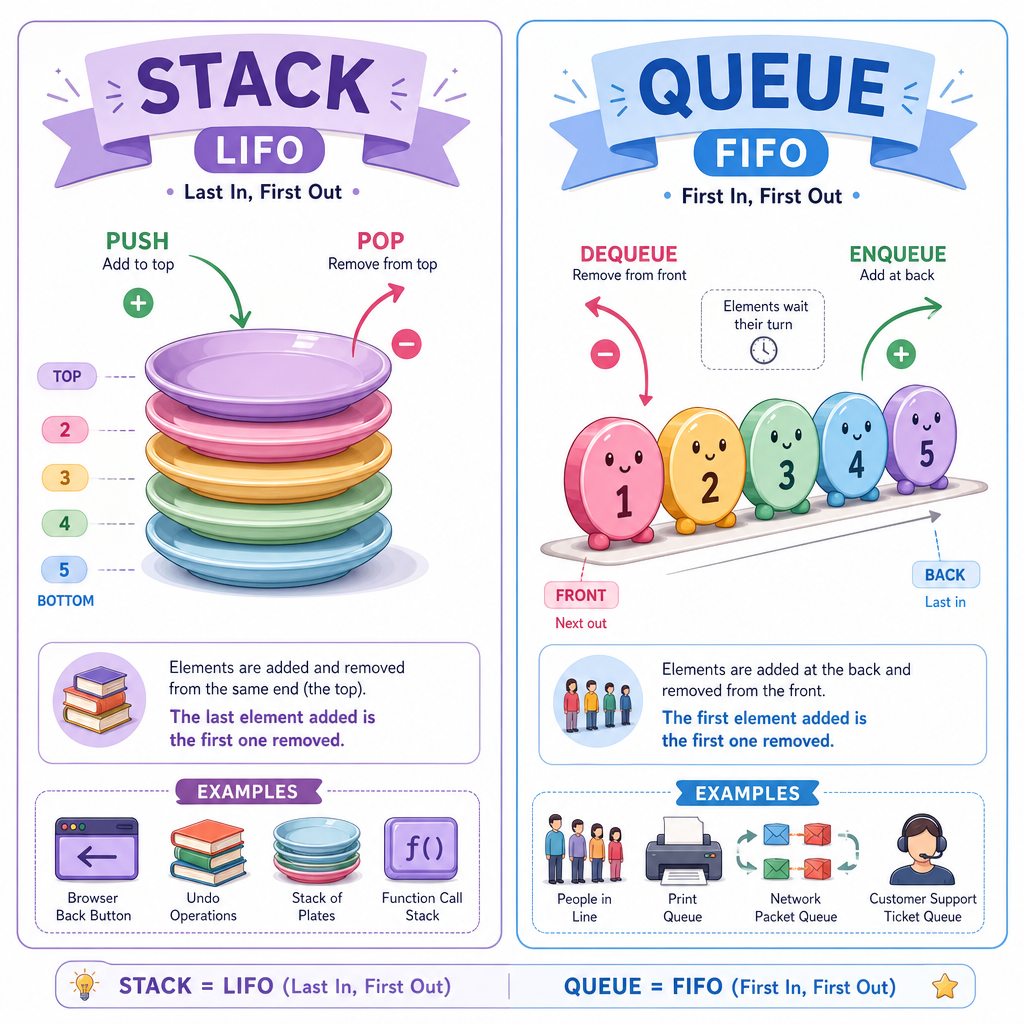
Stack: LIFO
Last In, First Out
push A     push B     pop -> B

bottom [ A, B ] top
Think of a stack of plates. The last plate placed on top is the first plate removed.
Queue: FIFO
First In, First Out
enqueue A   enqueue B   dequeue -> A

front [ A, B ] back
Think of a line at a trading desk coffee machine: whoever arrived first gets served first.
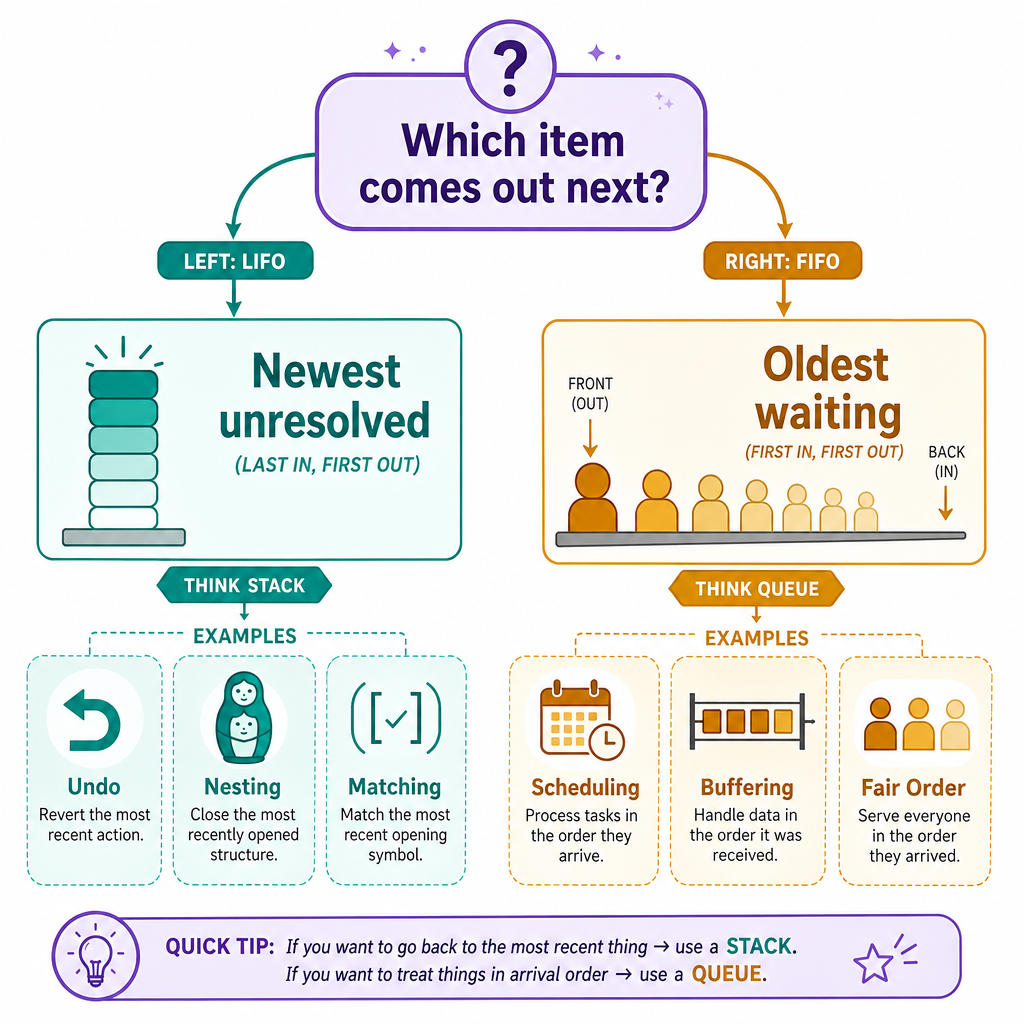
In interviews, your job is often to notice: Do I need the newest unfinished thing, or the oldest waiting thing?
Stack In Python
Use a list as a stack
In Python, the most common stack implementation is just a list.
Use:
-
append(x)to push onto the top -
pop()to remove from the top
Both operations are efficient at the end of a list.
Here is a tiny stack example that tracks recent actions:
```python
stack = []

stack.append("open order form")
stack.append("type quantity")
stack.append("submit order")

print("Current stack:", stack)

last_action = stack.pop()
print("Undo:", last_action)
print("After undo:", stack)

stack.append("edit quantity")
print("After new action:", stack)
```
Which Structure?
You are solving an interview problem where you repeatedly need to process the most recent unfinished item first.
Which structure best matches that access pattern?
Queue In Python
Use deque as a queue
For queues, use collections.deque.
Why not just use a list?
-
list.append(x)at the end is fine - but
list.pop(0)must shift the remaining elements left - that makes repeated front removals inefficient
A deque supports efficient operations at both ends.
Use:
-
append(x)to enqueue at the back -
popleft()to dequeue from the front
```python
from collections import deque

orders = deque()

orders.append("order_A")
orders.append("order_B")
orders.append("order_C")

print("Waiting orders:", list(orders))

first = orders.popleft()
print("Processing:", first)
print("Still waiting:", list(orders))

orders.append("order_D")
print("After new order:", list(orders))
```
List Queue Trap
True or false:
Using a Python list with pop(0) is usually a good queue implementation for large interview inputs.
When To Use
The interview decision
When you feel confused, ask one access question:
Which waiting item should be handled next?
Choose a stack when...
You need the newest unresolved thing.
Common signals:
- undo behavior
- nested structures
- matching open/close symbols
- backtracking-like cleanup
Choose a queue when...
You need the oldest waiting thing.
Common signals:
- fair order of arrival
- task scheduling
- buffering events
- level-by-level processing later in graph and tree problems
You do not need to memorize every pattern yet. Just connect the problem statement to the access rule.
Push Method
Fill in the blank.
In Python, when using a list as a stack, you push an item onto the top with:
stack.____(item)
Parentheses Pattern
A classic stack interview problem
One of the most common stack uses is checking whether brackets are properly matched.
Example:
"({[]})"  -> valid
"([)]"    -> invalid
Why stack?
Because when you see a closing bracket, it must match the most recent unmatched opening bracket.
That phrase — most recent unmatched — is a stack signal.
```python
def is_valid_brackets(s):
    stack = []
    pairs = {")": "(", "]": "[", "}": "{"}

    for ch in s:
        if ch in "([{":
            stack.append(ch)
        else:
            if not stack:
                return False
            top = stack.pop()
            if top != pairs[ch]:
                return False

    return len(stack) == 0

print(is_valid_brackets("({[]})"))
print(is_valid_brackets("([)]"))
print(is_valid_brackets("((()"))
```
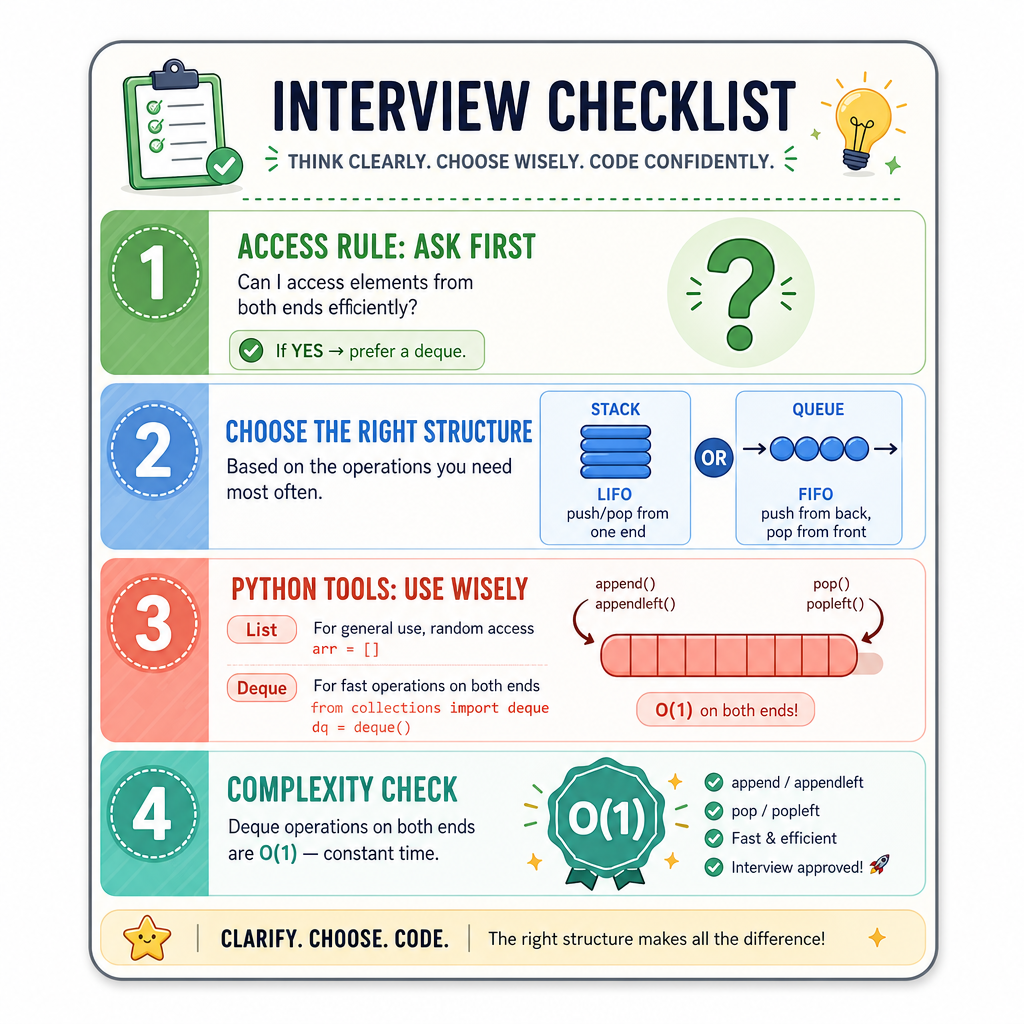
Interview Checklist
What to say out loud
For interview prep, do not just code the structure. Explain why it fits.
Use this template:
- Access rule: “I need the newest item” or “I need the oldest item.”
- Structure: “That suggests a stack” or “That suggests a queue.”
-
Python tool:
- Stack:
listwithappend()andpop() - Queue:
dequewithappend()andpopleft()
- Stack:
-
Complexity: Each push/pop or enqueue/dequeue is typically
O(1).
Stacks and queues are small ideas, but they become building blocks for harder topics. Next, linked lists will show another way to organize access and updates.