System Design Basics
Read at your own pace. Code execution, quizzes, progress tracking, and the AI tutor are available in the interactive view with JavaScript enabled.
From Algorithms To Systems
Why this matters
You have now practiced the core interview tools: arrays, hashing, graphs, recursion, dynamic programming, greedy choices, and complexity analysis.
System design asks a different question:
Instead of "What function solves this input?" ask: "What service keeps working as users, data, failures, and latency grow?"
For a financial firm, this could mean designing a trade feed, risk dashboard, market-data cache, or order status service. You do not need to be a senior architect yet. Your goal is to explain clear tradeoffs using the same disciplined thinking from earlier lessons.
In this lesson, we will build a beginner-friendly system design loop you can use in interviews.

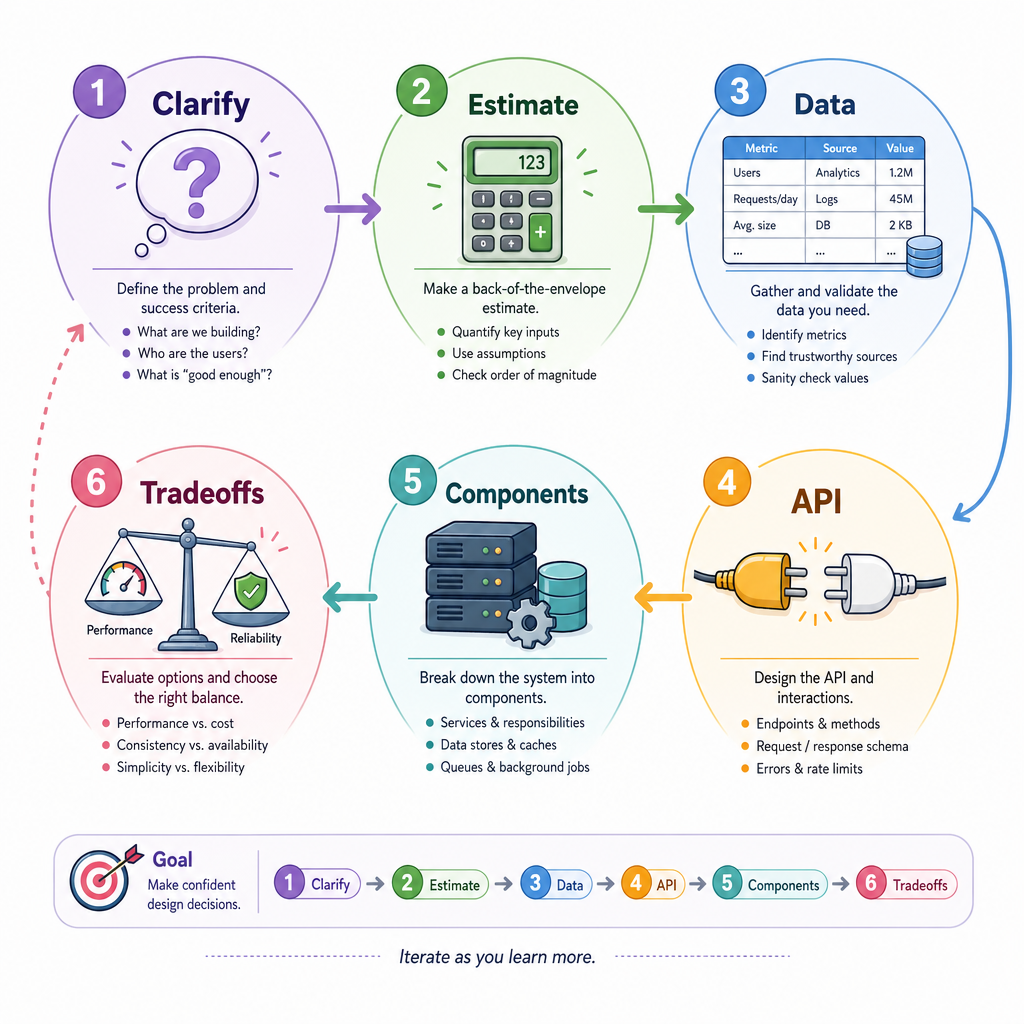
The Design Loop
A simple interview loop
When you hear "Design X," do not jump straight to databases or code.
Use this loop:
- Clarify requirements — What must the system do?
- Estimate scale — How many users, requests, records, or events?
- Define data — What objects exist?
- Sketch APIs — How does the outside world interact?
- Choose components — App servers, databases, caches, queues.
- Discuss tradeoffs — Speed, correctness, cost, simplicity, reliability.
This is similar to the "Interview Thinking Loop" from Introduction to Data Structures: understand the problem before picking the tool.
First Move Check
You are asked: "Design a service that shows a user their latest executed trades."
What is the best first move?
Requirements First
Functional vs non-functional
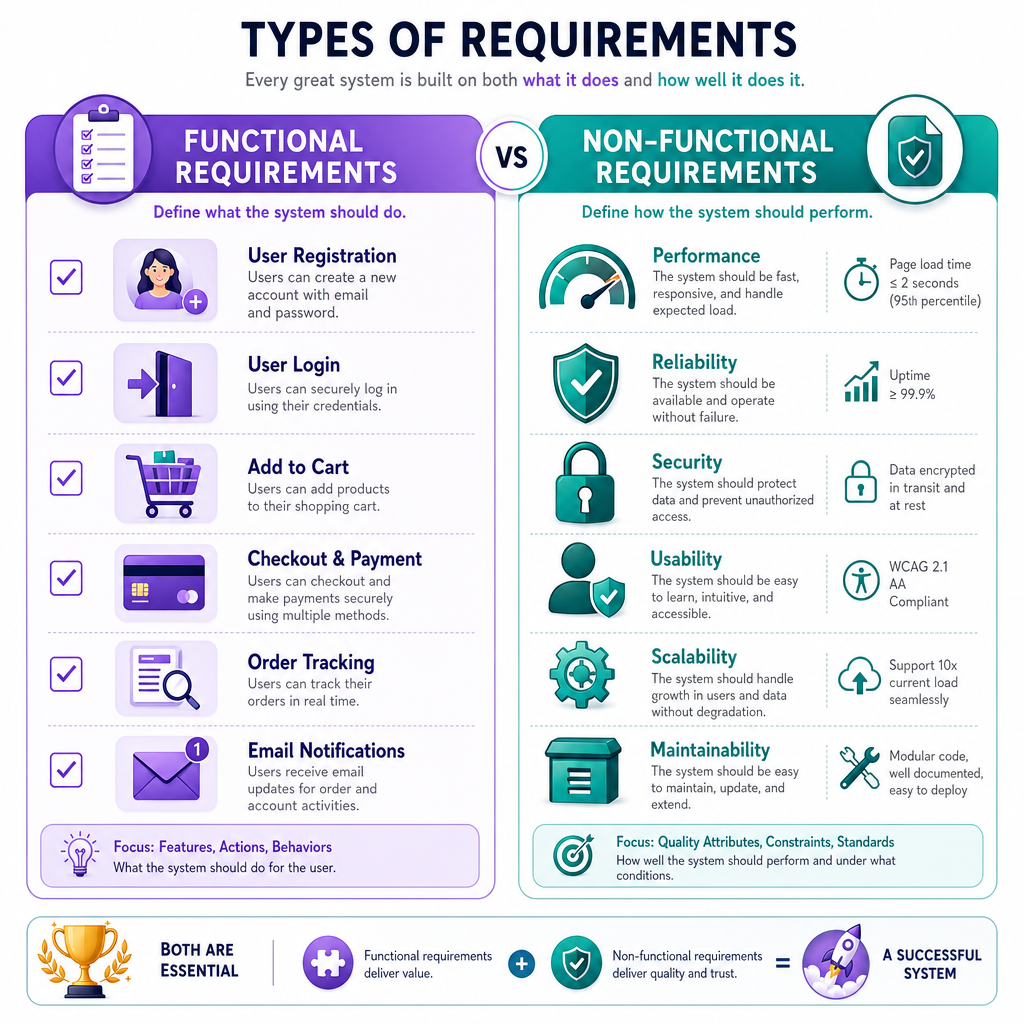
System design interviews often separate requirements into two buckets.
Functional requirements
What the system does.
Examples:
- Users can view their latest trades.
- Users can filter by symbol, like AAPL or BTC-USD.
- Internal risk tools can read all trades for a desk.
Non-functional requirements
How well the system must behave.
Examples: - Low latency: latest trades should load quickly. - Reliability: do not lose executed trades. - Security: users only see their own data. - Auditability: historical records must be recoverable.
For finance interviews, correctness and auditability often matter as much as speed.
Key Word
Before choosing databases, caches, or queues, clarify the system's ________.
Core Building Blocks
The basic pieces
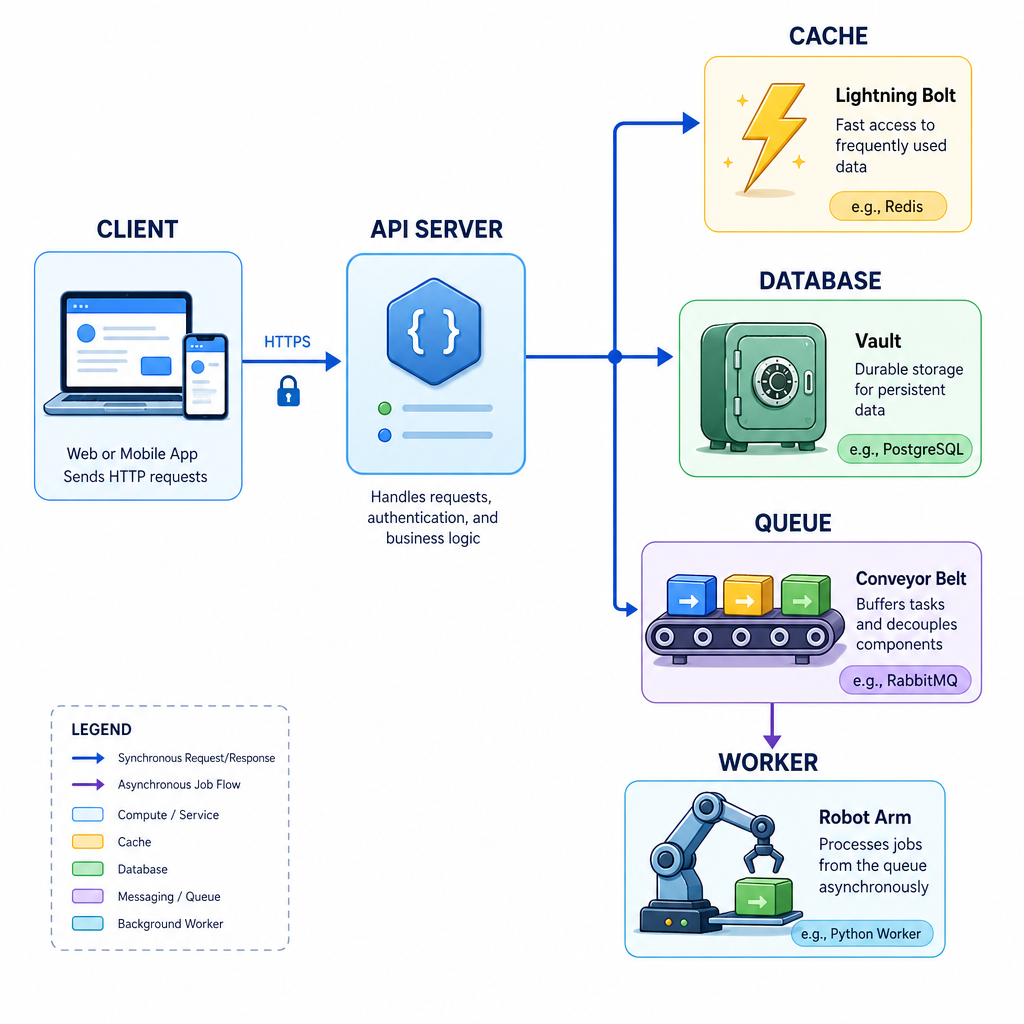
Most beginner system designs combine a few familiar building blocks:
Client
  |
  v
API / App Server
  |
  +--> Cache
  |
  +--> Database
  |
  +--> Queue --> Worker
Think of these like larger versions of data structures:
- Database: durable storage, like a persistent table of records.
- Cache: fast lookup, similar in spirit to a hash table from Hashing and Hash Tables.
- Queue: ordered background work, connected to the queue idea from Stacks and Queues.
- Worker: processes tasks outside the request path.
A good design does not use every component. It uses the smallest set that satisfies the requirements.
Tiny Trade API
APIs describe behavior
An API is the contract between the user/client and your system.
For a trade-history service, you might describe endpoints like:
-
POST /tradesrecords an executed trade. -
GET /users/{user_id}/tradesreturns that user's latest trades.
In an interview, you do not need production code first. But a tiny Python sketch can clarify the data shape and behavior.
```python
# Tiny in-memory sketch of a trade-history API.
# This is not a web server; it models the behavior.

trades_by_user = {}


def record_trade(user_id, trade_id, symbol, quantity, price):
    trade = {
        "trade_id": trade_id,
        "symbol": symbol,
        "quantity": quantity,
        "price": price,
    }
    trades_by_user.setdefault(user_id, []).append(trade)
    return trade


def get_latest_trades(user_id, limit=3):
    return trades_by_user.get(user_id, [])[-limit:][::-1]


record_trade("u1", "t100", "AAPL", 10, 190.50)
record_trade("u1", "t101", "MSFT", 5, 420.25)
record_trade("u2", "t200", "TSLA", 2, 175.00)
record_trade("u1", "t102", "AAPL", 7, 191.10)

print("Latest trades for u1:")
for trade in get_latest_trades("u1"):
    print(trade)
```
Cache Truth Check
True or false: Adding a cache always improves a system and should be one of the first components you add.
Estimate Before Scaling
Scale changes choices
A design for 100 trades per day is different from a design for 100,000 trades per second.
You can make simple estimates:
- How many writes per second?
- How many reads per second?
- How large is each record?
- How much storage per day?
This connects directly to Time and Space Complexity Analysis: you are still asking, "What happens as input grows?" The input is now traffic and data volume.
```python
# Simple capacity estimate for a trade storage service.

trades_per_second = 5000
bytes_per_trade = 300
seconds_per_day = 24 * 60 * 60

trades_per_day = trades_per_second * seconds_per_day
storage_per_day_gb = trades_per_day * bytes_per_trade / (1024 ** 3)

print(f"Trades per day: {trades_per_day:,}")
print(f"Approx storage per day: {storage_per_day_gb:.2f} GB")

# If we keep 7 years for audit/history:
years = 7
storage_7_years_tb = storage_per_day_gb * 365 * years / 1024
print(f"Approx storage for {years} years: {storage_7_years_tb:.2f} TB")
```
Tradeoffs Matter
There is rarely one perfect answer
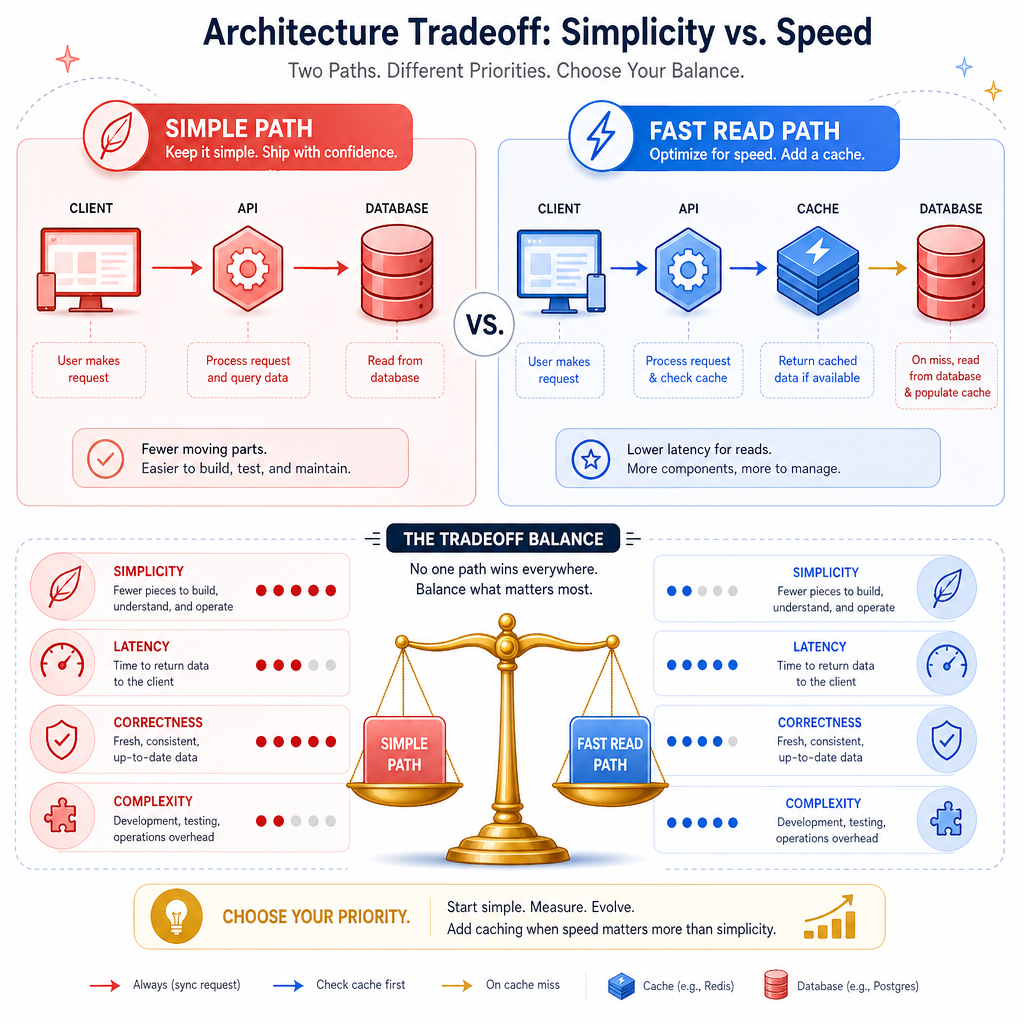
System design is about tradeoffs.
Example: latest-trades service
Simple version
Client -> API Server -> Database
Good when: - Traffic is moderate. - Correctness matters more than ultra-low latency. - You want fewer moving parts.
Faster read version
Client -> API Server -> Cache
                    -> Database
Good when: - Many users repeatedly request the same recent data. - Read latency is a major requirement.
But now you must answer: - When does the cache update? - What if cache and database disagree? - Is stale data acceptable?
In finance, "slightly stale" may be fine for a dashboard but unacceptable for order execution or risk limits.
Design Answer Shape
Your beginner system design template
When answering a basic system design question, use this structure:
-
Restate the goal
- "We need a service for users to view latest executed trades."
-
Clarify requirements
- Who uses it?
- How fresh must the data be?
- How much history is needed?
- What security or audit rules matter?
-
Estimate scale
- Reads/sec, writes/sec, record size, retention.
-
Define data and APIs
- Trade fields, user ID, symbol, timestamp.
- Read and write endpoints.
-
Sketch components
- API server, database, maybe cache or queue.
-
Explain tradeoffs
- Simplicity vs speed.
- Freshness vs caching.
- Reliability vs cost.
Next, Mock Interviews will help you practice saying this out loud under interview pressure.