Tree Data Structure
Read at your own pace. Code execution, quizzes, progress tracking, and the AI tutor are available in the interactive view with JavaScript enabled.
Why Trees Now
From linear patterns to branching structure
Now that we've covered Introduction to Data Structures, Recursion, and Sliding Windows, you're ready for a structure that shows up everywhere: trees.
Arrays and sliding windows are naturally linear: move left to right, maintain a range, update an invariant.
Trees are different:
- Data branches into parent-child relationships
- Recursion becomes a natural navigation tool
- Many interview problems become questions about shape, subtrees, and ordering rules
As a Java developer, you've already used tree-like ideas indirectly: file systems, DOM nodes, JSON objects, dependency graphs, indexes, and expression parsing.
In this lesson, we'll focus on the tree data structure itself: what it is, how to model it, and how to reason about its most common patterns.

Tree Vocabulary
A tree is hierarchical
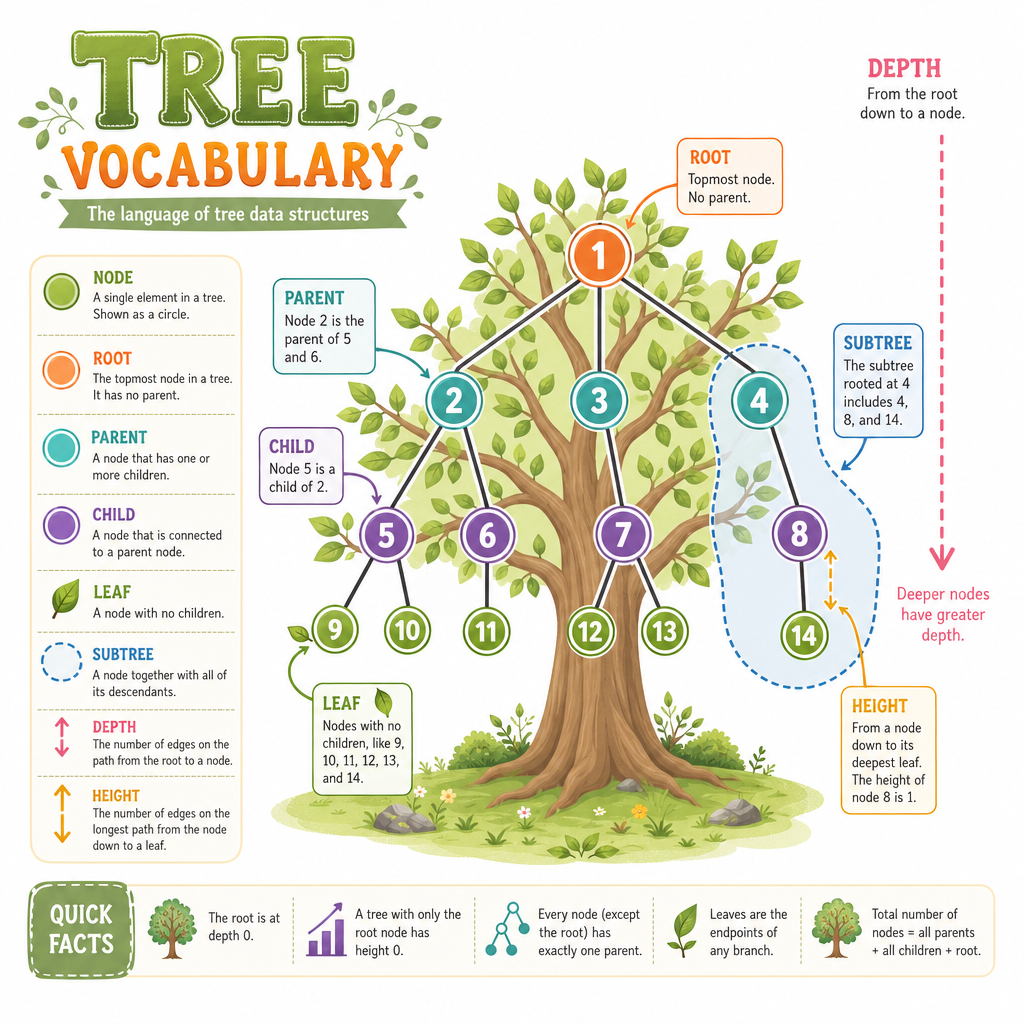
A tree is a collection of nodes connected by edges where each node can have children.
Unlike arrays, trees do not have one obvious next element. A node may branch into multiple possible paths.
        A        <- root
      /   \
     B     C     <- children of A
    / \     \
   D   E     F   <- leaves: D, E, F
Key terms:
- Root: the top node, with no parent
- Parent: a node directly above another node
- Child: a node directly below another node
- Leaf: a node with no children
- Subtree: any node plus all of its descendants
- Depth: distance from root to a node
- Height: longest distance from a node down to a leaf
The most important mental shift: with trees, you often solve the problem for one node, then trust recursion to solve the same problem for its subtrees.
Tree Property Check
Which statement best describes a basic tree structure?
Modeling Nodes
A node is data plus links
In Java, a tree node is usually modeled as an object containing:
- A value
- References to child nodes
For a binary tree, each node has at most two children: left and right.
The structure is not stored by index like an array. It is stored by references between objects.
This small example builds a tree manually and prints a few relationships.
```java
public class Main {
    static class TreeNode {
        int value;
        TreeNode left;
        TreeNode right;

        TreeNode(int value) {
            this.value = value;
        }
    }

    public static void main(String[] args) {
        TreeNode root = new TreeNode(10);
        root.left = new TreeNode(5);
        root.right = new TreeNode(15);
        root.left.left = new TreeNode(3);
        root.left.right = new TreeNode(7);

        System.out.println("Root: " + root.value);
        System.out.println("Left child: " + root.left.value);
        System.out.println("Right child: " + root.right.value);
        System.out.println("Is 7 a leaf? " + (root.left.right.left == null && root.left.right.right == null));
    }
}
```
Traversal Patterns
Traversal means visiting nodes
Because trees branch, you need a strategy for visiting nodes.
The classic depth-first traversal orders are:
- Preorder: node, left, right
- Inorder: left, node, right
- Postorder: left, right, node
This is where the Recursion lesson becomes immediately useful. Each traversal says:
- What should I do at the current node?
- When should I visit the left subtree?
- When should I visit the right subtree?
The code below prints all three orders for the same tree.
```java
public class Main {
    static class TreeNode {
        int value;
        TreeNode left, right;
        TreeNode(int value) { this.value = value; }
    }

    static void preorder(TreeNode node) {
        if (node == null) return;
        System.out.print(node.value + " ");
        preorder(node.left);
        preorder(node.right);
    }

    static void inorder(TreeNode node) {
        if (node == null) return;
        inorder(node.left);
        System.out.print(node.value + " ");
        inorder(node.right);
    }

    static void postorder(TreeNode node) {
        if (node == null) return;
        postorder(node.left);
        postorder(node.right);
        System.out.print(node.value + " ");
    }

    public static void main(String[] args) {
        TreeNode root = new TreeNode(10);
        root.left = new TreeNode(5);
        root.right = new TreeNode(15);
        root.left.left = new TreeNode(3);
        root.left.right = new TreeNode(7);

        System.out.print("Preorder: ");
        preorder(root);
        System.out.println();

        System.out.print("Inorder: ");
        inorder(root);
        System.out.println();

        System.out.print("Postorder: ");
        postorder(root);
        System.out.println();
    }
}
```
Binary Tree Rule
True or false: In a binary tree, each node may have at most two children.
Search Trees
Binary Search Tree invariant
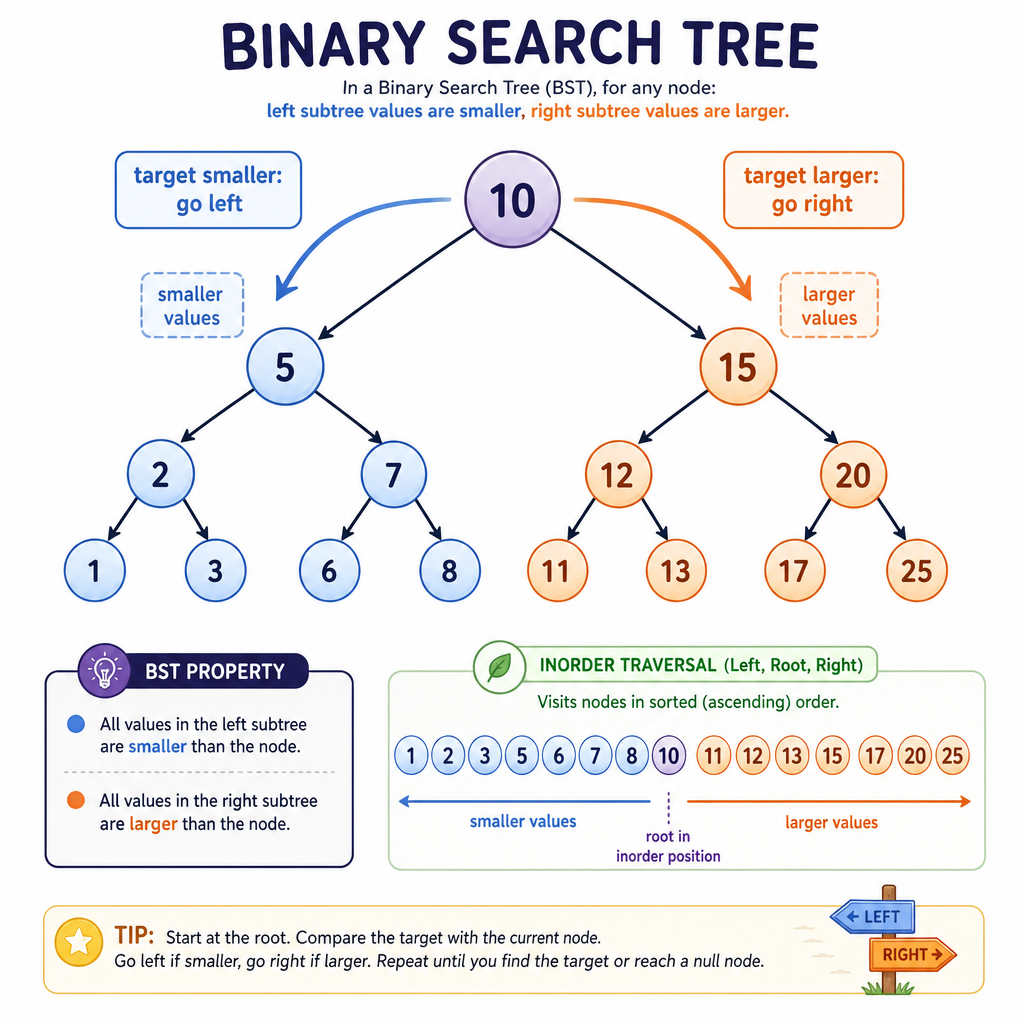
A Binary Search Tree, or BST, is a binary tree with an ordering rule:
For every node:
left subtree values  <  node value  <  right subtree values
Example:
        10
      /    \
     5      15
    / \       \
   3   7       20
This rule gives the tree a useful search pattern:
- If the target equals the current node, found it
- If the target is smaller, go left
- If the target is larger, go right
Notice how this connects back to Introduction to Data Structures: the interface might be "search for value," but the implementation shape controls the cost.
BST Direction
In a Binary Search Tree, values less than a node belong in that node's ____ subtree.
Height Controls Cost
Tree performance depends on shape
A BST can be very efficient, but only if its height stays small.
Balanced-ish tree:
        8
      /   \
     4     12
    / \   /  \
   2   6 10  14
Skewed tree:
1
 \
  2
   \
    3
     \
      4
In a balanced BST, search can be about O(log n) because each step discards a large part of the tree.
In a skewed BST, search degrades to O(n) because the tree behaves like a linked list.
This example compares the number of recursive checks needed for two different shapes.
```java
public class Main {
    static class TreeNode {
        int value;
        TreeNode left, right;
        TreeNode(int value) { this.value = value; }
    }

    static int searchSteps(TreeNode node, int target) {
        int steps = 0;
        while (node != null) {
            steps++;
            if (target == node.value) return steps;
            node = target < node.value ? node.left : node.right;
        }
        return steps;
    }

    public static void main(String[] args) {
        TreeNode balanced = new TreeNode(8);
        balanced.left = new TreeNode(4);
        balanced.right = new TreeNode(12);
        balanced.left.left = new TreeNode(2);
        balanced.left.right = new TreeNode(6);
        balanced.right.left = new TreeNode(10);
        balanced.right.right = new TreeNode(14);

        TreeNode skewed = new TreeNode(1);
        skewed.right = new TreeNode(2);
        skewed.right.right = new TreeNode(3);
        skewed.right.right.right = new TreeNode(4);

        System.out.println("Steps to find 14 in balanced tree: " + searchSteps(balanced, 14));
        System.out.println("Steps to find 4 in skewed tree: " + searchSteps(skewed, 4));
    }
}
```
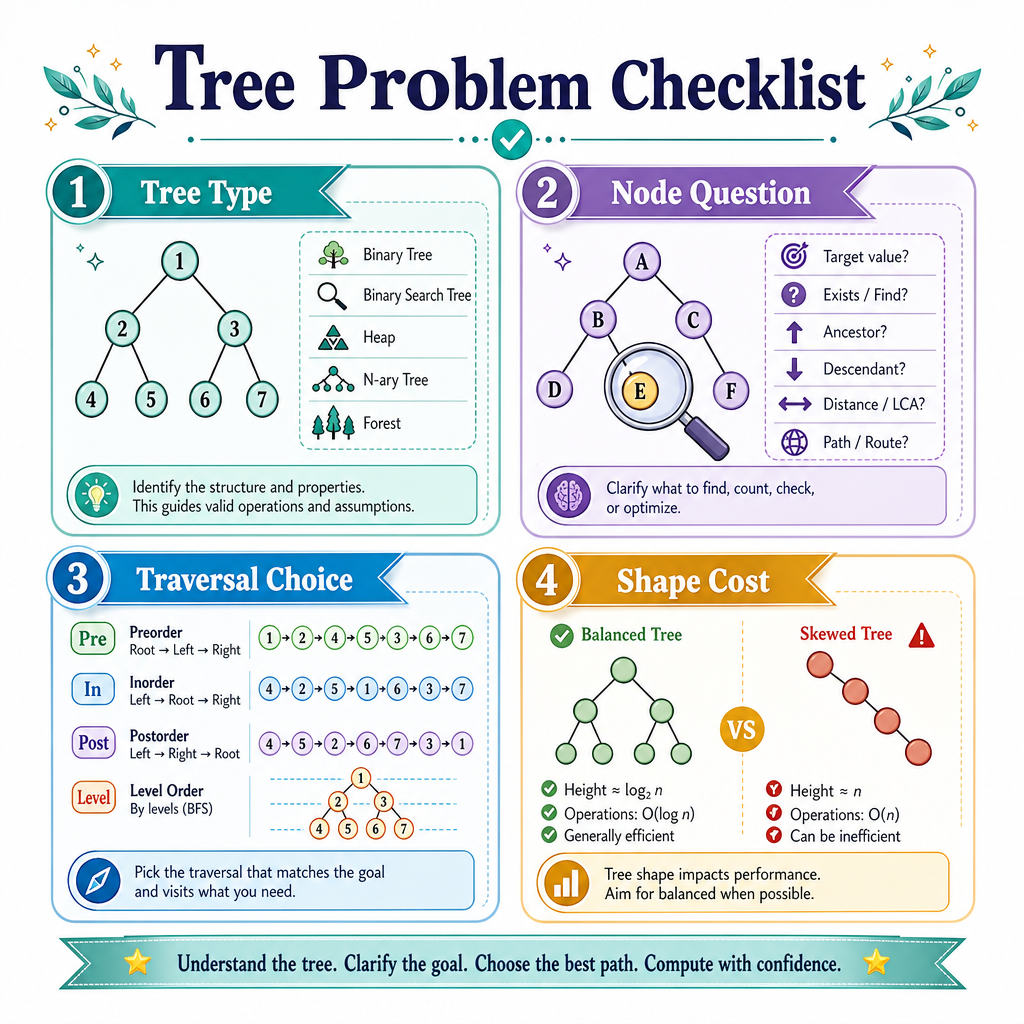
Pattern Checklist
How to recognize tree problems
When you see a tree problem, pause before coding and ask:
-
What kind of tree is it?
- General tree?
- Binary tree?
- Binary Search Tree?
-
What does one node need to know?
- Its value?
- Its children?
- Information returned from subtrees?
-
Which traversal fits the goal?
- Need to process parent before children? Preorder.
- Need sorted order in a BST? Inorder.
- Need child results before parent? Postorder.
-
What is the shape cost?
- Balanced: often shallow
- Skewed: potentially linear
The biggest lesson: trees combine the data-shape thinking from Introduction to Data Structures with the call-stack thinking from Recursion.
Next, we'll move into Dynamic Programming, where solving overlapping subproblems becomes the main pattern.