Trees and Binary Search Trees
Read at your own pace. Code execution, quizzes, progress tracking, and the AI tutor are available in the interactive view with JavaScript enabled.
From Chains Upward
Why trees matter
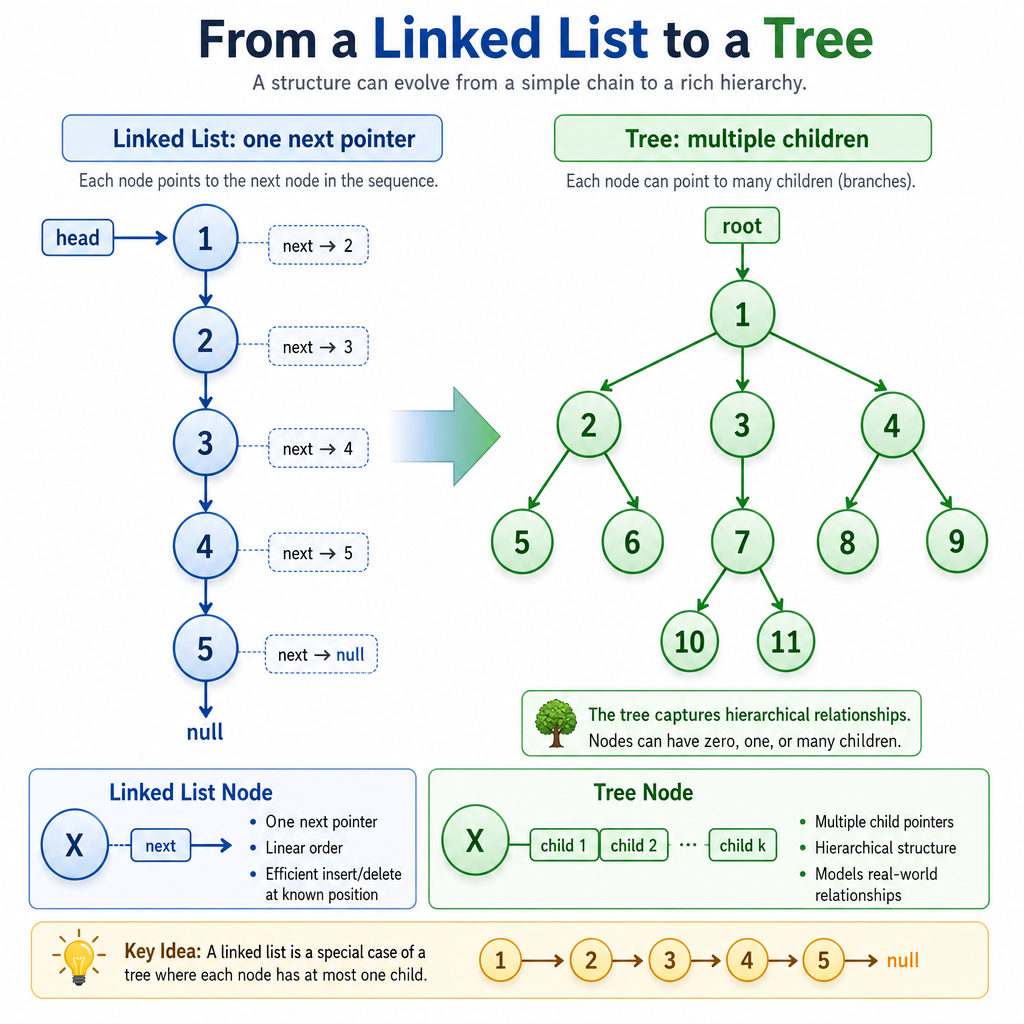
In Linked Lists, you learned that nodes can point to other nodes. A linked list is a chain: each node usually points to one next node.
A tree keeps the node idea, but lets one node point to multiple children. That gives us a shape for hierarchical data:
- folders inside folders
- comments and replies
- company org charts
- parsed math expressions
- decision paths in interview problems
For interview prep, trees are important because they combine pointers, ordering, and search shortcuts. Binary Search Trees, or BSTs, are the first tree structure where shape creates speed.
Tree Vocabulary
The basic tree words
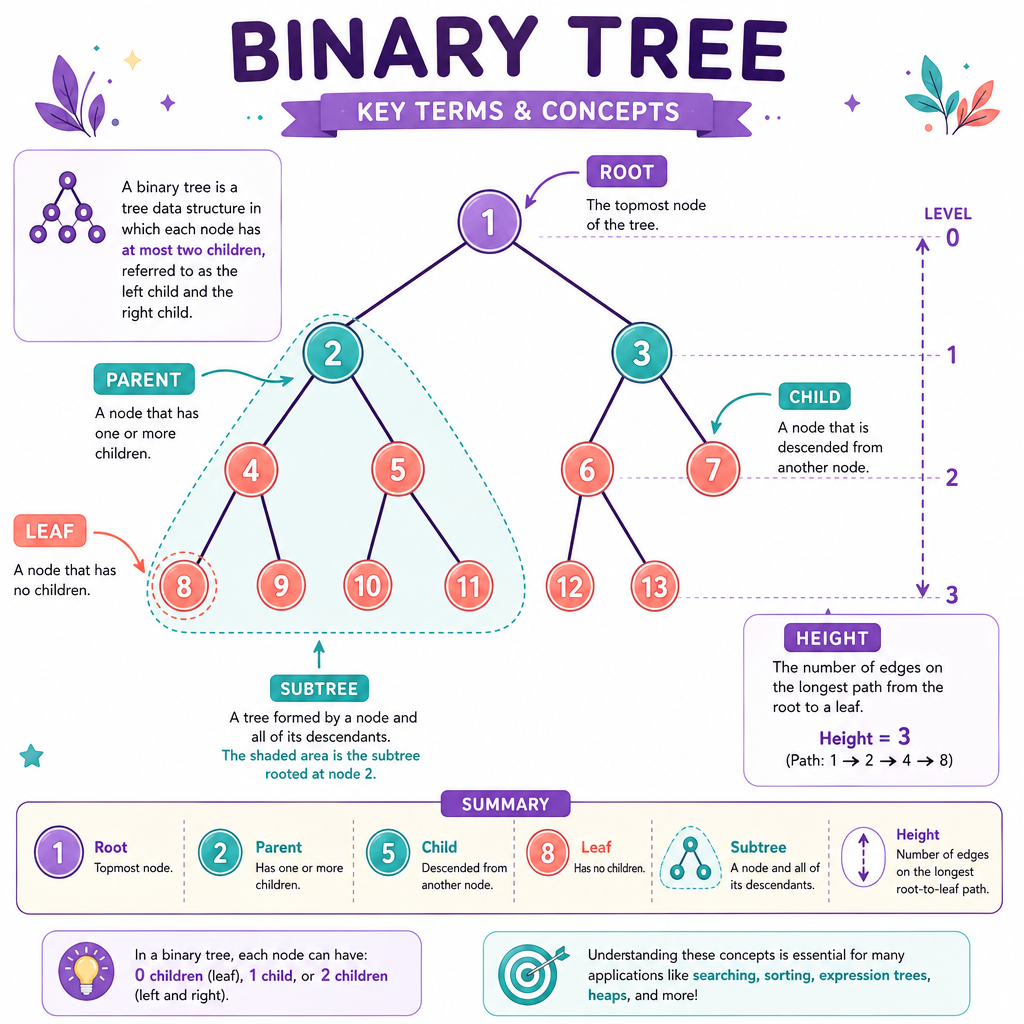
A tree is made of nodes connected by parent-to-child links.
        A        <- root
      /   \
     B     C     <- children of A
    / \
   D   E         <- leaves
Key terms:
-
Root: the top node. Here,
A. -
Parent: a node directly above another node.
Bis parent ofDandE. - Child: a node directly below another node.
-
Leaf: a node with no children.
C,D, andEare leaves. - Subtree: any node plus everything below it.
- Height: how many levels/edges you may need to go down.
A binary tree is a tree where each node has at most two children, often called left and right.
Find The Leaf
Given this tree:
        A
      /   \
     B     C
    / \
   D   E
Which option lists only leaf nodes?
BST Ordering
Binary Search Tree rule
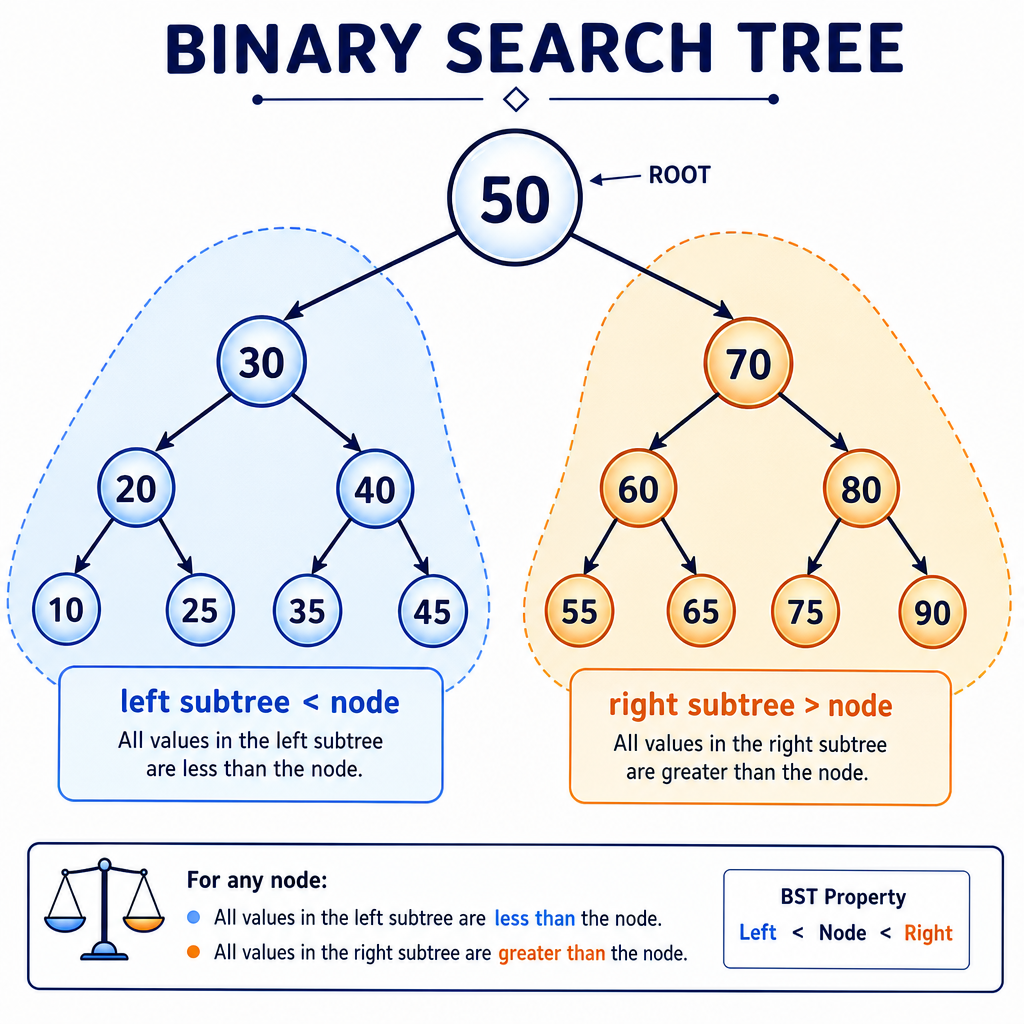
A Binary Search Tree is a binary tree with an ordering rule:
For every node:
- values in the left subtree are smaller
- values in the right subtree are larger
Example:
        50
      /    \
    30      70
   /  \    /  \
 20   40  60   80
This is not just about the direct children. The entire left subtree of 50 must be less than 50, and the entire right subtree must be greater than 50.
That global rule is what lets us search efficiently.
Search By Comparisons
Searching a BST
Searching a BST feels like binary search from Sorting and Searching, but on nodes instead of array indexes.
At each node:
- if target equals node value, found it
- if target is smaller, go left
- if target is larger, go right
You do not scan every node unless the tree shape is bad. You follow one path downward.
```python
class Node:
    def __init__(self, value):
        self.value = value
        self.left = None
        self.right = None


def insert(root, value):
    if root is None:
        return Node(value)

    current = root
    while True:
        if value < current.value:
            if current.left is None:
                current.left = Node(value)
                break
            current = current.left
        else:
            if current.right is None:
                current.right = Node(value)
                break
            current = current.right
    return root


def contains(root, target):
    current = root
    while current is not None:
        if target == current.value:
            return True
        elif target < current.value:
            current = current.left
        else:
            current = current.right
    return False


root = None
for value in [50, 30, 70, 20, 40, 60, 80]:
    root = insert(root, value)

for target in [40, 65, 80]:
    print(target, contains(root, target))
```
Always Logarithmic?
True or false:
Searching in a Binary Search Tree is always O(log n), no matter what order values were inserted.
Traversal Orders
Visiting every node
Sometimes you do not want to search for one value. You want to visit every node.
Common traversal orders:
- Preorder: node, left, right
- Inorder: left, node, right
- Postorder: left, right, node
For a BST, inorder traversal returns values in sorted order. That is a favorite interview observation.
We will use small recursive helpers here. Later, the Recursion and Backtracking lesson will make this pattern feel more systematic.
```python
class Node:
    def __init__(self, value):
        self.value = value
        self.left = None
        self.right = None


root = Node(50)
root.left = Node(30)
root.right = Node(70)
root.left.left = Node(20)
root.left.right = Node(40)
root.right.left = Node(60)
root.right.right = Node(80)


def preorder(node):
    if node is None:
        return []
    return [node.value] + preorder(node.left) + preorder(node.right)


def inorder(node):
    if node is None:
        return []
    return inorder(node.left) + [node.value] + inorder(node.right)


def postorder(node):
    if node is None:
        return []
    return postorder(node.left) + postorder(node.right) + [node.value]


print('preorder:', preorder(root))
print('inorder:', inorder(root))
print('postorder:', postorder(root))
```
Sorted Traversal
For a Binary Search Tree, an ____ traversal visits values in sorted ascending order.
Height Controls Cost
The important complexity idea
From Time and Space Complexity Analysis, you already know we care about how work grows.
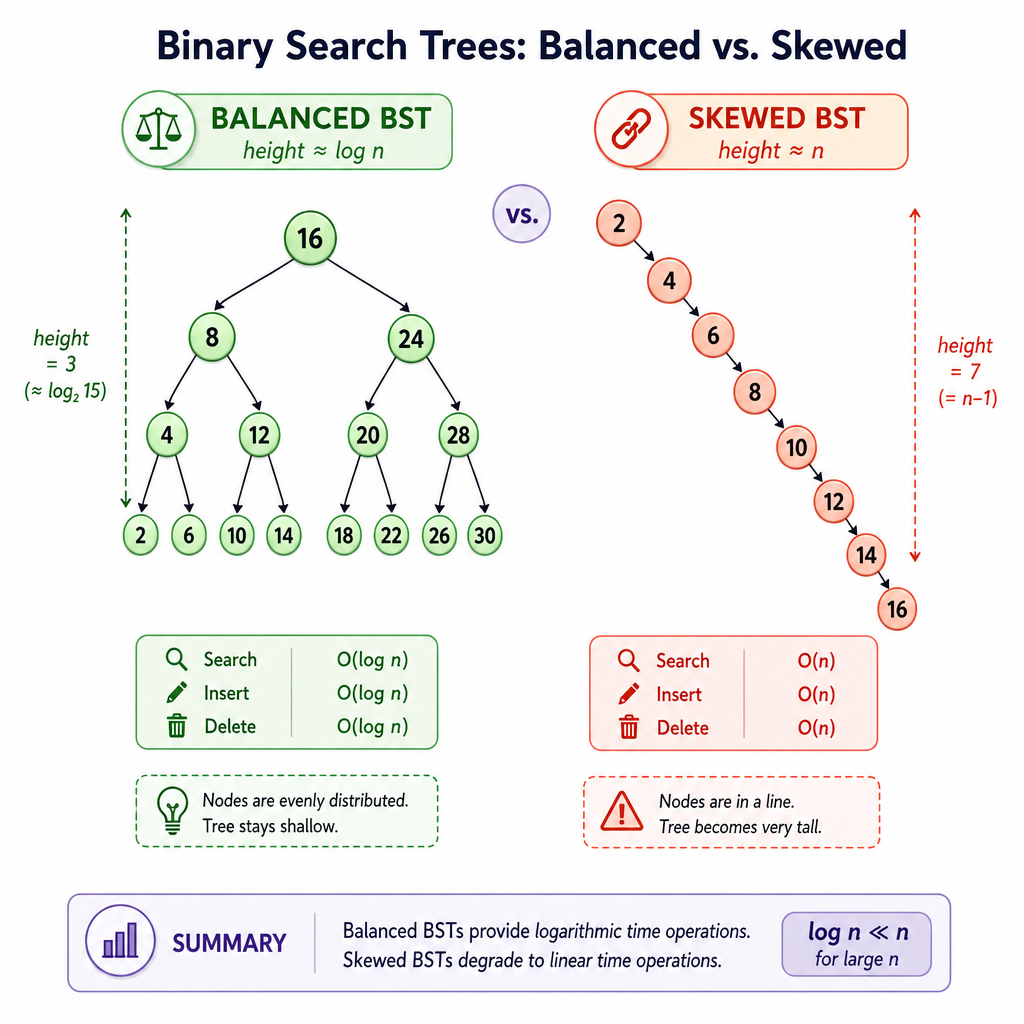
For BST search, insert, and delete, the key variable is usually tree height, often written as h.
- Balanced tree:
h ≈ log n, so search isO(log n) - Skewed tree:
h ≈ n, so search isO(n)
Balanced shape:
        4
      /   \
     2     6
    / \   / \
   1  3  5  7
Skewed shape:
1
 \
  2
   \
    3
     \
      4
Interview takeaway: a BST gives fast search only when its height stays small.
Validate A BST
Common interview task
A classic BST question is: is this binary tree actually a valid BST?
The subtle part: checking only each node against its immediate children is not enough.
Each node must obey a range created by all ancestors:
- go left: update the upper bound
- go right: update the lower bound
This pattern is useful in coding interviews because it tests whether you understand the global BST rule, not just the local shape.
```python
class Node:
    def __init__(self, value):
        self.value = value
        self.left = None
        self.right = None


def is_valid_bst(node, low=float('-inf'), high=float('inf')):
    if node is None:
        return True

    if not (low < node.value < high):
        return False

    return (
        is_valid_bst(node.left, low, node.value)
        and is_valid_bst(node.right, node.value, high)
    )


valid = Node(10)
valid.left = Node(5)
valid.right = Node(15)
valid.right.left = Node(12)
valid.right.right = Node(20)

invalid = Node(10)
invalid.left = Node(5)
invalid.right = Node(15)
invalid.right.left = Node(6)   # This is less than 10, so it breaks the global rule.
invalid.right.right = Node(20)

print('valid tree:', is_valid_bst(valid))
print('invalid tree:', is_valid_bst(invalid))
```
Global Rule Check
When validating whether a binary tree is a valid Binary Search Tree, which idea is most important?