Trees and Graphs
Read at your own pace. Code execution, quizzes, progress tracking, and the AI tutor are available in the interactive view with JavaScript enabled.
Why Trees Now
From linear to connected
In Arrays and Strings, Linked Lists, and Stacks and Queues, most data had a clear next item: index i + 1, node.next, push/pop, offer/poll.
Now we step into structures where one item can connect to many others.
That unlocks interview classics like:
- folder systems
- organization charts
- HTML/XML structure
- social networks
- maps and routes
- dependency graphs
Today’s goal is not advanced graph algorithms yet. We’ll build the mental model: nodes, edges, trees, graphs, representations, and basic traversal intuition in Java.

Tree Mental Model
A tree is a hierarchy
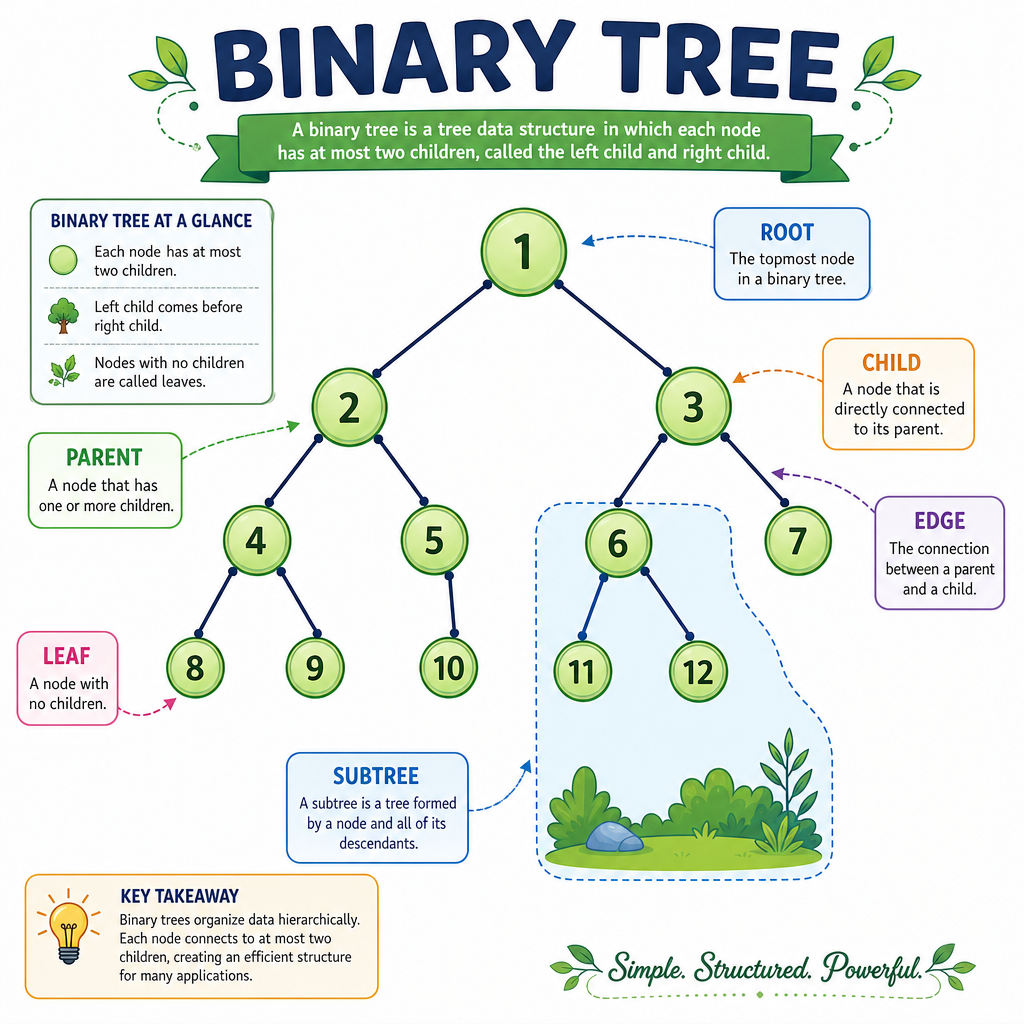
A tree is made of nodes connected by edges.
Key vocabulary:
- Root: the top node
- Parent: a node with children
- Child: a node below another node
- Leaf: a node with no children
- Subtree: any node plus everything below it
Example:
        A          root
      /   \
     B     C       children of A
    / \
   D   E           leaves: C, D, E
A common interview version is a binary tree, where each node has at most two children: left and right.
Think of a tree as a linked list that learned how to branch.
Level Order Java
Visiting a tree by levels
Because you already learned Queues, we can traverse a tree level by level.
This is called level-order traversal:
        10
      /    \
     5      20
    / \       \
   3   7       30

Output: 10 5 20 3 7 30
The idea:
- Put the root in a queue.
- Repeatedly remove one node.
- Print it.
- Add its children to the queue.
Notice how this builds directly on the queue pattern from Stacks and Queues.
```java
import java.util.*;

public class Main {
    static class TreeNode {
        int value;
        TreeNode left;
        TreeNode right;

        TreeNode(int value) {
            this.value = value;
        }
    }

    static void levelOrder(TreeNode root) {
        if (root == null) return;

        Queue<TreeNode> queue = new LinkedList<>();
        queue.offer(root);

        while (!queue.isEmpty()) {
            TreeNode current = queue.poll();
            System.out.print(current.value + " ");

            if (current.left != null) queue.offer(current.left);
            if (current.right != null) queue.offer(current.right);
        }
    }

    public static void main(String[] args) {
        TreeNode root = new TreeNode(10);
        root.left = new TreeNode(5);
        root.right = new TreeNode(20);
        root.left.left = new TreeNode(3);
        root.left.right = new TreeNode(7);
        root.right.right = new TreeNode(30);

        System.out.print("Level order: ");
        levelOrder(root);
    }
}
```
Tree Checkpoint
In a tree, what do we call a node that has no children?
Graph Mental Model
A graph is a network
A graph is also made of nodes and edges, but it does not need a hierarchy.
In graph language:
- Nodes are often called vertices.
- Connections are called edges.
- Edges can be undirected or directed.
Examples:
Undirected friendship:
A --- B
|     |
C --- D

Directed dependency:
Build -> Test -> Deploy
A useful distinction:
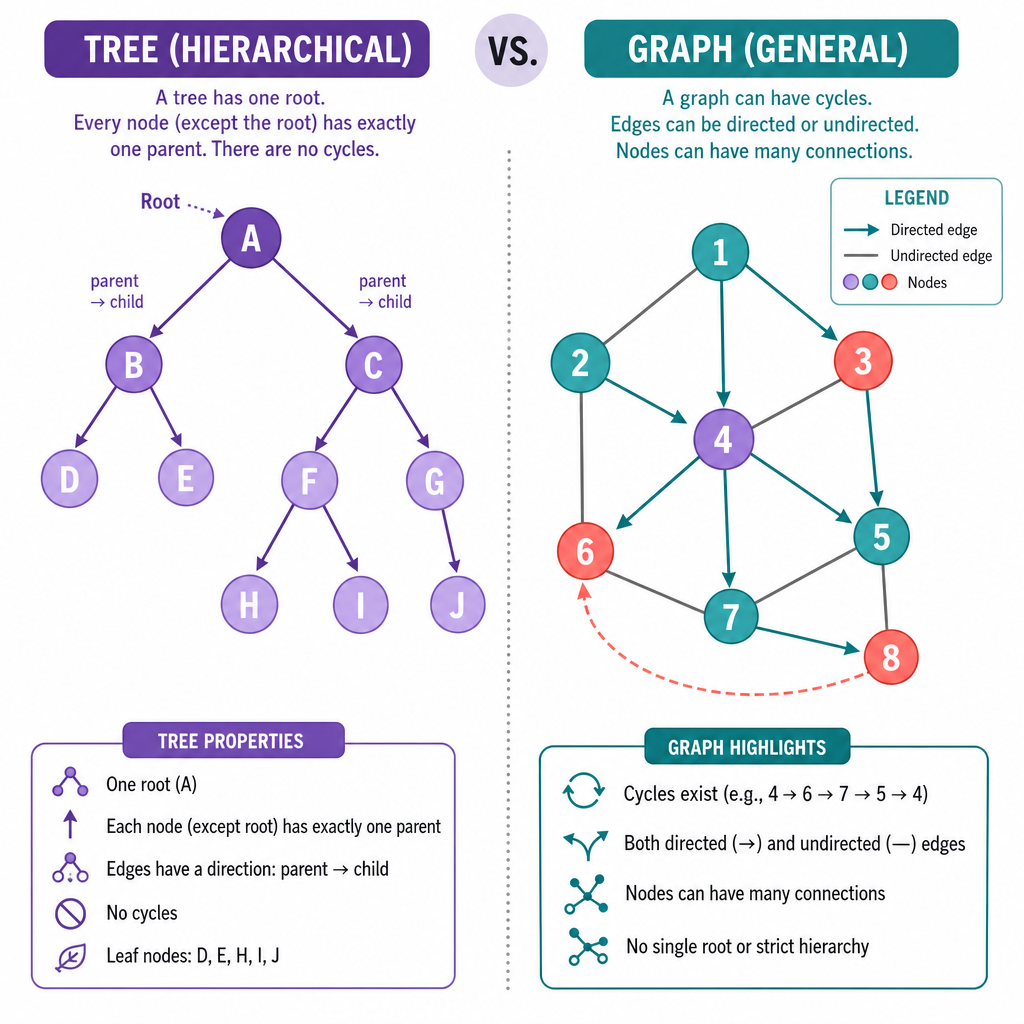
- A tree is a connected structure with no cycles and one clear hierarchy.
- A graph is more general: it can have cycles, multiple paths, and no obvious root.
So every tree is graph-like, but not every graph is a tree.
Representing Graphs
How do we store connections?
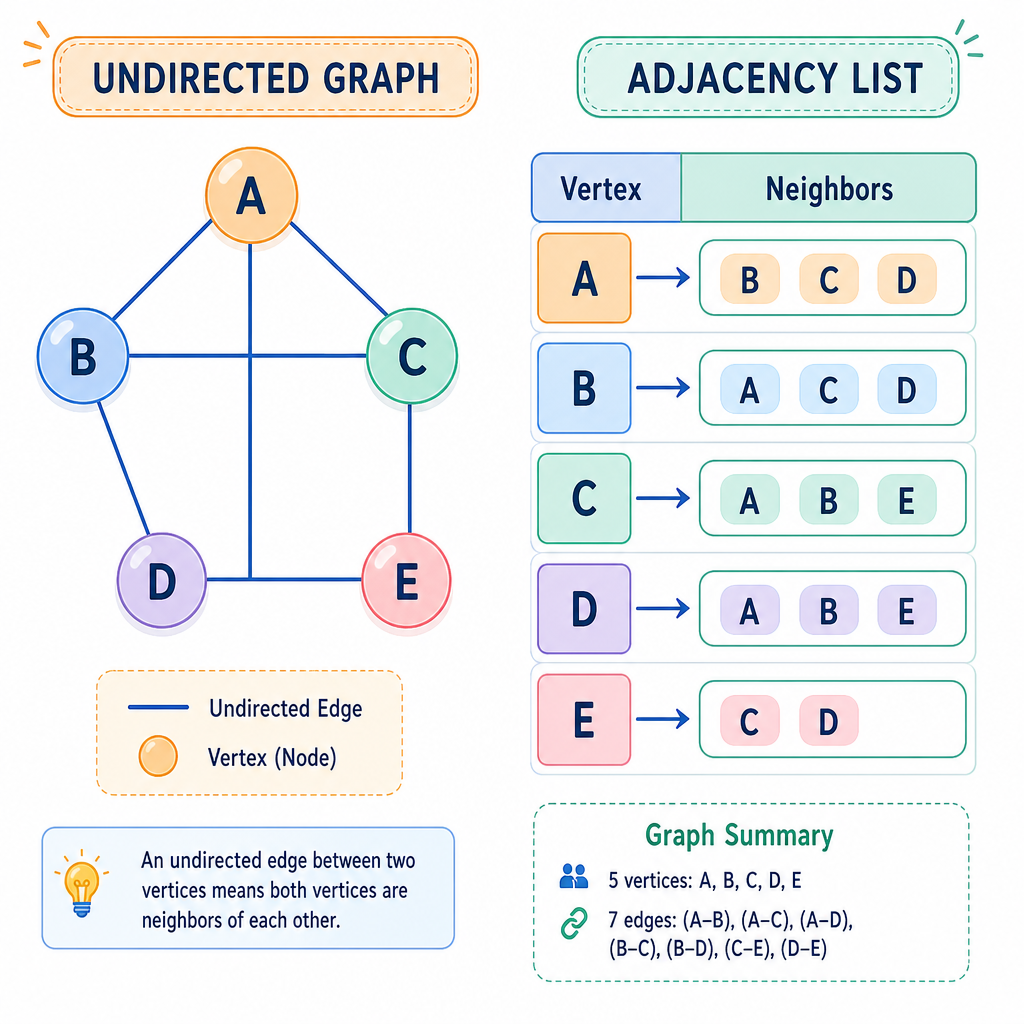
In Java interviews, the most common beginner-friendly graph representation is an adjacency list.
It answers one question efficiently:
“Given this node, who are its neighbors?”
Example graph:
0 --- 1
|     |
2 --- 3
Adjacency list:
0: [1, 2]
1: [0, 3]
2: [0, 3]
3: [1, 2]
Why interviewers like it:
- It is simple to build.
- It avoids wasting space on missing edges.
- It works well with queue-based or stack-based traversal.
We’ll study heavier graph algorithms later; for now, focus on representing relationships clearly.
Graph BFS Java
Traversing a graph safely
A graph can contain cycles, so traversal needs one extra idea: visited.
Without visited, you might bounce forever:
0 -> 1 -> 0 -> 1 -> ...
Here is a small breadth-first traversal using a queue. The structure should feel familiar from tree level-order traversal, but graphs require marking nodes we have already seen.
```java
import java.util.*;

public class Main {
    static void bfs(Map<Integer, List<Integer>> graph, int start) {
        Queue<Integer> queue = new LinkedList<>();
        Set<Integer> visited = new HashSet<>();

        queue.offer(start);
        visited.add(start);

        while (!queue.isEmpty()) {
            int node = queue.poll();
            System.out.print(node + " ");

            for (int neighbor : graph.getOrDefault(node, new ArrayList<>())) {
                if (!visited.contains(neighbor)) {
                    visited.add(neighbor);
                    queue.offer(neighbor);
                }
            }
        }
    }

    public static void main(String[] args) {
        Map<Integer, List<Integer>> graph = new HashMap<>();
        graph.put(0, Arrays.asList(1, 2));
        graph.put(1, Arrays.asList(0, 3));
        graph.put(2, Arrays.asList(0, 3));
        graph.put(3, Arrays.asList(1, 2));

        System.out.print("BFS from 0: ");
        bfs(graph, 0);
    }
}
```
Cycles Matter
True or false: A graph traversal never needs a visited set because each node has only one parent.
Representation Recall
Fill in the blank: A common way to store a graph where each node maps to a list of its neighbors is called an ________ list.
Interview Takeaways
What to remember
Trees and graphs are where interview problems start feeling less linear.
Core takeaways:
- A tree models hierarchy: root, parent, child, leaf.
- A binary tree has at most two children per node.
- A graph models general relationships: vertices and edges.
- Graph edges may be directed or undirected.
- An adjacency list is the most common graph representation for coding interviews.
- Queue-based traversal works for both trees and graphs, but graphs usually need
visited.
A useful interview question to ask yourself:
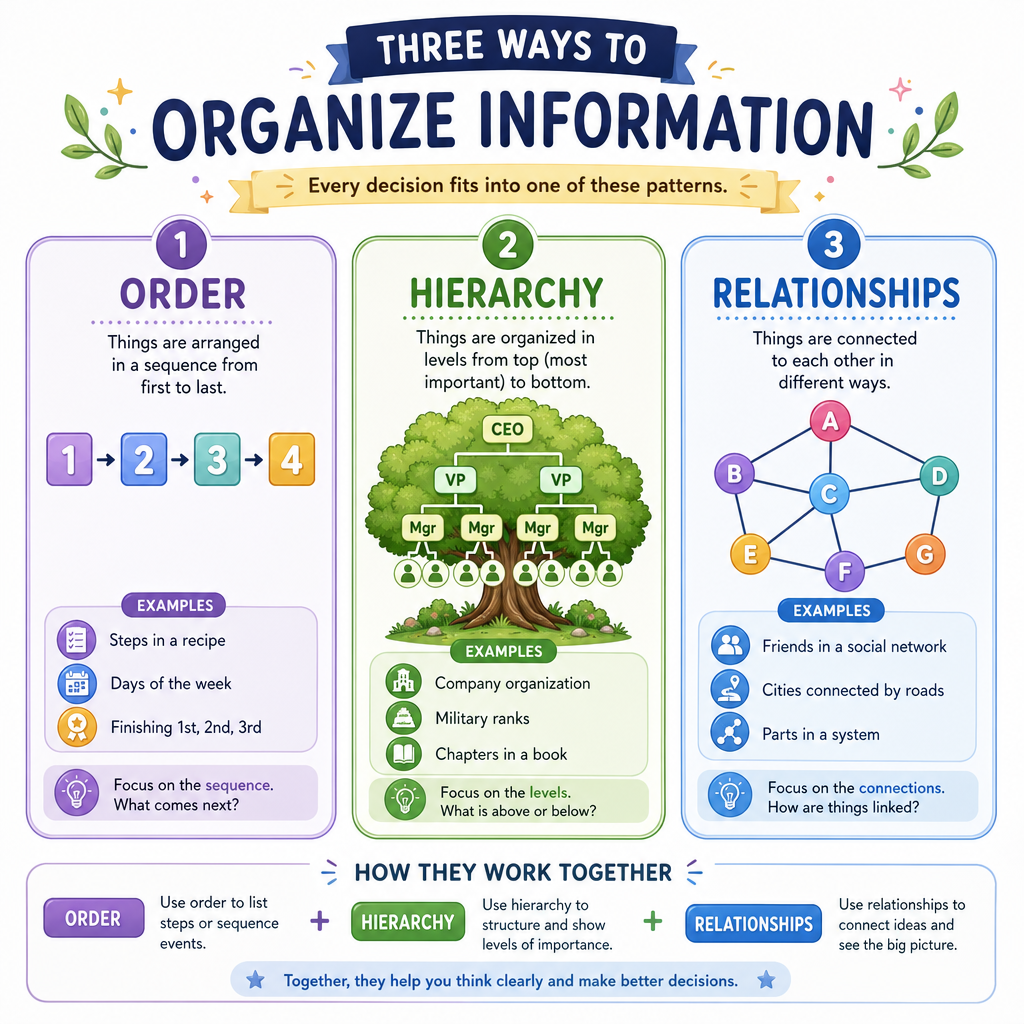
“Is this problem about order, hierarchy, or arbitrary relationships?”
If it is hierarchy, think tree. If it is arbitrary connections, think graph.
Next, we’ll return to a more classic interview area: Sorting and Searching, where ordering data efficiently becomes the main theme.