Trees: Hierarchical Structures
Read at your own pace. Code execution, quizzes, progress tracking, and the AI tutor are available in the interactive view with JavaScript enabled.
Why Trees Now
From connections to hierarchy
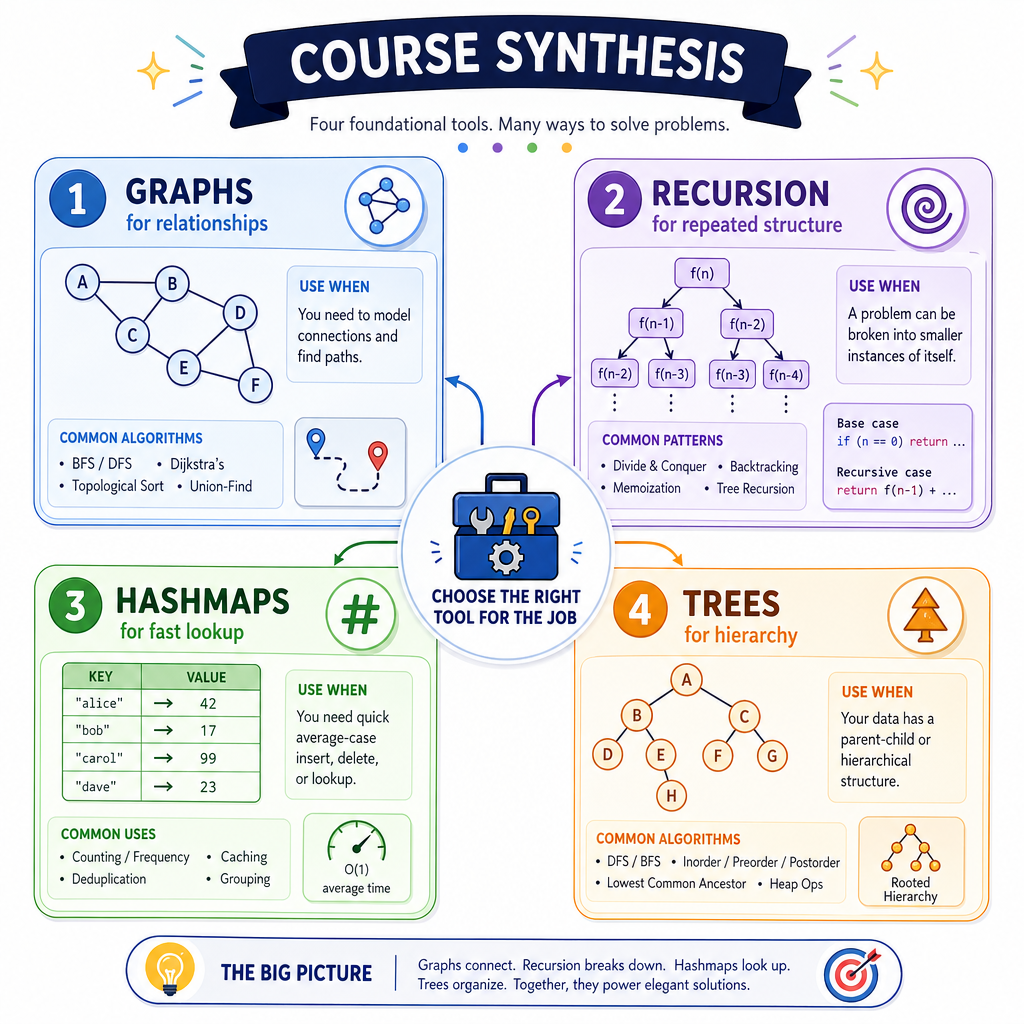
Now that you've completed Graphs: Concepts and Operations, Recursion: Principles and Algorithms, and Hashmaps: Efficient Data Retrieval, you're ready for a structure that combines ideas from all three.
A tree stores data in a hierarchy: one starting point branches into smaller subgroups.
You see trees in:
- File systems: folders contain folders and files
- Basketball tournaments: one bracket branches into matchups
- True crime case boards: a main case splits into suspects, timelines, evidence, and leads
- Search systems: decisions narrow down what you're looking for
In this lesson, we'll focus on the mental model, core vocabulary, traversal, and the most famous tree variant: the binary search tree.

Tree Vocabulary
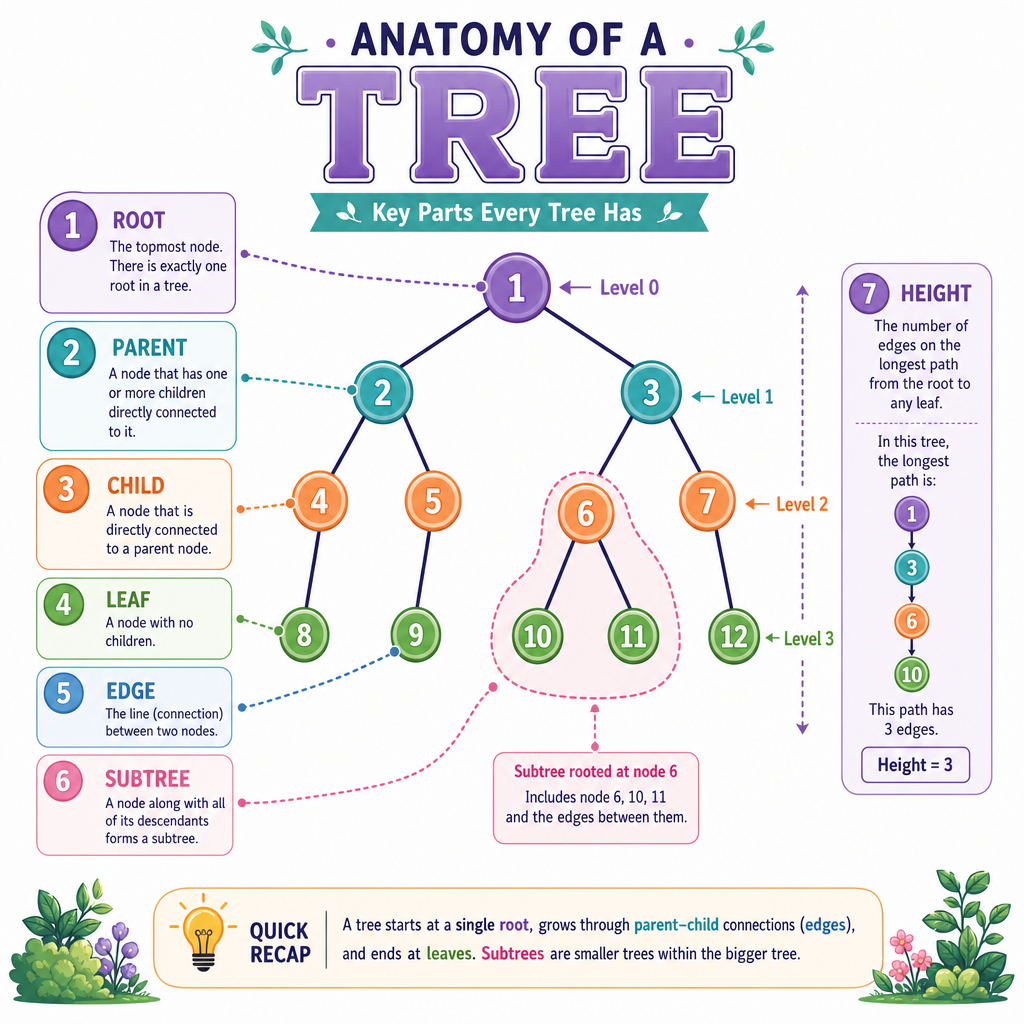
A tree is a connected hierarchy
A tree is a non-linear data structure made of nodes connected by edges.
Unlike a general graph, a basic tree has a strict hierarchy:
        A        <- root
      /   \
     B     C     <- children of A
    / \     \
   D   E     F   <- leaves
Key terms:
- Root: the top node; every tree starts here
- Parent: a node directly above another node
- Child: a node directly below another node
- Leaf: a node with no children
- Subtree: any node plus everything below it
- Height: how many edges are on the longest downward path
The big idea: trees make relationships feel like "contains," "belongs to," or "comes after" rather than just "is connected to."
Spot The Root
In a tree, which node is called the root?
Building Nodes
A tree node stores data and links
In Python, a basic tree node can be represented with a class that stores:
- a value
- a list of children
This is a general tree, meaning each node can have any number of children.
The example below models a small hierarchy like a team roster: one team has position groups, and each group has players.
```python
class TreeNode:
    def __init__(self, value):
        self.value = value
        self.children = []

    def add_child(self, child_node):
        self.children.append(child_node)

team = TreeNode("City Hoopers")
guards = TreeNode("Guards")
forwards = TreeNode("Forwards")

team.add_child(guards)
team.add_child(forwards)

guards.add_child(TreeNode("Ari"))
guards.add_child(TreeNode("Devin"))
forwards.add_child(TreeNode("Maya"))

print("Root:", team.value)
print("Position groups:", [child.value for child in team.children])
print("Guards:", [child.value for child in guards.children])
```
Traversal Patterns
Traversal means visiting every node
You already saw traversal in graphs. In trees, traversal is usually more structured because each node has clear children.
For a binary tree, each node has at most two children:
leftright
Three classic depth-first traversal orders are:
- Pre-order: node, left, right
- In-order: left, node, right
- Post-order: left, right, node
These orders are not random. They answer different questions: "process the boss first," "process sorted values," or "process children before parent."
```python
class BinaryNode:
    def __init__(self, value):
        self.value = value
        self.left = None
        self.right = None

def preorder(node):
    if node is None:
        return []
    return [node.value] + preorder(node.left) + preorder(node.right)

def inorder(node):
    if node is None:
        return []
    return inorder(node.left) + [node.value] + inorder(node.right)

def postorder(node):
    if node is None:
        return []
    return postorder(node.left) + postorder(node.right) + [node.value]

root = BinaryNode("A")
root.left = BinaryNode("B")
root.right = BinaryNode("C")
root.left.left = BinaryNode("D")
root.left.right = BinaryNode("E")

print("Pre-order:", preorder(root))
print("In-order:", inorder(root))
print("Post-order:", postorder(root))
```
Traversal Result
For a binary search tree, an in-order traversal visits values in ____ order.
Binary Search Trees
A tree built for searching
A binary search tree, or BST, is a binary tree with an ordering rule:
- values smaller than a node go in the left subtree
- values larger than a node go in the right subtree
That rule lets us search by repeatedly choosing left or right, similar to narrowing down suspects in a case file.
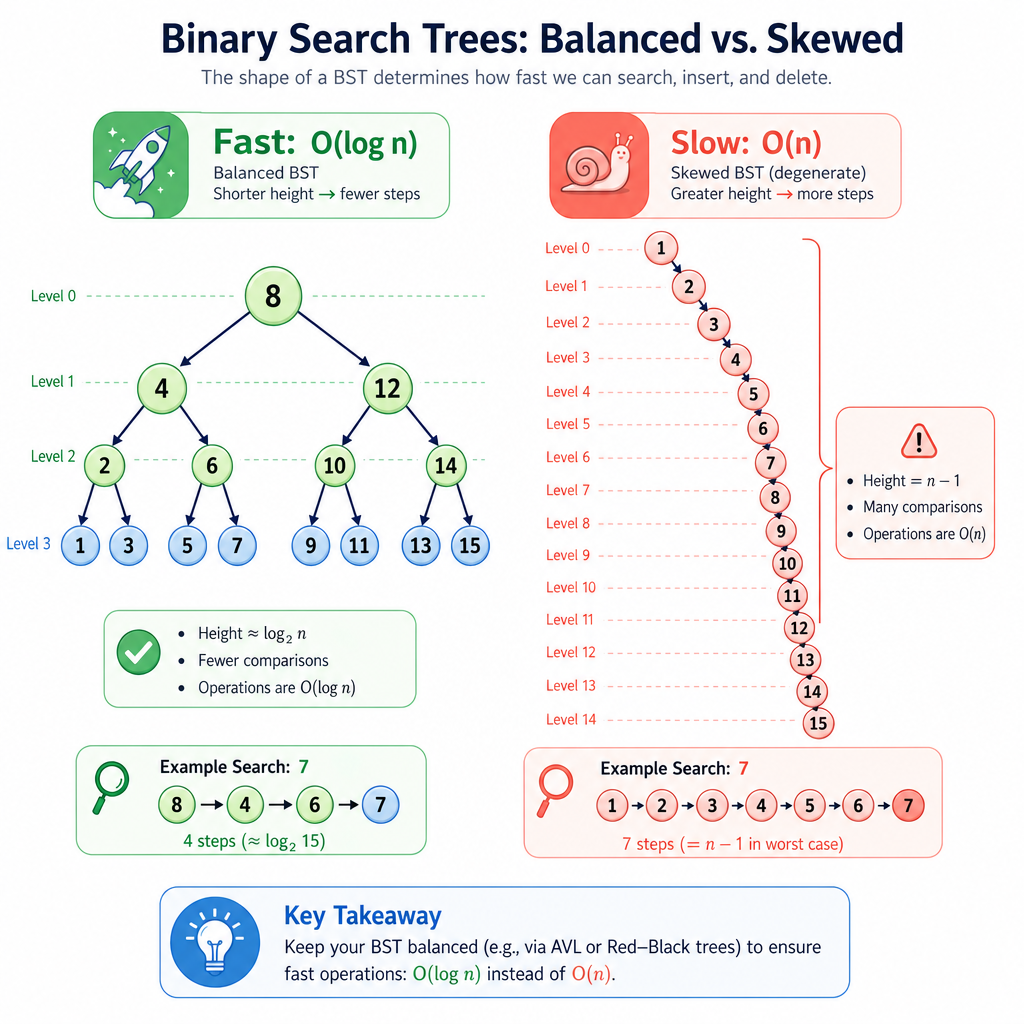
If the tree is reasonably balanced, search can be very fast: about O(log n). If the tree becomes a long chain, search can degrade to O(n).
```python
class BSTNode:
    def __init__(self, value):
        self.value = value
        self.left = None
        self.right = None

    def insert(self, value):
        if value < self.value:
            if self.left is None:
                self.left = BSTNode(value)
            else:
                self.left.insert(value)
        elif value > self.value:
            if self.right is None:
                self.right = BSTNode(value)
            else:
                self.right.insert(value)

    def contains(self, value):
        if value == self.value:
            return True
        if value < self.value:
            return self.left.contains(value) if self.left else False
        return self.right.contains(value) if self.right else False

root = BSTNode(50)
for score in [30, 70, 20, 40, 60, 80]:
    root.insert(score)

print("Contains 60?", root.contains(60))
print("Contains 25?", root.contains(25))
```
BST Rule Check
True or false: In a binary search tree with unique values, every value in a node's left subtree is smaller than that node, and every value in its right subtree is larger.
Shape Matters
The same values can form very different trees
Tree performance depends heavily on height.
A balanced tree stays short and wide:
      40
    /    \
   20     60
  / \    / \
10  30  50  70
An unbalanced tree can become a chain:
10
  \
   20
     \
      30
        \
         40
Why this matters:
- Searching a balanced BST is roughly
O(log n) - Searching a chain-shaped BST is
O(n) - Insertion can accidentally create a bad shape
- Deletion must preserve the BST ordering rule
Self-balancing trees like AVL trees and red-black trees fix this by rotating nodes after updates. You don't need to implement rotations yet; just remember that shape controls speed.
Tree Applications
Which scenario is the best natural fit for a tree structure?
Trees Takeaways
What you should remember
Trees are the course's clearest example of hierarchical structure.
You learned that:
- Trees have roots, parents, children, leaves, subtrees, and height
- A binary tree gives each node at most two children
- Traversals define the order in which nodes are visited
- A BST adds an ordering rule for faster search
- Tree height strongly affects performance
- Balanced trees protect search, insertion, and deletion from becoming too slow
You now have graphs for relationships, recursion for self-similar problems, hashmaps for fast lookup, and trees for hierarchy. In the final lesson, we'll briefly combine these tools to reason through real problem-solving choices.