Understanding Multiplication and Division
Read at your own pace. Code execution, quizzes, progress tracking, and the AI tutor are available in the interactive view with JavaScript enabled.
From Change To Groups
Welcome back, Number Explorer!
In Introduction to Numbers and Counting, you learned that numbers name amounts. In Introduction to Addition and Subtraction, you learned how amounts can grow or shrink.
Now we are ready for a faster idea:
- Multiplication helps when the same amount is added again and again.
- Division helps when one amount is split into equal groups.
These are not just school tricks. Computers use multiplication and division all the time in data science, artificial intelligence, and machine learning when they compare, resize, score, and organize numbers.

Multiplication Means Groups
Multiplication is equal groups
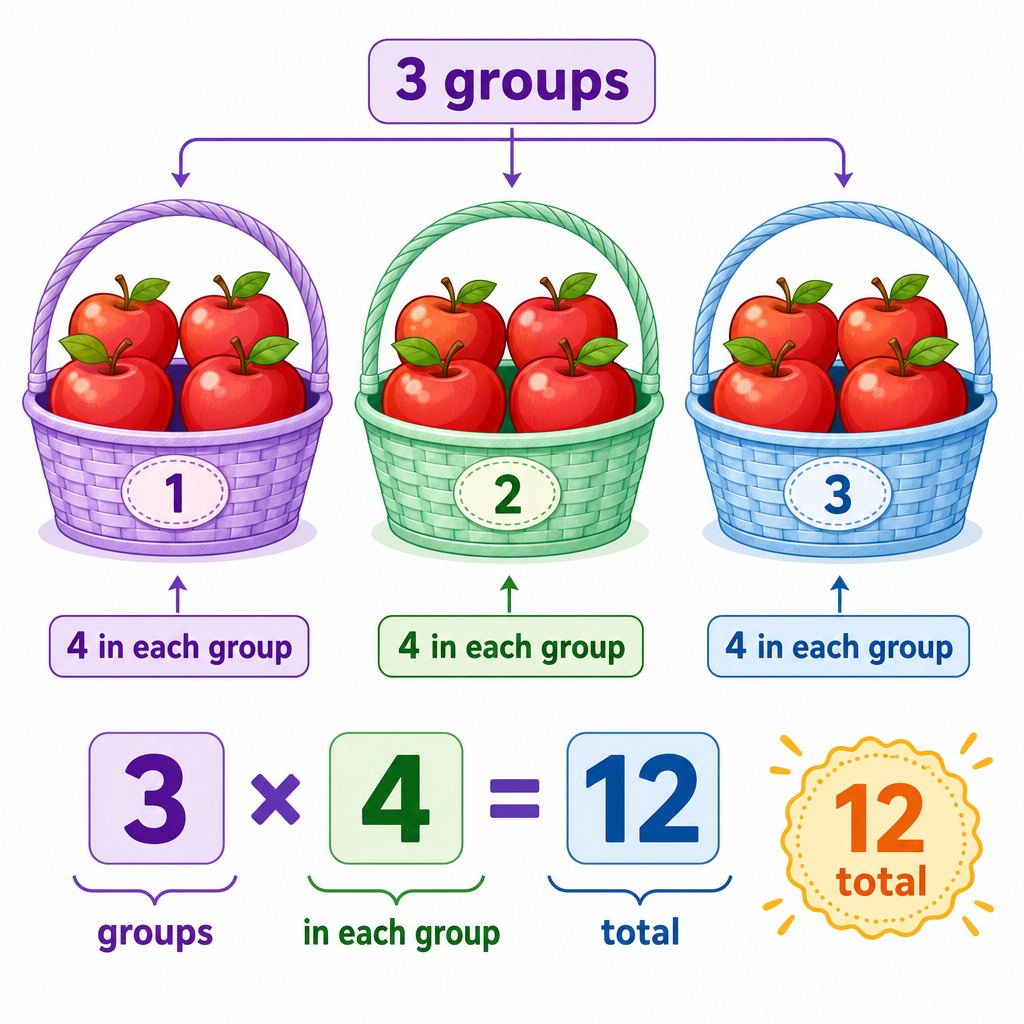
Imagine you have 3 baskets.
Each basket has 4 apples.
Basket 1: 🍎 🍎 🍎 🍎
Basket 2: 🍎 🍎 🍎 🍎
Basket 3: 🍎 🍎 🍎 🍎
You could add:
4 + 4 + 4 = 12
Or you can multiply:
3 × 4 = 12
Read it like this:
3 groups of 4 equals 12
Multiplication is a shortcut for repeated addition when the groups are the same size.
Count The Groups
Quick check
There are 5 boxes.
Each box has 2 crayons.
What multiplication sentence shows the total number of crayons?
Python Repeats Groups
Python can multiply too
In Python, we use * for multiplication.
So instead of writing:
4 + 4 + 4
we can write:
3 * 4
This matters because computers often need to do the same kind of number work many times, quickly and correctly.
```python
# 3 baskets, 4 apples in each basket
baskets = 3
apples_per_basket = 4

total_apples = baskets * apples_per_basket

print("Baskets:", baskets)
print("Apples in each basket:", apples_per_basket)
print("Total apples:", total_apples)

# Repeated addition gives the same result
same_total = apples_per_basket + apples_per_basket + apples_per_basket
print("Using repeated addition:", same_total)
```
Division Shares Fairly
Division means fair sharing
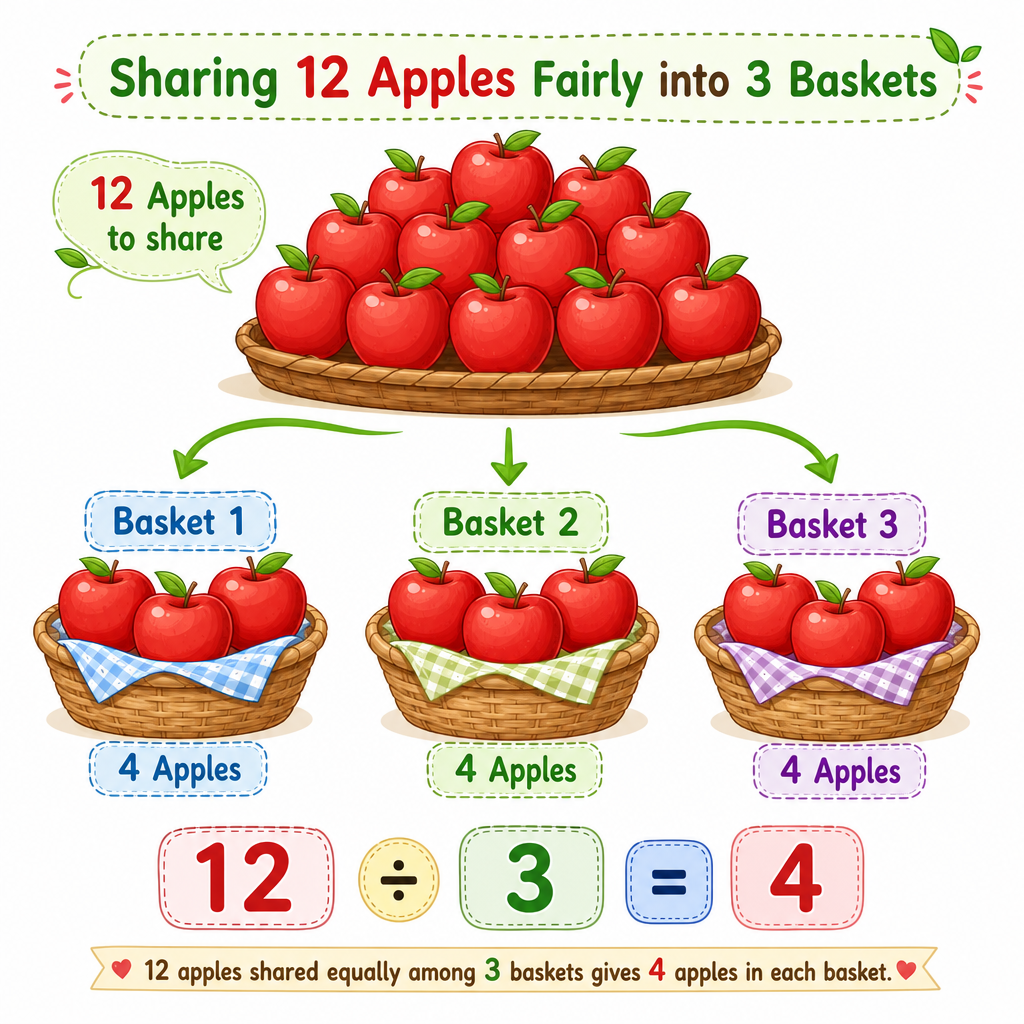
Now imagine you have 12 apples and 3 baskets.
You want each basket to get the same amount.
12 apples shared into 3 equal baskets
Each basket gets 4 apples.
So:
12 ÷ 3 = 4
Read it like this:
12 shared into 3 equal groups gives 4 in each group
Division helps answer: How many does each group get?
Fair Sharing Check
True or false?
If 10 stickers are shared equally between 2 kids, each kid gets 5 stickers.
Python Splits Amounts
Division in Python
Python uses / for division.
12 / 3
That gives 4.0. The .0 means Python is showing the answer as a decimal-style number.
Python also has:
-
//for whole-number division -
%for the leftover amount, called the remainder
Remainders are useful when things do not split perfectly evenly.
```python
cookies = 14
kids = 4

cookies_each_decimal = cookies / kids
cookies_each_whole = cookies // kids
leftover = cookies % kids

print("Cookies:", cookies)
print("Kids:", kids)
print("Decimal division:", cookies_each_decimal)
print("Whole cookies each:", cookies_each_whole)
print("Leftover cookies:", leftover)
```
Fill The Plates
Fill in the blank
There are 15 cookies.
They are shared equally onto 3 plates.
Each plate gets ___ cookies.
Fill in the blank: _____________
Opposite Math Friends
Multiplication and division undo each other
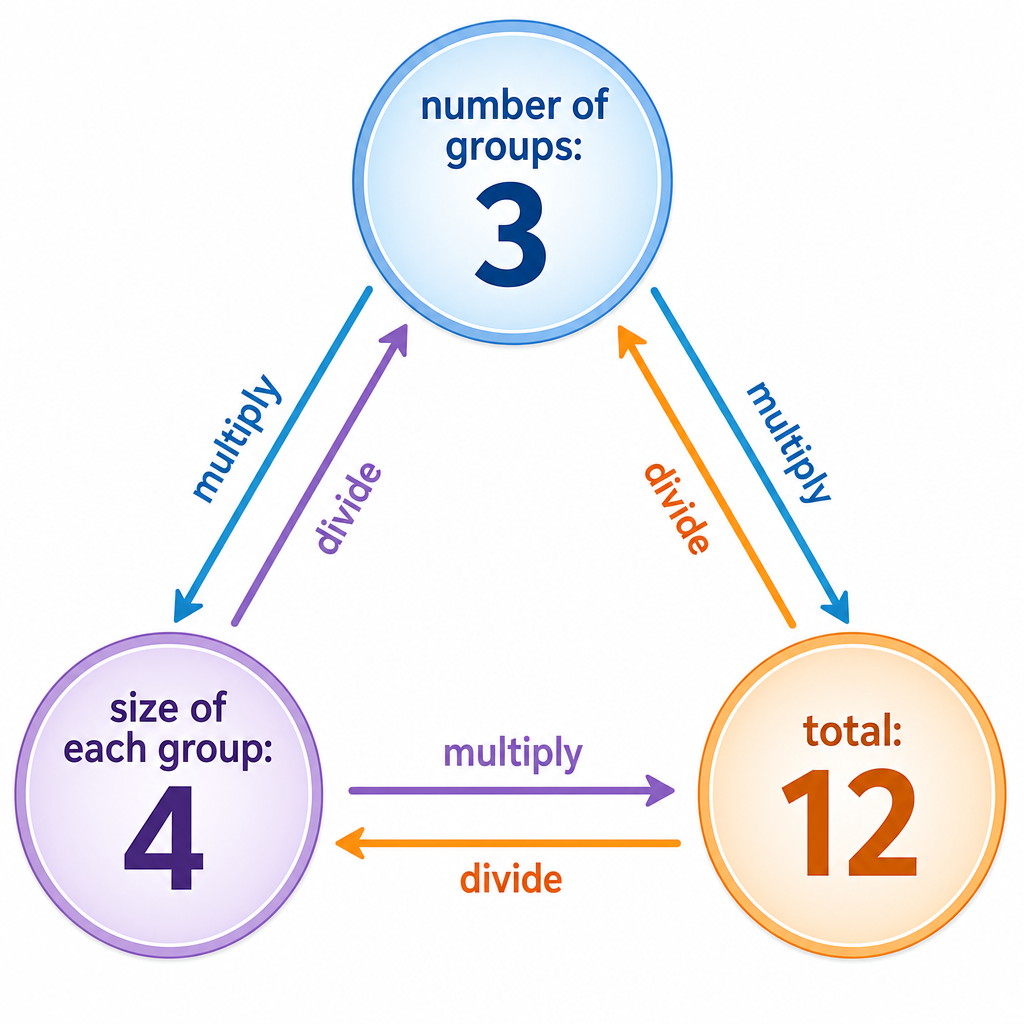
Multiplication builds equal groups.
Division takes a total and splits it back into equal groups.
They are like opposite math friends:
3 × 4 = 12
12 ÷ 3 = 4
12 ÷ 4 = 3
If you know one fact, you can often find the others.
This is powerful for computer work because programs often need to move between:
- group size
- number of groups
- total amount
Tiny Computer Use
Why data people care
Data science and AI are built from lots of small number steps.
For example, a computer may count how many items are in each group, then multiply to find totals.
Imagine a tiny shop dataset:
- Each toy car costs 6 coins.
- A customer buys 4 toy cars.
- The computer multiplies to find the cost.
This is still the same idea: equal groups.
```python
price_per_toy_car = 6
number_of_cars = 4

total_cost = price_per_toy_car * number_of_cars

print("Price per toy car:", price_per_toy_car)
print("Number of toy cars:", number_of_cars)
print("Total cost:", total_cost)

# If 24 coins are used to buy toy cars at 6 coins each,
# division tells us how many cars can be bought.
coins = 24
cars_can_buy = coins // price_per_toy_car
print("Cars that can be bought with 24 coins:", cars_can_buy)
```
Undo The Multiply
Final check
A program knows:
6 groups of 3 = 18
Which division sentence undoes this and finds the size of each group?