Bottom Left Node Value
Read at your own pace. Code execution, quizzes, progress tracking, and the AI tutor are available in the interactive view with JavaScript enabled.
Description
Assume we're using a binary tree in writing a video game via Binary Space Partitioning. We need to identify the bottom left leaf, that is-- the leftmost value in the lowest row of the binary tree.
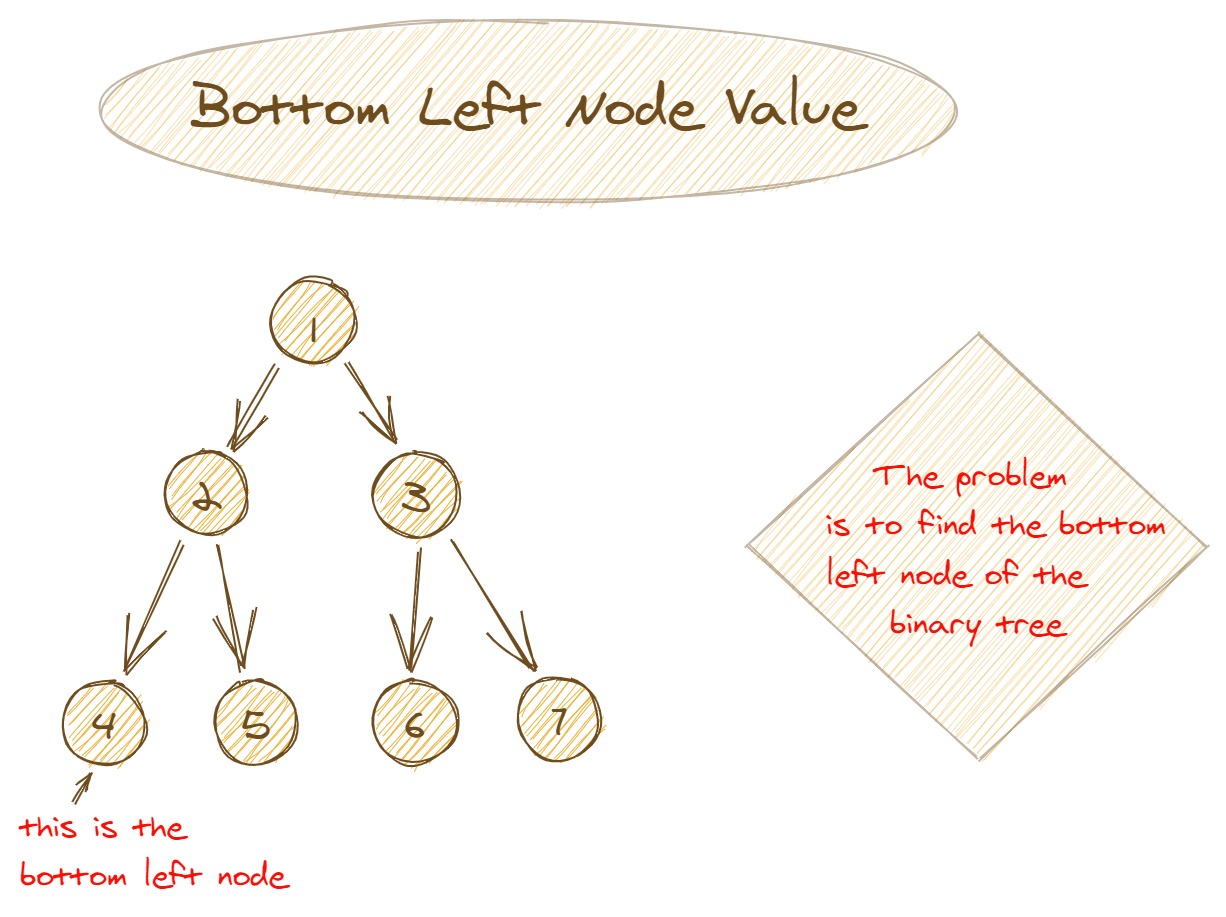
In this example, the bottom left leaf is 3:
/*
    4
   / \
  3   5
*/
Assuming the standard node definition of:
function Node(val) {
  this.val = val;
  this.left = this.right = null;
}
It would be called as such:
const root = new Node(4);
root.left = new Node(3);
root.right = new Node(5);

function bottomLeftNodeVal(root) { return; };
bottomLeftNodeVal(root);
// 3
Here's another example. Let's assume that there's at least the root node available in all binary trees passed as parameters.
/*
      4
     / \
    1   3
       / \
      5   9
*/

const root = new Node(4);
root.left = new Node(1);
root.right = new Node(3);
root.right.left = new Node(5);
root.right.right = new Node(9);

bottomLeftNodeVal(root);
// 5
Constraints
- Nodes in the binary tree <=
100000 - The values in the nodes will be in the range
-1000000000and1000000000 - Expected time complexity :
O(n) - Expected space complexity :
O(n)
```js
function Node(val) {
  this.val = val;
  this.left = this.right = null;
}

function bottomLeftNodeVal(root) {
  // Fill in this method
  return root;
}

// const root = new Node(4);
// root.left = new Node(1);
// root.right = new Node(3);
// root.right.left = new Node(5);
// root.right.right = new Node(9);

// console.log(bottomLeftNodeVal(root));
```
CONTINUE WITH ALGODAILY PREMIUM
Keep going with the complete tutorial.
Unlock the remaining explanations and exercises, alongside the full learning library.
Explore Premium →