How Deep Does It Go? Maximum Depth of Binary tree
Read at your own pace. Code execution, quizzes, progress tracking, and the AI tutor are available in the interactive view with JavaScript enabled.
Description
Write a method to determine how deep a binary tree goes. The tree's depth can be described as the number of nodes you encounter as you traverse from the root node to a leaf.
The root node is the topmost node, and a leaf is a node with no children.
For example, you're given the following binary tree:
    6
   / \
  2  14
    /  \
   13   19
The longest distance is from 6 to 19, and we return 3 because it covers 3 nodes.

The method will be invoked like the following:
const root = new Node(6);

function howDeep(root) {
    return;
};

howDeep(root);
Constraints
- Number of nodes in the tree <=
100000 - The nodes will always contain integer values between
-1000000000and1000000000 - Expected time complexity :
O(logn) - Expected space complexity :
O(n)considering the call stack
```js
function howDeep(root) {
  // Fill in this method
  return root;
}
```
Step Two
This seems like a pretty straightforward problem: we essentially want to just count the maximum number of levels that the tree has. There's several ways to do this, but we'll need to traverse the tree.
Given that it's a binary tree, this means that there's up to two paths to move -- left and right. This fact simplifies things a bit, as traversal just requires navigating two children at each node.
During traversal, we can detect a leaf either when there is no left or right:
```js
if (!node.left && !node.right) {
  return;
}
```
Step Three
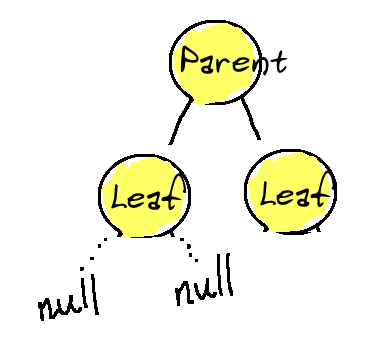
Or we could simply return when there is no node at all.
```js
if (!node) {
  // if parent returned twice here (left/right), it was a leaf
  return;
}
```
Step Four
At every node, we can recursively traverse down the left and right children if they exist, until we reach a leaf.
The difficult part is keeping track of the number of levels.
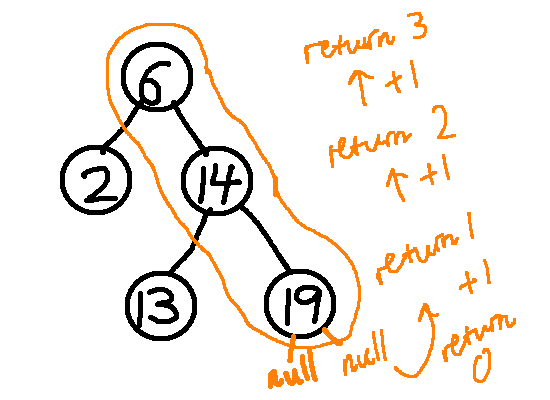
To do that, we can make the return statement the number of levels thus far, and increment it by 1 at every step.
This solution has a time complexity O(log n).
One Pager Cheat Sheet
One Pager Cheat Sheet
- Write a method to
calculate the depthof abinary treeusingO(logn)time complexity andO(n)space complexity. - We can traverse the
binary treeto count itsmaximum levelsby navigating two children at each node and detecting aleafwhen aleftorrightdoes not exist. - We can
returnwhen there is nonodepresent. - We can recursively traverse down the left and right children of each node until we reach a leaf,
returningthe number of levels traversed and with a time complexity of O(log n).