Nth Smallest Number in a Stream
Read at your own pace. Code execution, quizzes, progress tracking, and the AI tutor are available in the interactive view with JavaScript enabled.
Description
Many modern programming languages have the notion of a stream. A stream is a resource that's broken down and sent (usually over a network) in small chunks.
Imagine a video that's playing-- it would be inefficient to need to download an entire 1 gigabyte movie before being able to watch it. Instead, browsers will gradually download it in pieces.
Given a stream of numbers with an infinite length, can you find the nth smallest element at each point of the streaming?
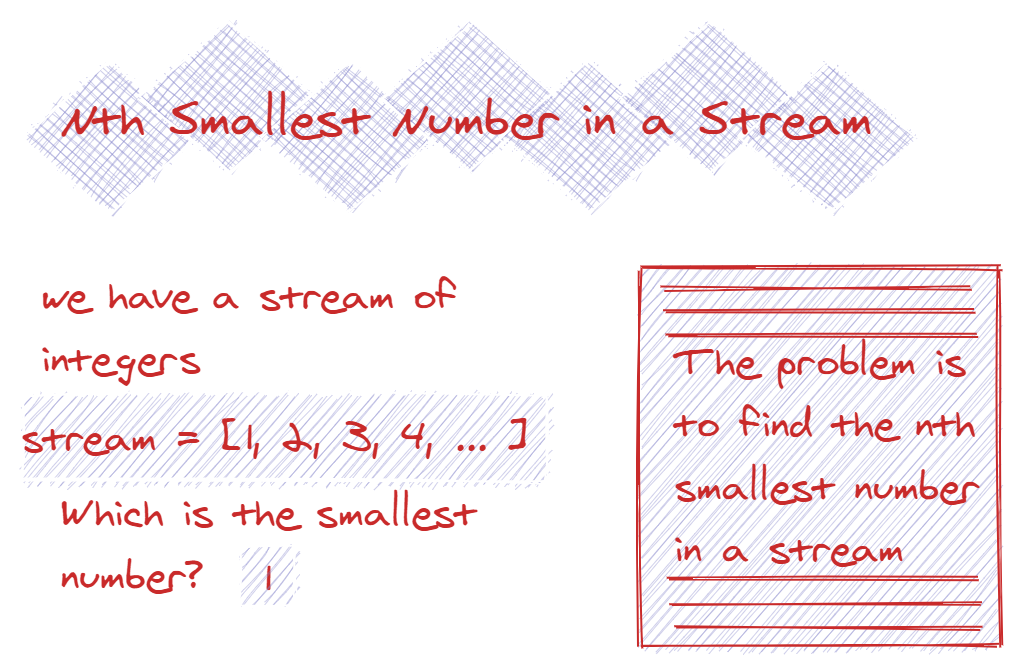
In the below example, we are looking for the second smallest element.
// stream is the resource, the "..." represents future integers
const stream = [3, 4, 5, 6, 7, ...]
nthSmallestNumber(2); // 2nd smallest number
// [null, 4, 4, 4, ...] (4 is always second smallest)
Let's use a for-loop to simulate a stream. Your method will be called as follows:
for (let i = 0; i < 10; i++) {
  const newInt = Math.floor(Math.random() * 10) + 1;
  nthSmallestNumber(n);
  // return nth smallest number
}
Constraints
- Length of the stream <=
100000 - The values in the stream will be between
-1000000000and1000000000 - Expected time complexity :
O(nlogn) - Expected space complexity :
O(n)
```js
function nthSmallestNumber(num) {
	const stream = makeStream(20);
	let current;
	for (let i = 0; i <= 5; i++) {
		current = stream.next().value;
    console.log('Next number is ', current);

    // fill in this method
	}
}

nthSmallestNumber(3);
```
CONTINUE WITH ALGODAILY PREMIUM
Keep going with the complete tutorial.
Unlock the remaining explanations and exercises, alongside the full learning library.
Explore Premium →