Data Structures and Algorithms with JavaScript
Read at your own pace. Code execution, quizzes, progress tracking, and the AI tutor are available in the interactive view with JavaScript enabled.
Why DSA Now
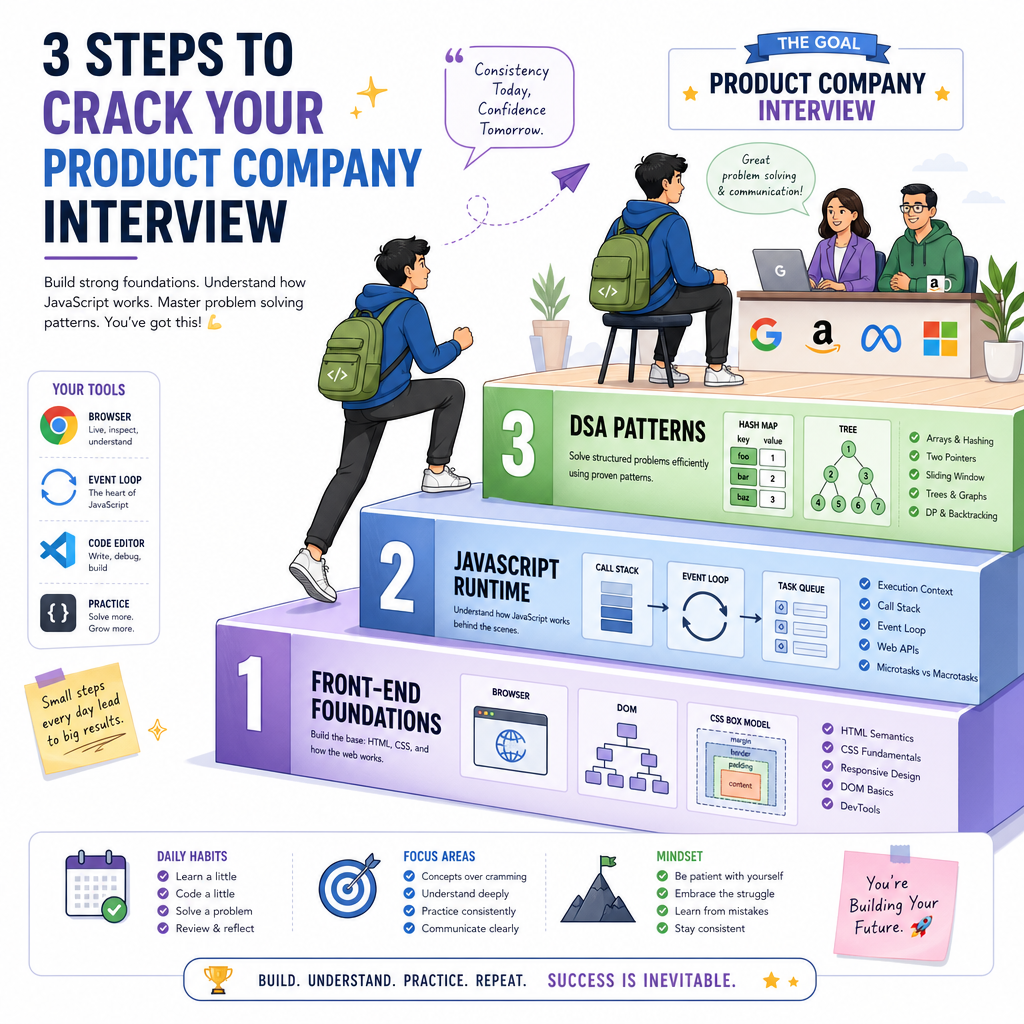
From front-end builder to product-company candidate
In Front End Basics, you mapped the browser, client-server loop, and product-quality mindset. In JavaScript in Depth, you built a runtime mental model: scope, identity, prototypes, and async scheduling.
Now we add the layer many product interviews use to test problem-solving: Data Structures and Algorithms.
Even for front-end roles, DSA shows up in real work:
- Filtering, sorting, and searching large UI lists
- Autocomplete and typeahead suggestions
- Routing and navigation graphs
- Component trees and DOM traversal
- Caching API results
- Parsing user input, markdown, JSON, or logs
You prefer C++, so we will practice patterns in C++ while keeping the front-end connection clear. The core ideas transfer directly to JavaScript.

Complexity Budget
Big O is a performance budget
Big O does not predict exact milliseconds. It answers: how does work grow when input grows?
For front-end engineering, this matters because users feel growth:
Pattern Meaning UI riskO(1)
constant work
great for cache lookup
O(log n)
divide search space
binary search, balanced trees
O(n)
scan once
okay for moderate lists
O(n log n)
efficient sorting
common in ranking/sorting
O(n^2)
nested growth
can freeze large UIs
A support-role background often builds strong debugging patience. Product interviews add one more habit: before coding, estimate the shape of the work.
Ask:
- What is
n? - Do I scan once, nest loops, or repeatedly split?
- What extra memory do I use?

Spot The Bottleneck
A UI search feature loops through n visible items. For each item, it scans another list of n blocked keywords.
What is the time complexity?
Arrays And Pointers
Arrays are your interview default
Many problems start with arrays or strings because they expose the most common patterns:
- Two pointers: move from both ends or maintain a left/right window
- Sliding window: track a changing range
- Prefix sums: answer range questions quickly
- Sorting first: simplify comparisons
In front-end work, array patterns appear in filtered lists, paginated results, table rows, search matches, and client-side transformations.
Here is a classic two-pointer example: cleanly checking whether a string is a palindrome while ignoring spaces and punctuation.
```cpp
#include <bits/stdc++.h>
using namespace std;

bool isCleanPalindrome(const string& s) {
    int left = 0;
    int right = (int)s.size() - 1;

    while (left < right) {
        while (left < right && !isalnum((unsigned char)s[left])) left++;
        while (left < right && !isalnum((unsigned char)s[right])) right--;

        char a = tolower((unsigned char)s[left]);
        char b = tolower((unsigned char)s[right]);

        if (a != b) return false;
        left++;
        right--;
    }
    return true;
}

int main() {
    vector<string> tests = {
        "A man, a plan, a canal: Panama",
        "frontend"
    };

    for (const string& text : tests) {
        cout << text << " -> " << (isCleanPalindrome(text) ? "true" : "false") << endl;
    }

    return 0;
}
```
Pointer Pattern Check
In a sorted array, the classic two-sum two-pointer approach starts at the ______ ends and moves inward depending on whether the sum is too small or too large.
Maps For Memory
Hash maps trade memory for speed
A hash map is often the simplest upgrade from repeated scanning.
Instead of asking, “Have I seen this before?” by looping again and again, store what you know:
- Frequencies
- Last seen index
- Cached API response by key
- User selection state by ID
- Deduplication sets
In JavaScript, you might use Map, Set, or plain objects depending on the case. In C++, unordered_map gives average O(1) lookup.
Example: find the first non-repeating character.
```cpp
#include <bits/stdc++.h>
using namespace std;

int main() {
    string s = "swiss";
    unordered_map<char, int> freq;

    for (char c : s) {
        freq[c]++;
    }

    char answer = '#';
    for (char c : s) {
        if (freq[c] == 1) {
            answer = c;
            break;
        }
    }

    cout << "String: " << s << endl;
    cout << "First non-repeating character: " << answer << endl;

    return 0;
}
```
Hash Map Reality
True or false: A hash map always keeps its keys in sorted order.
Stacks Queues Trees
Structures match the shape of the problem
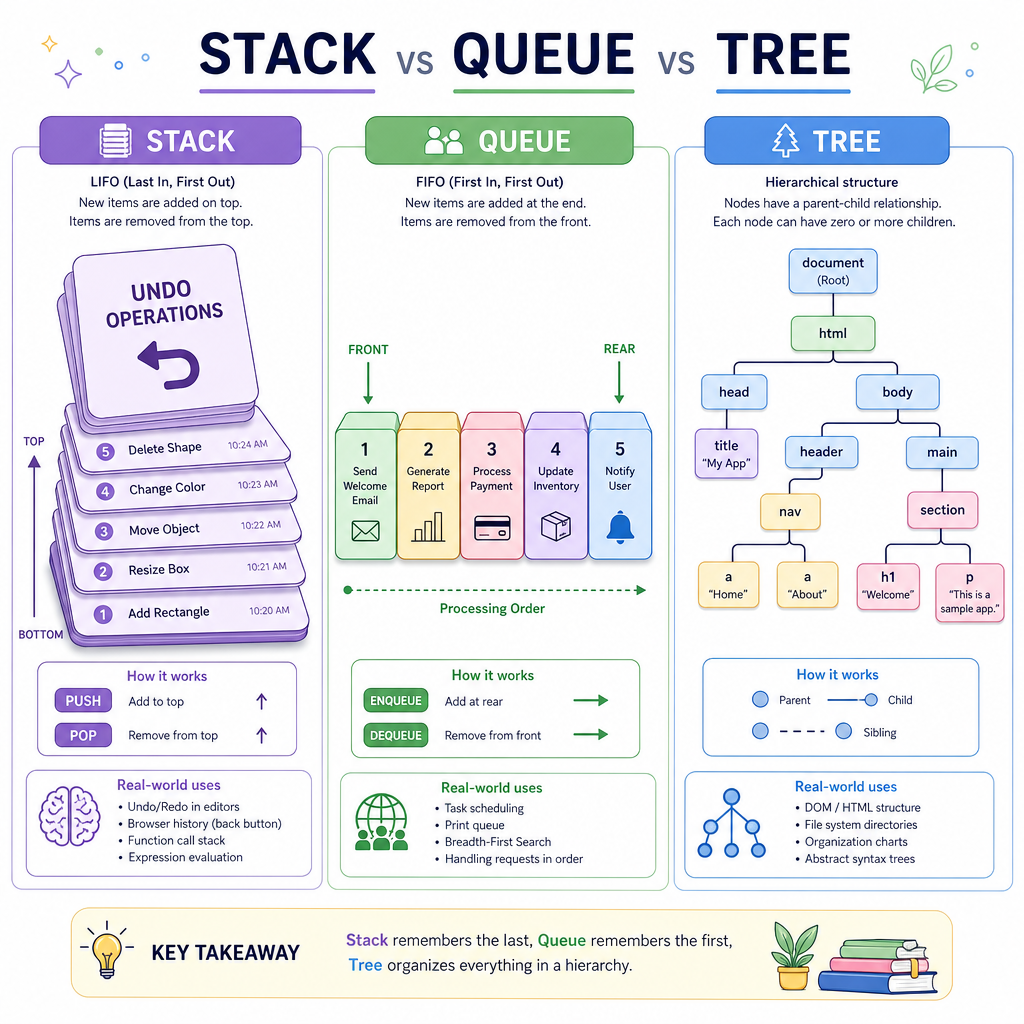
Once arrays and maps feel natural, choose the structure that matches the workflow:
Stack: last in, first out
Use for:
- Undo/redo
- Valid parentheses
- Browser navigation history
- Depth-first traversal
Queue: first in, first out
Use for:
- Task processing
- Breadth-first traversal
- Level-order search
- Scheduling flows
Tree: hierarchical data
Use for:
- DOM structure
- Component hierarchy
- File explorers
- Comments and replies
This connects directly to your front-end path: the DOM and component tree are not abstract interview toys. They are real data structures you touch every day.
BFS In Practice
Breadth-first search explores by layers
BFS is a natural fit when you need the shortest number of steps in an unweighted graph.
Front-end-flavored examples:
- Shortest click path between screens
- Finding nearest matching node in a component tree
- Exploring related routes or menu items
- Level-order rendering or inspection
The queue is the key: process the current node, then add its neighbors.
```cpp
#include <bits/stdc++.h>
using namespace std;

int main() {
    vector<vector<int>> graph = {
        {1, 2},    // node 0 connects to 1 and 2
        {3},       // node 1 connects to 3
        {3, 4},    // node 2 connects to 3 and 4
        {4},       // node 3 connects to 4
        {}         // node 4 has no outgoing edges
    };

    vector<bool> visited(graph.size(), false);
    queue<int> q;

    q.push(0);
    visited[0] = true;

    cout << "BFS order from node 0: ";

    while (!q.empty()) {
        int node = q.front();
        q.pop();

        cout << node << " ";

        for (int next : graph[node]) {
            if (!visited[next]) {
                visited[next] = true;
                q.push(next);
            }
        }
    }

    cout << endl;
    return 0;
}
```
Finish Strong
Your course wrap-up
You now have the core bridge for a front-end transition into product-company interviews:
- Front End Basics gave you the browser, HTML, CSS, JavaScript, and product-quality map.
- JavaScript in Depth gave you the runtime confidence to reason about behavior, identity, closures, prototypes, and async scheduling.
- Data Structures and Algorithms gave you the problem-solving patterns behind efficient UI work and interview questions.
Your interview operating system
For every DSA problem, practice this flow:
- Restate the problem in plain language
- Identify input size and constraints
- Start with brute force
- Name the bottleneck
- Choose a structure: array, map, stack, queue, tree, graph
- Explain time and space complexity
- Code cleanly
- Test edge cases out loud
Final mindset
You are not starting from zero. Your support engineering experience already trained debugging, production awareness, and patience. Add front-end depth plus DSA structure, and you become much closer to the profile product teams look for: someone who can build, reason, optimize, and communicate.