Evaluating Clusters in Practice
Read at your own pace. Code execution, quizzes, progress tracking, and the AI tutor are available in the interactive view with JavaScript enabled.
Why Evaluate Clusters
Evaluating Clusters in Practice
Now that we've covered unsupervised learning and clustering with Scikit-learn in Machine Learning Made Easy: Scikit-Learn (Part-2: Unsupervised Learning), we are ready for the uncomfortable but practical question:
How do we know if our clusters are any good?
In supervised learning, we used train/test metrics because we had labels. In clustering, labels are often missing, so evaluation becomes more like debugging a system with incomplete logs.
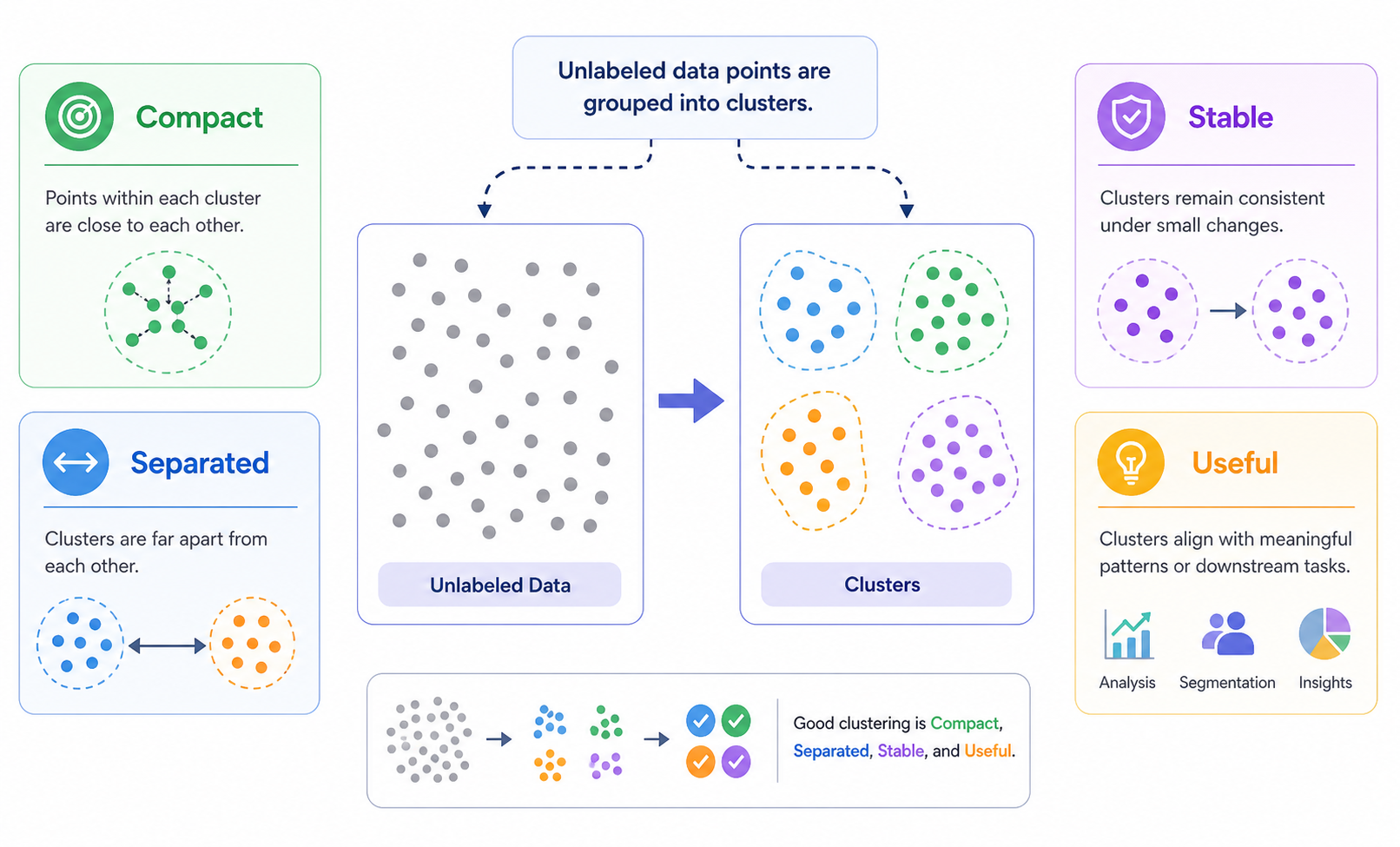
A useful cluster solution should usually be:
- compact: points inside a cluster are close together
- separated: different clusters are meaningfully apart
- stable: small data or seed changes do not completely rewrite the grouping
- useful: the clusters help with a real decision, workflow, or investigation
This lesson keeps us in the same Python + Scikit-learn stack, but shifts from “run clustering” to “trust clustering carefully.”
CONTINUE WITH ALGODAILY PREMIUM
Keep going with the complete tutorial.
Unlock the remaining explanations and exercises, alongside the full learning library.
Explore Premium →