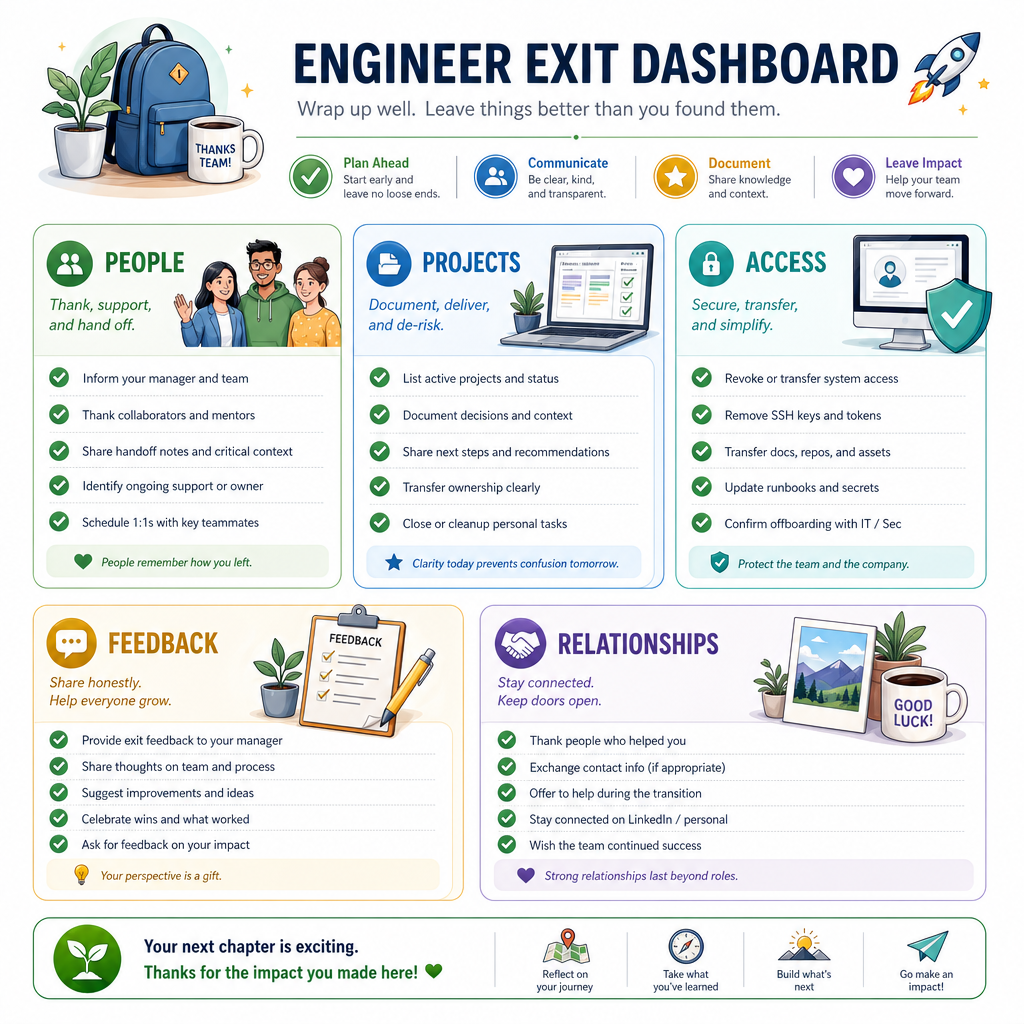
Leaving a Position in Good Standing
Read at your own pace. Code execution, quizzes, progress tracking, and the AI tutor are available in the interactive view with JavaScript enabled.
Exit With Leverage
Why this matters now
In Following Up After Negotiation, you closed loops professionally after the ask. Now we apply that same discipline to a bigger transition: leaving a role without burning trust.
For a senior engineer, your exit is part of your career architecture. A clean departure can preserve references, future boomerang options, internal transfers, consulting opportunities, and your reputation in a surprisingly small tech network.
Think of it like walking off the field after a tough Steelers game: the tape still matters. People remember how you handled pressure when the clock was running out.

Two Exit Paths
Internal move vs. external departure
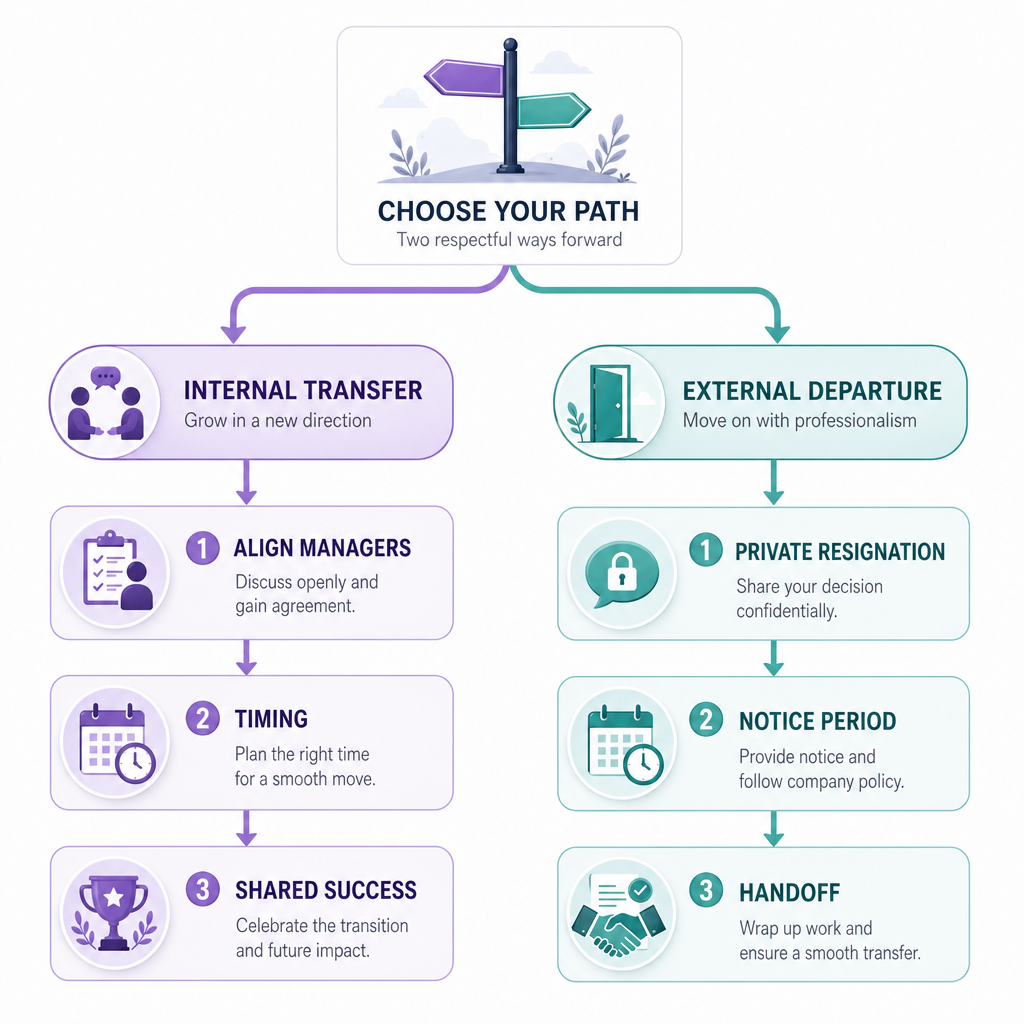
Leaving in good standing looks different depending on where you are going.
If you are moving internally
- Align with both managers before public announcements.
- Clarify timing so neither team feels blindsided.
- Keep your tone collaborative: you are not escaping, you are redeploying.
- Document what your old team needs to operate without you.
If you are leaving the company
- Resign privately before sharing widely.
- Keep the reason concise and professional.
- Offer a realistic transition plan.
- Avoid turning your notice period into a courtroom drama.
The goal is not to over-explain your decision. The goal is to make your departure easy to trust.
Notice And Narrative
Your resignation narrative
Your message should be brief, respectful, and consistent. You do not need to litigate every reason you are leaving.
A useful structure:
- Decision: I have accepted another opportunity / I am transitioning to another team.
- Gratitude: I appreciate the work, mentorship, and trust here.
- Timing: My proposed last day is X.
- Transition: I will prepare a handoff plan and support knowledge transfer.
Below is a tiny C++ model for generating the pieces of an exit packet. You would not literally automate your resignation, but as a senior developer, modeling the deliverables makes the process concrete.
```cpp
#include <iostream>
#include <vector>
#include <string>

struct ExitItem {
    std::string name;
    std::string owner;
    int dueInDays;
};

int main() {
    std::vector<ExitItem> packet = {
        {"Resignation conversation", "You", 0},
        {"Written confirmation", "You", 1},
        {"Project handoff notes", "You", 5},
        {"Access and admin checklist", "Manager", 7},
        {"Final thank-you messages", "You", 10}
    };

    std::cout << "Exit packet checklist:\n";
    for (const auto& item : packet) {
        std::cout << "- " << item.name
                  << " | Owner: " << item.owner
                  << " | Due in " << item.dueInDays << " day(s)\n";
    }

    return 0;
}
```
Best First Move
You have accepted a new external offer and are ready to resign. What is the strongest first move?
Transition Responsibilities
Reduce operational risk
A strong handoff is not just a courtesy. It lowers risk for the team you are leaving.
For senior engineers, focus on:
- Systems you own: services, repositories, dashboards, alerts.
- Decisions in flight: architecture proposals, vendor reviews, roadmap tradeoffs.
- Hidden context: Slack threads, production quirks, undocumented scripts.
- People dependencies: stakeholders, approvers, domain experts.
- Risk level: what could break if nobody owns it?
This is your chance to raise the team's bus factor before you go. Like a well-designed API, your handoff should make the next maintainer's job obvious.
```cpp
#include <algorithm>
#include <iostream>
#include <string>
#include <vector>

struct Handoff {
    std::string area;
    std::string nextOwner;
    int risk; // 1 = low, 5 = high
};

int main() {
    std::vector<Handoff> items = {
        {"Payment retry service", "Rina", 5},
        {"Release checklist", "Marco", 3},
        {"Analytics dashboard", "Sam", 2},
        {"Legacy cron cleanup", "Unassigned", 4}
    };

    std::sort(items.begin(), items.end(), [](const Handoff& a, const Handoff& b) {
        return a.risk > b.risk;
    });

    std::cout << "Prioritized handoff list:\n";
    for (const auto& item : items) {
        std::cout << "Risk " << item.risk << ": " << item.area
                  << " -> " << item.nextOwner << "\n";
    }

    return 0;
}
```
Exit Interview Candor
True or false: An exit interview is usually the best place to unload every frustration you have been saving up.
Exit Interview Strategy
Be useful, not explosive
Exit interviews vary. Some are genuine learning conversations; others are procedural. Treat them professionally either way.
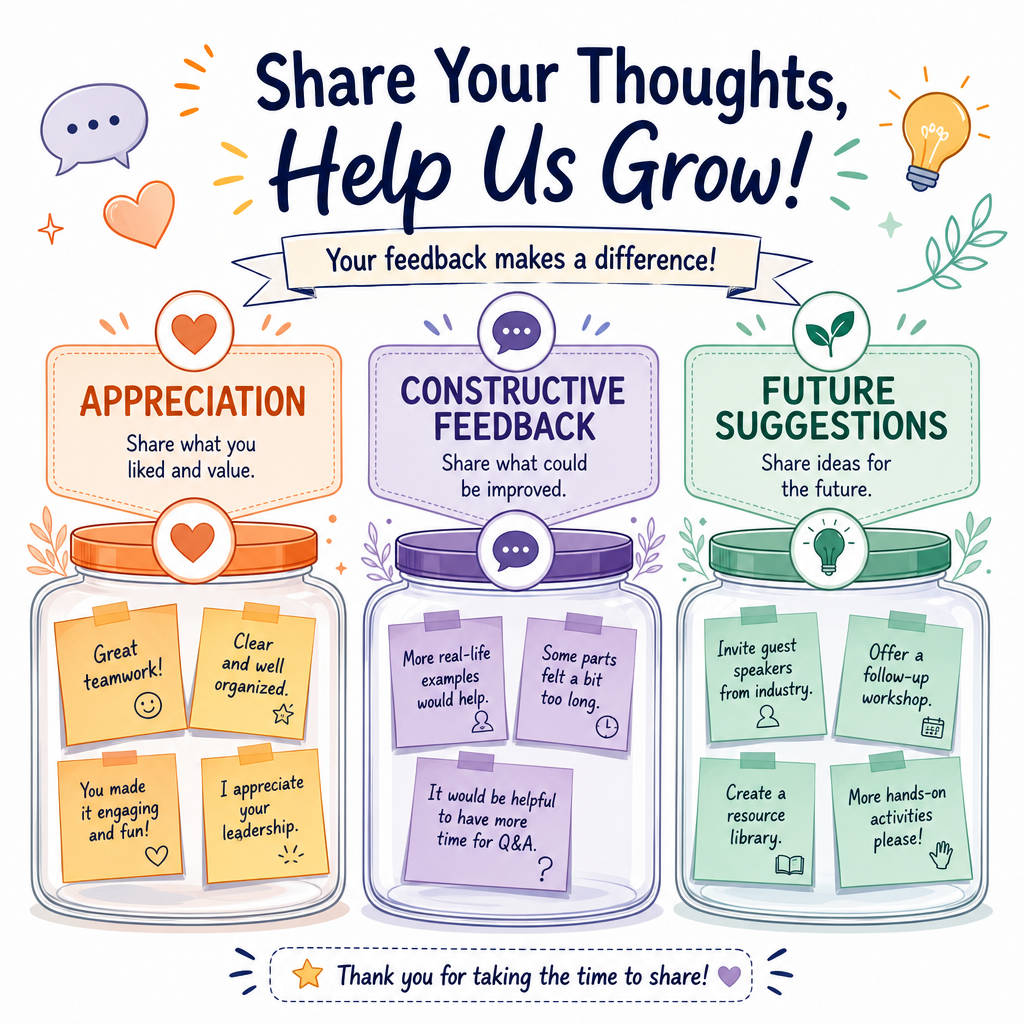
Use three buckets:
1. Appreciation
Name what worked: mentorship, hard problems, team trust, growth opportunities.
2. Constructive feedback
Offer specific, behavior-based observations. Prefer: When X happened, it created Y impact. Avoid character attacks.
3. Future-facing suggestions
Frame feedback as a system improvement: clearer promotion criteria, better on-call support, earlier roadmap alignment.
If your feedback sounds like a Stephen King monologue from the haunted hotel, it is probably too much. Keep it grounded, concise, and actionable.
Name The Artifact
Complete the phrase: The document that lists open work, owners, deadlines, risks, and important links is a ____.
Maintain The Network
Relationships continue after the last day
Leaving well includes a relationship plan. You do not need to network performatively; you just need to close human loops.
Consider:
- Thanking your manager and key teammates individually.
- Offering to answer brief handoff questions for a limited window.
- Connecting on LinkedIn with people you genuinely want to keep in touch with.
- Asking for references while the work is still fresh.
- Sending a short update after you settle into the new role.
The Knicks do not win by ignoring spacing. Careers work similarly: maintain healthy distance, but keep the passing lanes open.
```cpp
#include <iostream>
#include <string>
#include <vector>

struct Touchpoint {
    int day;
    std::string action;
};

int main() {
    std::vector<Touchpoint> plan = {
        {0, "Send personal thank-you notes"},
        {7, "Share final links and confirm handoff questions"},
        {30, "Check in with close former teammates"},
        {90, "Send a brief career update to key mentors"}
    };

    std::cout << "Post-exit relationship plan:\n";
    for (const auto& t : plan) {
        std::cout << "Day " << t.day << ": " << t.action << "\n";
    }

    return 0;
}
```
Good Standing Checklist
Your final pass
Before your last day, run this checklist:
- Manager informed privately and respectfully.
- Written resignation or transfer confirmation complete.
- Last day, PTO, benefits, and equipment return clarified.
- Transition plan shared and prioritized by risk.
- Key docs, repos, dashboards, and credentials identified.
- Exit interview handled constructively.
- Thank-you messages sent to important collaborators.
- Public announcement, if any, kept positive and concise.
Leaving in good standing is not about pretending everything was perfect. It is about protecting your reputation, reducing chaos, and ending the chapter with maturity.
Next, we will zoom back out and look at how performance and expectations shape the negotiation story over time.