Lesson 5: Scaling and Replication
Read at your own pace. Code execution, quizzes, progress tracking, and the AI tutor are available in the interactive view with JavaScript enabled.
From One Box
Why this lesson matters
In Lesson 2, we built a tiny key-value store. In Lesson 3, we made it survive restarts. In Lesson 4, we added indexes so reads could be smarter than scanning everything.
Now we hit a new wall: one machine is not enough.
Scaling asks:
- How do we split keys across many machines?
- How does a client know where a key lives?
- What happens when a machine dies?
- How do we keep copies synchronized?
This is the lesson where our datastore stops being just a data structure and starts becoming a distributed system.
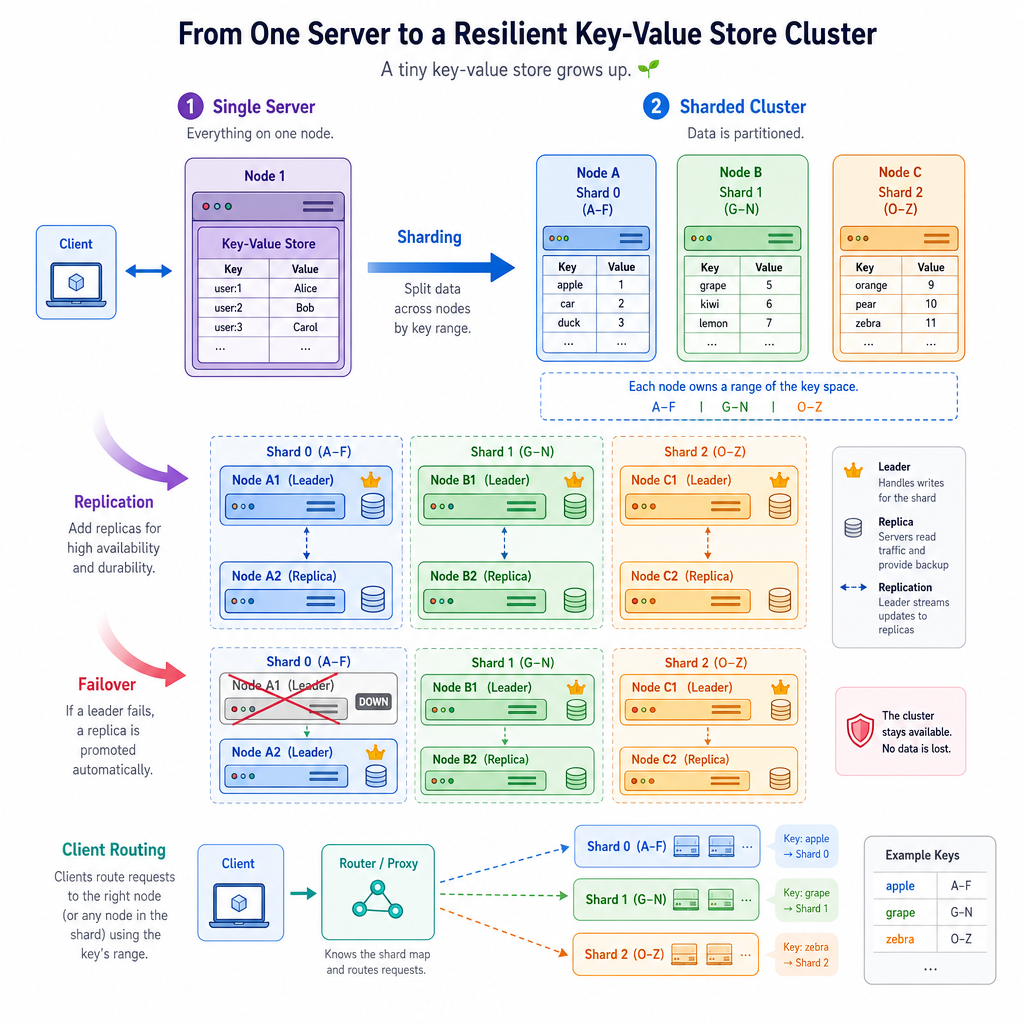
Two Scaling Axes
Scaling has two separate jobs
When people say scale the database, they often mix two ideas:
1. Partitioning / Sharding
Split the keyspace across machines.
user:1  -> shard A
user:2  -> shard B
user:3  -> shard C
This increases capacity and throughput because each node owns fewer keys.
2. Replication
Store copies of the same data on multiple machines.
shard A primary -> shard A replica 1
                -> shard A replica 2
This improves availability and can improve read throughput.
A scalable datastore usually uses both: first decide which shard owns the key, then decide which replica serves the request.

Stable Key Routing
Routing keys to shards
The simplest shard function is:
shard = hash(key) % number_of_shards
That works, but it has a painful property: if the number of shards changes, many keys move.
A common alternative is rendezvous hashing. For each key, score every node and choose the highest score. When you add a node, only keys that prefer the new node move.
This is useful in real systems because adding capacity should not require reshuffling the entire database.
```python
import hashlib


def score(key, node):
    data = f"{key}:{node}".encode()
    return int(hashlib.sha256(data).hexdigest(), 16)


def choose_node(key, nodes):
    return max(nodes, key=lambda node: score(key, node))

keys = ["account:1", "account:2", "trade:99", "price:AAPL", "price:MSFT"]
nodes_before = ["node-a", "node-b", "node-c"]
nodes_after = ["node-a", "node-b", "node-c", "node-d"]

print("Before adding node-d:")
before = {}
for key in keys:
    before[key] = choose_node(key, nodes_before)
    print(key, "->", before[key])

print("\nAfter adding node-d:")
moved = 0
for key in keys:
    new_node = choose_node(key, nodes_after)
    if new_node != before[key]:
        moved += 1
    print(key, "->", new_node)

print(f"\nMoved keys: {moved} of {len(keys)}")
```A Routed Cluster
A minimal sharded key-value cluster
Our earlier store had one dictionary-like object behind set, get, and delete.
A sharded version keeps the same external API, but adds a routing layer:
client.set("user:42", value)
        |
        v
router chooses shard
        |
        v
node stores key locally
This separation matters. Application code should not manually decide where keys live. The datastore should hide that behind a stable API.
```python
import hashlib

class Node:
    def __init__(self, name):
        self.name = name
        self.data = {}

    def set(self, key, value):
        self.data[key] = value

    def get(self, key):
        return self.data.get(key)

class ShardedKV:
    def __init__(self, node_names):
        self.nodes = [Node(name) for name in node_names]

    def _pick_node(self, key):
        digest = hashlib.sha256(key.encode()).hexdigest()
        index = int(digest, 16) % len(self.nodes)
        return self.nodes[index]

    def set(self, key, value):
        node = self._pick_node(key)
        node.set(key, value)
        print(f"SET {key!r} on {node.name}")

    def get(self, key):
        node = self._pick_node(key)
        value = node.get(key)
        print(f"GET {key!r} from {node.name} -> {value!r}")
        return value

cluster = ShardedKV(["shard-0", "shard-1", "shard-2"])
cluster.set("user:42", {"tier": "pro"})
cluster.set("price:AAPL", 189.25)
cluster.get("user:42")
cluster.get("price:AAPL")
```
Routing Blank
Fill in the missing term:
A datastore that decides which node owns a key is using a key-to-_____ function.
Replication Model
Replication: copies with roles
For each shard, we can keep multiple copies:
primary replica: accepts writes
secondary replicas: copy writes from primary
A common simple protocol is leader-based replication:
- Client sends write to the leader.
- Leader appends the write to a log.
- Followers read and apply log entries in order.
- Reads can go to the leader or, with some staleness risk, followers.
This log-based idea connects directly to Lesson 3: persistence made writes durable on one machine; replication sends those writes to other machines too.

Tiny Replication Log
Implementing the core idea
Below is a deliberately small replication model.
The leader records each mutation in a log. Followers apply entries they have not seen yet. This is not a production protocol, but it captures the essential invariant:
Replicas converge when they apply the same ordered log of writes.
Notice that reads from a follower can be stale if replication has not caught up.
```python
class Replica:
    def __init__(self, name):
        self.name = name
        self.data = {}
        self.applied = 0

    def apply(self, entry):
        op, key, value = entry
        if op == "SET":
            self.data[key] = value
        elif op == "DELETE":
            self.data.pop(key, None)
        self.applied += 1

class Leader(Replica):
    def __init__(self, name):
        super().__init__(name)
        self.log = []

    def set(self, key, value):
        entry = ("SET", key, value)
        self.log.append(entry)
        self.apply(entry)
        print(f"leader accepted {entry}")

    def delete(self, key):
        entry = ("DELETE", key, None)
        self.log.append(entry)
        self.apply(entry)
        print(f"leader accepted {entry}")

    def replicate_to(self, follower):
        while follower.applied < len(self.log):
            entry = self.log[follower.applied]
            follower.apply(entry)
            print(f"replicated to {follower.name}: {entry}")

leader = Leader("primary")
follower = Replica("replica-1")

leader.set("order:7", {"status": "open"})
print("Follower before replication:", follower.data)

leader.replicate_to(follower)
print("Follower after replication:", follower.data)

leader.delete("order:7")
leader.replicate_to(follower)
print("Follower after delete:", follower.data)
```
Replica Freshness
True or false: In leader-based replication, a follower read may return stale data if the follower has not applied the leader's latest log entries.
Quorums And Failover
Availability is a policy choice
Once data is replicated, the system must decide when an operation counts as successful.
Common write policies
- Async replication: leader replies immediately, then followers catch up later.
- Sync replication: leader waits for one or more followers before replying.
- Quorum replication: require acknowledgements from a majority-like subset.
For three replicas, a common quorum rule is:
write succeeds after 2 of 3 replicas acknowledge
This gives stronger durability than pure async replication, but increases latency. In finance-style systems, this tradeoff is serious: a fast acknowledgement that disappears during a crash may be unacceptable.
Failover
If the leader dies, the cluster needs to promote a follower. The safest follower is usually the one with the most complete log.
Next lesson, we'll look at deeper optimizations; for now, focus on the core design triangle: capacity, availability, and consistency.

Quorum Reasoning
A shard has 3 replicas. The system requires 2 acknowledgements before a write is considered successful. What is this policy mainly trying to improve compared with replying after only the leader writes locally?