Longest Common Subsequence
Read at your own pace. Code execution, quizzes, progress tracking, and the AI tutor are available in the interactive view with JavaScript enabled.
From Fibonacci To LCS
Welcome back, DP adventurer
In Fibonacci Series, you saw how caching or tabulating smaller answers prevents repeated work.
Now we level up: instead of a 1D sequence, Longest Common Subsequence uses a 2D DP table to compare two strings.
By the end, you will be able to answer questions like:
What is the longest sequence of characters that appears in both
NARUTOandBORUTO, in the same relative order?
That sequence is RUTO, length 4.
This pattern appears in diff tools, DNA comparison, spell correction, plagiarism detection, and version control.

Subsequence Not Substring
The key definition
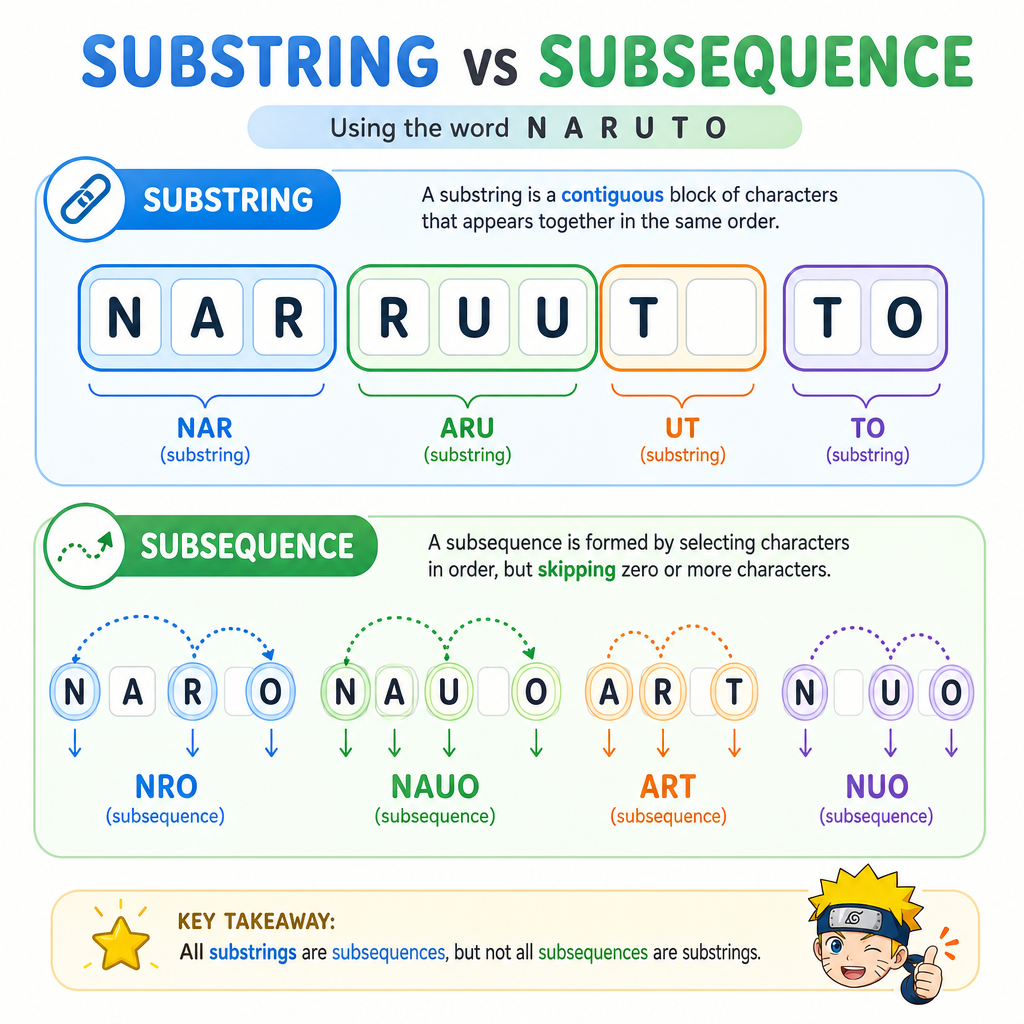
A subsequence keeps characters in the same relative order, but it does not need to be contiguous.
For NARUTO:
-
NTOis a subsequence:N _ _ _ T O -
RUTOis a subsequence:_ _ R U T O -
RUNis not a subsequence becauseNappears beforeR
A substring must be contiguous. So RUT is both a substring and a subsequence, but NTO is only a subsequence.
LCS asks for the longest sequence that two strings can both form by deleting characters only.
Check The Definition
For the string ABCDE, which option is a valid subsequence but not a substring?
The DP State
Prefixes make the problem smaller
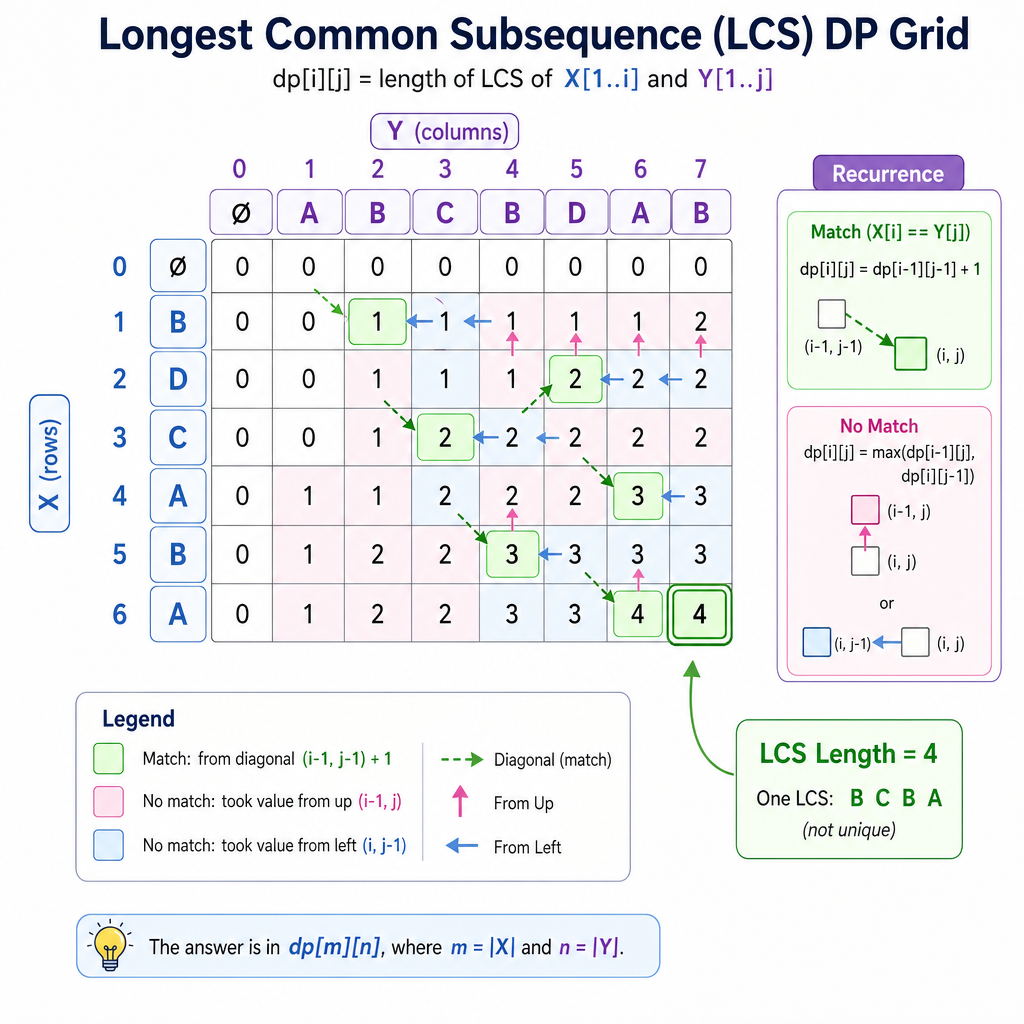
For strings a and b, define:
dp[i][j] = length of the LCS between a[:i] and b[:j]
That means:
-
icounts how many characters we use froma -
jcounts how many characters we use fromb -
dp[0][j] = 0because an empty string has no common subsequence -
dp[i][0] = 0for the same reason
The recurrence has two cases:
If the current characters match
If a[i - 1] == b[j - 1], that character can extend the best LCS from the smaller prefixes:
dp[i][j] = 1 + dp[i - 1][j - 1]
If they do not match
We cannot use both current characters together, so we try skipping one side:
dp[i][j] = max(dp[i - 1][j], dp[i][j - 1])
This is the same DP mindset from Fibonacci, but each answer depends on neighboring cells in a grid instead of earlier numbers in a line.
Match Case
Fill in the recurrence.
If a[i - 1] == b[j - 1], then:
dp[i][j] = ____
Top Down LCS
Memoized recursion
Since you already used memoization in Fibonacci Series, this should feel familiar.
Let solve(i, j) mean:
LCS length of
a[i:]andb[j:]
At each step:
- If either index reaches the end, return
0 - If characters match, take
1 + solve(i + 1, j + 1) - Otherwise, skip one character from either string and take the better result
The cache prevents the same (i, j) pair from being recomputed.
```python
from functools import lru_cache


def lcs_length_top_down(a, b):
    @lru_cache(None)
    def solve(i, j):
        if i == len(a) or j == len(b):
            return 0

        if a[i] == b[j]:
            return 1 + solve(i + 1, j + 1)

        return max(solve(i + 1, j), solve(i, j + 1))

    return solve(0, 0)


print(lcs_length_top_down("NARUTO", "BORUTO"))
print(lcs_length_top_down("ABCBDAB", "BDCABA"))
```
Bottom Up Table
Tabulation version
Now we build the table directly.
This is usually the clearest LCS implementation in interviews because the table mirrors the recurrence exactly.
We create a (len(a) + 1) x (len(b) + 1) grid. The extra row and column represent empty prefixes, which naturally start at 0.
Then we fill row by row.
```python

def lcs_length_bottom_up(a, b):
    rows, cols = len(a) + 1, len(b) + 1
    dp = [[0] * cols for _ in range(rows)]

    for i in range(1, rows):
        for j in range(1, cols):
            if a[i - 1] == b[j - 1]:
                dp[i][j] = 1 + dp[i - 1][j - 1]
            else:
                dp[i][j] = max(dp[i - 1][j], dp[i][j - 1])

    return dp[-1][-1], dp


length, table = lcs_length_bottom_up("ABC", "AC")
print("LCS length:", length)
print("DP table:")
for row in table:
    print(row)
```
Dependency Direction
True or false?
In the bottom-up LCS table, dp[i][j] only depends on cells that are already known if we fill the table from top-left toward bottom-right.
Recover One LCS
Length is useful, but the string is better
The table gives the LCS length at dp[len(a)][len(b)].
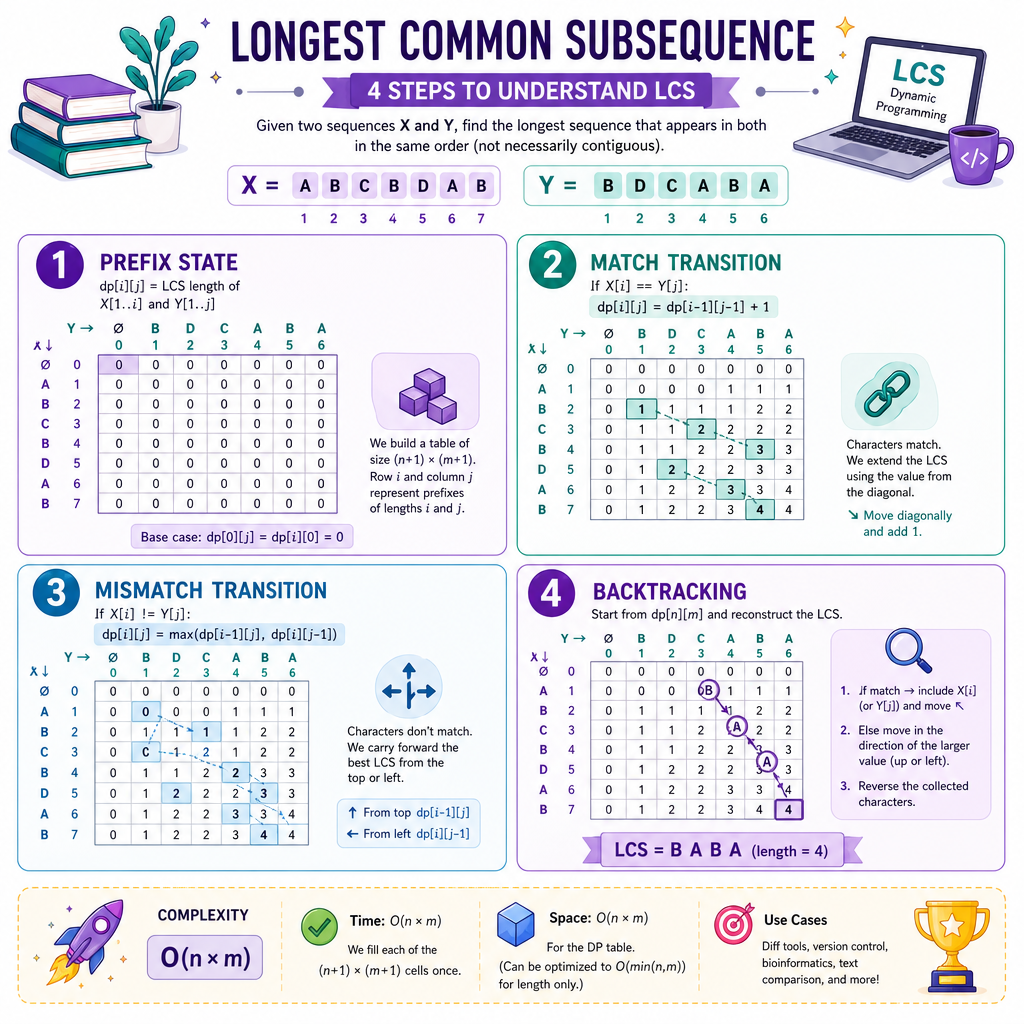
To reconstruct one actual LCS, walk backward:
- If
a[i - 1] == b[j - 1], that character belongs to the answer - Move diagonally to
(i - 1, j - 1) - Otherwise, move toward the larger neighbor: up or left
There can be multiple valid LCS strings. Returning any one of them is usually acceptable unless the problem states otherwise.
```python

def lcs_string(a, b):
    rows, cols = len(a) + 1, len(b) + 1
    dp = [[0] * cols for _ in range(rows)]

    for i in range(1, rows):
        for j in range(1, cols):
            if a[i - 1] == b[j - 1]:
                dp[i][j] = 1 + dp[i - 1][j - 1]
            else:
                dp[i][j] = max(dp[i - 1][j], dp[i][j - 1])

    i, j = len(a), len(b)
    answer = []

    while i > 0 and j > 0:
        if a[i - 1] == b[j - 1]:
            answer.append(a[i - 1])
            i -= 1
            j -= 1
        elif dp[i - 1][j] >= dp[i][j - 1]:
            i -= 1
        else:
            j -= 1

    return "".join(reversed(answer))


print(lcs_string("NARUTO", "BORUTO"))
print(lcs_string("ABCBDAB", "BDCABA"))
```
Cost And Memory
Complexity
Let:
n = len(a)m = len(b)
The standard LCS table has:
-
Time:
O(n * m)because every cell is computed once -
Space:
O(n * m)for the full table
If you only need the length, you can compress space to keep just the previous row and current row. But if you want to reconstruct the actual subsequence, the full table is the most straightforward approach.
Takeaway
LCS is the first major 2D DP pattern in this course:
- Define a prefix-based state
- Write match and mismatch transitions
- Fill the table in dependency order
- Optionally backtrack to recover the answer
Next, we will use similar DP discipline on optimization with capacity constraints in 0/1 Knapsack Problem.
Complexity Check
For the standard bottom-up LCS table between strings of lengths n and m, what are the time and space complexities?