Points On Slow and Fast Pointers
Read at your own pace. Code execution, quizzes, progress tracking, and the AI tutor are available in the interactive view with JavaScript enabled.
Introduction
There are so many different types of problems in computer science. As such, there are plenty of algorithms developed to solve each type of problem. For instance, to search an item in a list, you can use either binary search, linear search, or breadth-first search, among many other possible solutions.
Luckily, for search and other types of problems, we've narrowed the field of solutions used in real-world architectures to just a handful of efficient, proven ones.
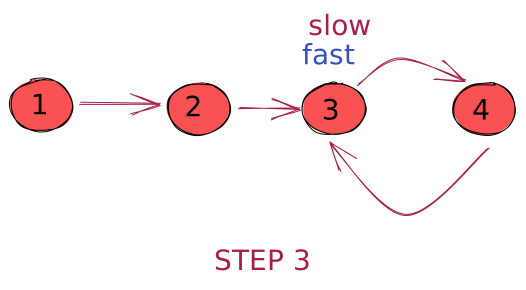
In this tutorial, we're going to do a deep dive on one such algorithm. The slow and fast pointers algorithm (also known as Floyd's Cycle Detection algorithm or the Tortoise and Hare algorithm) uses two pointers to determine traits about a graph. It is often used to detect cycles in a linked list.
0CONTINUE WITH ALGODAILY PREMIUM
Keep going with the complete tutorial.
Unlock the remaining explanations and exercises, alongside the full learning library.
Explore Premium →