Stacks and Queues
Read at your own pace. Code execution, quizzes, progress tracking, and the AI tutor are available in the interactive view with JavaScript enabled.
Next Layer Up
From storage to behavior
In Arrays and Linked Lists, you focused on how data is physically arranged and how that affects access, insertion, and deletion.
Now we move one layer up: abstract data types.
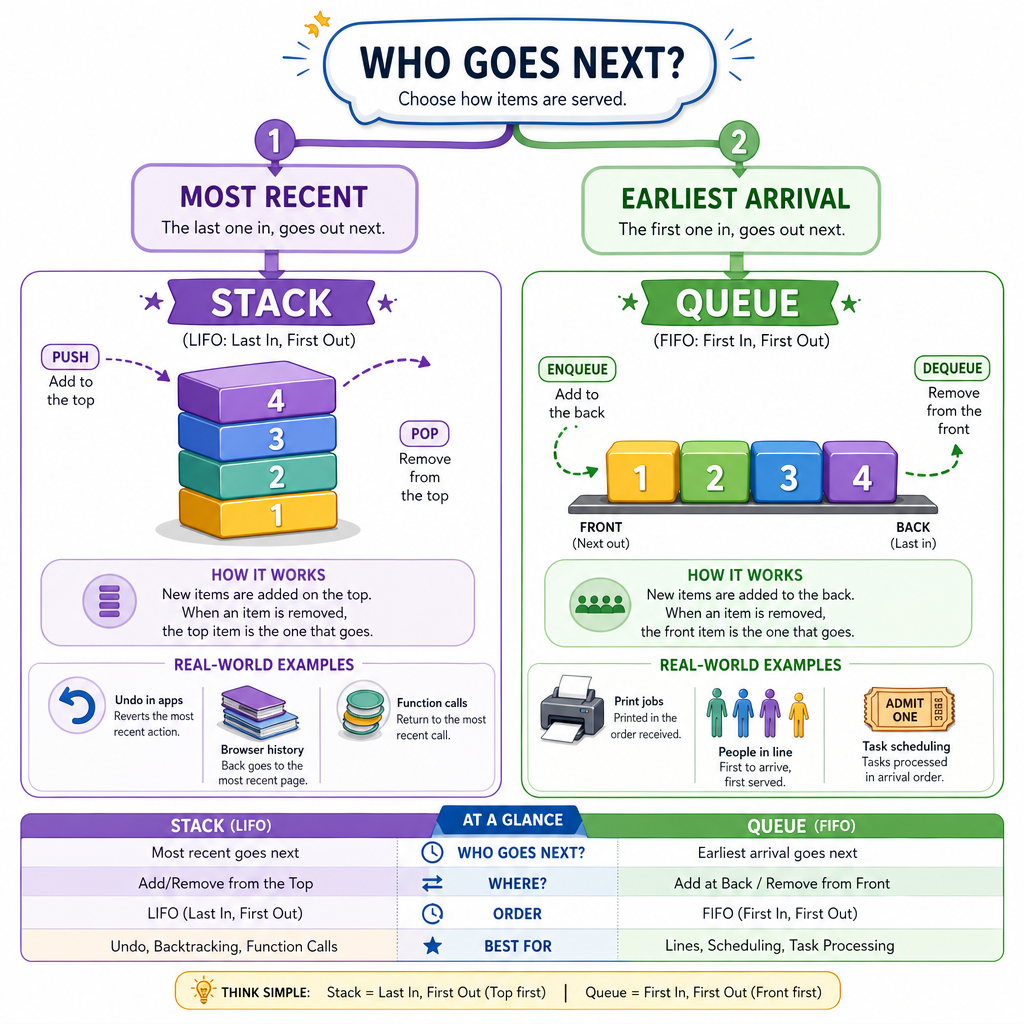
A stack and a queue are not mainly about where data lives. They are about the rule for who gets removed next.
- Stack: most recently added item leaves first
- Queue: earliest added item leaves first
These simple rules show up everywhere: undo buttons, browser history, task scheduling, print jobs, request handling, and many easy/medium interview problems.

Stack Mental Model
Last In, First Out
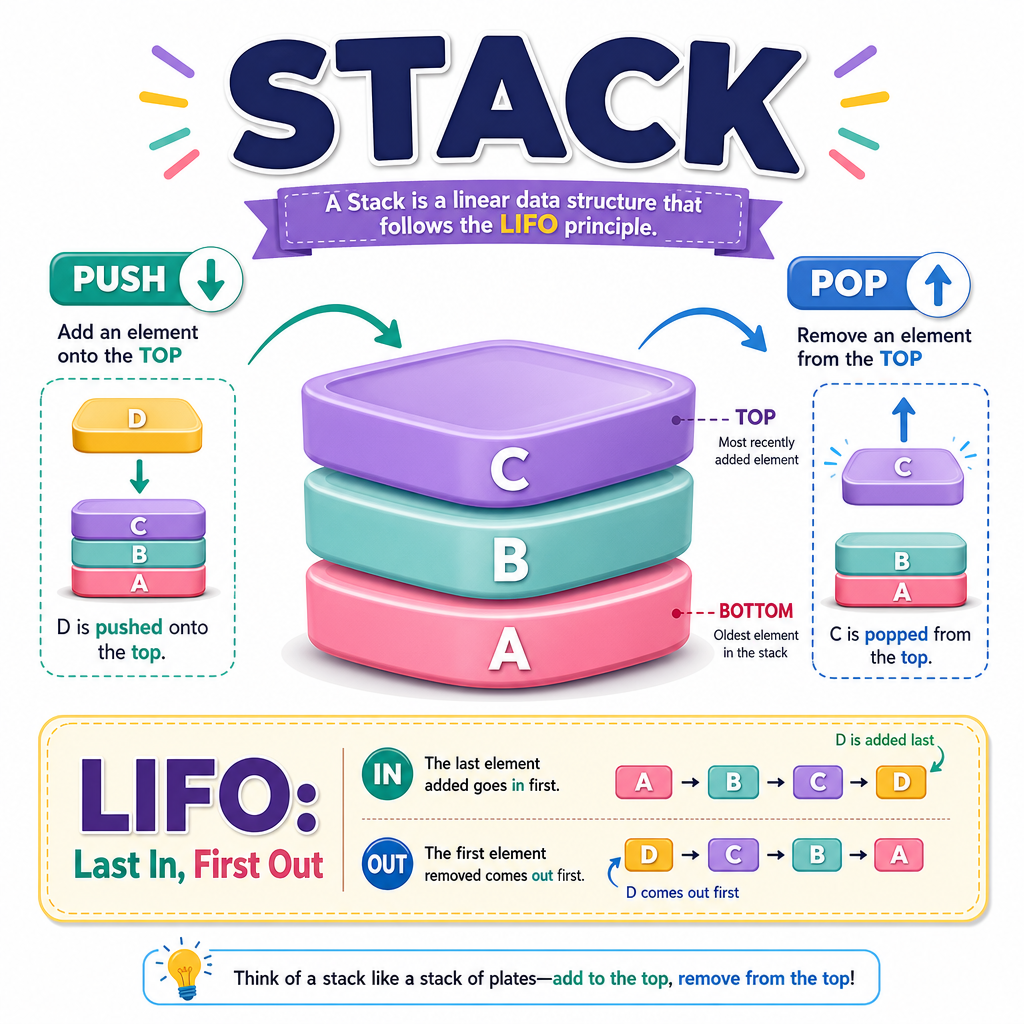
A stack follows LIFO: Last In, First Out.
Think of a stack of plates:
Top
 ↓
[ C ]  ← removed first
[ B ]
[ A ]  ← added first
The only end we care about is the top.
Core operations:
-
push(item)— add to the top -
pop()— remove from the top -
peek()— look at the top without removing -
isEmpty()— check whether the stack has items
The important constraint is not that the data is vertical. It is that the most recent item has priority.
Stack In JavaScript
Arrays make simple stacks
JavaScript arrays already give us efficient stack-like operations at the end of the array.
-
pushadds to the end -
popremoves from the end
Because the end of an array does not require shifting all other elements, these operations are typically O(1).
```javascript
const stack = [];

stack.push("open file");
stack.push("edit line");
stack.push("save file");

console.log("Current stack:", stack);
console.log("Peek:", stack[stack.length - 1]);

console.log("Undo:", stack.pop());
console.log("Undo:", stack.pop());

console.log("Remaining stack:", stack);
console.log("Is empty?", stack.length === 0);
```
Stack Check
You run these operations on an empty stack:
push(10)
push(20)
push(30)
pop()
Which value is returned by pop()?
Queue Mental Model
First In, First Out
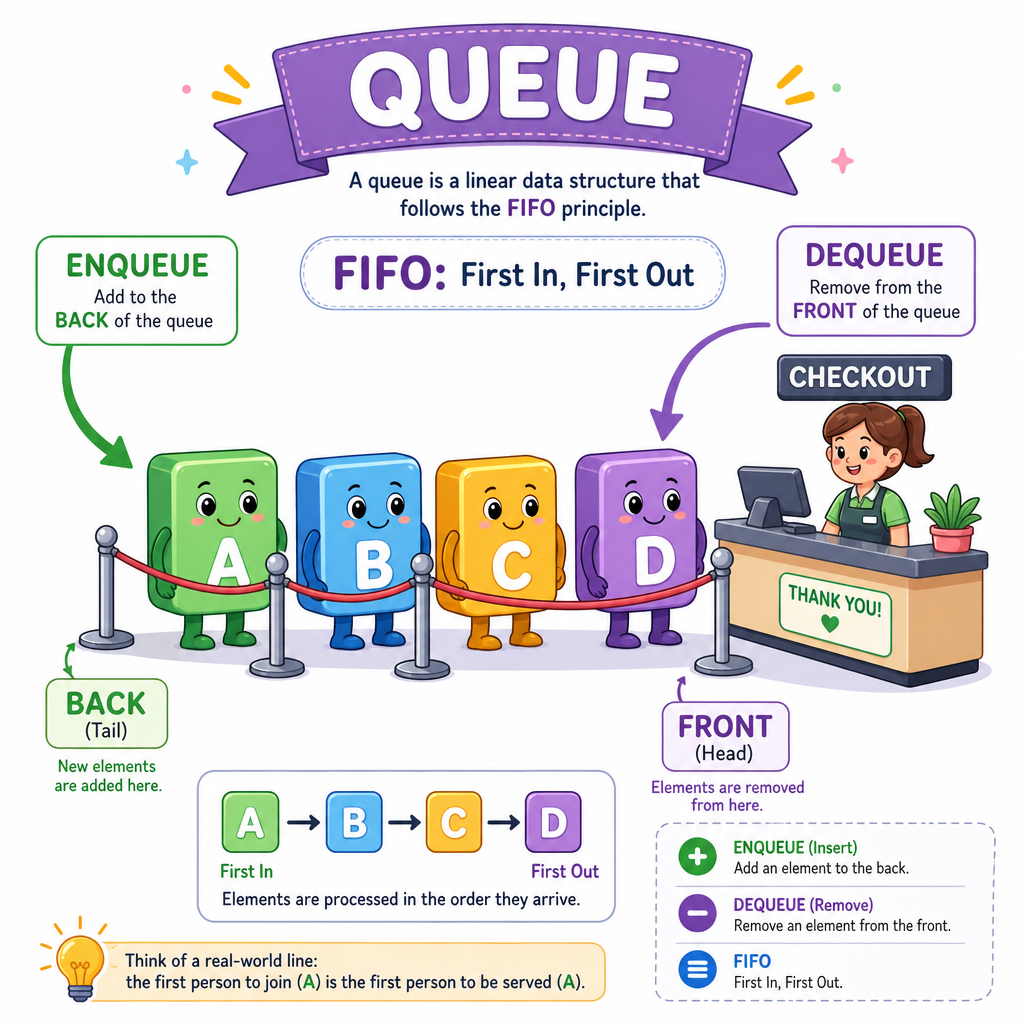
A queue follows FIFO: First In, First Out.
Think of people waiting in line:
Front                         Back
  ↓                            ↓
[ A ] → [ B ] → [ C ] → [ D ]
remove                      add here
Core operations:
-
enqueue(item)— add to the back -
dequeue()— remove from the front -
front()orpeek()— inspect the next item -
isEmpty()— check whether the queue has items
Stacks prioritize recency. Queues prioritize arrival order.
Queue With Arrays
The obvious version
A queue can also be modeled with a JavaScript array.
A beginner-friendly version uses:
-
pushto enqueue at the back -
shiftto dequeue from the front
This is easy to read and fine for small inputs. But there is a performance catch: shift() may require moving every remaining item one position left, making it O(n).
```javascript
const queue = [];

queue.push("Alice");
queue.push("Ben");
queue.push("Chloe");

console.log("Queue:", queue);
console.log("Serving:", queue.shift());
console.log("Serving:", queue.shift());
console.log("Remaining:", queue);
```
Queue Vocabulary
In a queue, the operation that adds a new item to the back is called _____.
Efficient Queue
Avoid shifting work
For larger inputs, repeatedly calling shift() can become expensive.
Instead, keep a head index that points to the current front of the queue. Dequeueing becomes moving the pointer forward rather than physically moving all elements.
This keeps enqueue and dequeue operations effectively O(1).
```javascript
class Queue {
  constructor() {
    this.items = [];
    this.head = 0;
  }

  enqueue(value) {
    this.items.push(value);
  }

  dequeue() {
    if (this.isEmpty()) return undefined;
    const value = this.items[this.head];
    this.head += 1;
    return value;
  }

  front() {
    return this.isEmpty() ? undefined : this.items[this.head];
  }

  isEmpty() {
    return this.head >= this.items.length;
  }

  size() {
    return this.items.length - this.head;
  }
}

const tasks = new Queue();
tasks.enqueue("download report");
tasks.enqueue("validate rows");
tasks.enqueue("send summary");

console.log("Next:", tasks.front());
console.log("Run:", tasks.dequeue());
console.log("Run:", tasks.dequeue());
console.log("Remaining size:", tasks.size());
console.log("Next:", tasks.front());
```
True Or False
A stack is a good fit when you need to process items in the same order they arrived.
Choosing The Structure
Ask: who goes next?
When deciding between a stack and a queue, focus on the removal rule.
Need Use Undo the most recent action Stack Track browser back history Stack Serve requests in arrival order Queue Manage print jobs Queue Explore most recent choice first StackKey takeaways
- A stack uses LIFO: last added, first removed.
- A queue uses FIFO: first added, first removed.
- JavaScript arrays naturally support stacks with
pushandpop. - Queues need more care if many front removals are expected.
Next, we will build on these ideas when we look at Trees, where ordering and traversal become more structured.