Understanding Equity in Offers
Read at your own pace. Code execution, quizzes, progress tracking, and the AI tutor are available in the interactive view with JavaScript enabled.
Equity Changes Math
From cash range to ownership value
In Researching Salary Ranges, Determining Your Personal Salary Range, and Negotiating Outside Your Home Country, you learned to normalize offers so you are comparing like with like.
Equity is another normalization problem: it can be valuable, but it is not the same as salary.
Think of it like evaluating a veteran contract with incentives: the headline number may sound huge, but the real question is what is guaranteed, what must happen first, and when you can actually use it.
In this lesson, you will learn to:
- Identify the equity components inside an offer
- Translate equity into scenarios instead of wishful thinking
- Spot the variables that affect real value
- Decide what to negotiate when equity is part of the package
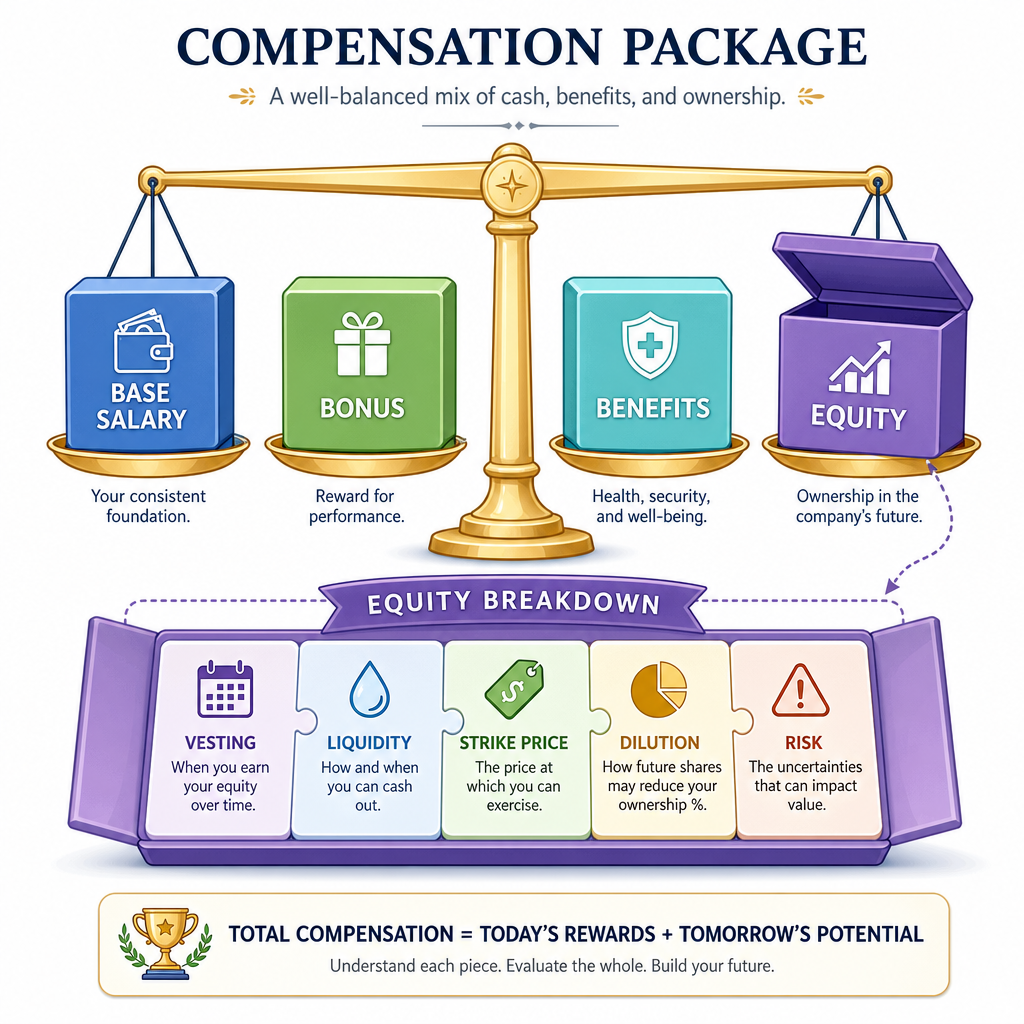
Equity Offer Terms
Know what you are being offered
Equity language can be precise, so slow down and identify the instrument before judging the value.
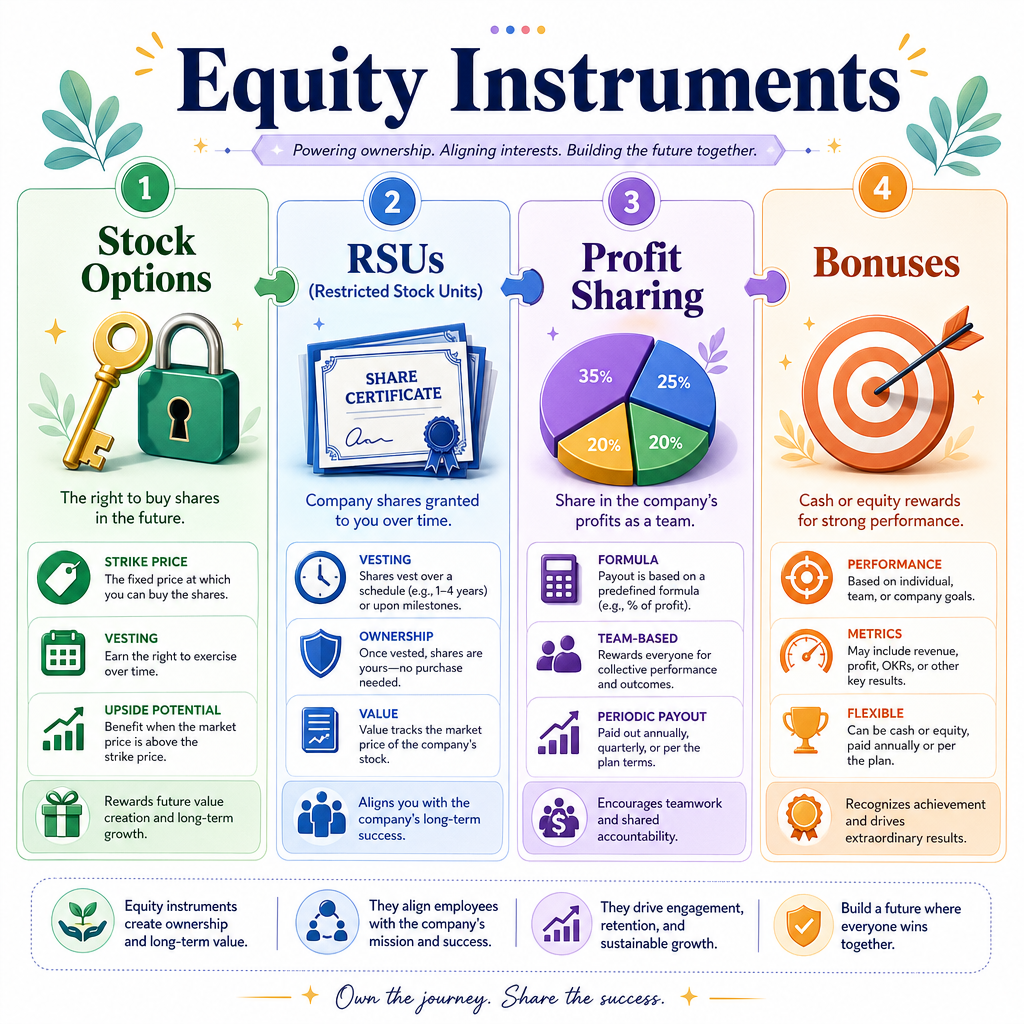
Common components:
- Stock options: the right to buy shares later at a fixed strike price.
- RSUs: restricted stock units that typically become actual shares as they vest.
- Profit sharing: a formula-based share of company profit.
- Bonuses: cash or equity payouts tied to personal, team, or company performance.
A simple map:
Offer component     Key question
-----------------   ----------------------------------
Options             What is the strike price and upside?
RSUs                What are shares worth when they vest?
Profit sharing      What formula determines the payout?
Bonus               Is it guaranteed, target, or discretionary?
For a senior engineer, especially at startups, the goal is not to sound impressed by the largest number. It is to ask: what can this realistically become, and what conditions control it?
Model Option Upside
Options need scenario math
A stock option is not automatically worth the current share price. Its basic pre-tax value at a future liquidity event is:
max(exit share price - strike price, 0) * vested option count
That max() matters. If the company exits below your strike price, the option has no intrinsic value.
Here is a small C++ model you can adapt for an offer. It does not predict the future; it makes assumptions visible.
```cpp
#include <iostream>
#include <iomanip>
#include <vector>
#include <algorithm>

int main() {
    int grantedOptions = 20000;
    double vestedPercent = 0.50;       // after some time in role
    double strikePrice = 2.00;         // cost to buy each share
    std::vector<double> exitPrices = {1.00, 3.00, 8.00, 20.00};

    int vestedOptions = static_cast<int>(grantedOptions * vestedPercent);

    std::cout << "Granted options: " << grantedOptions << "\n";
    std::cout << "Vested options:  " << vestedOptions << "\n\n";

    std::cout << std::fixed << std::setprecision(2);
    std::cout << "Exit price | Pre-tax intrinsic value\n";
    std::cout << "-----------|------------------------\n";

    for (double exitPrice : exitPrices) {
        double spread = std::max(exitPrice - strikePrice, 0.0);
        double value = spread * vestedOptions;
        std::cout << "$" << std::setw(9) << exitPrice
                  << " | $" << value << "\n";
    }

    return 0;
}
```
Ownership Signal
You receive an offer for 20,000 options. The company has 20,000,000 fully diluted shares.
Which statement best describes your approximate ownership percentage before future dilution?
Vesting Reality
The grant is not yours all at once
Equity usually vests over time. A common startup pattern is:
- 4-year vesting period
- 1-year cliff
- Monthly vesting after the cliff
The cliff means you may receive zero vested equity if you leave before the first anniversary. After that, equity often vests gradually.
This matters because the value you can actually capture depends on tenure, not just the grant size.
```cpp
#include <iostream>
#include <iomanip>

int main() {
    int totalShares = 12000;
    int totalMonths = 48;
    int cliffMonths = 12;

    std::cout << "Month | Vested shares\n";
    std::cout << "------|--------------\n";

    for (int month : {6, 12, 24, 36, 48}) {
        int vested = 0;
        if (month >= cliffMonths) {
            vested = totalShares * month / totalMonths;
        }
        std::cout << std::setw(5) << month << " | " << vested << "\n";
    }

    return 0;
}
```
Guaranteed Cash?
True or false: once stock options vest, they are guaranteed cash compensation.
Compare Equity Types
Different equity has different risk
A seasoned engineer will often compare equity types by asking: how much has to go right before this becomes money?
Broadly:
- Cash bonus: usually most liquid, but may be discretionary or performance-based.
- RSUs at public companies: often easier to value because there is a market price.
- Profit sharing: depends on the formula and whether profit is consistently produced.
- Startup options: potentially high upside, but usually high uncertainty.
Here is a simple comparison model. It intentionally uses rough assumptions, because the real point is to make uncertainty explicit.
```cpp
#include <iostream>
#include <iomanip>

int main() {
    double targetBonus = 15000.0;
    double bonusProbability = 0.80;

    int rsuShares = 400;
    double publicSharePrice = 75.0;
    int vestYears = 4;

    int startupOptions = 20000;
    double strike = 2.0;
    double possibleExitPrice = 10.0;
    double probabilityOfLiquidity = 0.25;

    double expectedBonus = targetBonus * bonusProbability;
    double annualRsuValue = (rsuShares * publicSharePrice) / vestYears;
    double startupIntrinsic = (possibleExitPrice - strike) * startupOptions;
    double expectedStartupValue = startupIntrinsic * probabilityOfLiquidity;

    std::cout << std::fixed << std::setprecision(2);
    std::cout << "Expected cash bonus:        $" << expectedBonus << "\n";
    std::cout << "Annualized RSU value:       $" << annualRsuValue << "\n";
    std::cout << "Expected startup option EV: $" << expectedStartupValue << "\n";

    return 0;
}
```
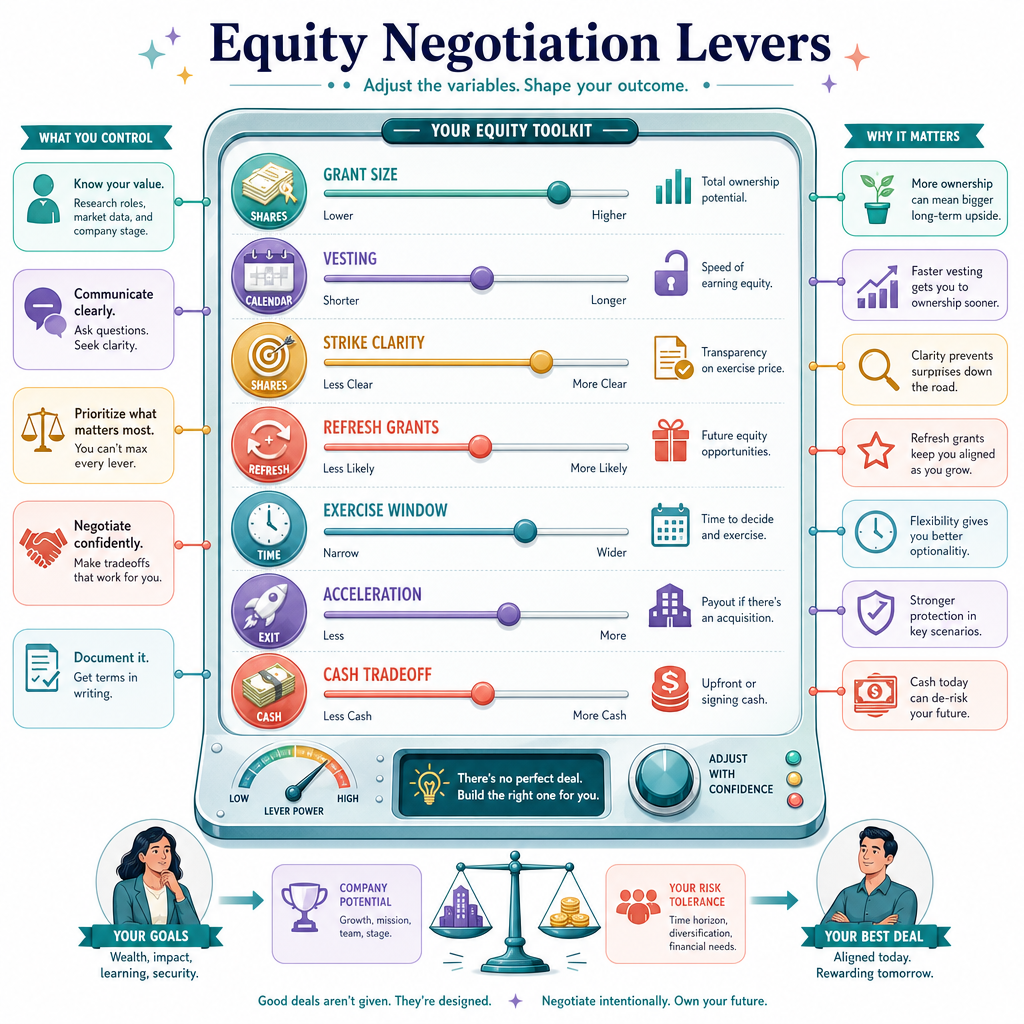
Negotiate The Levers
Equity negotiation is not only “more shares”
More equity can be useful, but there are several levers to consider. Use the prep habits from Preparing for Negotiation and the phrasing from Effective Communication in Negotiation to ask specific questions.
Potential levers:
- Grant size: additional options or RSUs
- Strike price clarity: confirmation of current strike and valuation basis
- Vesting schedule: start date, cliff, monthly or quarterly vesting
- Refresh grants: future equity for continued performance
- Exercise window: time to exercise vested options after leaving
- Acceleration: vesting treatment if the company is acquired
- Cash-equity tradeoff: higher base or bonus if equity risk is high
A strong ask sounds like:
“I’m excited about the ownership component. To evaluate it responsibly, could you share the fully diluted share count, vesting schedule, strike price, and whether refresh grants are standard for this level?”
That is collaborative, informed, and hard to dismiss.
Ownership Formula
To estimate your approximate ownership percentage, divide your shares or options by the company’s ____.
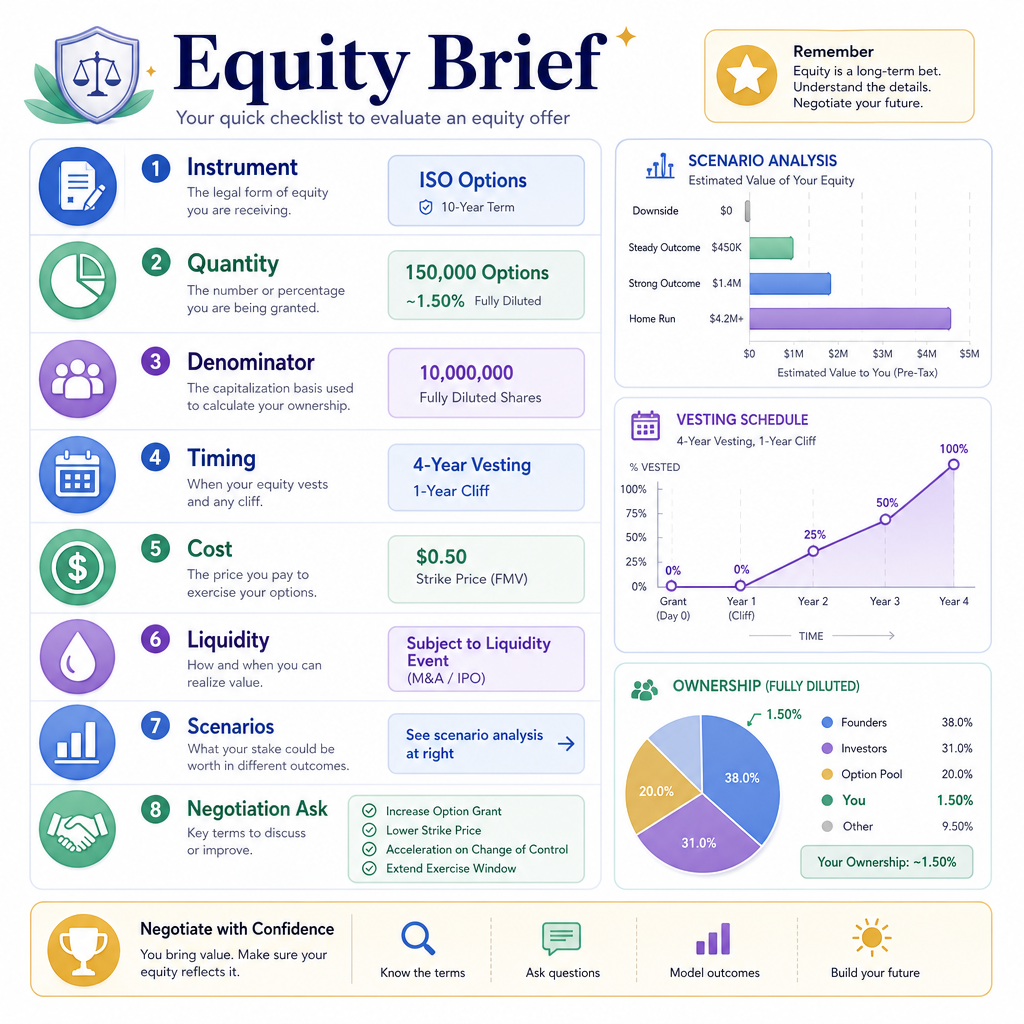
Your Equity Brief
Turn the offer into a clear brief
Before you respond to an equity-heavy offer, create a short equity brief next to the salary range work you have already done.
Include:
- Instrument: options, RSUs, profit sharing, bonus, or mix
- Quantity: number of shares, options, units, or target payout
- Denominator: fully diluted shares, if relevant
- Timing: vesting schedule, cliff, grant date, refresh cycle
- Cost: strike price, exercise cost, and possible tax exposure
- Liquidity: public market, tender offers, acquisition path, or unknown
- Scenarios: conservative, likely, and upside cases
- Negotiation ask: the one or two levers that matter most
Your final decision should compare equity to your personal salary range without treating uncertain upside as guaranteed money. If it feels like a Stephen King plot twist is required for the equity to pay off, price that risk honestly.
Next, you will learn how to follow up after a negotiation so the terms you discuss become clear, written agreement.