Detect An Undirected Graph Cycle
Read at your own pace. Code execution, quizzes, progress tracking, and the AI tutor are available in the interactive view with JavaScript enabled.
Description
Can you detect a cycle in an undirected graph? Recall that an undirected graph is one where the edges are bidirectional. A cycle is one where there is a closed path, that is, the first and last graph vertices can be the same.
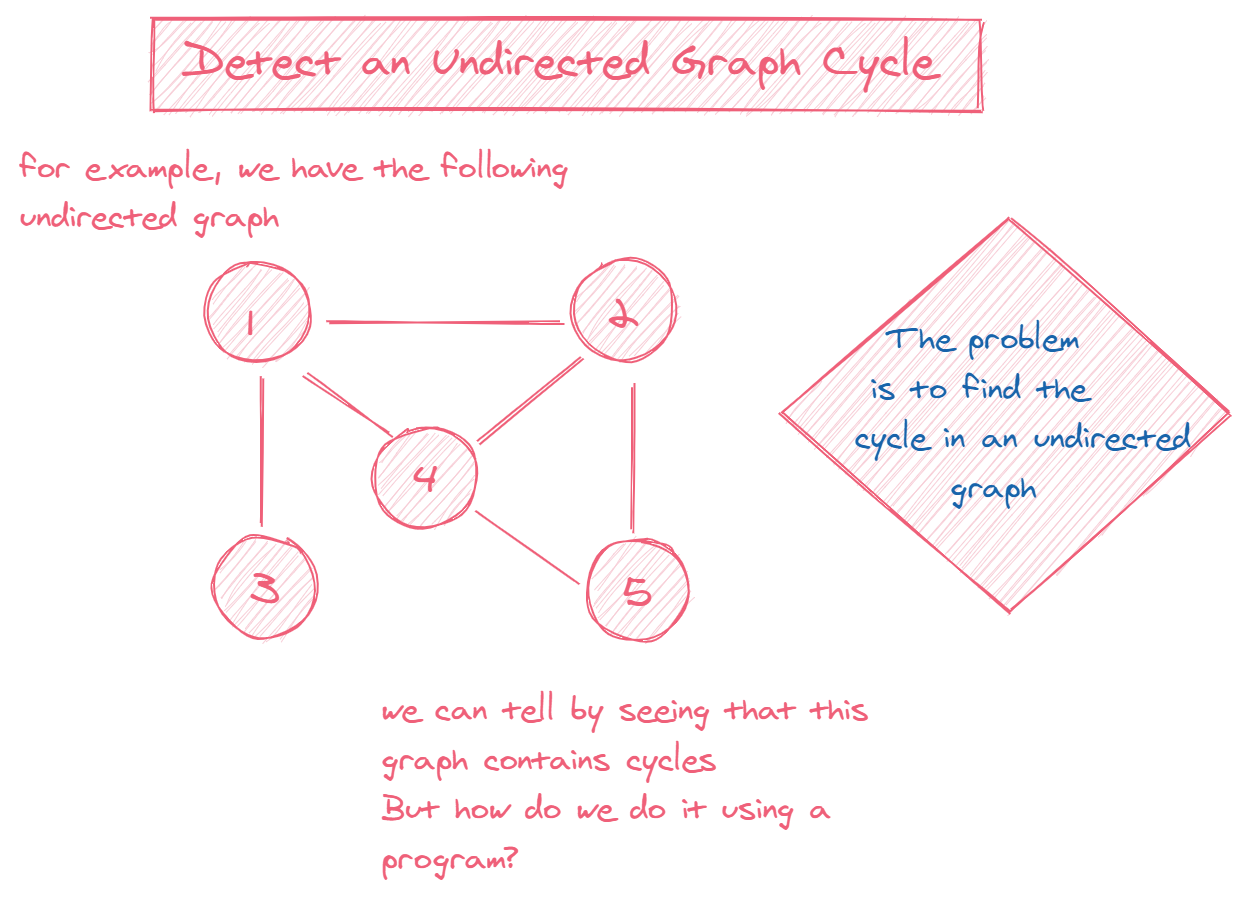
We've covered how to detect a cycle using depth-first search, but can you find one without it? Assume the following graph definition:
class Graph {
    constructor() {
        this.adjacencyList = new Map();
    }

    addVertex(nodeVal) {
        this.adjacencyList.set(nodeVal, []);
    }

    addEdge(src, dest) {
        this.adjacencyList.get(src).push(dest);
        this.adjacencyList.get(dest).push(src);
    }

    removeVertex(val) {
        if (this.adjacencyList.get(val)) {
            this.adjacencyList.delete(val);
        }

        this.adjacencyList.forEach((vertex) => {
            const neighborIdx = vertex.indexOf(val);
            if (neighborIdx >= 0) {
                vertex.splice(neighborIdx, 1);
            }
        });
    }

    removeEdge(src, dest) {
        const srcDestIdx = this.adjacencyList.get(src).indexOf(dest);
        this.adjacencyList.get(src).splice(srcDestIdx, 1);

        const destSrcIdx = this.adjacencyList.get(dest).indexOf(src);
        this.adjacencyList.get(dest).splice(destSrcIdx, 1);
    }
}
Constraints
- The number of vertices in the graph <=
100000 - The number of edges in the graph <=
100000 - Let
|V|,|E|represent the number of vertices and edges of the graph - Expected time complexity :
O(|V|+|E|) - Expected space complexity :
O(|V|)
```js
class UnionFind {
	constructor(n) {
    // fill in this method
  }

  hasCycle(graph) {
    // fill in this method
  }

	union(i, j) {
    // fill in this method
	}

	find(i) {
    // fill in this method
	}
}

class Graph {
	constructor() {
		this.adjacencyList = new Map();
	}

	addVertex(nodeVal) {
		this.adjacencyList.set(nodeVal, []);
	}

	addEdge(src, dest) {
		this.adjacencyList.get(src).push(dest);
		this.adjacencyList.get(dest).push(src);
	}

	removeVertex(val) {
		if (this.adjacencyList.get(val)) {
			this.adjacencyList.delete(val);
		}

		this.adjacencyList.forEach((vertex) => {
			const neighborIdx = vertex.indexOf(val);
			if (neighborIdx >= 0) {
				vertex.splice(neighborIdx, 1);
			}
		});
	}

	removeEdge(src, dest) {
		const srcDestIdx = this.adjacencyList.get(src).indexOf(dest);
		this.adjacencyList.get(src).splice(srcDestIdx, 1);

		const destSrcIdx = this.adjacencyList.get(dest).indexOf(src);
		this.adjacencyList.get(dest).splice(destSrcIdx, 1);
  }
}
```
CONTINUE WITH ALGODAILY PREMIUM
Keep going with the complete tutorial.
Unlock the remaining explanations and exercises, alongside the full learning library.
Explore Premium →